
Automated central trace management
a central trace management and automatic technology, applied in the field of communication network trace management, can solve the problems of inability to effectively control traces, inability to manage and locate abandoned traces, and difficulty in integrating information from several network elements, so as to improve the functionality of a trace integration reference point (irp), and restrict control of trace usag
Patent Information
- Authority / Receiving Office
- US · United States
- Patent Type
- Applications(United States)
- Current Assignee / Owner
- Publication Date
- 2007-09-27
- Estimated Expiration
- Not applicable · inactive patent
Smart Images
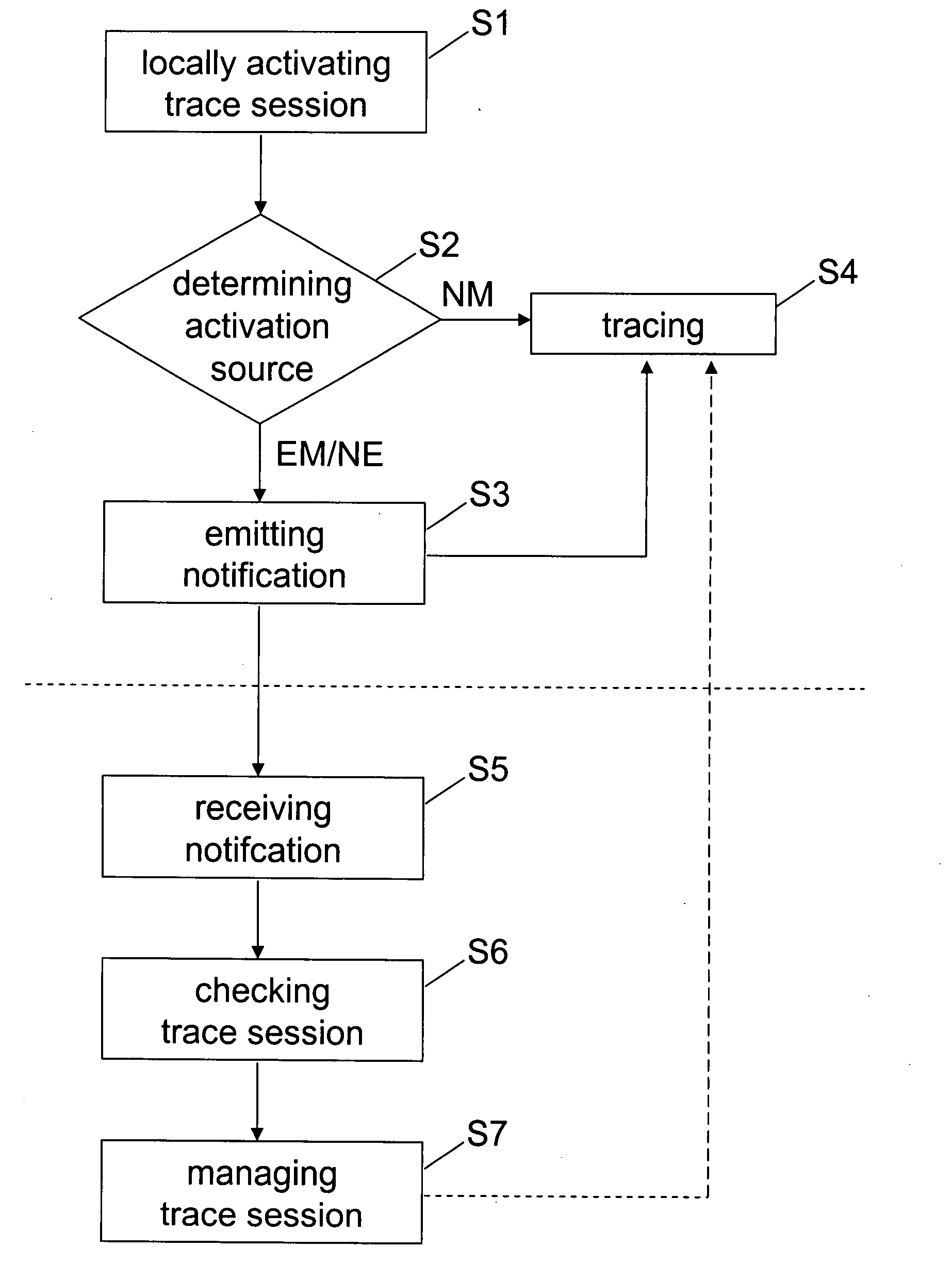
Figure 1 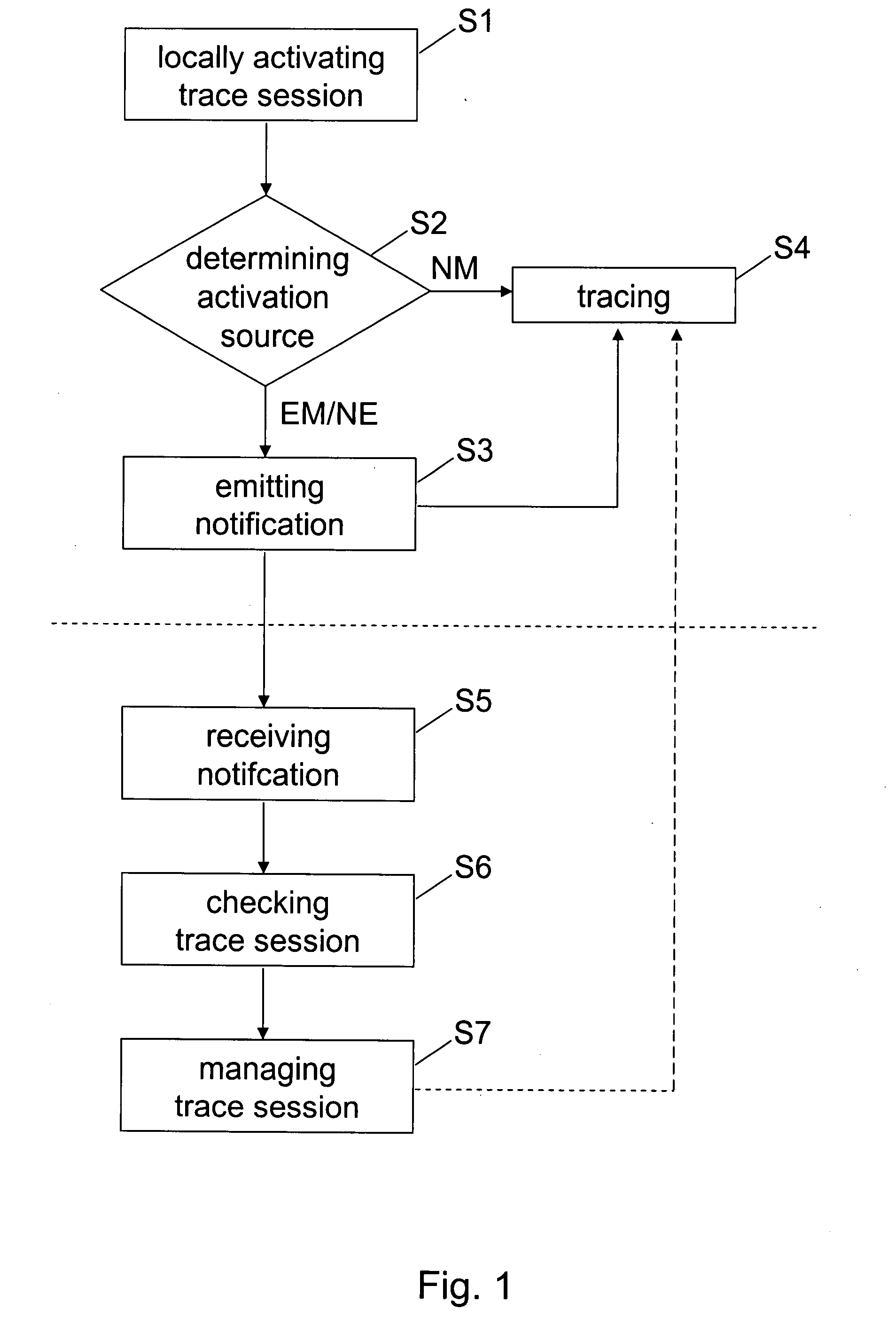
Figure 2 
Figure 3
Abstract
Description
REFERENCE TO RELATED APPLICATIONS
[0001] This application claims priority of U.S. Provisional Patent Application Ser. No. 60 / 784,755, filed on Mar. 23, 2006, the contents of which are hereby incorporated by reference.FIELD OF THE INVENTION
[0002] The present invention relates to trace management in communication networks. In particular, the present invention relates to an automated central trace management for local trace activation in the network.BACKGROUND OF THE INVENTION
[0003] In the field of network management and particularly communication network management, there is known the concept of tracing. To, this end, traces for every object to be traced are established in the network, which may for example be a second generation network such as GSM (Global System for Mobile Communication) or a third generation network such as UMTS (Universal Mobile Telecommunication System) or CDMA (Code Division Multiple Access), or any intermediary network such as GPRS (General Packet Radio Service)...
Examples
Embodiment Construction
[0083]The present invention is described herein with reference to particular non-limiting examples. A person skilled in the art will appreciate that the invention is not limited to these examples, and may be more broadly applied.
[0084]In particular, the present invention is described in relation to telecommunications management network (TMN) terminology. Such terminology is only used in the context of the presented examples, and does not limit the invention in any way.
[0085]FIG. 1 shows a flow chart of a method according to an embodiment of the present invention. This method relates to a communication network including a network managing entity, hereinafter referred to as network manager NM, and at least one subordinate network entity, hereinafter referred to as element manager or network element depending on the particular system context concerned.
[0086]In FIG. 1, the upper half of the method flow above the broken line relates to an operation method of the above-mentioned subordina...