
Separation Medium for Biochemical Analysis
a biochemical analysis and separation medium technology, applied in the field of separation medium, can solve the problems of difficult selection of separation medium, short life span of capillaries, and decreased resolution of separation medium, and achieve the effects of high theoretical plate number, easy replacement of separation medium, and high reproducibility
Patent Information
- Authority / Receiving Office
- US · United States
- Patent Type
- Applications(United States)
- Current Assignee / Owner
- Publication Date
- 2009-08-27
- Estimated Expiration
- Not applicable · inactive patent
Smart Images
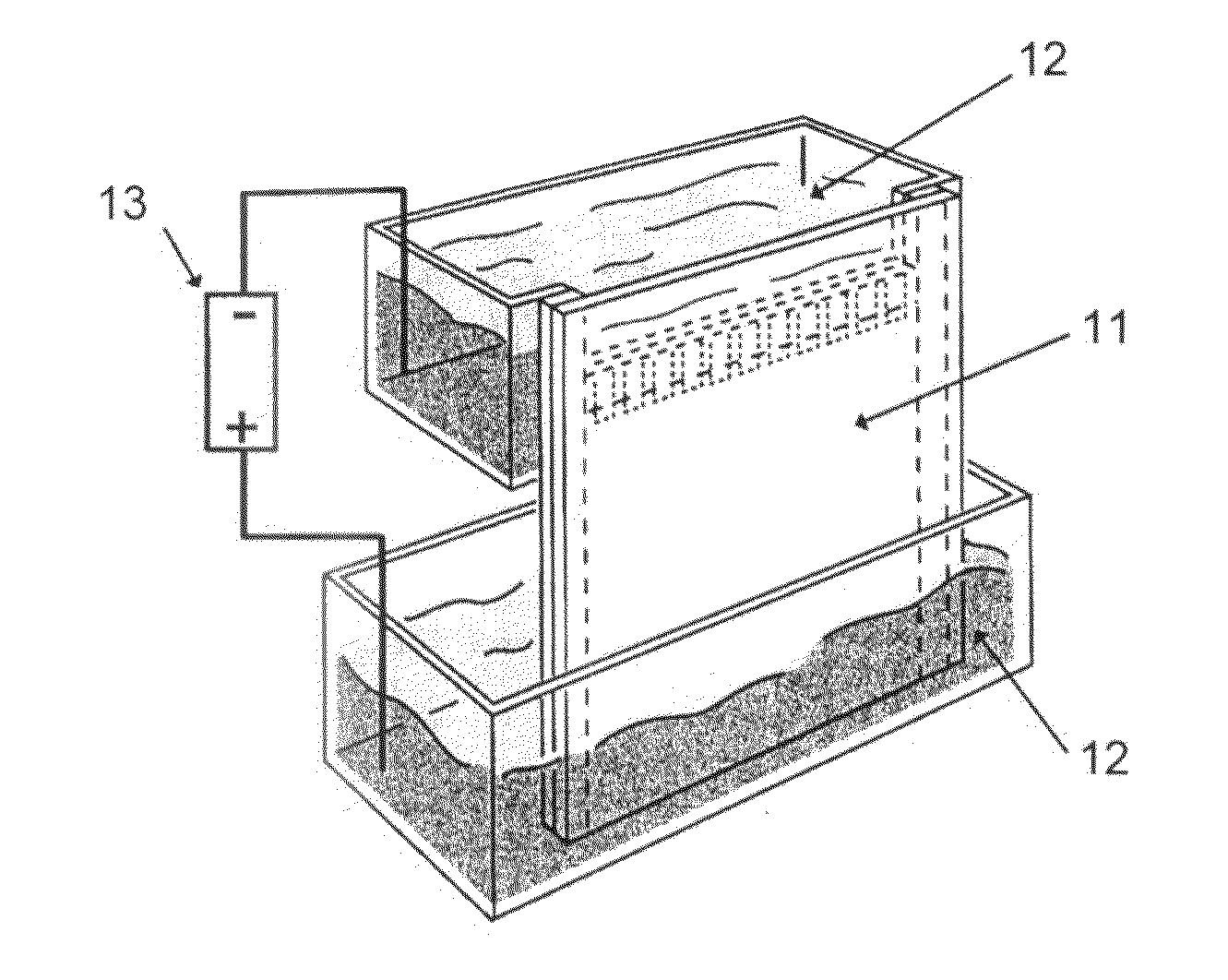
Figure 1 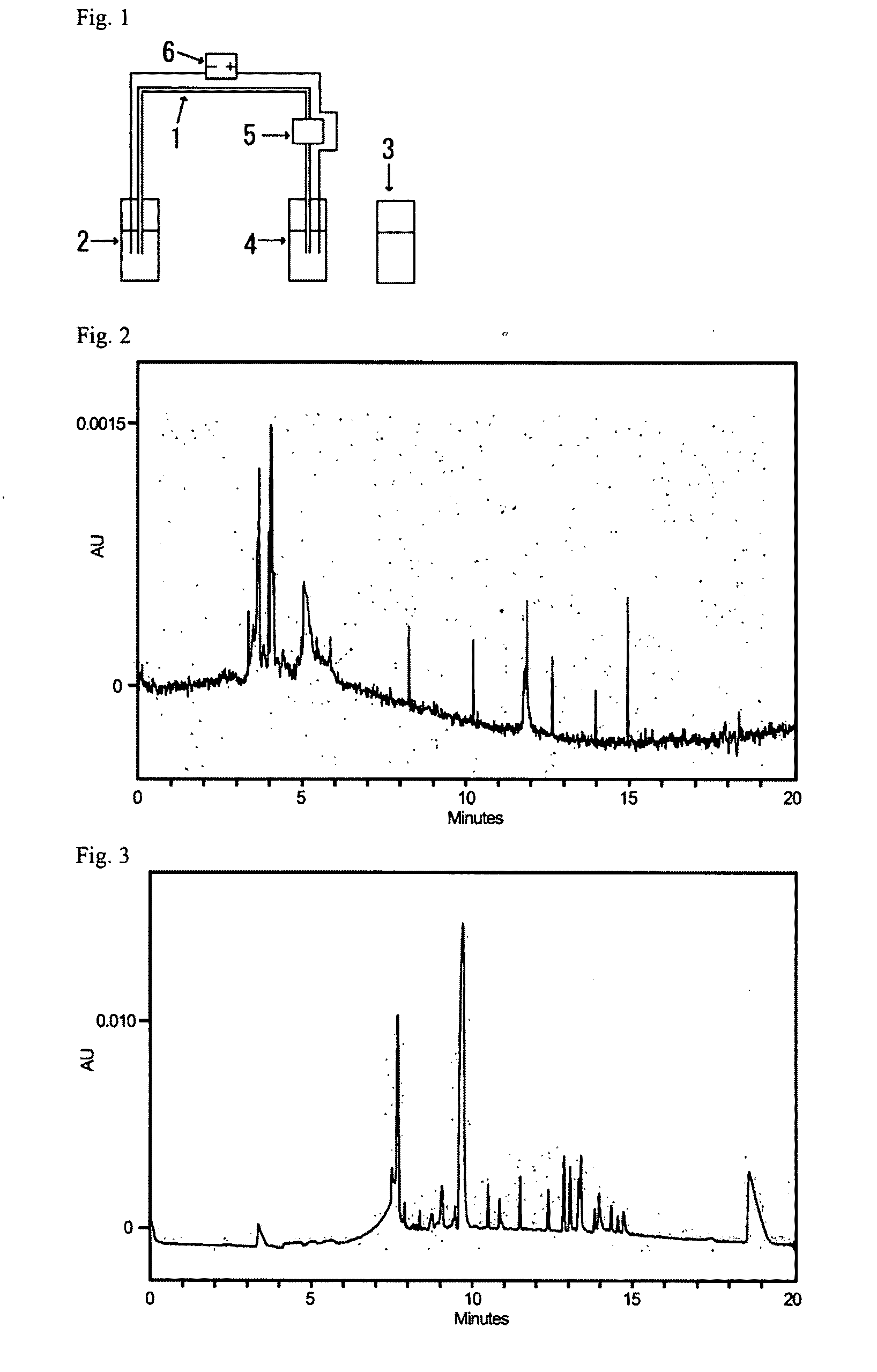
Figure 2 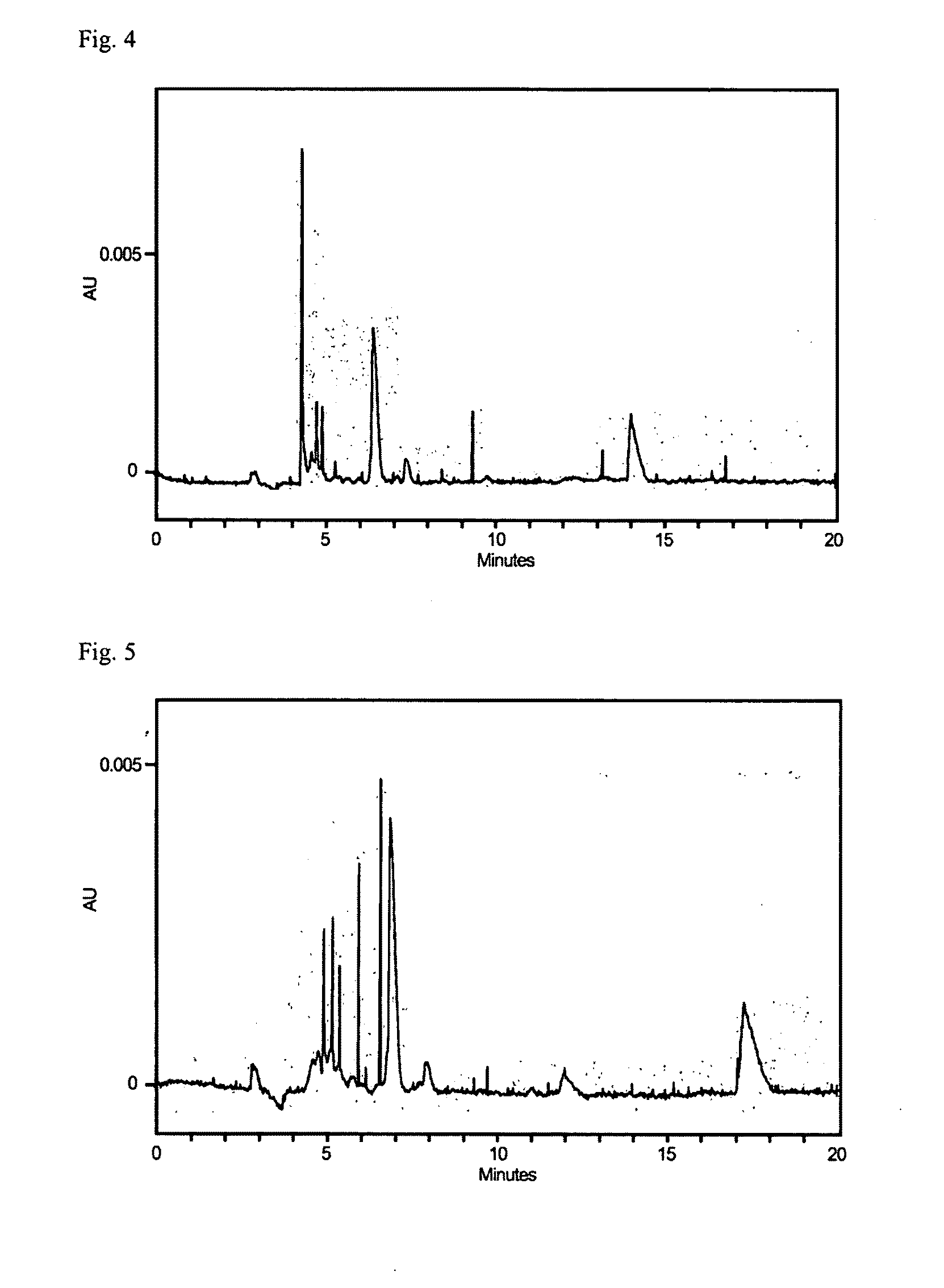
Figure 3
Abstract
Description
TECHNICAL FIELD
[0001] The present invention relates to a separation medium which is used in electrophoresis apparatus for biochemical analysis and the like, a capillary column packed with the separation medium, and a separation system using the separation medium. More particularly, the present invention relates to a packing composition for electrophoretic separation and / or analysis which contains long self-assemblies produced by dissolving a amphiphilic compound having a hydrophobic moiety and a hydrophilic moiety in water under heating and then cooling the resulting solution; a process for the production of the packing composition; a method of separation and / or analysis with the composition; and so on.BACKGROUND ART
[0002] To clarify a biological function at the cellular level, analyses and assays of proteins, peptides, nucleic acids, amino acids, saccharides, neurotransmitters and the like in the living body are performed. As a means thereof, high performance liquid chromatography co...
Examples
example 1
(1) Packing of Capillary with Self-Assemblable Hydrogel
[0161]First, in a glass vessel, 1, 20-3′-thymidylic acid bolaamphiphile of the following formula:
[0162]which is a self-assemblable amphiphilic compound (see R. Iwaura et al. Chem. Mater., 2002, 14, 3047, and JP-A No. 2003-55642) (10 mg, 0.01 millimoles, or 5 mg, 0.005 millimoles) was measured, and to this, 0.5 mL of TE buffer (Wako Pure Chemical Industries, Ltd., product No. 316-90025) at pH 8 was added. The mixture was dissolved while heating with a heat gun to prepare solutions containing 2% by weight and 0.5% by weight of the amphiphilic compound. These solutions were filtered through a 0.45 micron membrane filter (Gelman Science Japan, Ltd., product No. 4457).
[0163]Next, the above-described solution containing the amphiphilic compound at a temperature of 40 to 60° C. was set into a capillary electrophoresis apparatus (Beckman Coulter, Inc., P / ACE System MDQ), and by pressurizing at 10 psi for 3 minutes, the solution was pack...
example 2
[0172]4.958 mL of sterilized water was added to ethanediyl-1,2-bis(hexadecyldimethylammonium bromide) (compound 35, (see I. Huc et al., Angew. Chem., Int. Ed. 1998, 37, 2689-2691 for the synthesis) (19.94 mg, 0.0352 mmol), which is a self-assemblable compound, and an equivalent of L-tartaric acid (6.82 mg, 0.0351 mmol)), and the mixture was dissolved under heating, to condition a hot aqueous 0.4 wt % solution of compound 35 mL-tartaric acid salt.
[0173]Next, a solution was obtained by dissolving 1.5 mL of 40% acrylamide / bis solution (BIORAD, Inc., product No. 161-0146), 3.9 mL of 0.5×TBE buffer solution (50-fold dilution of 10×TBE of BIORAD, Inc., product No. 161-0733), 9.375 mL of sterilized water, and 0.1 g of ammonium persulfate (Wako Pure Chemical Industries, Ltd., product No. 018-03282) dissolved in 1 mL of sterilized water, and 0.075 mL of this solution was mixed into a gel solution. To this gel solution, 0.15 mL of the hot aqueous solution formed of the above-described L-tarta...