
Low compliant catheter tubing
Patent Information
- Authority / Receiving Office
- US · United States
- Current Assignee / Owner
- Publication Date
- 2010-05-27
Smart Images
Figure 1 
Figure 2 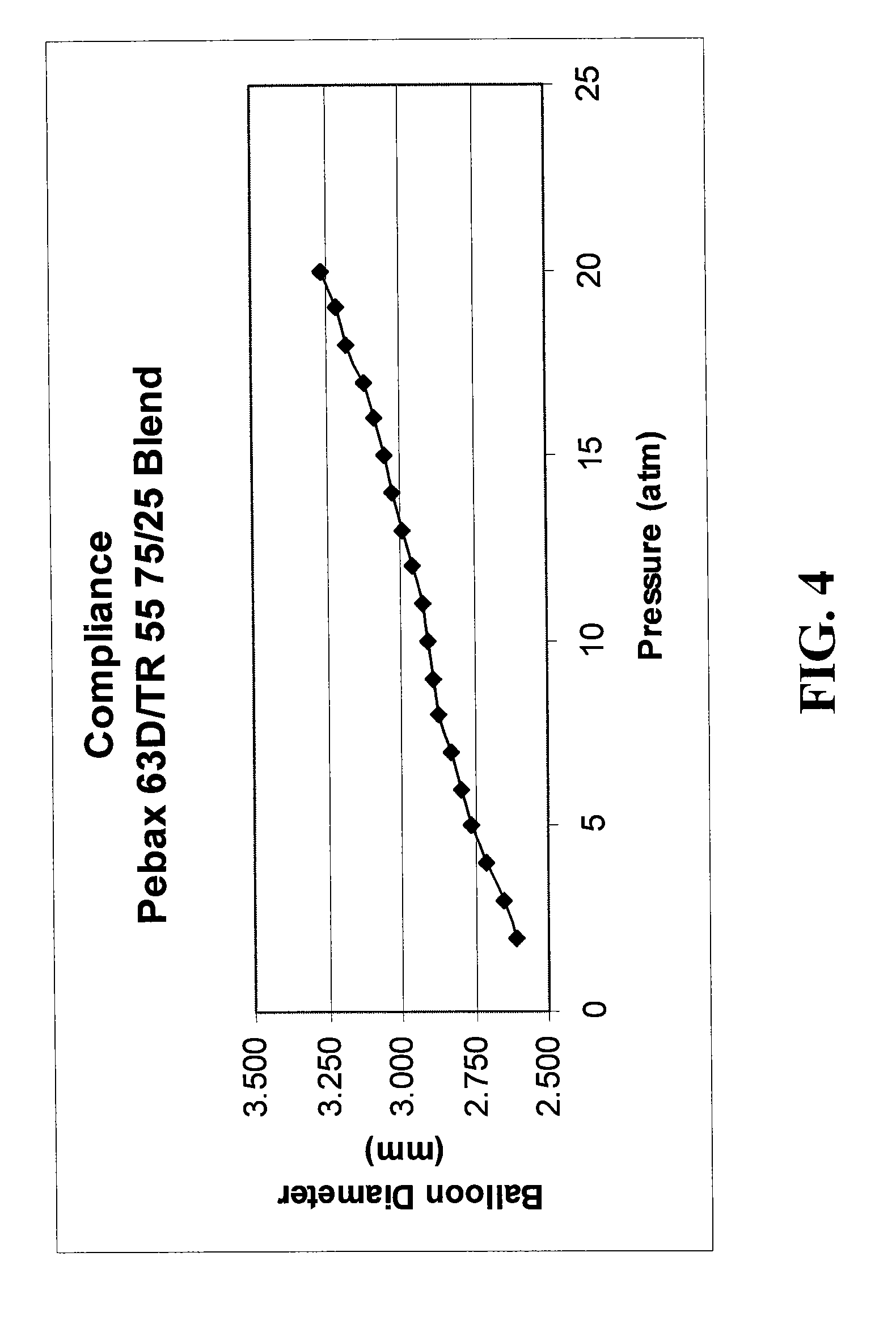
Figure 3
Abstract
Description
BACKGROUND
[0001] The invention relates to the field of intravascular catheters, and more particularly to a balloon catheter or other catheter component, such as a guidewire enclosure, that would benefit from the properties of the materials disclosed herein.
[0002] In percutaneous transluminal coronary angioplasty (PTCA) procedures, a guiding catheter is advanced until the distal tip of the guiding catheter is seated in the ostium of a desired coronary artery. A guidewire, positioned within an inner lumen of an dilatation catheter, is first advanced out of the distal end of the guiding catheter into the patient's coronary artery until the distal end of the guidewire crosses a lesion to be dilated. Then the dilatation catheter having an inflatable balloon on the distal portion thereof is advanced into the patient's coronary anatomy, over the previously introduced guidewire, until the balloon of the dilatation catheter is properly positioned across the lesion. Once properly positioned, th...
Examples
example 1
[0030]A blended composition of 75% Pebax 63D and 25% EMS TR 55 (transparent amorphous nylon) was constructed into ten sample catheter balloons according to the present invention, which produced an average working pressure range of eight to nine atmospheres for a 2.75 mm balloon. At five atmospheres, the balloon is about 2.75 mm (nominal diameter) and at thirteen atmospheres the balloon has grown radially roughly 0.25 mm to 3.00 mm (quarter size diameter). As shown in FIG. 4, this results in a compliance performance that is flatter in the operating range of the balloon, a desired characteristic. The balloon in Example 1 has a compliance of about 0.023 mm / atm between 5 atmospheres and 18 atmospheres, i.e., from nominal to the rated burst pressure of the balloon, where the nominal pressure is the pressure required to expand the balloon to its working diameter, and the rated burst pressure, calculated from the average rupture pressure, is the pressure at which 95% of the balloons can be...