
FGF based fibrin binding peptides
Patent Information
- Authority / Receiving Office
- US · United States
- Current Assignee / Owner
- Publication Date
- 2012-12-13
- Estimated Expiration
- Not applicable · inactive patent
Smart Images
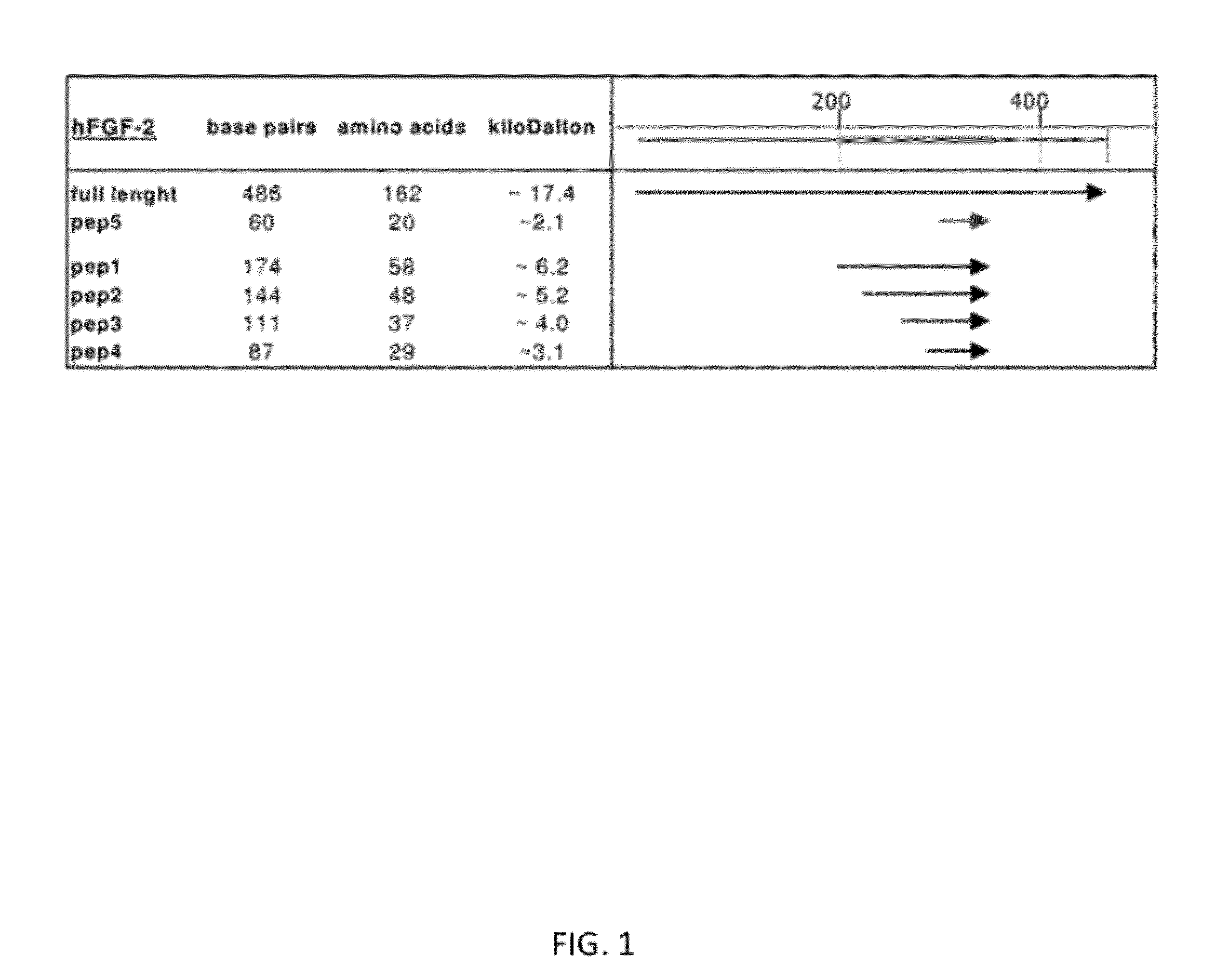
Figure 1 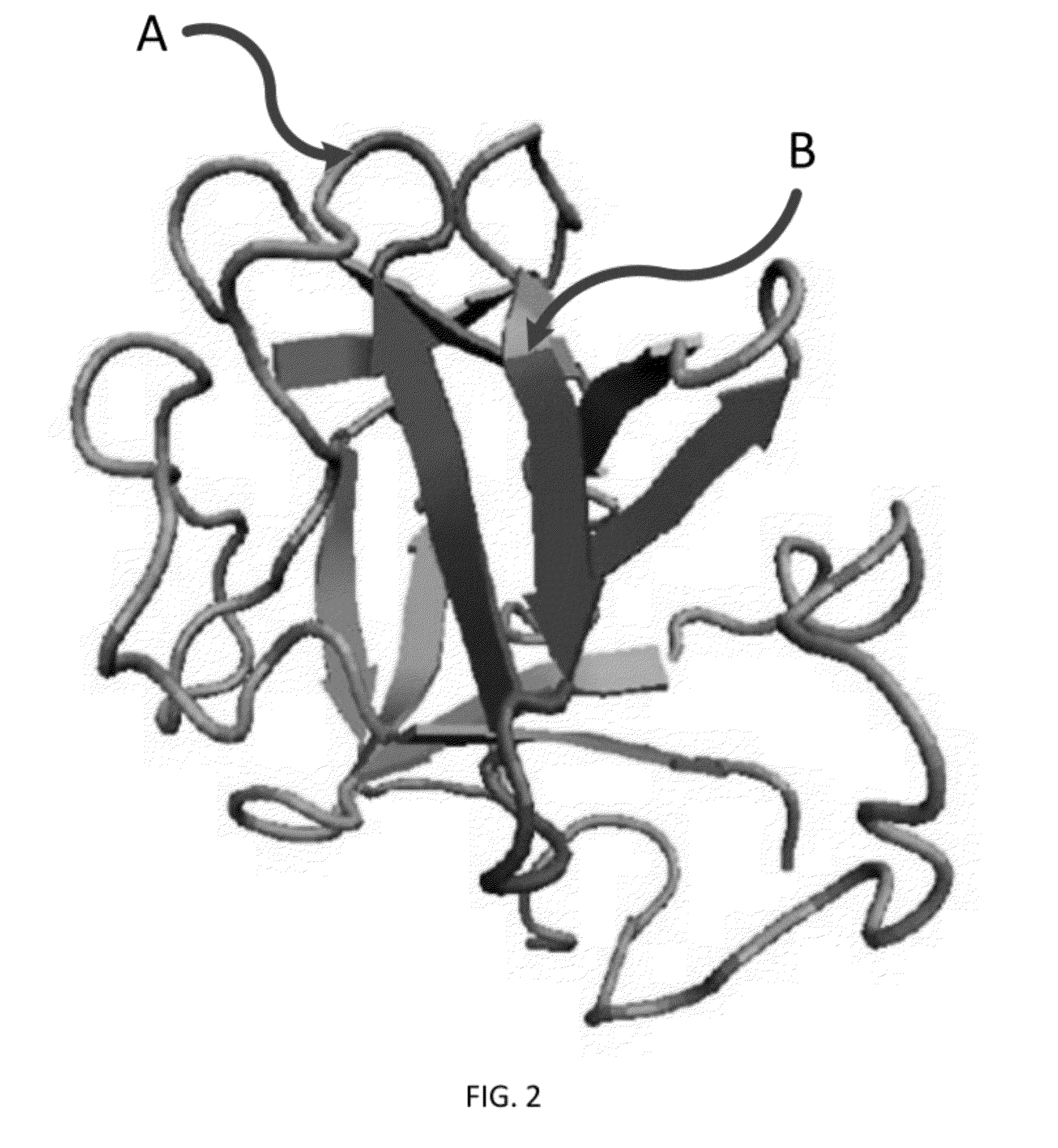
Figure 2 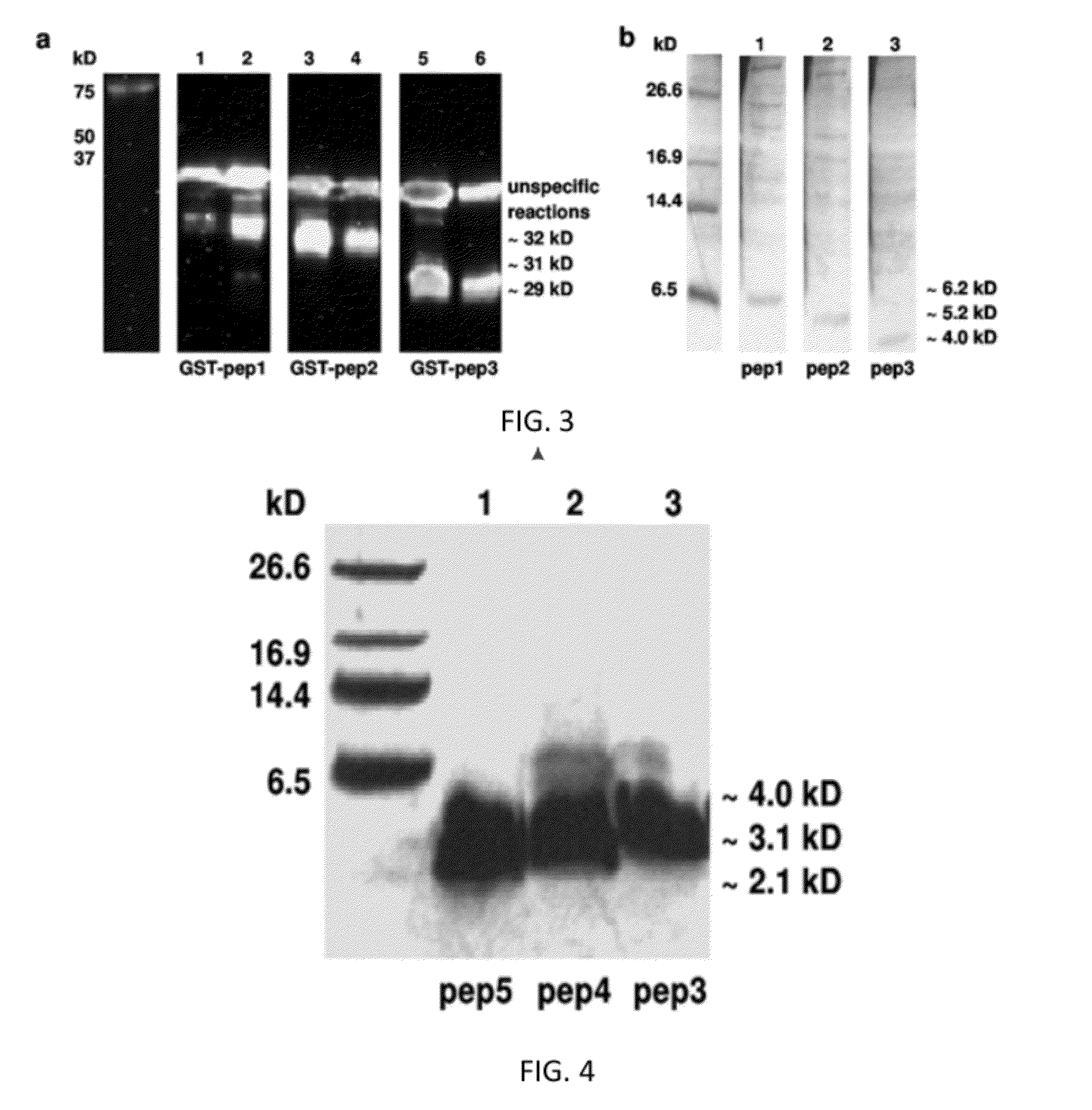
Figure 3
Abstract
Description
CROSS-REFERENCES TO RELATED APPLICATIONS
[0001] This application is a nonprovisional of, and claims the benefit of priority to, U.S. provisional patent application No. 61 / 481,337 filed May 2, 2011, the content of which is incorporated herein by reference.FIELD OF THE INVENTION
[0002] The present invention relates to peptides having a fibrin(ogen) binding domain and with biological activity on various cell types.BACKGROUND OF THE INVENTION
[0003] Fibrin is naturally associated with a number of growth factors that bind to fibrinogen and may promote wound healing (1;2). Such growth factors attract or stimulate cells involved in tissue repair (3;4). Human Fibroblast growth factor-2 (hFGF-2) holds significant potential as a therapeutic additive to sealant products, because hFGF-2 can stimulate wound healing, tissue regeneration, and angiogenesis.
[0004] Human FGF-2 (human basic FGF, heparin-binding growth factor or prostatropin) belongs to a family of heparin-binding growth factors (5). As a sin...
Examples
example 1
a) Construction of hFGF-2 and Various Truncated hFGF-2 Expression Plasmids
[0073]Using a standard PCR program (95° C., 30 sec; 60° C., 30 sec; 72° C., 30 sec; 25 cycles), full length hFGF-2 cDNA was amplified with primers containing EcoRI and XhoI restriction sites and a HIS-tag (6×) on the C-terminus (Table 1).
TABLE 1 Primers containing EcoRI and XhoI restriction sites were used forsubcloning full length hFGF-2 cDNA and hFGF-2 cDNA fragments into pGEX-6P-2expression vector. The restriction sites are inderlined and the 6x HIS-tagon the C-terminus is marked in italics. The sequences of the synthetic peptides #3, #4, and #5 contain a 5x HIS-tag at the C-terminus (italics).Primerssense (s) and antisense (as); 5′-3′EcoR I restriction sitehbFGF full length senseGGA ATT CCC ATG GCA GCC GGG AGC ATC (SEQ ID NO: 8)hbFGF pep1 senseGGA ATT CCC GAA GAG AGA GGA GTT GTG (SEQ ID NO: 9)hbFGF pep2 senseGGA ATT CCC GTG TGT GCT AAC CGT TAC (SEQ ID NO: 10)Xho I restriction sitehbFGF full lengthCTC GAG T...
example 2
[0086]Aprotinin was successfully covalently bound to one FS-anchor (His-FGF-2, pep1 (68 an), pep3 (37 aa) and pep4 (28 aa)) using a standard protocol for 1-ethyl-3-(3-dimethylaminopropyl)carbodiimide) (EDC) coupling (FIG. 8A). For a positive control recombinant human FGF-2 (ProSpec Tany, Israel) and for a negative control phosphate buffered saline (PBS) were used. Covalently linked to a FS-anchor and purified aprotinin was mixed with fibrinogen and finally with thrombin to form fibrin clots. These fibrin clots were kept in PBS at 37° C. to observe stability and degradation of fibrin. After 5 days fibrin clots with the pep3 and pep4 FS-anchor showed a higher stability as die fibrin clots with His-FGF-2 and pep1 (FIG. 5B).
Discussion
[0087]It was the aim to produce biological active hFGF-2 peptides with a binding affinity to fibrinogen and fibrin. hFGF-2 peptides as well as foil length hFGF-2 were recombinantly expressed and purified. Human FGF-2 is a single chain polypeptide without an...