
System and Methods for Diagnosis and Treatment of Discogenic Lower Back Pain
a lower back pain and discogenic technology, applied in the field of energy impulse delivery, can solve the problems of disc rupture or bulging outward, sprain, strain, or spasm in one or more muscles or ligaments in the back, and the posterior longitudinal ligament may be injured, so as to prevent the rotation and migration of the leads and reduce back pain
Patent Information
- Authority / Receiving Office
- US · United States
- Patent Type
- Applications(United States)
- Current Assignee / Owner
- Publication Date
- 2016-03-10
Smart Images
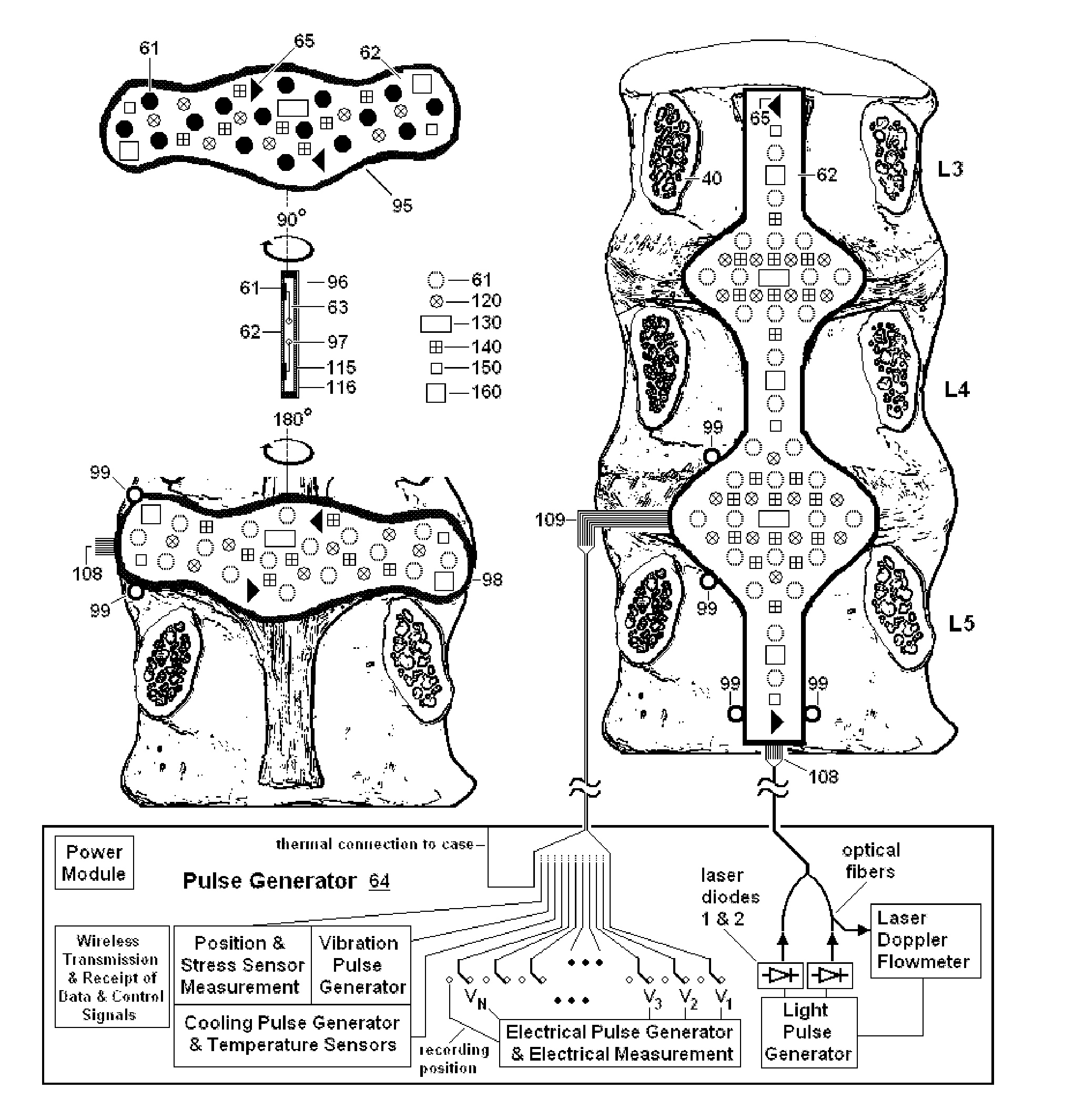
Figure 1 
Figure 2 
Figure 3
Abstract
Description
CROSS REFERENCE TO RELATED APPLICATIONS
[0001] The present application is a division of pending U.S. application Ser. No. 14 / 465,822 having publication No. US 20150005680, which was filed on Aug. 21, 2014. That pending application is a continuation-in-part of application Serial Number U.S. Ser. No. 13 / 402,093 having publication No. US 20120215218, which was filed Feb. 22, 2012 and which issued as U.S. Pat. No. 8,880,189 on Nov. 4, 2014. The present application also claims the benefit of a division of that application Serial Number U.S. Ser. No. 13 / 402,093, namely, Serial Number U.S. Ser. No. 14 / 099,910 having publication No. US 20140135876, which was filed 7 Dec. 2013 and which issued as U.S. Pat. No. 8,892,215 on Nov. 18, 2014. Those three applications, as well as the present application, claim the benefit of provisional patent application number U.S. 61 / 463,800, entitled System and Method for Electrical Stimulation of the Lumbar Vertebral Column, to J. D. LIPANI, with a filing date ...
Examples
Embodiment Construction
[0065]FIG. 5 shows an array of electrodes and a pulse generator that may be used to stimulate nerves in the posterior longitudinal ligament and underlying annulus fibrosus, according to the present invention. An array of electrodes is also known as a lead. In FIG. 5A, the lead 60 is shown to be a percutaneous flat lead. The width of the lead may be, for example, 0.5 cm. As shown, it contains eight contact electrodes 61, which are embedded in insulating material 62. For example, the contact electrodes may be made of an alloy of platinum / iridium, and the insulation material may be made of a flexible, inert silicone elastomer (such as Silastic™), polyurethane or silicone / polyurethane. When the lead is rotated by 90 degrees and sectioned along its axis, wires 63 are seen to connect each contact to corresponding connection points in the Pulse Generator 64. The wires 63 may also be embedded in the insulating material 62. For example, the wires may be made of the conducting material 35NLT-...