
System and Method for Robust Touch Detection for On-Skin Augmented Reality/Virtual Reality Interfaces
a virtual reality and touch detection technology, applied in the field of system and method for robust touch detection for on-skin augmented reality/virtual reality interfaces, can solve the problems of inability to detect the touch, the user must take extra care, and the approach is invasive, and achieves high accuracy tracking, simple instrumentation, and robust touch segmentation
Patent Information
- Authority / Receiving Office
- US · United States
- Patent Type
- Applications(United States)
- Current Assignee / Owner
- Publication Date
- 2021-04-15
Smart Images
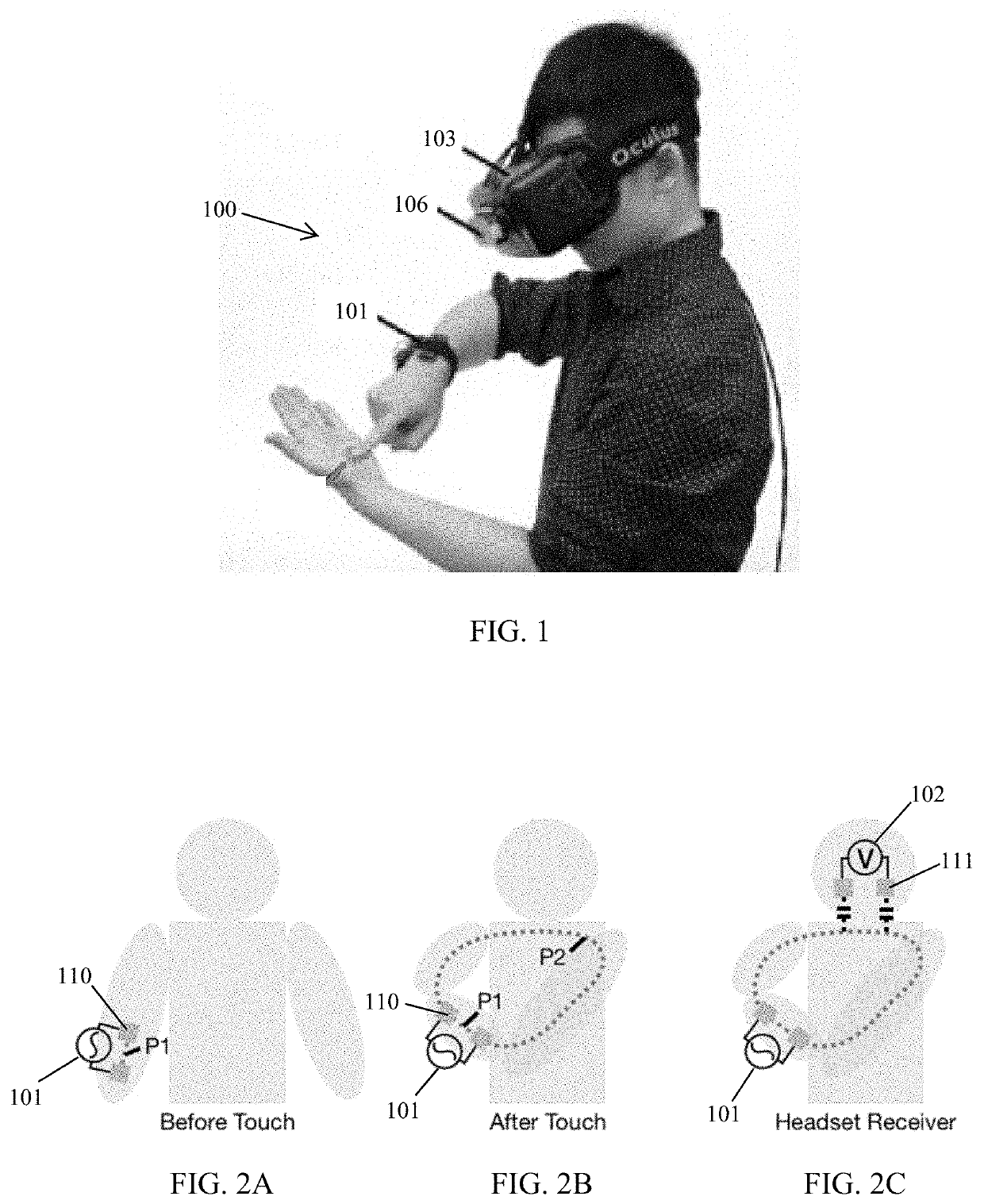
Figure 1 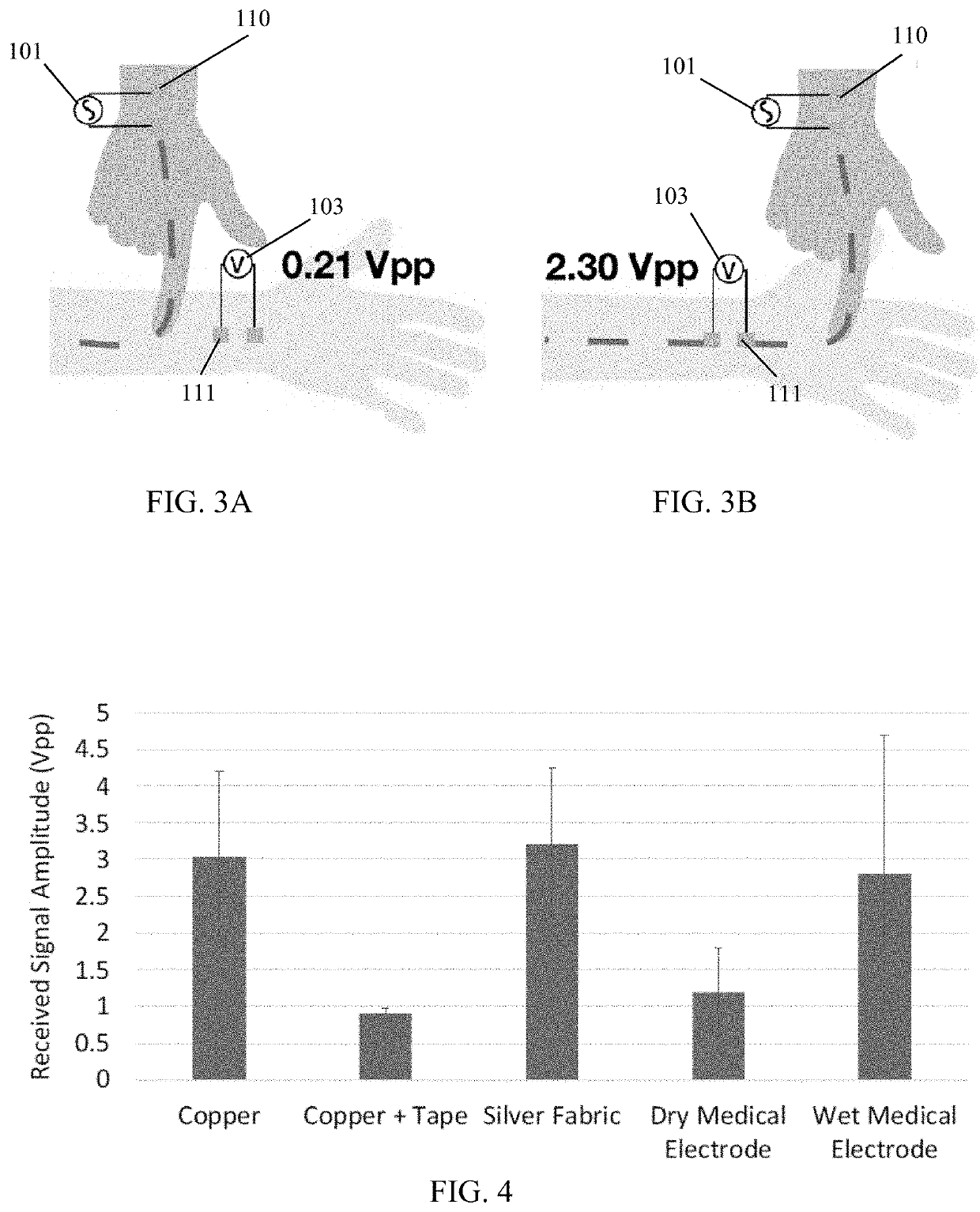
Figure 2 
Figure 3
Abstract
Description
CROSS-REFERENCE TO RELATED APPLICATIONS
[0001] This application claims the benefit under 35 U.S.C. § 119 of Provisional Application Ser. No. 62 / 973,569, filed on Oct. 11, 2019, which is incorporated herein by reference.STATEMENT REGARDING FEDERALLY SPONSORED RESEARCH
[0002] Not applicable.BACKGROUND OF THE INVENTION
[0003] Augmented reality and virtual reality (AR / VR) systems generally rely on either handheld controllers or in-air bare hand gestures for user input. Both of these approaches excel at fluid, coarse-grained input but are weaker at fine-grained interactions, such as typing on a virtual keyboard. Indeed, it is rare to see closely packed targets in current AR / VR interfaces, and when they do appear, extra care must be taken by the user.
[0004] Other modalities are possible, which can improve the precision, bandwidth, and comfort of AR / VR interactions. One option is to directly modify the body, for example, by adding a sensing layer to the skin's surface or implanting sensors under ...
Examples
Embodiment Construction
[0021]The system and method of the present invention leverage the conductivity of the human body, which serves as a transmission medium for radio frequency (RF) signals. In one embodiment, the augmented reality / virtual reality (AR / VR) interface 100 comprises an emitter 101 and a receiver 102. As shown in FIG. 1, the emitter 101 can be a smartwatch or similar body-worn device and comprises two electrodes 110 used to transmit the signal into the user's body. The receiver 102 is housed within a AR / VR headset 103 and is capable of detecting the signal from the emitter 101.
[0022]When a user wears an emitter 101 on the arm, wrist, hand, or other body part, the RF signal is conducted through the user's skin on a short path (P1) between the electrodes 110 of the emitter 101, as shown in FIG. 2A. When a user touches their arm or hand, a second, longer path (P2) is formed through the opposite arm from which the emitter 101 is worn. Path P2 is depicted on FIG. 2B. Thus, the RF signal emitted f...