
Pediatric formulation of tyrosine kinase inhibitors
Patent Information
- Authority / Receiving Office
- US · United States
- Current Assignee / Owner
- Publication Date
- 2021-10-07
Smart Images
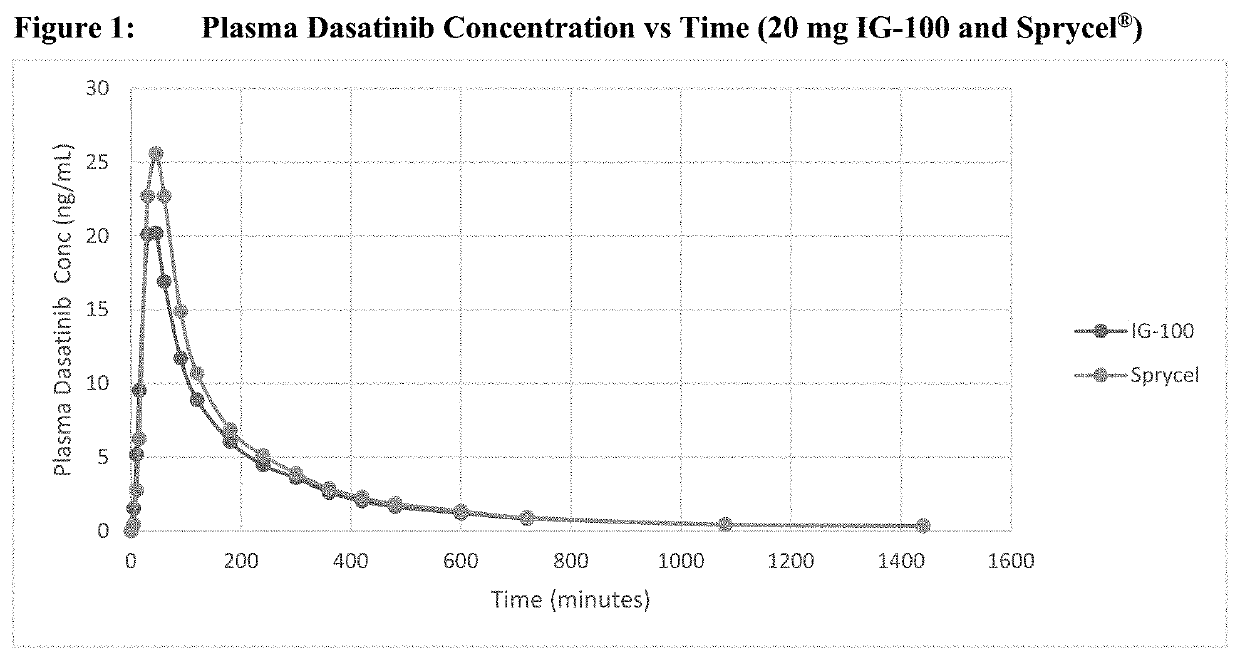
Figure 1
Abstract
Description
CROSS REFERENCE TO RELATED APPLICATIONS
[0001] This application claims priority to and the benefit of U.S. Provisional Patent Application No. 63 / 001,824, filed on Mar. 30, 2020 and entitled “PEDIATRIC FORMULATION OF TYROSINE KINASE INHIBITORS”, the contents of which are incorporated herein by reference as though fully set forth herein.BACKGROUND OF INVENTION
[0002] Congenital heart disease (CHD) is the most common defect found in newborns, occurring in about 1% of live births. Over 1 million people in the United States have some form of CHD, most of whom require continual monitoring and treatment to prevent deterioration of cardiac function. Atrioventricular canal defect (AVCD) includes different anomalies of atrioventricular valves and atrial and ventricular septa. In the complete form, a single common atrioventricular valve and an atrial septal defect (ostium primum) confluent with a posterior ventricular septal defect in the inlet portion of the ventricular septum are found. In the p...
Examples
examples
[0038]The following examples are provided to illustrate certain features of the present invention. These examples should not be construed to limit the present invention to the particular features stated in these examples.
example i development process
[0039]
Major Equipment ListEquipmentSterling Equipment ID #ScaleSPS-001ScaleSPS-002Caframo Stir MachineSPS-0031
Material Formula
[0040]
250.0g(Totalsugarspheres)×1.8571=464.2754(Theoreticalendweightofcoatedsugarspheres)Theoretical End WeightPer 130QuantityRaw Materialmg (mg)%% Excess%per BatchSugar Sphere 180-250 μm46.535.769—35.769Sugar Sphere 425-500 μm23.518.077—18.077Hypromellose15.011.53820.013.8461Ammonia Solution Strong—————Talcum15.011.53820.013.846630.023.07720.027.6927Water5—————Total130.0100.0%——464.27545Evaporates during coating process
[0041]
1(QuantityperBatch)1 / 2(%ofcoatingsuspension)2=3(Theoreticalendweightofcoating)3QuantityRaw Material%per CoatingHypromellose3.741321Ammonia Solution Strong0.0611Talcum3.74136Dasantinib1.007Water92.456Total100.03
Theoretical End WeightRawMaterialMaterialTareGrossNetPerformedCheckedMaterialLot #SupplierWeightWeightWeightBy / DateBy / DateSugar SphereG2781Paulaur25.0191.1166.1g180-250 μmSugar SphereZ69...
example ii
Bioavailability Study Comparing Dasatinib 20 mg Tablets and IG-100 20 mg Suspension Under Fasted Conditions.”
Study Information
[0056]Samples were collected in support of “A Pilot Single-Dose, Two-Period, Two-Treatment, Two-Way Crossover Relative Bioavailability Study Comparing Dasatinib 20 mg Tablets and IG-100 20 mg Suspension under Fasted Conditions.” The samples were analyzed according to Worldwide-SOP-BSC-006, Revision 4, and processed according to Worldwide-SOP-BSC-011, Revision 6. Study data were collected using Analyst® (Version 1.6.1, Applied Biosystems / Sciex) and Watson Laboratory Information Management System (LIMS; Version 7.5, Thermo Fisher Scientific) software.
Method Summary
[0057]Human plasma samples were analyzed for dasatinib according to Worldwide procedure ATM-2572, Original, effective 23 Oct. 2020. The assay validation was finalized and reported under Worldwide DCN 1004600. The method used in this study was validated for a range of 0.200 to 200 ng / mL based on the an...