
Organic compounds
a technology of organic compounds and compounds, applied in the field of organic compounds, can solve the problems of poor oral bioavailability, natural neuroactive steroids are generally unsuitable for pharmacological agents, and progesterone is not consistently effective in the treatment of the above-mentioned syndromes
Patent Information
- Authority / Receiving Office
- US · United States
- Patent Type
- Applications(United States)
- Current Assignee / Owner
- Publication Date
- 2022-03-10
Smart Images
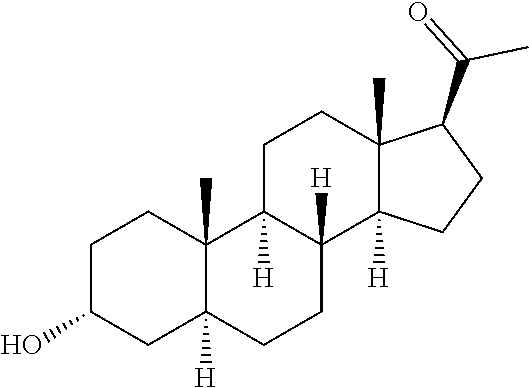
Figure 1 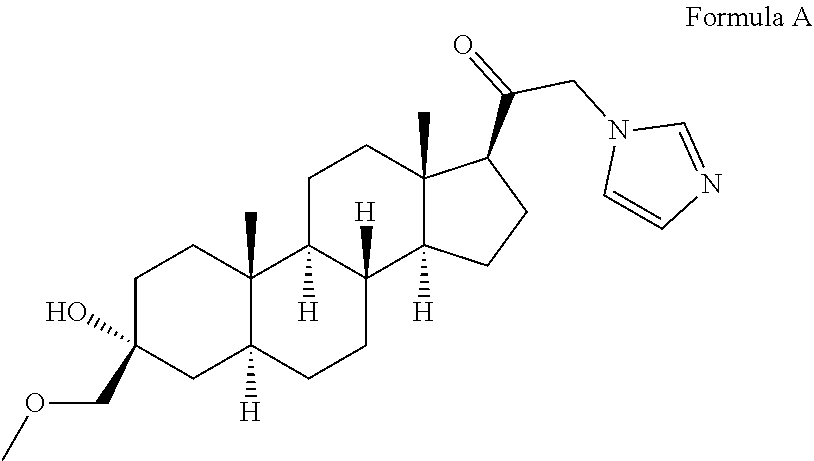
Figure 2 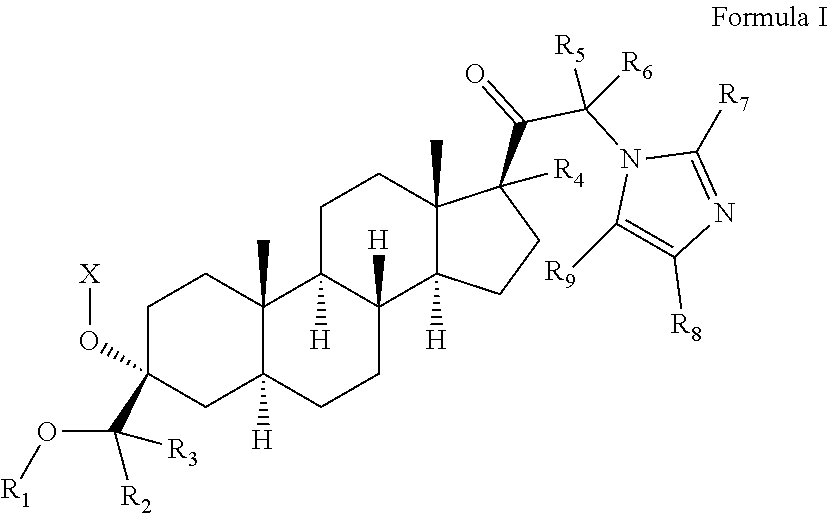
Figure 3
Abstract
Description
CROSS-REFERENCE TO RELATED APPLICATIONS
[0001] This application is an international application which claims priority to and the benefit of U.S. Provisional Application No. 62 / 780,703, filed on Dec. 17, 2018, the contents of which are hereby incorporated by reference in its entirety.FIELD OF THE INVENTION
[0002] The invention relates to particular prodrugs and analogs of (3α,5α)-3-hydroxy-21-(1H-imidazol-1-yl)-3-methoxymethyl)-pregnan-20-one, in free or pharmaceutically acceptable salt and / or substantially pure form as described herein, pharmaceutical compositions thereof, and methods of use as sedatives, hypnotics, anxiolytics, and / or anesthetics, and methods for treatment of depression, anxiety, insomnia, epilepsy, and other central nervous system disorders, as well as to combinations with other agents.BACKGROUND OF THE INVENTION
[0003] Brain excitability is defined as the level of arousal of an animal, a continuum that ranges from coma to convulsions, and is regulated by various neurot...
Examples
example 1
of 3α-Hydroxy-21-(1′-imidazolyl)-3β-methoxymethyl-5α-pregnan-20-one (Compound of Formula A)
[0151]
Step 1: 21-Bromo-3α-hydroxy-30-methoxymethyl-5α-pregnan-20-one
[0152]To a solution of 3α-hydroxy-30-methoxymethyl-5α-pregnan-20-one (30.0 g, 82.9 mmol) in 900 mL of methanol stirring at room temperature is added 3 drops of a 48% aqueous HBr solution. Bromine (13.9 g, 87.1 mmol) is then added dropwise as a solution in 200 mL of methanol over 2 hours during which the reaction was shielded from light. After TLC (1% acetone / methylene chloride) indicates the absence of starting material and the formation of a less polar product, the reaction is concentrated to approximately 300 mL. CH2Cl2 (400 mL) is then added and the reaction is poured into a separatory funnel containing 200 mL of water. The phases are separated and the aqueous phase is extracted with CH2Cl2 (3×100 mL). The organic phases are combined, washed with 200 mL of a saturated aqueous NaHCO3 solution, dried over Na2SO4, and concentr...
example 2
,8R,9S,10S,13S,14S,17S)-3-hydroxy-3-(methoxymethyl)-10,13-dimethylhexadecahydro-1H-cyclopenta[a]phenanthren-17-yl)-2-(1H-imidazol-1-yl-d3)ethan-1-one
[0154]
[0155]To a solution of imidazole-d4 (0.193 g, 2.72 mmol, 3.0 equiv.) in THF (2 mL) at 0° C. is added lithium hydride (0.0237 g, 2.8 mmol, 3.1 equiv.). The solution is stirred at 0° C. for 2 hours under Ar. 21-Bromo-3α-hydroxy-3β-methoxymethyl-5α-pregnan-20-one (0.40 g, 0.906 mmol, 1.0 equiv.) in THF (2.5 mL) is slowly added to the reaction mixture at 0° C. over a period of 5 min under Ar. After being stirred at 0° C. for 3 hours, the reaction mixture is quenched by methanol in ice-bath. The organic layer is separated and concentrated under reduced pressure. The residue is further purified by column chromatography to give the pure title compound (0.184 g, 0.426 mmol) as white powder in 50% isolated yield. 1H NMR (500 MHz, Chloroform-d) δ 4.86-4.60 (m, 2H), 3.41 (s, 3H), 3.20 (s, 2H), 2.60 (t, J=8.9 Hz, 1H), 2.31-2.12 (m, 1H), 2.06-...
example 3
,8R,9S,10S,13S,14S,17S)-3-hydroxy-3-((methoxy-d3)methyl)-10,13-dimethylhexadecahydro-1H-cyclopenta[a]phenanthren-17-yl)-2-(1H-imidazol-1-yl)ethan-1-one
[0156]
Step 1: 1-((3R,5S,8R,9S,10S,13S,14S,17S)-10,13-dimethylhexadecahydrospiro[cyclopenta[a]phenanthrene-3,2′-oxiran]-17-yl)ethan-1-one
[0157]A stirred solution trimethylsulfoxonium iodide (2.09 g, 9.5 mmol) and potassium tert-butoxide (1.134 g, 10.01 mmol) in DMSO (30.0 mL) is heated at 60° C. for 1 hour under Ar. 5α-Pregnane-3,20-dione (2.0 g, 6.3 mmol) is added to the reaction mixture and stirred at room temperature for overnight. After the reaction is completed, the reaction mixture is quenched and precipitated by water (30 mL) in ice-bath. The resultant precipitate is collected by filtration, washed with water (50 mL×2). The residue is purified by recrystallization from MeOH / acetone (4 / 1), then the solid is dried under vacuum overnight to give pure final product (1.83 g, 5.54 mmol) as a white powder in 87% yield. 1H NMR (500 MHz,...