
Processes for production of tumor infiltrating lymphocytes and uses of same in immunotherapy
a technology of infiltrating lymphocytes and immunotherapy, which is applied in the direction of tumor/cancer cells, cell culture active agents, drug compositions, etc., can solve the problems of limited manufacturing processes, no commercial process has become available, and the potential to commercialize such processes is severely limited
Patent Information
- Authority / Receiving Office
- US · United States
- Patent Type
- Applications(United States)
- Current Assignee / Owner
- Publication Date
- 2022-04-21
Smart Images
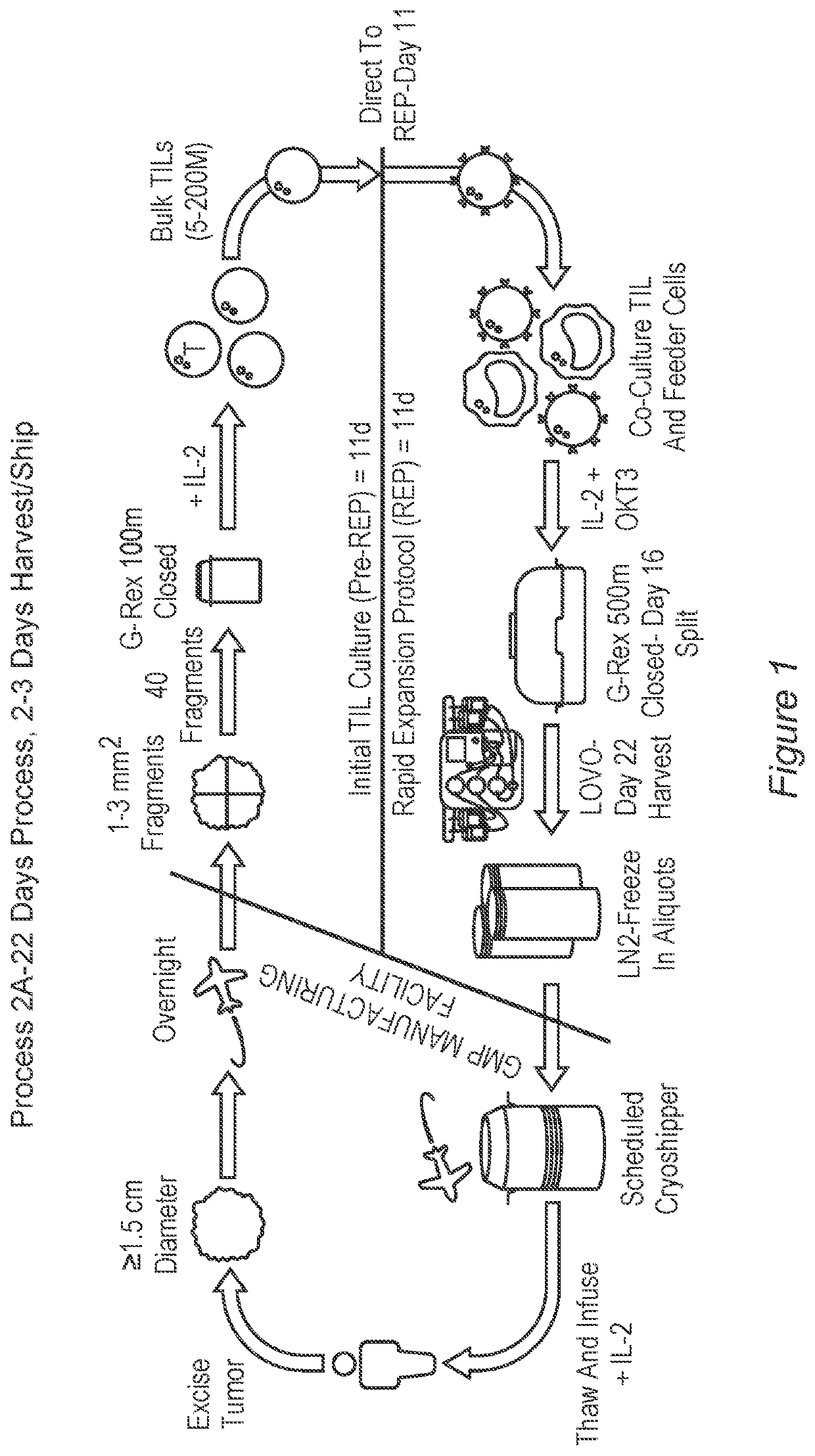
Figure 1 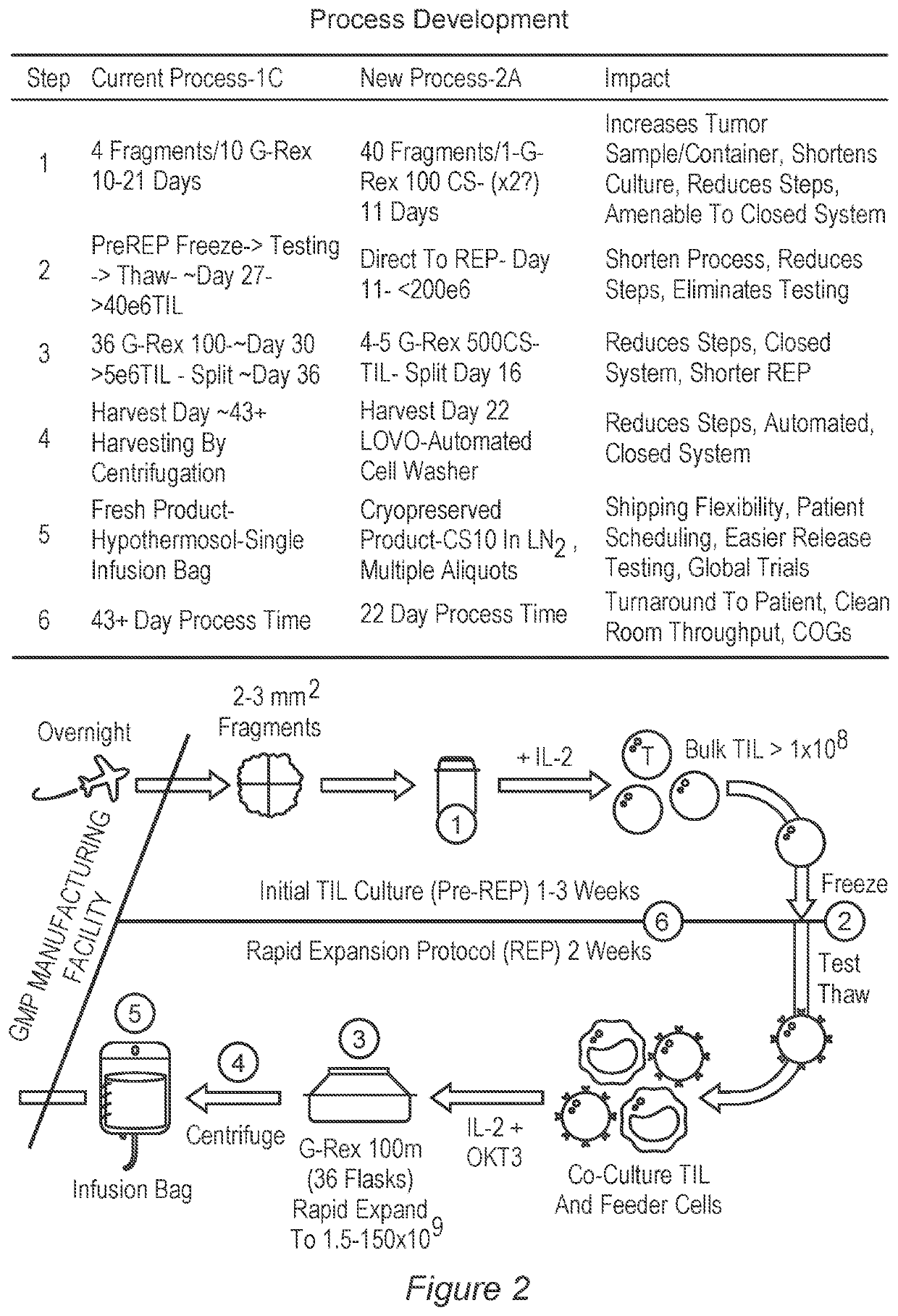
Figure 2 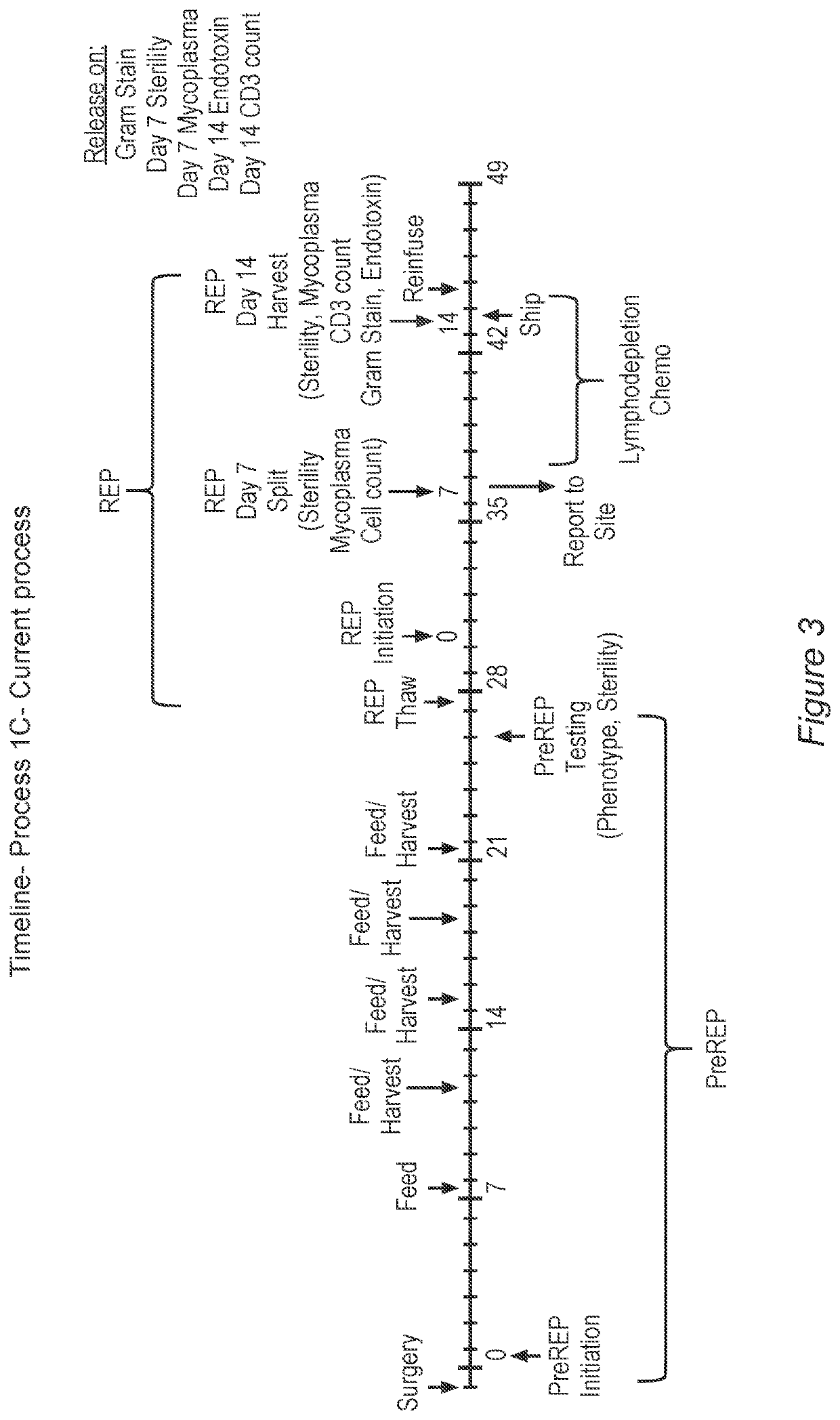
Figure 3
Abstract
Description
CROSS REFERNCE TO RELATED APPLICATIONS
[0001] This application is a U.S. National Phase Application under 35 U.S.C. § 371 of International Application No. PCT / US19 / 31624, filed May 9, 2019 which claims priority to U.S. Provisional Patent Application No. 62 / 669,876, filed on May 10, 2018, which is expressly incorporated by reference in its entirety.BACKGROUND OF THE INVENTION
[0002] Treatment of bulky, refractory cancers using adoptive transfer of tumor infiltrating lymphocytes (TILs) represents a powerful approach to therapy for patients with poor prognoses. Gattinoni, et al., Nat. Rev. Immunol. 2006, 6, 383-393. A large number of TILs are required for successful immunotherapy, and a robust and reliable process is needed for commercialization. This has been a challenge to achieve because of technical, logistical, and regulatory issues with cell expansion. IL-2-based TIL expansion followed by a “rapid expansion process” (REP) has become a preferred method for TIL expansion because of its...
Examples
example 1
Closed System Assays
[0962]As discussed herein, protocols and assays were developed for generating TIL from patient tumors in a closed system.
[0963]This Example describes a novel abbreviated procedure for generating clinically relevant numbers of TILs from patients' resected tumor tissue in G-REX devices and cryopreservation of the final cell product. Additional aspects of this procedure are described in Examples 2 to 8.
Definitions / Abbreviations
[0964]BSC—Biological Safety Cabinet[0965]° C.—degrees Celsius[0966]CO2—Carbon dioxide[0967]CD3—Cluster of Differentiation 3[0968]CM1—Complete Medium 1[0969]CM2—Complete Medium 2[0970]TIWB—Tumor Isolation Wash Buffer[0971]CM4—Complete Medium 4[0972]CRF—Control Rate Freezer[0973]EtOH—ethanol[0974]GMP—Good Manufacturing Practice[0975]IL-2, rIL-2—Interleukin-2, Recombinant human Interleukin-2,[0976]IU—International Unit[0977]L—Liter[0978]LN2—liquid nitrogen[0979]mL—milliliter[0980]μl—microliter[0981]mM—millimolar[0982]μm—micrometer[0983]NA—Not App...
example 2
Process Run On 8 Patient Tumors
[1158]The process of Example 1 was run using 8 patient tumors to produce 8 batches of TILs. Good recovery from culture, viability, cell counts, CD3+ (indicating the % T cell content) and IFN-gamma (IFN-g or IFN-γ) release were obtained, as shown in Table 7 below and in FIG. 7 through FIG. 10.
TABLE 7Results of Testing of Identity, Potency, and Viability / Recoveryof the Process of Example 1.IFNgCells / mL(pg / 1e6(Viable +% Recoverycells / 24 hr)CD3 (%)Nonviable)Fresh / Lovo% ViabilityM1061T457095.31.27E+0810388.1M1062T392199.71.65E+088984.5M1063T558798.71.51E+0811282.1M1064T61984.51.75E+088386.8M1065T136396.83.42E+0712876.4EP11001T426390.41.82E+089277.9M1056T606594.22.11E+088584.8M1058T1007992.72E+088987.5
example 3
Scalability of Modified TIL Process
[1159]The studies presented here were performed in a process development (PD) lab, and subsequently, a process qualification (PQ) study utilizing engineering runs was performed in the GMP clean room suite at a manufacturing facility. Three PQ / engineering runs were completed in the GMP facility clean room according to a qualification protocol, and a batch record based on the PD studies presented here. Acceptance criteria for the engineering runs were set prospectively. The PQ study is further summarized below, and test results obtained for the engineering batches are provided in the following sections.
[1160]The number of cells generated from pre-rapid expansion protocol (pre-REP) cultures often exceeded 100×106 viable cells. In addition, including a freeze-thaw cycle between the Pre-REP and REP culture steps reduced the viable cell yield. By eliminating the in-process cryopreservation step, the REP could be reliably and regularly initiated with an i...