
Optical information medium and its fabrication process
a technology of optical information medium and fabrication process, which is applied in the direction of photomechanical equipment, instruments, transportation and packaging, etc., can solve the problems of medium warping, difficult to form the light-transmitting layer used for this structure, and difficulty in achieving uniform curing so as to reduce the optical heterogeneity of the light-transmitting layer in the thickness direction, prevent warping of the optical information medium, and uniform thickness
Patent Information
- Authority / Receiving Office
- US · United States
- Patent Type
- Patents(United States)
- Current Assignee / Owner
- Publication Date
- 2002-06-25
- Estimated Expiration
- Not applicable · inactive patent
Smart Images
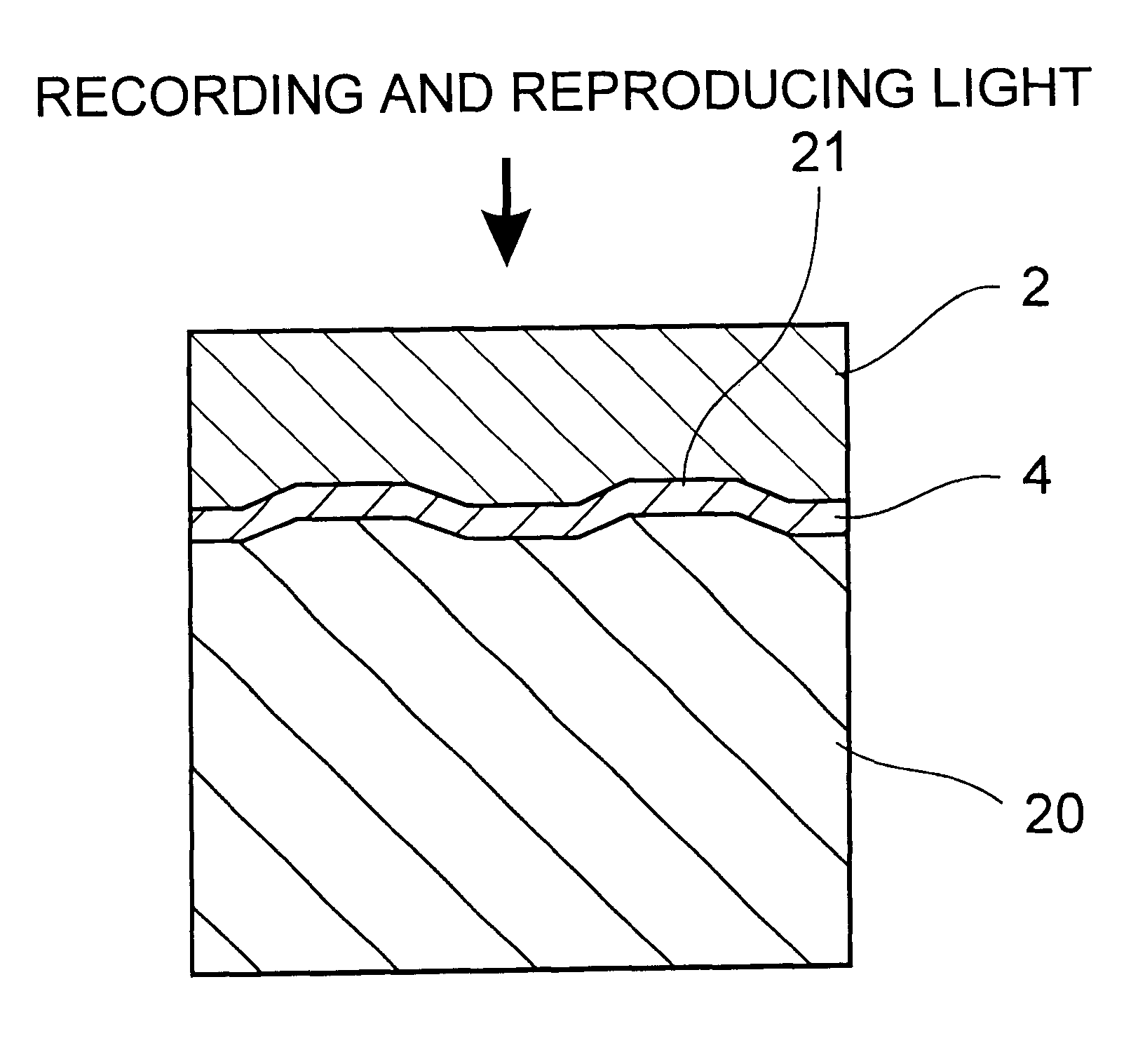
Figure 1 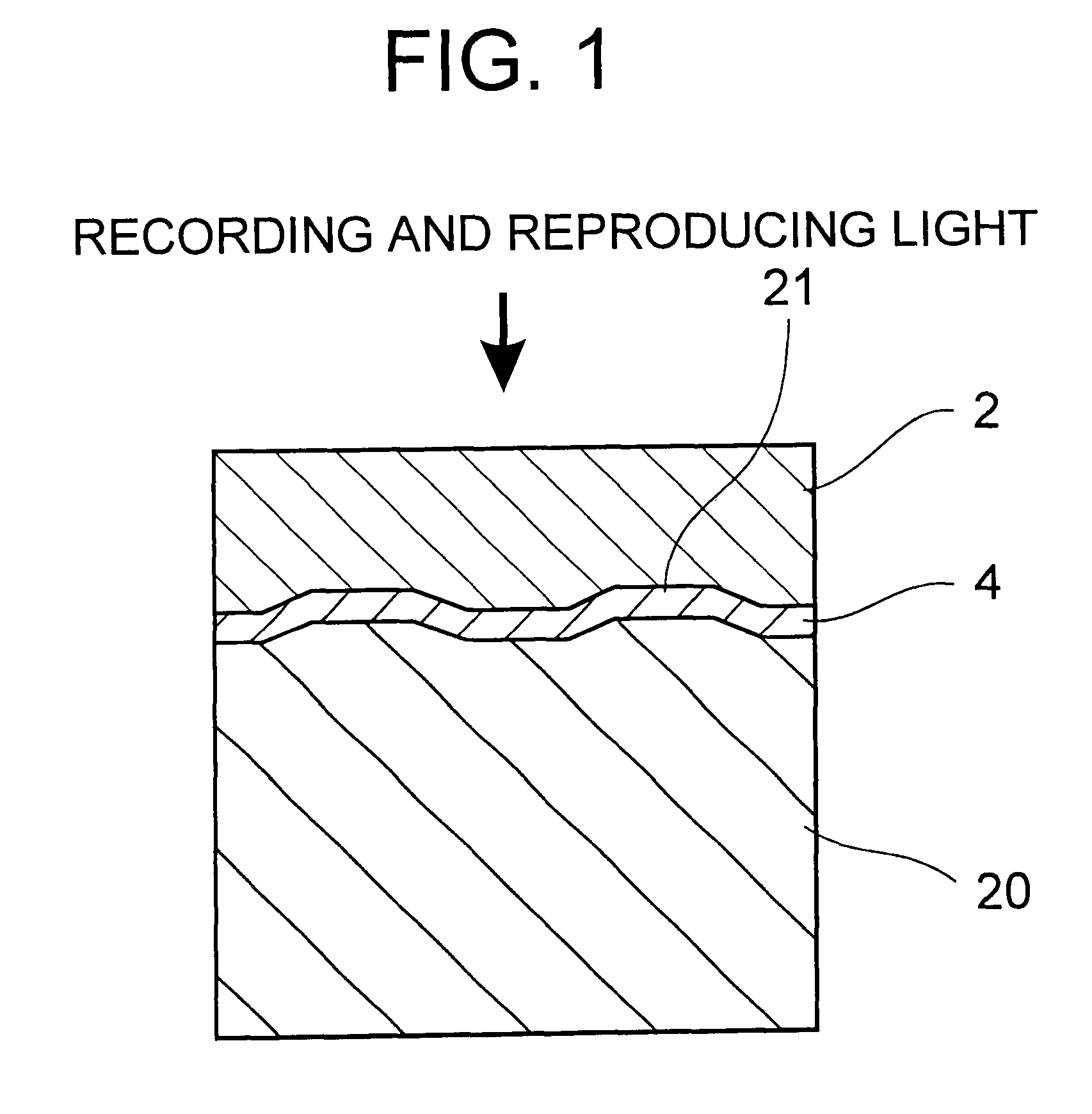
Figure 2
Abstract
Description
BACKGROUND OF THE INVENTIONThe present invention relates to an optical information medium such as read only optical disks and optical recording disks and its fabrication process.In recent years, optical information media such as read only optical disks and optical recording disks have been required to have ever-higher recording densities and, hence, ever-higher capacities so as to record or store an enormous amount of information such as moving image information. To meet this requirement, media having such high recording densities are now under extensive and intensive research and development.According to one of approaches proposed so far to this end, recording and reproducing wavelengths are shortened while the numerical aperture (NA) of an objective in a recording and reproducing optical system is increased, thereby reducing the diameter of recording and reproducing laser beams, as typically practiced in the case of a digital versatile disk or DVD. When the recording and reproduci...
Examples
example 1
Read only optical disk samples shown in Table 1 were prepared through the following process steps.
Sample No. 1
By sputtering, a reflective film made of an Al alloy was formed on the surface of a disk form of supporting substrate (a polycarbonate substrate of 120 mm in diameter and 1.2 mm in thickness) having asperities defining pits for carrying information thereon, as seen from the light-transmitting layer side.
Then, a resin (having a viscosity of 92 cps at 25.degree. C.) containing an ultraviolet-curing cationic resin and a photo-polymerization initiator was coated on the surface of the reflective film by means of a dispenser, then spin-coated at 2,000 rpm for 2 seconds, and finally cured by ultraviolet irradiation. For the ultraviolet-curing cationic resin a mixture of alicyclic epoxy resins was used, and for the photopolymerization initiator an aromatic sulfonium salt was used. This cycle of dispenser coating.fwdarw.spin coating.fwdarw.curing was repeated five times in all, there...