
Braided stent method for its manufacture
a stent and brad technology, applied in the field of brad stents and stentgrafts, can solve the problems of reducing radial strength, insufficient to adequately maintain an open passageway, and difficult intraluminal delivery and placement, and achieve the effect of increasing radial strength
Patent Information
- Authority / Receiving Office
- US · United States
- Patent Type
- Patents(United States)
- Current Assignee / Owner
- Publication Date
- 2006-02-21
- Estimated Expiration
- Not applicable · inactive patent
Smart Images
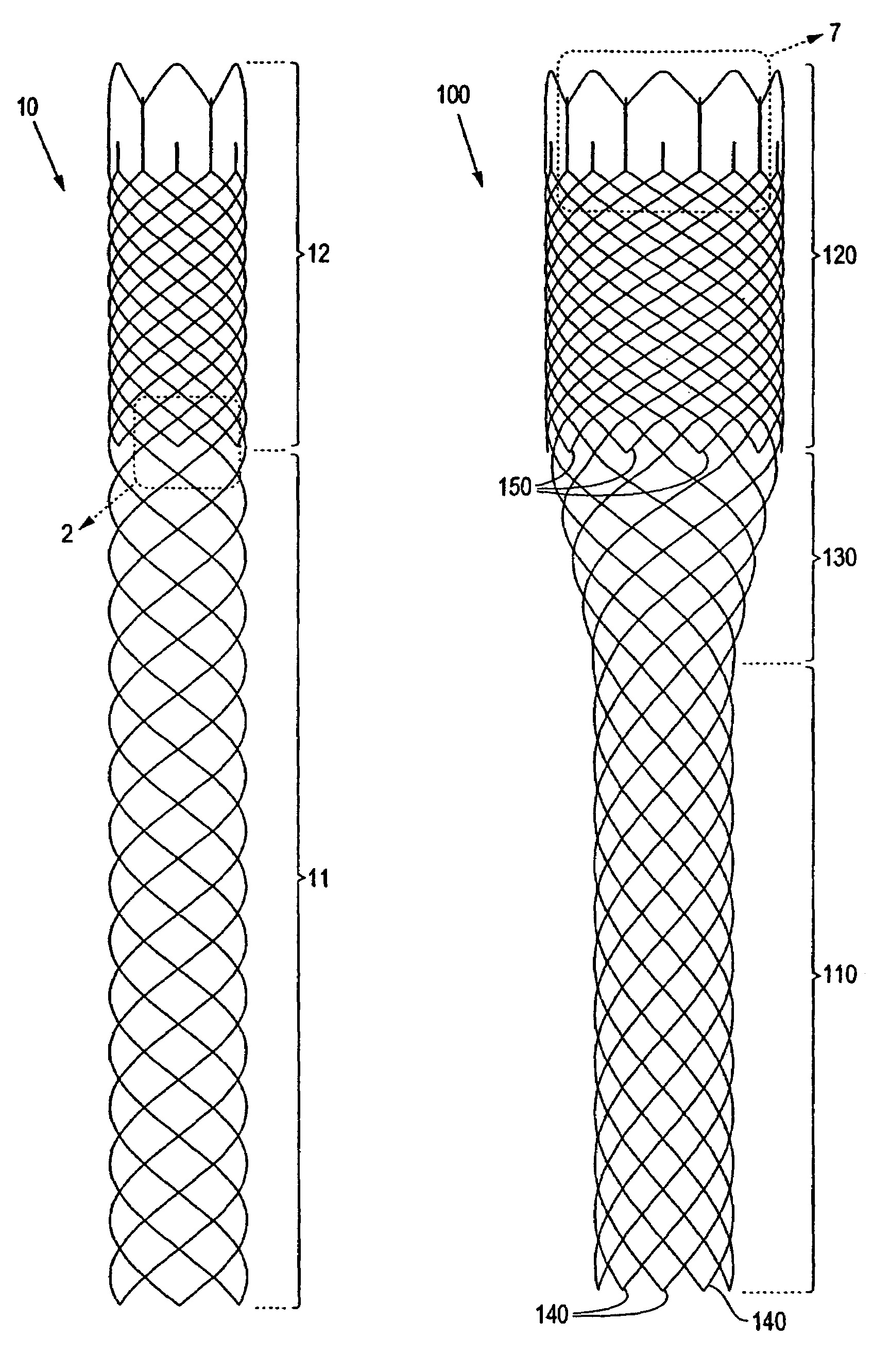
Figure 1 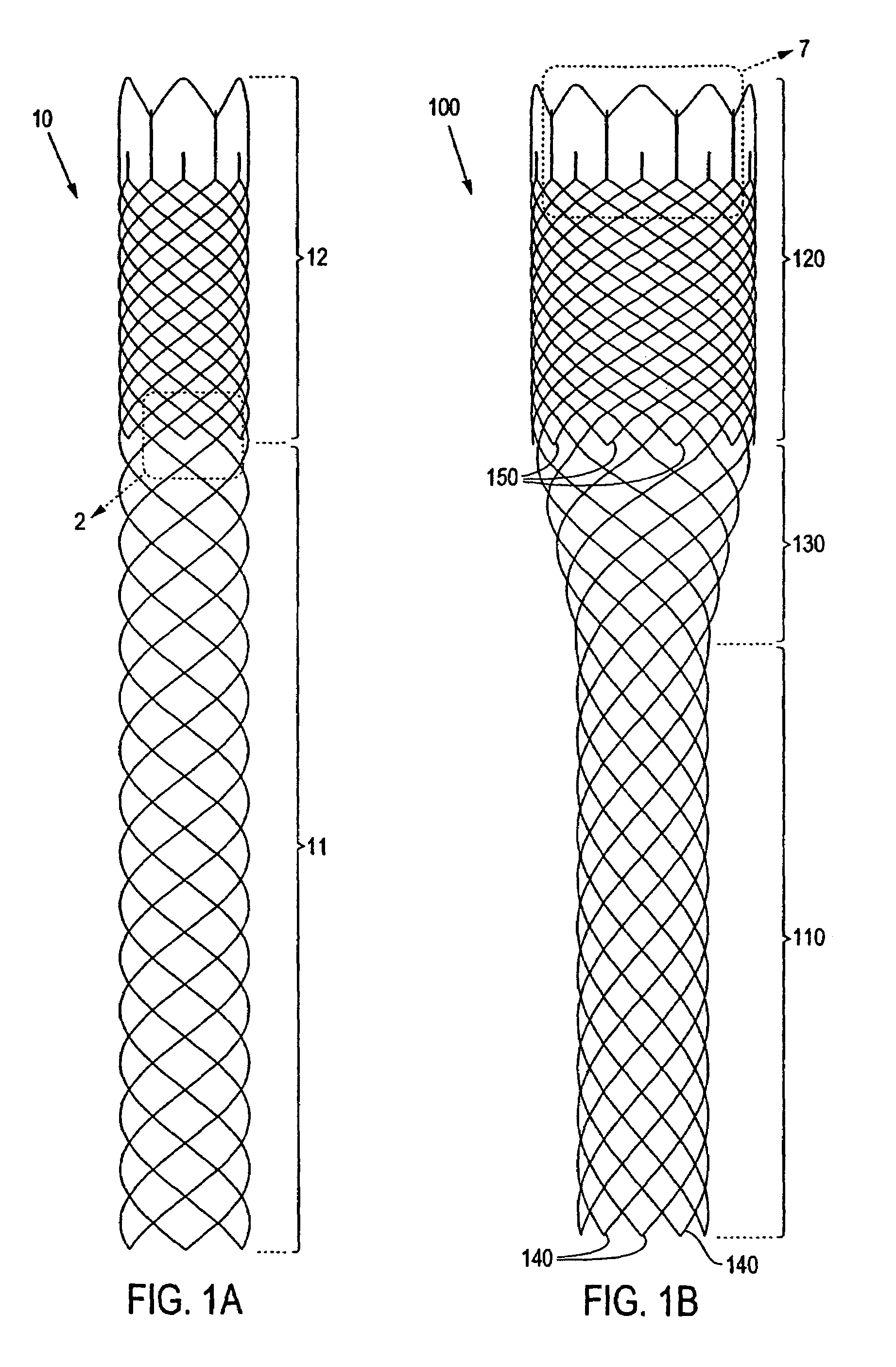
Figure 2 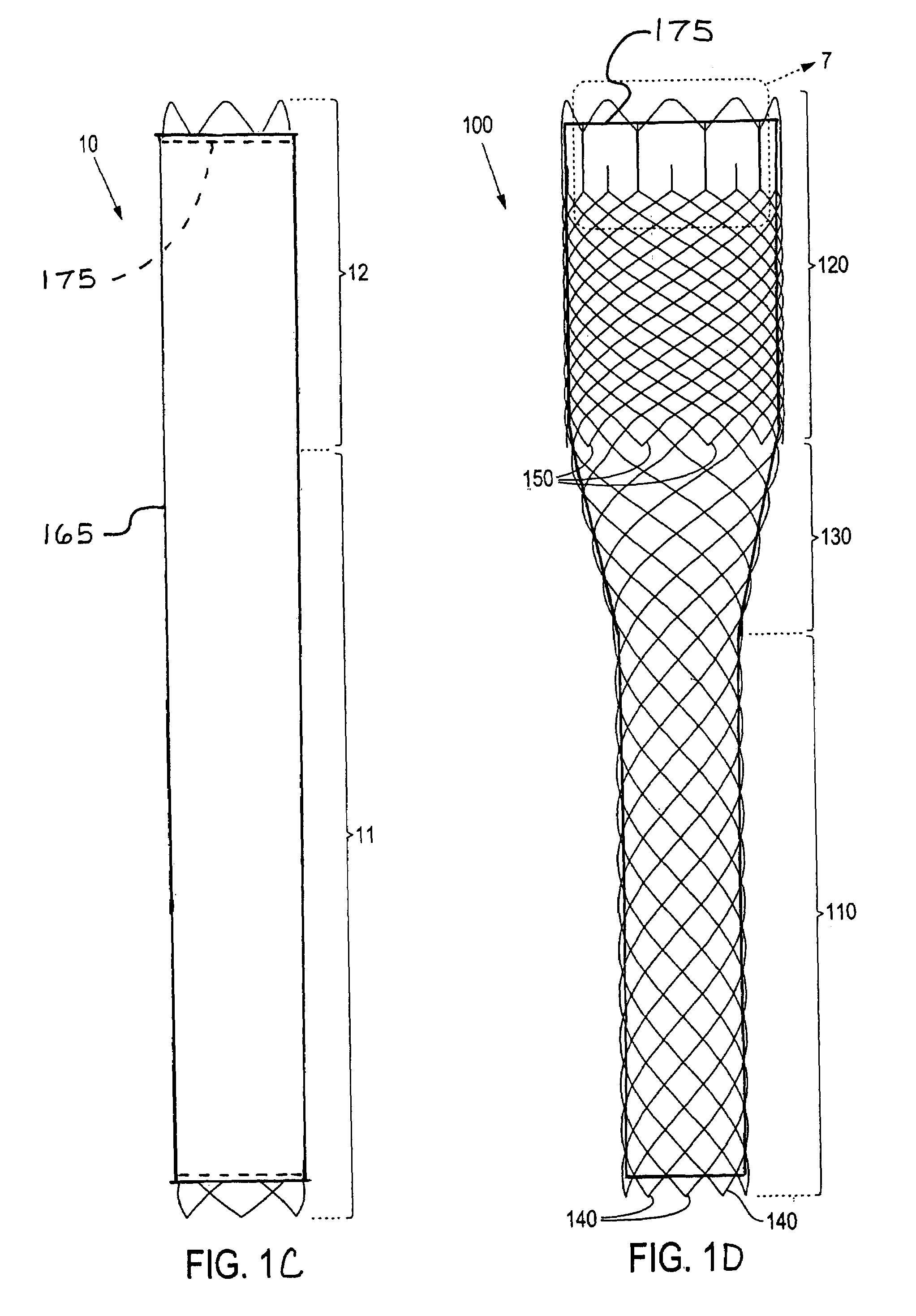
Figure 3
Abstract
Description
TECHNICAL FIELD
[0001] This invention relates generally to stents and stent-grafts, and more specifically, to braided stents and stent-grafts having segments of different strength and rigidity along the length, and / or different diameters of varying or constant strength and rigidity along the length.BACKGROUND OF THE INVENTION
[0002] A stent is an elongated device used to support a luminal wall. A stent, along with a graft cover or liner, together provide an unobstructed conduit for fluid flow in the area of a stenosis. Such a stent-graft would typically have a tubular graft layer covering, or lining, the inside or outside of the stent (or both), thus providing a fluid conduit to bypass a stenosis or otherwise diseased body passageway.
[0003] Various types of stent architectures are known in the art, including many designs comprising a filament or number of filaments, such as a wire or wires, wound or braided into a particular configuration. Included among these wire stent configurations a...
Examples
Embodiment Construction
[0022]The invention will next be illustrated with reference to the figures wherein similar numbers indicate the same elements in all figures. Such figures are intended to be illustrative rather than limiting and are included herewith to facilitate the explanation of the apparatus of the present invention.
[0023]Referring to FIG. 1A, there is shown a braided stent 10 according to the present invention. For purposes of this invention, a braided stent is one formed by at least two sets of parallel continuous filaments, the two sets traversing the circumference of the stent in lengthwise but angularly intersecting directions. The two sets of filaments are interlaced or interwoven to form a tubular, supportive structure. The stent shown in FIG. 1A comprises a relatively flexible region 11 and a relatively rigid region 12 (having greater radial strength than flexible region 11). Rigid region 12 comprises more filaments than flexible region 11 and therefore exhibits greater radial strength....