
System for accelerated magnetic resonance imaging using parallel coils
a magnetic resonance imaging and parallel coil technology, applied in the field of parallel image acquisition and processing in mr imaging, can solve the problems of reducing the field of view (fov), limiting the range of mr imaging, and reducing the number of k-space lines acquired, so as to accelerate magnetic resonance imaging and reduce the number of acquired k-space scan lines
Patent Information
- Authority / Receiving Office
- US · United States
- Patent Type
- Patents(United States)
- Current Assignee / Owner
- Publication Date
- 2017-03-14
Smart Images
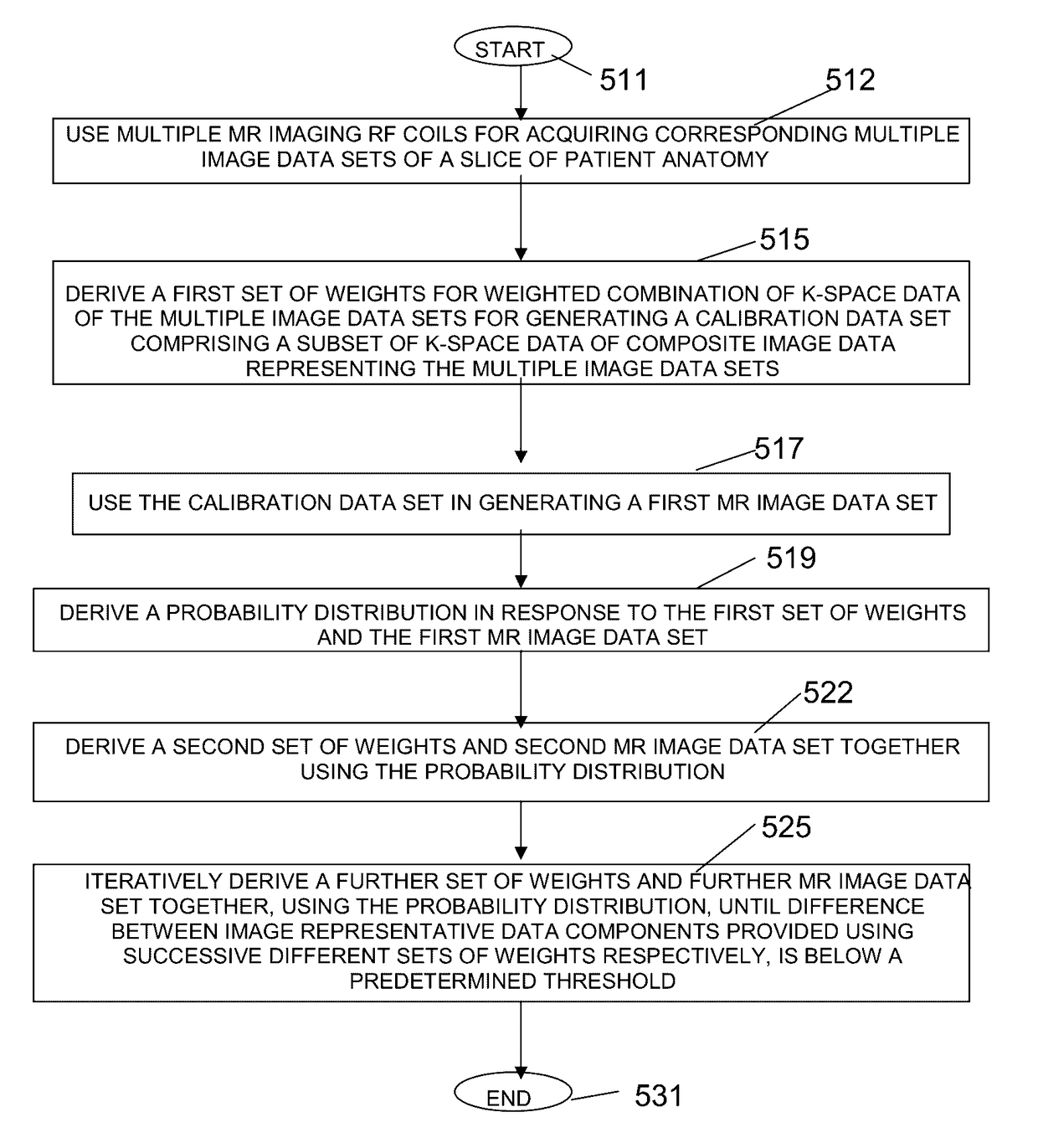
Figure 1 
Figure 2 
Figure 3
Abstract
Description
[0001] This invention was made with government support under Grant No. R01 EB007942 awarded by the National Institutes of Health and under Grant No. CCF0643836 awarded by the National Science Foundation. The government has certain rights in the invention.
[0002] This is a non-provisional application of provisional application Ser. No. 61 / 599,201 filed 15 Feb. 2012, by Daniel Weller et al.FIELD OF THE INVENTION
[0003] This invention concerns a system for parallel image acquisition and processing in MR imaging by deriving weights using a probability distribution for weighted combination of k-space data and of combining image data sets from different RF coils for generating a calibration data set and composite MR image data set.BACKGROUND OF THE INVENTION
[0004] In known magnetic resonance imaging (MRI), image data is commonly acquired by raster scanning a spatial Fourier transform domain called k-space, thereby sampling k-space lines, and taking an inverse Fourier transform of the samples. M...
Examples
Embodiment Construction
[0012]A system employs a Bayesian interpretation of a reconstruction problem and a joint estimator that unifies a kernel calibration with full k-space reconstruction and denoising using a single solution. The system improves reconstruction quality at high levels of acceleration, accommodating both greater spacing between k-space samples and fewer autocalibration (ACS) lines. The acceleration of magnetic resonance imaging (MRI) by reducing the number of acquired k-space scan lines benefits conventional MR imaging significantly by decreasing the time subjects remain in the scanner and can limit image artifacts caused by patient movement during the acquisition. The system advantageously employs a Bayesian estimation method for jointly calibrating a GRAPPA reconstruction kernel and reconstructing full k-space from undersampled parallel MRI data. The system employs a joint sparsity signal model for processing coil image data in conjunction with observation models for both the acquired da...