
Acceleration of stereolithography
a stereolithography and acceleration technology, applied in the field of additives, can solve the problems of needing to submerge, use additional mechanical elements, extreme care, etc., and achieve the effects of enhancing the photopolymerization cure chemistry, reducing the viscosity of the liquid, and facilitating the re-filling of polymerizable liquid
Patent Information
- Authority / Receiving Office
- US · United States
- Patent Type
- Patents(United States)
- Current Assignee / Owner
- Publication Date
- 2018-05-22
Smart Images
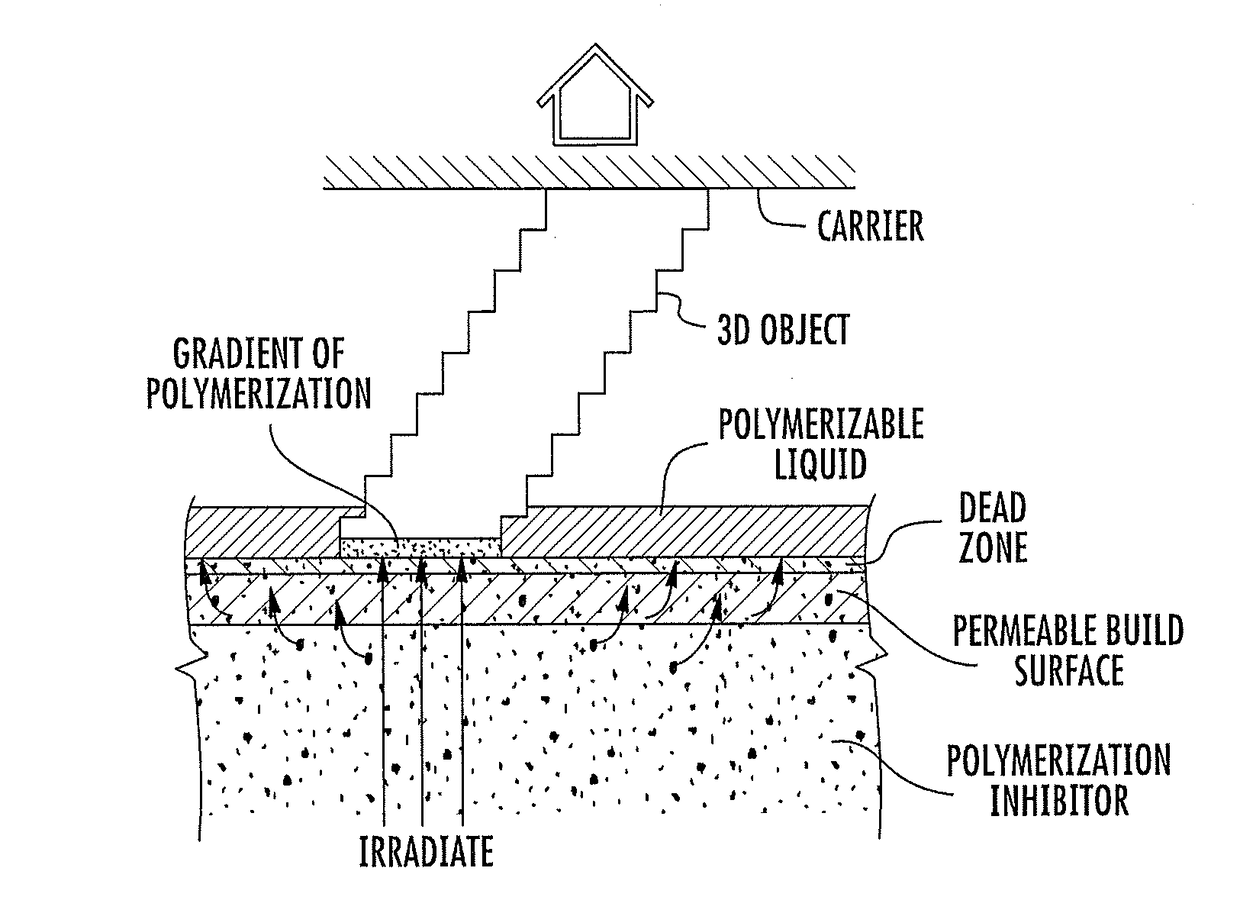
Figure 1 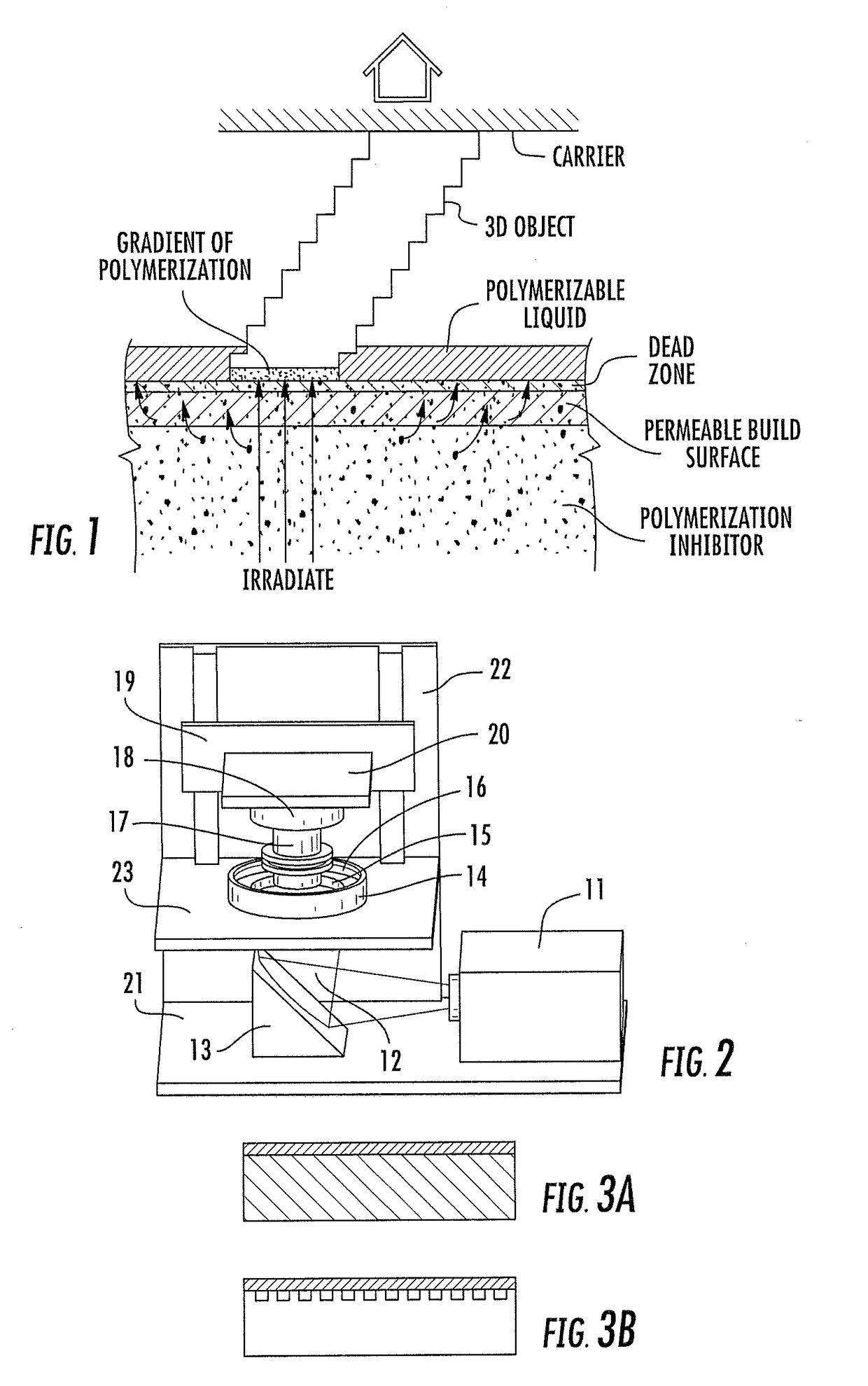
Figure 2 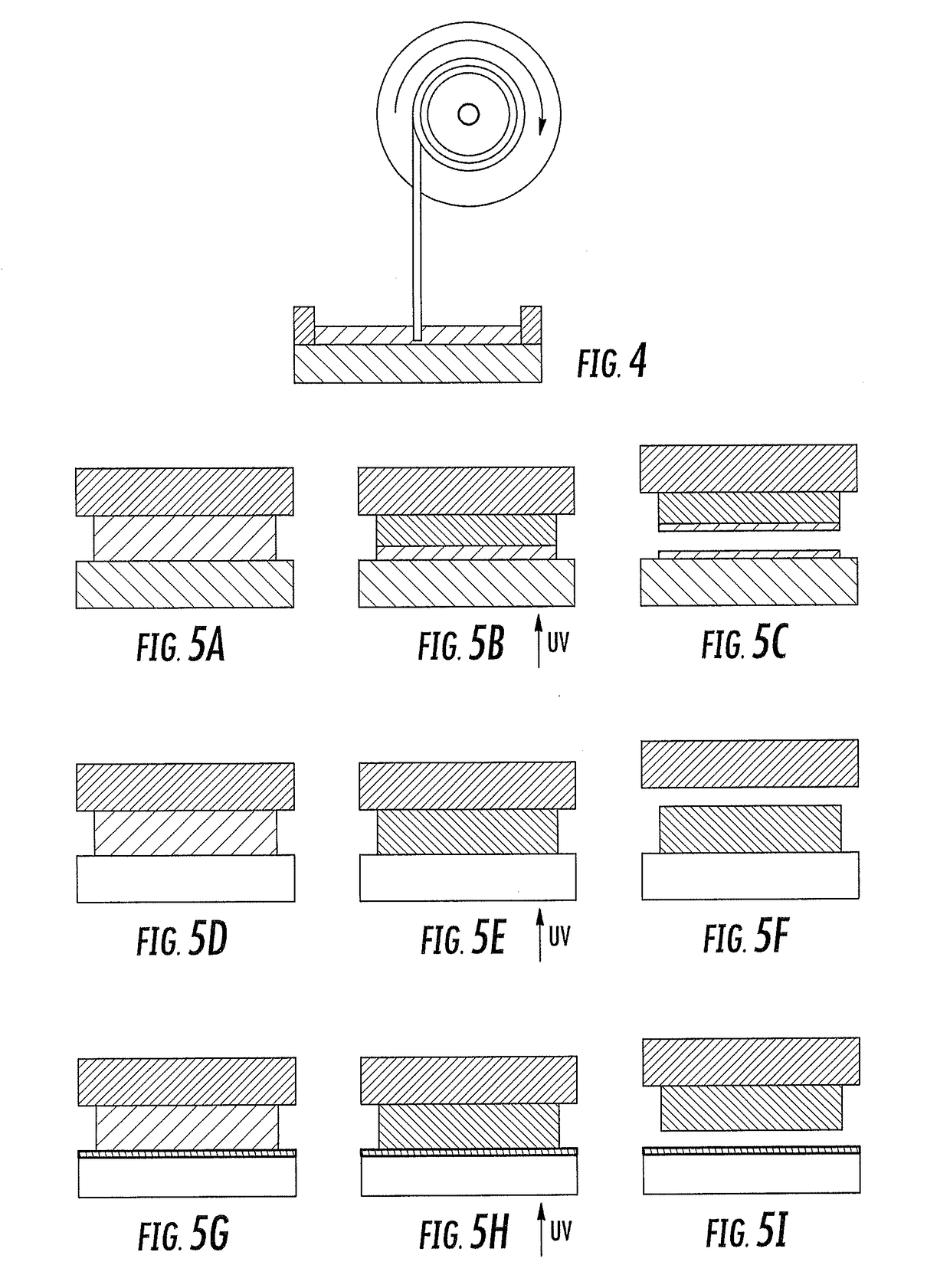
Figure 3
Abstract
Description
RELATED APPLICATIONS
[0001] This application claims the benefit of U.S. provisional patent application Ser. No. 62 / 036,394, filed Aug. 12, 2014, the disclosure of which is incorporated by reference herein in its entirety.FIELD OF THE INVENTION
[0002] The present invention concerns additives and methods of speeding the fabrication of the three-dimensional objects in additive manufacturing techniques such as “bottom up” three dimensional fabrication (sometimes generally referred to as stereolithography).BACKGROUND OF THE INVENTION
[0003] In conventional additive or three-dimensional fabrication techniques, construction of a three-dimensional object is performed in a step-wise or layer-by-layer manner. In particular, layer formation is performed through solidification of photo curable resin under the action of visible or UV light irradiation. Two techniques are known: one in which new layers are formed at the top surface of the growing object; the other in which new layers are formed at the ...
Examples
example 1
Inhibitor Transfer to Build Surface from a Separate Feed Surface
[0161]A drop of ultraviolet (UV) curable adhesive was placed on a metal plate and covered with 10 mm thick plate of TEFLON® AF fluoropolymer (a amorphous, glassy polymer) as shown in FIG. 5A. UV radiation was supplied to the adhesive from the side of Teflon AF as shown in FIG. 5B. After UV exposure the two plates were separated. It was found that no force was required to separate the two plates. Upon examination of the samples it was discovered that the adhesive was cured only next to the metal plate, and that a thin film of uncured adhesive was present on the Teflon AF fluoropolymer plate and also on the cured portion of the adhesive as shown in FIG. 5C.
[0162]Two controlled experiments were also performed where clean glass (FIGS. 5D-5F) and also glass treated with release layer (FIGS. 5G-5I) was used. It was confirmed that considerable force was needed to separate clean glass from the metal and it was found that adhesi...
example 2
Inhibitor Transfer Through Build Plate to Build Surface
[0164]Samples 1 and 2 were prepared in a similar manner wherein a drop of UV curable adhesive was placed on a metal plate and covered with 10 mm thick plate of TEFLON® AF fluoropolymer as shown in FIG. 6A. Both samples were exposed to a nitrogen environment to eliminate any presence of oxygen as shown in FIG. 6B. Next both samples were brought into a standard atmosphere environment and Sample 1 was immediately exposed to UV radiation while Sample 2 was exposed to UV radiation 10 minutes after being in the atmosphere environment. Both samples were exposed to the same amount of UV radiation as shown in FIG. 6C and FIG. 6E. Upon examination of the samples after UV exposure it was discovered that the adhesive was cured completely in Sample 1 as shown in FIG. 6D and only next to the metal plate in Sample 2 as shown in FIG. 6F. A thin film of uncured adhesive was present on the Teflon AF fluoropolymer plate and also on the cured porti...
example 3
Increasing Fabrication Rate: Pressure
[0165]A highly oxygen permeable, and UV transparent material is used as the bottom of a chamber filled with photocurable resin in a device of the invention. During construction, the top of an object is attached to a support plate which is moved up at a substantially constant speed while the bottom portion of the object is constantly being formed just above the bottom of the chamber. The gap between the bottom of the object and the bottom of the chamber is always filled with resin. As the object is being formed and advanced, the resin in the gap is constantly replenished with supply resin contained in the chamber.
[0166]The speed of the object's formation depends on the viscosity of the resin η, atmospheric pressure P, the height of the gap between the object and the bottom of the chamber h, and the linear dimension L of the object's bottom surface. Simple calculations are performed to estimate this speed using the theory of viscous flow between tw...