
Free-Form Spatial 3-D Printing Using Part Levitation
a free-form, spatial technology, applied in the direction of additive manufacturing, manufacturing tools, additive manufacturing, etc., can solve the problems of limiting the geometry and/or features of parts that can be fabricated, and the use of a single print head to form features of each layer renders the fabrication process relatively slow, so as to achieve the effect of increasing the fabrication speed
Patent Information
- Authority / Receiving Office
- US · United States
- Patent Type
- Applications(United States)
- Current Assignee / Owner
- Publication Date
- 2018-01-11
Smart Images
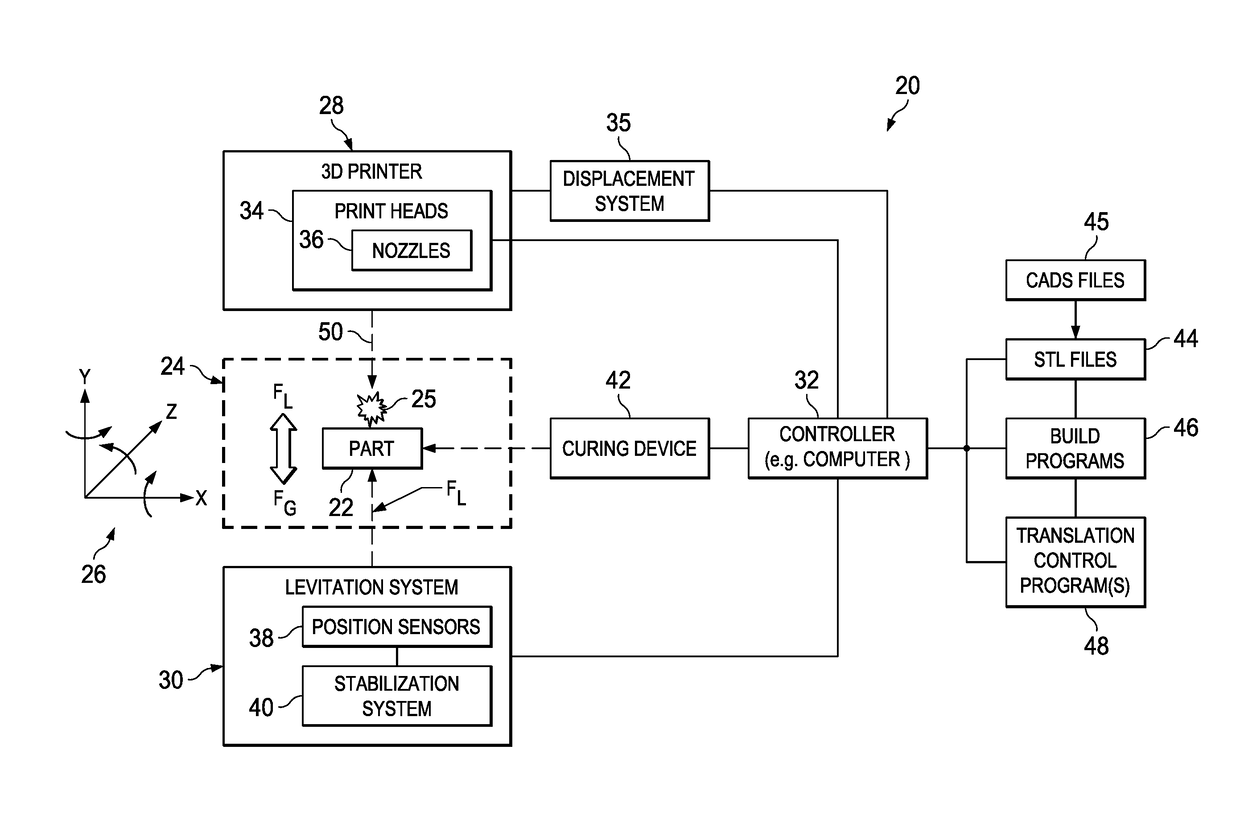
Figure 1 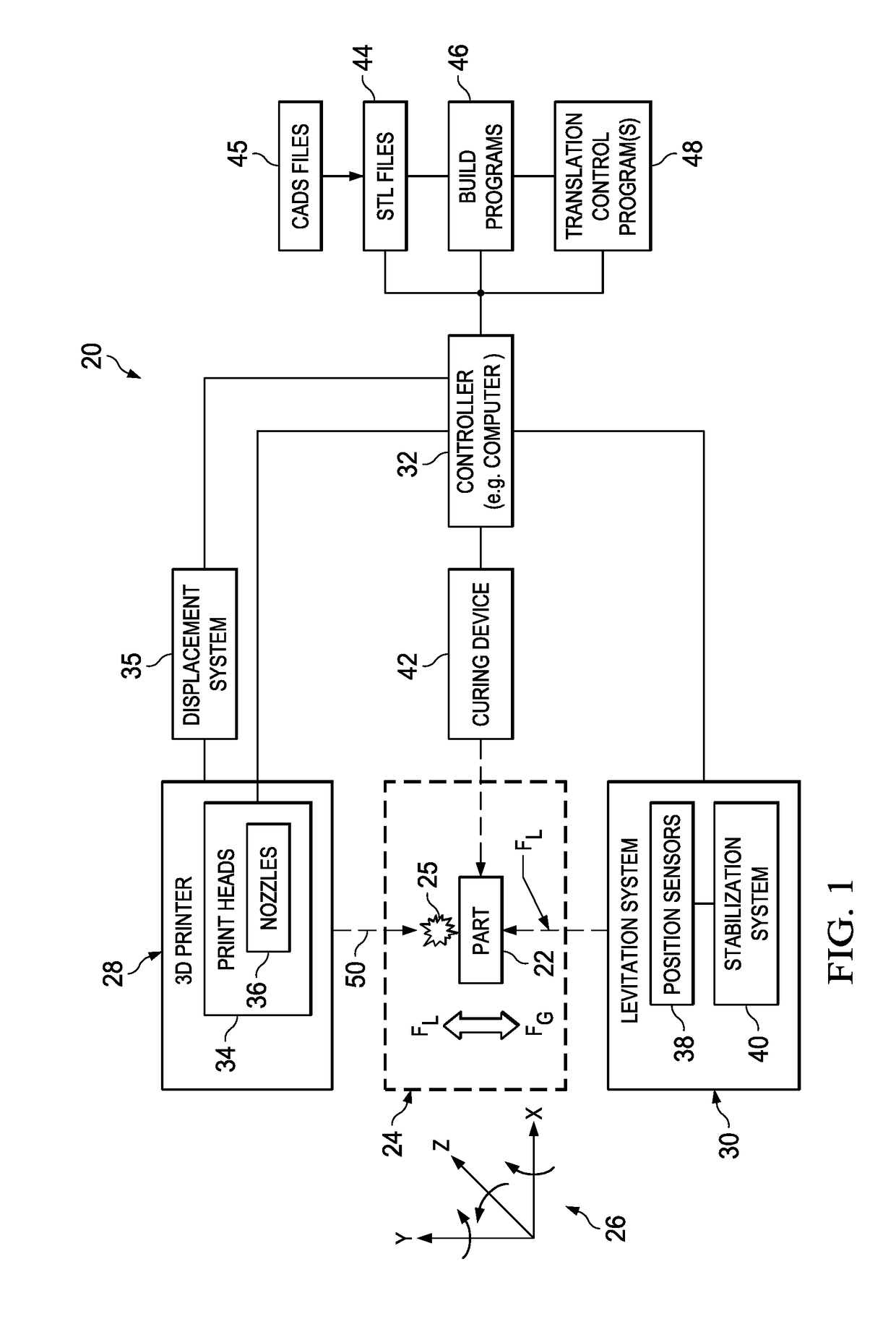
Figure 2 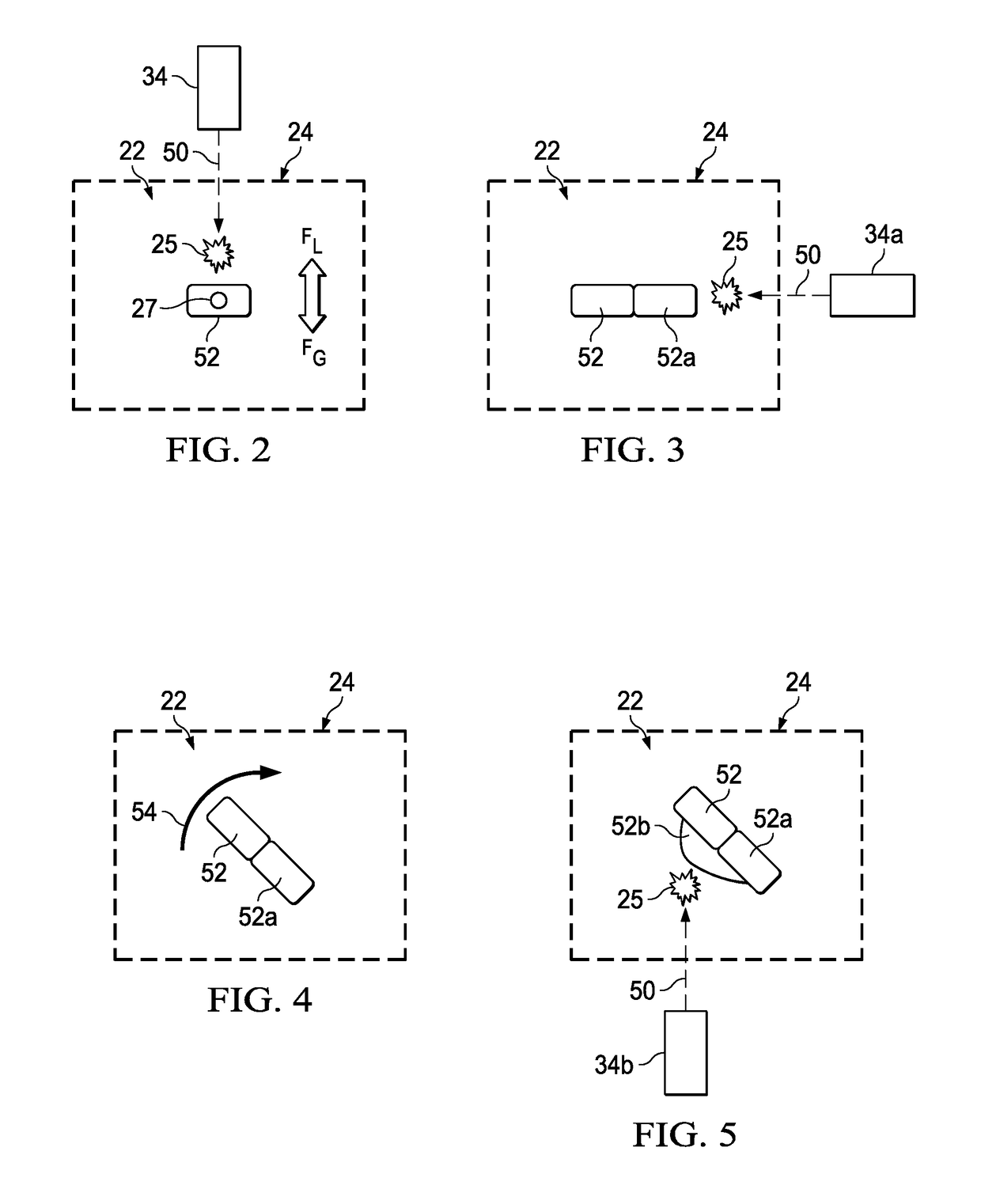
Figure 3
Abstract
Description
[0001] This application is a continuation application of U.S. patent application Ser. No. 14 / 446,141, filed Jul. 29, 2014.BACKGROUND INFORMATION1. Field
[0002] The present disclosure generally relates to additive manufacturing processes, and deals more particularly with a method and apparatus for 3-D printing a part in free space using part levitation.2. Background
[0003] Additive Manufacturing (AM) is a process that creates physical parts directly from a 3-D (three dimensional) CAD (computer aided design) file using computer controlled additive fabrication techniques. Common AM techniques, sometimes also referred to as 3-D manufacturing, include stereolithography (SLA), fused deposition modeling (FDM), selective laser sintering (SLS) and three dimensional printing (3-DP), to name only a few. Each of these processes builds a three dimensional solid part, layer-by-layer, by locally fusing or curing building materials that may be in powder or liquid form.
[0004] Each of the AM processes ment...
Examples
Embodiment Construction
[0022]FIG. 1 illustrates the overall components of an apparatus 20 for full body, free-form 3-D printing and levitating a part in space. The apparatus 20 broadly comprises a 3-D printer 28 for additive fabrication of a part 22, and a levitation system 30 for levitating and translating the part 22 within a coordinate system 26 in free-space 24 during the fabrication process. The levitation system 30 applies a levitational force FL to the part 22 which is substantially equal to the gravitational force FG acting on the part 22, resulting in the part 22 being suspended or levitated within the space 24.
[0023]The 3-D printer 28 may comprise any of a variety of known devices that build the part 22 by selectively placing and adding material 25 to the part 22. The 3-D printer 28 may include one or more print heads 34 located at different positions around the space 24, each of which may include a plurality of nozzles 36 for extruding, propelling or jetting 50 material 25 into the space 24.
[00...