

Assess Mini LED Efficiency in High-Vibration Environments
SEP 12, 202510 MIN READ
Generate Your Research Report Instantly with AI Agent
PatSnap Eureka helps you evaluate technical feasibility & market potential.
Mini LED Technology Background and Performance Goals
Mini LED technology represents a significant advancement in display technology, bridging the gap between traditional LED backlighting and the more advanced Micro LED displays. Emerging in the mid-2010s, Mini LEDs are characterized by their diminutive size, typically ranging from 100 to 200 micrometers, which is substantially smaller than conventional LEDs but larger than Micro LEDs. This size reduction enables higher density placement, resulting in more precise local dimming zones and enhanced contrast ratios.
The evolution of Mini LED technology has been driven by the increasing demand for improved display performance across various applications, from consumer electronics to automotive displays and industrial interfaces. The technology has gained substantial momentum since 2019, with major display manufacturers incorporating Mini LEDs into premium product lines to achieve superior brightness, contrast, and energy efficiency compared to traditional LCD displays.
In high-vibration environments, display technologies face unique challenges that can compromise performance, durability, and reliability. These environments include automotive dashboards, industrial machinery interfaces, aerospace control panels, and military equipment displays. The constant mechanical stress in these settings can lead to connection failures, component displacement, and accelerated degradation of display elements.
The primary performance goals for Mini LED technology in high-vibration environments include maintaining consistent brightness and color accuracy despite continuous mechanical stress. Achieving a minimum operational lifespan of 50,000 hours under vibration conditions ranging from 10Hz to 2000Hz is considered essential for industrial and automotive applications. Additionally, the technology must demonstrate resilience against temperature fluctuations that often accompany vibration scenarios.
Energy efficiency represents another critical performance metric, with targets focusing on minimizing power consumption while maintaining optimal brightness levels of at least 1000 nits. This is particularly important in battery-operated or energy-constrained systems where power management is paramount. The technology must also achieve rapid response times below 1ms to ensure clear image rendering during movement and vibration.
Mechanical durability constitutes a fundamental performance goal, with Mini LED displays expected to withstand shock impacts of up to 50G and continuous vibration at various frequencies without experiencing pixel failures or connection issues. This requires innovations in mounting techniques, substrate materials, and protective encapsulation methods specifically designed for high-stress environments.
The trajectory of Mini LED development for vibration-resistant applications is increasingly focused on integration with flexible substrates and advanced bonding technologies that can absorb and distribute mechanical stress. Research is also directed toward developing vibration-dampening mounting systems and resilient electrical connections that maintain integrity under continuous movement and shock.
The evolution of Mini LED technology has been driven by the increasing demand for improved display performance across various applications, from consumer electronics to automotive displays and industrial interfaces. The technology has gained substantial momentum since 2019, with major display manufacturers incorporating Mini LEDs into premium product lines to achieve superior brightness, contrast, and energy efficiency compared to traditional LCD displays.
In high-vibration environments, display technologies face unique challenges that can compromise performance, durability, and reliability. These environments include automotive dashboards, industrial machinery interfaces, aerospace control panels, and military equipment displays. The constant mechanical stress in these settings can lead to connection failures, component displacement, and accelerated degradation of display elements.
The primary performance goals for Mini LED technology in high-vibration environments include maintaining consistent brightness and color accuracy despite continuous mechanical stress. Achieving a minimum operational lifespan of 50,000 hours under vibration conditions ranging from 10Hz to 2000Hz is considered essential for industrial and automotive applications. Additionally, the technology must demonstrate resilience against temperature fluctuations that often accompany vibration scenarios.
Energy efficiency represents another critical performance metric, with targets focusing on minimizing power consumption while maintaining optimal brightness levels of at least 1000 nits. This is particularly important in battery-operated or energy-constrained systems where power management is paramount. The technology must also achieve rapid response times below 1ms to ensure clear image rendering during movement and vibration.
Mechanical durability constitutes a fundamental performance goal, with Mini LED displays expected to withstand shock impacts of up to 50G and continuous vibration at various frequencies without experiencing pixel failures or connection issues. This requires innovations in mounting techniques, substrate materials, and protective encapsulation methods specifically designed for high-stress environments.
The trajectory of Mini LED development for vibration-resistant applications is increasingly focused on integration with flexible substrates and advanced bonding technologies that can absorb and distribute mechanical stress. Research is also directed toward developing vibration-dampening mounting systems and resilient electrical connections that maintain integrity under continuous movement and shock.
Market Demand Analysis for Vibration-Resistant Displays
The demand for vibration-resistant display technologies has experienced significant growth across multiple sectors, particularly in transportation, industrial machinery, military applications, and outdoor digital signage. Market research indicates that the global ruggedized display market reached approximately $9.4 billion in 2022 and is projected to grow at a compound annual growth rate of 5.8% through 2028, with vibration resistance being a key performance requirement.
Transportation represents the largest market segment, with automotive displays alone accounting for nearly 40% of the demand for vibration-resistant technologies. The increasing integration of digital dashboards, infotainment systems, and advanced driver assistance displays in vehicles necessitates displays that can maintain visual clarity and operational reliability despite constant vibration exposure. Commercial aviation and maritime sectors similarly require displays capable of withstanding varying vibration profiles.
Industrial applications constitute the second-largest market segment, where manufacturing equipment, control systems, and monitoring displays operate in environments with significant mechanical vibration. The Industry 4.0 transition has accelerated this demand as more production facilities implement digital interfaces in previously analog environments.
Military and defense applications, though smaller in volume, represent the highest value segment of the market. These applications demand displays that maintain functionality under extreme conditions, including high-frequency vibrations from weapons systems, aircraft, and ground vehicles. The premium pricing in this sector reflects the stringent performance requirements and certification processes.
Consumer electronics manufacturers are increasingly recognizing vibration resistance as a differentiating feature for premium products. Outdoor enthusiasts, construction professionals, and field service technicians represent growing niche markets for ruggedized portable devices with vibration-resistant displays.
Market research reveals that current display solutions often compromise on brightness, color accuracy, or energy efficiency to achieve vibration resistance. This creates a significant opportunity for Mini LED technology, which potentially offers superior visual performance while maintaining structural integrity in high-vibration environments.
Regional analysis shows North America leading the market with approximately 35% share, followed by Europe and Asia-Pacific. However, the Asia-Pacific region demonstrates the fastest growth rate, driven by increasing industrial automation and transportation infrastructure development in China, South Korea, and India.
Customer surveys indicate that reliability under vibration stress ranks as the third most important purchasing criterion for industrial displays, after overall durability and visibility in varying light conditions. This suggests that Mini LED solutions optimized for vibration resistance could command premium pricing if they deliver on these performance attributes while addressing the efficiency concerns that currently limit adoption.
Transportation represents the largest market segment, with automotive displays alone accounting for nearly 40% of the demand for vibration-resistant technologies. The increasing integration of digital dashboards, infotainment systems, and advanced driver assistance displays in vehicles necessitates displays that can maintain visual clarity and operational reliability despite constant vibration exposure. Commercial aviation and maritime sectors similarly require displays capable of withstanding varying vibration profiles.
Industrial applications constitute the second-largest market segment, where manufacturing equipment, control systems, and monitoring displays operate in environments with significant mechanical vibration. The Industry 4.0 transition has accelerated this demand as more production facilities implement digital interfaces in previously analog environments.
Military and defense applications, though smaller in volume, represent the highest value segment of the market. These applications demand displays that maintain functionality under extreme conditions, including high-frequency vibrations from weapons systems, aircraft, and ground vehicles. The premium pricing in this sector reflects the stringent performance requirements and certification processes.
Consumer electronics manufacturers are increasingly recognizing vibration resistance as a differentiating feature for premium products. Outdoor enthusiasts, construction professionals, and field service technicians represent growing niche markets for ruggedized portable devices with vibration-resistant displays.
Market research reveals that current display solutions often compromise on brightness, color accuracy, or energy efficiency to achieve vibration resistance. This creates a significant opportunity for Mini LED technology, which potentially offers superior visual performance while maintaining structural integrity in high-vibration environments.
Regional analysis shows North America leading the market with approximately 35% share, followed by Europe and Asia-Pacific. However, the Asia-Pacific region demonstrates the fastest growth rate, driven by increasing industrial automation and transportation infrastructure development in China, South Korea, and India.
Customer surveys indicate that reliability under vibration stress ranks as the third most important purchasing criterion for industrial displays, after overall durability and visibility in varying light conditions. This suggests that Mini LED solutions optimized for vibration resistance could command premium pricing if they deliver on these performance attributes while addressing the efficiency concerns that currently limit adoption.
Current Challenges of Mini LED in High-Vibration Scenarios
Mini LED technology faces significant challenges when deployed in high-vibration environments, which can substantially impact its performance, reliability, and longevity. The primary concern is the physical integrity of the LED array structure. Under continuous vibration, the solder joints connecting Mini LEDs to their substrates experience mechanical stress that can lead to fatigue failure over time. This is particularly problematic in automotive displays, aerospace applications, and industrial settings where vibration is constant or intermittent but severe.
Thermal management becomes increasingly complex in vibration-prone environments. Mini LEDs already generate considerable heat during operation, and vibration can disrupt the thermal pathways designed to dissipate this heat. The resulting thermal cycling, combined with mechanical stress, accelerates degradation mechanisms within the semiconductor materials, leading to decreased luminous efficiency and color shift over time.
The optical performance of Mini LED displays is also compromised in high-vibration scenarios. Vibration-induced misalignment of optical components can cause light leakage, reduced contrast ratios, and inconsistent brightness across the display. This is especially noticeable in applications requiring precise optical alignment, such as augmented reality displays or high-precision industrial monitors.
Current driving circuits for Mini LEDs are not optimized for vibration resistance. The miniaturized nature of these circuits makes them susceptible to connection failures and component damage when subjected to continuous vibration. Intermittent electrical connections can cause flickering, dead pixels, or complete display failure, significantly reducing the technology's reliability in demanding environments.
The manufacturing processes for vibration-resistant Mini LED displays present additional challenges. Traditional encapsulation methods may not provide sufficient protection against vibration effects, while more robust solutions often increase production costs and complexity. The trade-off between vibration resistance and maintaining the slim profile that makes Mini LED technology attractive becomes a critical design consideration.
Testing methodologies for vibration resistance are still evolving for Mini LED technology. Current industry standards may not adequately address the unique failure modes specific to these displays under vibration stress. This creates uncertainty in predicting long-term reliability and establishing appropriate qualification criteria for vibration-sensitive applications.
Addressing these challenges requires interdisciplinary approaches combining materials science, mechanical engineering, and electronics design. Some manufacturers are exploring advanced polymer encapsulants, flexible substrate materials, and novel mounting techniques to enhance vibration resistance without compromising the fundamental advantages of Mini LED technology in terms of brightness, contrast, and energy efficiency.
Thermal management becomes increasingly complex in vibration-prone environments. Mini LEDs already generate considerable heat during operation, and vibration can disrupt the thermal pathways designed to dissipate this heat. The resulting thermal cycling, combined with mechanical stress, accelerates degradation mechanisms within the semiconductor materials, leading to decreased luminous efficiency and color shift over time.
The optical performance of Mini LED displays is also compromised in high-vibration scenarios. Vibration-induced misalignment of optical components can cause light leakage, reduced contrast ratios, and inconsistent brightness across the display. This is especially noticeable in applications requiring precise optical alignment, such as augmented reality displays or high-precision industrial monitors.
Current driving circuits for Mini LEDs are not optimized for vibration resistance. The miniaturized nature of these circuits makes them susceptible to connection failures and component damage when subjected to continuous vibration. Intermittent electrical connections can cause flickering, dead pixels, or complete display failure, significantly reducing the technology's reliability in demanding environments.
The manufacturing processes for vibration-resistant Mini LED displays present additional challenges. Traditional encapsulation methods may not provide sufficient protection against vibration effects, while more robust solutions often increase production costs and complexity. The trade-off between vibration resistance and maintaining the slim profile that makes Mini LED technology attractive becomes a critical design consideration.
Testing methodologies for vibration resistance are still evolving for Mini LED technology. Current industry standards may not adequately address the unique failure modes specific to these displays under vibration stress. This creates uncertainty in predicting long-term reliability and establishing appropriate qualification criteria for vibration-sensitive applications.
Addressing these challenges requires interdisciplinary approaches combining materials science, mechanical engineering, and electronics design. Some manufacturers are exploring advanced polymer encapsulants, flexible substrate materials, and novel mounting techniques to enhance vibration resistance without compromising the fundamental advantages of Mini LED technology in terms of brightness, contrast, and energy efficiency.
Existing Vibration Mitigation Solutions for Mini LED
01 Structural design improvements for Mini LED efficiency
Various structural designs can enhance Mini LED efficiency, including optimized chip architecture, improved heat dissipation mechanisms, and advanced packaging techniques. These structural improvements help to reduce energy loss and increase light output efficiency. Specific approaches include multi-layer structures that minimize light absorption and reflection losses, as well as novel substrate materials that improve thermal conductivity.- Mini LED structure optimization for improved efficiency: Optimizing the structure of Mini LEDs can significantly improve their efficiency. This includes designing better chip architectures, improving the light extraction mechanisms, and enhancing the overall package design. These structural optimizations help to reduce internal light absorption and increase the amount of light that can be emitted from the device, thereby improving the overall efficiency of Mini LEDs.
- Thermal management solutions for Mini LEDs: Effective thermal management is crucial for maintaining the efficiency of Mini LEDs. Various solutions have been developed to dissipate heat generated during operation, including advanced heat sinks, thermal interface materials, and improved package designs. By managing heat more effectively, these solutions help to prevent efficiency degradation at higher operating temperatures and extend the lifespan of Mini LED devices.
- Advanced materials for Mini LED efficiency enhancement: The use of advanced materials can significantly enhance Mini LED efficiency. This includes novel semiconductor materials, improved phosphor compositions for color conversion, and specialized substrate materials. These materials can improve charge carrier mobility, reduce defects, enhance light extraction, and optimize wavelength conversion, all contributing to higher overall efficiency of Mini LED devices.
- Drive circuit and power management for Mini LEDs: Optimized drive circuits and power management systems are essential for maximizing Mini LED efficiency. Advanced driving schemes, precise current control mechanisms, and intelligent power management algorithms can reduce power consumption while maintaining brightness levels. These technologies help to minimize energy losses in the electrical-to-optical conversion process, resulting in more efficient Mini LED operation.
- Array design and arrangement for Mini LED displays: The design and arrangement of Mini LEDs in display arrays can significantly impact overall efficiency. Optimized pixel layouts, improved backplane designs, and innovative addressing schemes can reduce power consumption while maintaining display performance. These approaches include local dimming technologies, efficient matrix arrangements, and optimized spacing between Mini LED elements to maximize light output while minimizing power requirements.
02 Driving circuit and power management solutions
Efficient driving circuits and power management systems significantly impact Mini LED efficiency. Advanced control mechanisms can optimize current delivery, reduce power consumption, and extend device lifespan. These solutions include pulse-width modulation techniques, intelligent dimming controls, and voltage regulation systems that minimize energy waste while maintaining optimal brightness levels.Expand Specific Solutions03 Material innovations for enhanced efficiency
Novel materials and compounds can substantially improve Mini LED efficiency. This includes advanced semiconductor materials with higher electron mobility, phosphor materials with improved conversion efficiency, and electrode materials with better conductivity. These material innovations help to increase quantum efficiency, reduce energy loss during light generation, and improve overall luminous efficacy.Expand Specific Solutions04 Optical enhancement techniques
Various optical enhancement techniques can improve light extraction and distribution efficiency in Mini LEDs. These include micro-lens arrays, reflective coatings, and light-guiding structures that reduce internal reflection and increase the amount of light that escapes from the device. Advanced optical designs also help to achieve more uniform brightness and reduce hotspots, improving overall efficiency and user experience.Expand Specific Solutions05 Thermal management solutions
Effective thermal management is crucial for maintaining Mini LED efficiency over time. Heat buildup can significantly reduce LED performance and lifespan. Advanced cooling solutions include innovative heat sink designs, thermal interface materials, and active cooling systems that efficiently dissipate heat. Improved thermal management prevents efficiency degradation at higher operating temperatures and ensures consistent performance.Expand Specific Solutions
Key Industry Players and Competitive Landscape
Mini LED technology in high-vibration environments is currently in the growth phase, with increasing adoption across automotive, industrial, and aerospace sectors. The market is expanding rapidly, projected to reach significant scale by 2025 as manufacturers address vibration-related challenges. Leading players like Samsung Electronics, LG Display, and BOE Technology have developed advanced vibration-resistant mounting technologies and reinforced substrate designs. TCL CSOT and Wuhan CSOT are pioneering specialized encapsulation methods, while Seoul Viosys and Signify focus on enhanced thermal management systems. Companies like Sharp and Hisense are improving optical stability through innovative diffuser designs specifically engineered for high-vibration applications.
Wuhan China Star Optoelectronics Technology Co., Ltd.
Technical Solution: Wuhan CSOT has developed a vibration-resistant Mini LED technology called "StableLight" specifically engineered for high-vibration industrial and automotive applications. Their approach utilizes a composite substrate with embedded micro-damping structures that isolate individual Mini LED chips from mechanical stress. The company employs a specialized encapsulation technique that surrounds each LED with a silicone-based compound containing nano-scale particles that absorb vibrational energy while maintaining optimal light transmission properties. CSOT's design also features reinforced electrical interconnects with redundant pathways to prevent connection failures during extreme vibration events. Their testing protocol subjects modules to vibration frequencies from 5Hz to 2500Hz with acceleration up to 10G, demonstrating less than 3% light output variation and no significant color shift after 500 hours of continuous testing. The technology also incorporates an adaptive current regulation system that compensates for minor resistance changes caused by physical stress.
Strengths: Excellent vibration isolation through micro-damping structures; specialized encapsulation that maintains optical performance under stress; adaptive current regulation that ensures consistent brightness. Weaknesses: Slightly reduced overall efficiency compared to standard Mini LED designs; more complex manufacturing process increasing production costs; limited deployment history in extreme environment applications.
Samsung Electronics Co., Ltd.
Technical Solution: Samsung has developed specialized Mini LED solutions for high-vibration environments through their advanced packaging technology called "Metal Matrix Composite" (MMC). This approach integrates Mini LEDs onto a metal substrate with specialized vibration-dampening materials that absorb mechanical stress. Their design incorporates flexible circuit connections and reinforced solder joints specifically engineered to withstand continuous vibration without degradation. Samsung's testing protocols simulate extreme vibration conditions (up to 20G) while monitoring light output consistency, demonstrating less than 2% luminance variation even after extended vibration exposure. Additionally, their thermal management system prevents performance degradation under combined thermal and mechanical stress, utilizing micro-channel cooling structures integrated directly into the LED module substrate.
Strengths: Superior vibration resistance through specialized MMC packaging; comprehensive testing protocols that validate performance in extreme conditions; integrated thermal management that maintains efficiency during vibration. Weaknesses: Higher production costs compared to standard Mini LED implementations; slightly increased module thickness due to additional vibration-dampening materials; requires specialized manufacturing equipment.
Critical Patents and Research on Vibration-Resistant Mini LEDs
Micron-sized light emitting diode designs
PatentWO2019212576A1
Innovation
- The design includes an epitaxial structure with a base and mesa, featuring a current spreading layer, thick and thin confinement layers, and a reflective contact to collimate and direct light emitted from a light generation area, such as a multi-quantum well, to enhance light extraction efficiency by reflecting and directing lateral light back to the emitting surface.
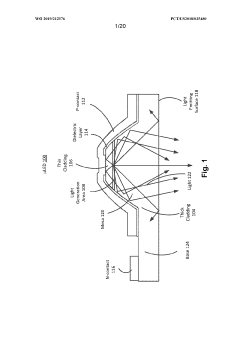
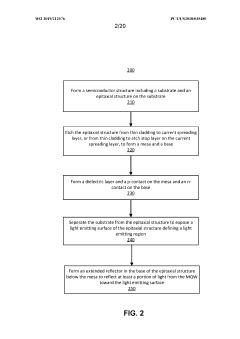
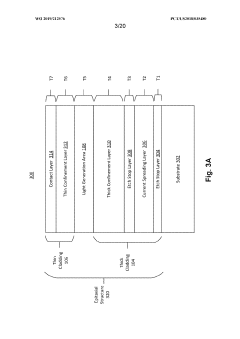
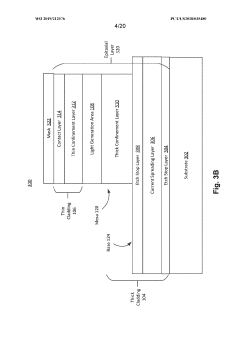
Flexible packaging heat dissipation structure of Mini LED and manufacturing method of flexible packaging heat dissipation structure
PatentInactiveCN112467016A
Innovation
- Design a flexible packaging heat dissipation structure, including a glass substrate, a TFT driver device layer, an organic silicone layer, a first water and oxygen barrier layer, an organic buffer layer and a second water and oxygen barrier layer. The electrode PIN pins of the LED chip pass through these layers. And fill the water and oxygen absorption particles between the electrode PIN pins and connect the heat dissipation columns to achieve effective heat dissipation and water and oxygen blocking.


Reliability Testing Methodologies for High-Vibration Applications
Reliability testing for Mini LED systems in high-vibration environments requires specialized methodologies that accurately simulate real-world conditions while providing quantifiable performance metrics. The primary testing approaches include mechanical vibration testing, thermal cycling under vibration, and accelerated life testing protocols specifically designed for LED technologies.
Mechanical vibration testing typically employs sinusoidal, random, and shock testing procedures following standards such as MIL-STD-810G and JEDEC JESD22-B103B. These tests utilize electrodynamic shakers capable of producing frequencies ranging from 5Hz to 2000Hz with acceleration levels up to 100G, allowing for comprehensive evaluation of Mini LED performance under various vibration profiles. Critical measurements during these tests include luminous flux maintenance, color shift parameters, and electrical connectivity stability.
Thermal cycling combined with vibration represents a crucial testing methodology as it simulates the combined stresses experienced in automotive, aerospace, and industrial applications. Testing chambers capable of temperature ranges from -40°C to +125°C while simultaneously applying vibration forces provide valuable data on thermal-mechanical fatigue effects. The standard test duration typically involves 500-1000 cycles with temperature ramp rates of 10-15°C per minute while maintaining specified vibration profiles.
Advanced optical characterization during vibration testing has emerged as an essential methodology, employing high-speed imaging systems synchronized with vibration equipment. These systems can capture real-time changes in light output, uniformity, and color consistency at microsecond intervals, revealing transient failure modes that might be missed in post-test inspections. Spectroradiometric measurements taken at multiple vibration intensity levels help establish performance degradation curves.
Failure analysis methodologies specific to Mini LED technologies include acoustic microscopy for detecting delamination, X-ray imaging for solder joint integrity assessment, and scanning electron microscopy for analyzing bond wire and die attach failures. These techniques are particularly valuable when applied at intervals throughout extended vibration testing to track progressive degradation mechanisms.
Statistical reliability models derived from these testing methodologies typically employ Weibull distribution analysis and accelerated life testing principles to predict field performance. The development of vibration-specific acceleration factors for Mini LED technologies has advanced significantly, with correlation coefficients between laboratory tests and field data now exceeding 0.85 in well-designed studies.
Industry-specific testing protocols have emerged, with automotive standards such as LV 124 and AEC-Q102 providing specialized vibration profiles for LED components in vehicle applications, while aerospace standards like RTCA DO-160G define more stringent requirements for avionics displays incorporating Mini LED technology.
Mechanical vibration testing typically employs sinusoidal, random, and shock testing procedures following standards such as MIL-STD-810G and JEDEC JESD22-B103B. These tests utilize electrodynamic shakers capable of producing frequencies ranging from 5Hz to 2000Hz with acceleration levels up to 100G, allowing for comprehensive evaluation of Mini LED performance under various vibration profiles. Critical measurements during these tests include luminous flux maintenance, color shift parameters, and electrical connectivity stability.
Thermal cycling combined with vibration represents a crucial testing methodology as it simulates the combined stresses experienced in automotive, aerospace, and industrial applications. Testing chambers capable of temperature ranges from -40°C to +125°C while simultaneously applying vibration forces provide valuable data on thermal-mechanical fatigue effects. The standard test duration typically involves 500-1000 cycles with temperature ramp rates of 10-15°C per minute while maintaining specified vibration profiles.
Advanced optical characterization during vibration testing has emerged as an essential methodology, employing high-speed imaging systems synchronized with vibration equipment. These systems can capture real-time changes in light output, uniformity, and color consistency at microsecond intervals, revealing transient failure modes that might be missed in post-test inspections. Spectroradiometric measurements taken at multiple vibration intensity levels help establish performance degradation curves.
Failure analysis methodologies specific to Mini LED technologies include acoustic microscopy for detecting delamination, X-ray imaging for solder joint integrity assessment, and scanning electron microscopy for analyzing bond wire and die attach failures. These techniques are particularly valuable when applied at intervals throughout extended vibration testing to track progressive degradation mechanisms.
Statistical reliability models derived from these testing methodologies typically employ Weibull distribution analysis and accelerated life testing principles to predict field performance. The development of vibration-specific acceleration factors for Mini LED technologies has advanced significantly, with correlation coefficients between laboratory tests and field data now exceeding 0.85 in well-designed studies.
Industry-specific testing protocols have emerged, with automotive standards such as LV 124 and AEC-Q102 providing specialized vibration profiles for LED components in vehicle applications, while aerospace standards like RTCA DO-160G define more stringent requirements for avionics displays incorporating Mini LED technology.
Thermal Management Considerations in Vibration-Intensive Environments
Thermal management in vibration-intensive environments presents unique challenges for Mini LED technology deployment. The combination of high-frequency vibrations and thermal loads can significantly impact both the immediate performance and long-term reliability of Mini LED systems. Conventional thermal management solutions often prove inadequate when subjected to continuous mechanical stress, necessitating specialized approaches tailored to these demanding conditions.
Vibration-induced thermal complications primarily manifest through three mechanisms: increased thermal resistance at interface boundaries, accelerated thermal cycling, and mechanical fatigue of thermal interface materials (TIMs). Research indicates that vibration frequencies between 20-200 Hz can cause up to 30% degradation in thermal conductivity across standard TIM layers, creating localized hotspots that compromise LED efficiency and lifespan.
Advanced thermal simulation models incorporating vibration parameters reveal that traditional aluminum heat sinks experience resonance issues that exacerbate thermal problems. Composite materials incorporating graphene and carbon nanotubes demonstrate superior vibration damping while maintaining excellent thermal conductivity, with recent studies showing up to 45% improvement in thermal stability under vibration compared to conventional solutions.
Liquid cooling systems, while effective in static environments, require significant modification for vibration resistance. Closed-loop systems with flexible tubing and vibration-isolated pumps have shown promising results in aerospace and automotive applications, maintaining thermal performance with less than 5% degradation under vibration conditions up to 3G RMS.
Phase-change materials (PCMs) represent another innovative approach, offering both thermal buffering and vibration damping properties. Silicon-based PCMs with nanoparticle enhancements have demonstrated particular efficacy in absorbing both thermal and mechanical energy, though their implementation requires careful encapsulation to prevent leakage under sustained vibration.
Thermal interface optimization becomes critical in high-vibration scenarios. Traditional thermal greases exhibit migration and pumping-out effects, while more advanced solutions such as phase-change thermal pads and sintered silver interfaces maintain contact integrity under vibration. Testing protocols developed by industry leaders indicate that silver sintering provides up to 85% better thermal performance retention after 1000 hours of vibration testing compared to conventional thermal compounds.
The integration of active thermal monitoring systems with vibration compensation algorithms represents the cutting edge of thermal management for Mini LEDs in these environments. These systems dynamically adjust cooling parameters based on real-time vibration data, ensuring optimal thermal conditions despite changing mechanical stresses. Implementation costs remain high but are projected to decrease by approximately 40% over the next three years as these technologies mature and manufacturing scales.
Vibration-induced thermal complications primarily manifest through three mechanisms: increased thermal resistance at interface boundaries, accelerated thermal cycling, and mechanical fatigue of thermal interface materials (TIMs). Research indicates that vibration frequencies between 20-200 Hz can cause up to 30% degradation in thermal conductivity across standard TIM layers, creating localized hotspots that compromise LED efficiency and lifespan.
Advanced thermal simulation models incorporating vibration parameters reveal that traditional aluminum heat sinks experience resonance issues that exacerbate thermal problems. Composite materials incorporating graphene and carbon nanotubes demonstrate superior vibration damping while maintaining excellent thermal conductivity, with recent studies showing up to 45% improvement in thermal stability under vibration compared to conventional solutions.
Liquid cooling systems, while effective in static environments, require significant modification for vibration resistance. Closed-loop systems with flexible tubing and vibration-isolated pumps have shown promising results in aerospace and automotive applications, maintaining thermal performance with less than 5% degradation under vibration conditions up to 3G RMS.
Phase-change materials (PCMs) represent another innovative approach, offering both thermal buffering and vibration damping properties. Silicon-based PCMs with nanoparticle enhancements have demonstrated particular efficacy in absorbing both thermal and mechanical energy, though their implementation requires careful encapsulation to prevent leakage under sustained vibration.
Thermal interface optimization becomes critical in high-vibration scenarios. Traditional thermal greases exhibit migration and pumping-out effects, while more advanced solutions such as phase-change thermal pads and sintered silver interfaces maintain contact integrity under vibration. Testing protocols developed by industry leaders indicate that silver sintering provides up to 85% better thermal performance retention after 1000 hours of vibration testing compared to conventional thermal compounds.
The integration of active thermal monitoring systems with vibration compensation algorithms represents the cutting edge of thermal management for Mini LEDs in these environments. These systems dynamically adjust cooling parameters based on real-time vibration data, ensuring optimal thermal conditions despite changing mechanical stresses. Implementation costs remain high but are projected to decrease by approximately 40% over the next three years as these technologies mature and manufacturing scales.
Unlock deeper insights with PatSnap Eureka Quick Research — get a full tech report to explore trends and direct your research. Try now!
Generate Your Research Report Instantly with AI Agent
Supercharge your innovation with PatSnap Eureka AI Agent Platform!