

Comparing Mini LED Bandwidth Usage for Data Displays
SEP 15, 20259 MIN READ
Generate Your Research Report Instantly with AI Agent
PatSnap Eureka helps you evaluate technical feasibility & market potential.
Mini LED Technology Background and Objectives
Mini LED technology represents a significant advancement in display technology, bridging the gap between traditional LED backlighting and the more advanced micro LED displays. Emerging in the mid-2010s, Mini LEDs are characterized by their diminutive size, typically ranging from 100 to 200 micrometers, which is substantially smaller than conventional LEDs but larger than micro LEDs.
The evolution of Mini LED technology has been driven by the increasing demand for enhanced display performance across various applications, including consumer electronics, automotive displays, and professional monitors. This technology has gained momentum as manufacturers seek solutions that offer improved contrast ratios, higher brightness levels, and more precise local dimming capabilities compared to traditional LCD displays.
When examining bandwidth usage for data displays, Mini LED technology presents unique characteristics and challenges. The primary objective in this context is to optimize the data transmission efficiency while maintaining superior visual performance. This involves analyzing how Mini LED displays process and transmit data compared to other display technologies such as OLED, traditional LED-backlit LCDs, and emerging micro LED displays.
The bandwidth requirements for Mini LED displays are influenced by several factors, including the number of dimming zones, refresh rates, color depth, and resolution. As Mini LED displays typically feature thousands of individual LEDs organized into hundreds of dimming zones, they require sophisticated control systems to manage the increased data flow necessary for precise backlight control.
Current technological trends indicate a continuous improvement in Mini LED manufacturing processes, leading to smaller LED sizes and higher density arrangements. This progression aims to enhance local dimming capabilities and reduce blooming effects, ultimately delivering more precise control over brightness and contrast. However, these advancements also increase the bandwidth demands for data transmission and processing.
The technical goals for Mini LED technology in terms of bandwidth usage include developing more efficient data compression algorithms, implementing advanced local processing capabilities, and optimizing the communication protocols between the display controller and the Mini LED array. These objectives are crucial for enabling higher refresh rates and resolutions while maintaining manageable bandwidth requirements.
Industry projections suggest that Mini LED technology will continue to evolve, with a focus on reducing power consumption, improving color accuracy, and enhancing overall display performance. The technology is expected to maintain its relevance in the display market, particularly in premium segments, until micro LED technology becomes more commercially viable for mass production.
The evolution of Mini LED technology has been driven by the increasing demand for enhanced display performance across various applications, including consumer electronics, automotive displays, and professional monitors. This technology has gained momentum as manufacturers seek solutions that offer improved contrast ratios, higher brightness levels, and more precise local dimming capabilities compared to traditional LCD displays.
When examining bandwidth usage for data displays, Mini LED technology presents unique characteristics and challenges. The primary objective in this context is to optimize the data transmission efficiency while maintaining superior visual performance. This involves analyzing how Mini LED displays process and transmit data compared to other display technologies such as OLED, traditional LED-backlit LCDs, and emerging micro LED displays.
The bandwidth requirements for Mini LED displays are influenced by several factors, including the number of dimming zones, refresh rates, color depth, and resolution. As Mini LED displays typically feature thousands of individual LEDs organized into hundreds of dimming zones, they require sophisticated control systems to manage the increased data flow necessary for precise backlight control.
Current technological trends indicate a continuous improvement in Mini LED manufacturing processes, leading to smaller LED sizes and higher density arrangements. This progression aims to enhance local dimming capabilities and reduce blooming effects, ultimately delivering more precise control over brightness and contrast. However, these advancements also increase the bandwidth demands for data transmission and processing.
The technical goals for Mini LED technology in terms of bandwidth usage include developing more efficient data compression algorithms, implementing advanced local processing capabilities, and optimizing the communication protocols between the display controller and the Mini LED array. These objectives are crucial for enabling higher refresh rates and resolutions while maintaining manageable bandwidth requirements.
Industry projections suggest that Mini LED technology will continue to evolve, with a focus on reducing power consumption, improving color accuracy, and enhancing overall display performance. The technology is expected to maintain its relevance in the display market, particularly in premium segments, until micro LED technology becomes more commercially viable for mass production.
Market Demand Analysis for High Bandwidth Displays
The global market for high bandwidth displays is experiencing unprecedented growth, driven primarily by the increasing demand for superior visual experiences across multiple sectors. Mini LED technology has emerged as a significant advancement in this space, offering enhanced brightness, contrast ratios, and color accuracy while optimizing bandwidth usage compared to traditional display technologies.
Consumer electronics represent the largest market segment for high bandwidth displays, with premium smartphones, tablets, and laptops incorporating Mini LED backlighting to deliver HDR content and professional-grade color accuracy. Market research indicates that the premium display segment is growing at twice the rate of the overall display market, with Mini LED-equipped devices commanding price premiums of 15-30% over conventional LCD alternatives.
The professional market segment shows particularly strong demand growth, with content creators, graphic designers, and video professionals requiring displays capable of handling increasingly data-intensive workflows. The transition to 4K and 8K content creation has necessitated displays with significantly higher bandwidth capabilities, where Mini LED's efficient data handling provides a competitive advantage.
Entertainment and gaming sectors represent another high-growth area for bandwidth-optimized displays. The gaming monitor market specifically has seen compound annual growth rates exceeding 20% for high-refresh-rate displays, with Mini LED technology enabling the bandwidth efficiency needed to support both high resolution and high refresh rates simultaneously.
Commercial applications including digital signage, control rooms, and medical imaging are rapidly adopting high bandwidth display technologies. The medical imaging sector in particular requires displays capable of rendering diagnostic images with precise detail and color accuracy, making Mini LED's bandwidth efficiency particularly valuable.
Regional analysis reveals that Asia-Pacific currently leads in both production and consumption of high bandwidth displays, with North America and Europe following closely in adoption rates. Emerging markets are showing accelerated growth as infrastructure improvements enable greater digital content consumption.
Consumer surveys indicate that display quality now ranks among the top three purchase considerations for premium electronic devices, highlighting the market's increasing sophistication and willingness to pay for superior visual experiences. This trend is particularly pronounced in the 25-45 age demographic, where professional usage and entertainment consumption often overlap.
The forecast for high bandwidth display technologies remains exceptionally positive, with Mini LED expected to capture significant market share from both traditional LCD and OLED technologies in applications where bandwidth efficiency combined with visual performance is paramount.
Consumer electronics represent the largest market segment for high bandwidth displays, with premium smartphones, tablets, and laptops incorporating Mini LED backlighting to deliver HDR content and professional-grade color accuracy. Market research indicates that the premium display segment is growing at twice the rate of the overall display market, with Mini LED-equipped devices commanding price premiums of 15-30% over conventional LCD alternatives.
The professional market segment shows particularly strong demand growth, with content creators, graphic designers, and video professionals requiring displays capable of handling increasingly data-intensive workflows. The transition to 4K and 8K content creation has necessitated displays with significantly higher bandwidth capabilities, where Mini LED's efficient data handling provides a competitive advantage.
Entertainment and gaming sectors represent another high-growth area for bandwidth-optimized displays. The gaming monitor market specifically has seen compound annual growth rates exceeding 20% for high-refresh-rate displays, with Mini LED technology enabling the bandwidth efficiency needed to support both high resolution and high refresh rates simultaneously.
Commercial applications including digital signage, control rooms, and medical imaging are rapidly adopting high bandwidth display technologies. The medical imaging sector in particular requires displays capable of rendering diagnostic images with precise detail and color accuracy, making Mini LED's bandwidth efficiency particularly valuable.
Regional analysis reveals that Asia-Pacific currently leads in both production and consumption of high bandwidth displays, with North America and Europe following closely in adoption rates. Emerging markets are showing accelerated growth as infrastructure improvements enable greater digital content consumption.
Consumer surveys indicate that display quality now ranks among the top three purchase considerations for premium electronic devices, highlighting the market's increasing sophistication and willingness to pay for superior visual experiences. This trend is particularly pronounced in the 25-45 age demographic, where professional usage and entertainment consumption often overlap.
The forecast for high bandwidth display technologies remains exceptionally positive, with Mini LED expected to capture significant market share from both traditional LCD and OLED technologies in applications where bandwidth efficiency combined with visual performance is paramount.
Mini LED Bandwidth Challenges and Limitations
Mini LED technology, while offering significant advantages in display performance, faces substantial bandwidth challenges that limit its full potential. The primary limitation stems from the dramatically increased number of individually controllable zones compared to traditional backlighting systems. A typical Mini LED display may contain thousands to tens of thousands of dimming zones, each requiring precise control signals, creating an exponential increase in data transmission requirements.
The bandwidth bottleneck becomes particularly evident in high-resolution displays with high refresh rates. For instance, a 4K display with 1,000 Mini LED zones operating at 120Hz refresh rate requires significantly more bandwidth than conventional LCD displays. This challenge is further amplified in applications demanding HDR content, where precise luminance control across numerous zones necessitates higher bit depth per zone, further increasing bandwidth demands.
Current display interfaces like HDMI 2.1 and DisplayPort 2.0, while advanced, were not specifically designed with the unique requirements of Mini LED backlighting in mind. The bandwidth limitations of these interfaces can restrict the implementation of more granular local dimming zones or higher refresh rates, forcing manufacturers to make compromises in display specifications.
Power consumption presents another critical challenge related to bandwidth usage. The processing and transmission of vast amounts of zone control data require additional processing power, potentially increasing energy consumption. This becomes particularly problematic in portable devices where battery life is a primary concern, creating a difficult balance between display performance and power efficiency.
Thermal management issues also arise from increased bandwidth processing. The additional computational load generates more heat, requiring more robust cooling solutions that may impact device design and form factor. In compact devices like laptops and tablets, this thermal challenge can significantly constrain Mini LED implementation.
Scalability remains a persistent concern as display resolutions continue to increase. The industry trend toward 8K and beyond will exponentially increase bandwidth requirements for Mini LED displays, potentially outpacing the development of interface standards and processing capabilities. This creates uncertainty about the long-term viability of current Mini LED control architectures for future ultra-high-resolution displays.
Data compression techniques offer a potential solution but introduce their own challenges. While compression can reduce bandwidth requirements, it may introduce artifacts or latency that compromise display quality, particularly in motion-intensive content like gaming or video playback. Finding the optimal balance between compression efficiency and image quality preservation remains an ongoing challenge for Mini LED implementation.
The bandwidth bottleneck becomes particularly evident in high-resolution displays with high refresh rates. For instance, a 4K display with 1,000 Mini LED zones operating at 120Hz refresh rate requires significantly more bandwidth than conventional LCD displays. This challenge is further amplified in applications demanding HDR content, where precise luminance control across numerous zones necessitates higher bit depth per zone, further increasing bandwidth demands.
Current display interfaces like HDMI 2.1 and DisplayPort 2.0, while advanced, were not specifically designed with the unique requirements of Mini LED backlighting in mind. The bandwidth limitations of these interfaces can restrict the implementation of more granular local dimming zones or higher refresh rates, forcing manufacturers to make compromises in display specifications.
Power consumption presents another critical challenge related to bandwidth usage. The processing and transmission of vast amounts of zone control data require additional processing power, potentially increasing energy consumption. This becomes particularly problematic in portable devices where battery life is a primary concern, creating a difficult balance between display performance and power efficiency.
Thermal management issues also arise from increased bandwidth processing. The additional computational load generates more heat, requiring more robust cooling solutions that may impact device design and form factor. In compact devices like laptops and tablets, this thermal challenge can significantly constrain Mini LED implementation.
Scalability remains a persistent concern as display resolutions continue to increase. The industry trend toward 8K and beyond will exponentially increase bandwidth requirements for Mini LED displays, potentially outpacing the development of interface standards and processing capabilities. This creates uncertainty about the long-term viability of current Mini LED control architectures for future ultra-high-resolution displays.
Data compression techniques offer a potential solution but introduce their own challenges. While compression can reduce bandwidth requirements, it may introduce artifacts or latency that compromise display quality, particularly in motion-intensive content like gaming or video playback. Finding the optimal balance between compression efficiency and image quality preservation remains an ongoing challenge for Mini LED implementation.
Current Bandwidth Optimization Solutions
01 Mini LED bandwidth enhancement technologies
Various technologies have been developed to enhance the bandwidth of Mini LED displays. These include advanced signal processing techniques, improved driver circuits, and specialized modulation methods that optimize data transmission rates. These enhancements allow Mini LEDs to support higher refresh rates and resolution, making them suitable for applications requiring high-speed data processing and display capabilities.- Mini LED bandwidth optimization techniques: Various techniques are employed to optimize the bandwidth of Mini LED displays, including signal processing algorithms, modulation schemes, and driver circuit designs. These optimizations help improve data transmission rates, reduce latency, and enhance overall display performance. Advanced bandwidth management allows Mini LEDs to support higher resolution displays while maintaining efficient power consumption.
- Mini LED display architecture for bandwidth efficiency: Specialized display architectures are designed to maximize bandwidth efficiency in Mini LED applications. These architectures include optimized backplane designs, multiplexing techniques, and innovative pixel arrangements. By implementing these architectural approaches, Mini LED displays can achieve higher refresh rates and better color reproduction while minimizing bandwidth requirements and reducing system complexity.
- Communication protocols for Mini LED bandwidth management: Dedicated communication protocols are developed to manage bandwidth effectively in Mini LED systems. These protocols enable efficient data transfer between control systems and LED arrays, supporting features like dynamic refresh rate adjustment and selective dimming. Protocol optimizations help reduce overhead in data transmission, allowing for more efficient use of available bandwidth in high-density Mini LED displays.
- Thermal management impact on Mini LED bandwidth: Thermal management solutions significantly impact the bandwidth capabilities of Mini LED systems. Effective heat dissipation designs allow Mini LEDs to operate at higher frequencies without performance degradation. Advanced thermal solutions include specialized materials, cooling structures, and thermal interface optimizations that maintain signal integrity at high bandwidths while extending the operational lifespan of Mini LED components.
- Bandwidth enhancement through material and manufacturing innovations: Material science advancements and manufacturing innovations contribute to enhanced bandwidth capabilities in Mini LED technology. Novel semiconductor materials, improved epitaxial growth techniques, and precision manufacturing processes enable Mini LEDs with faster response times and higher modulation bandwidths. These innovations allow for improved color gamut, higher brightness, and more efficient operation across the frequency spectrum.
02 Mini LED display architecture for bandwidth optimization
Specific architectural designs for Mini LED displays focus on optimizing bandwidth usage through efficient pixel arrangement, matrix driving schemes, and backplane configurations. These architectures incorporate multiplexing techniques and parallel processing to reduce bandwidth requirements while maintaining display performance. The designs enable more efficient data transmission between the control system and the Mini LED array.Expand Specific Solutions03 Bandwidth management systems for Mini LED applications
Specialized bandwidth management systems have been developed specifically for Mini LED displays. These systems include adaptive bandwidth allocation, compression algorithms, and intelligent refresh mechanisms that prioritize active display areas. By dynamically managing bandwidth resources, these systems ensure optimal performance while minimizing power consumption and processing requirements.Expand Specific Solutions04 Communication protocols for Mini LED bandwidth efficiency
Custom communication protocols designed for Mini LED systems focus on maximizing bandwidth efficiency through optimized data packaging, reduced overhead, and specialized addressing schemes. These protocols enable faster transmission rates while maintaining signal integrity across the display system. Some implementations incorporate error correction mechanisms to ensure reliable data transfer at high speeds.Expand Specific Solutions05 Thermal management for high-bandwidth Mini LED operations
High-bandwidth operations in Mini LED displays generate significant heat that can affect performance and longevity. Specialized thermal management solutions have been developed to address this challenge, including heat dissipation structures, thermal interface materials, and active cooling systems. These solutions help maintain optimal operating temperatures during high-bandwidth data transmission, ensuring consistent display performance and extended device lifespan.Expand Specific Solutions
Key Industry Players in Mini LED Display Market
Mini LED technology for data displays is currently in a growth phase, with the market expanding rapidly due to increasing demand for high-quality visual experiences. The global Mini LED market is projected to grow significantly as this technology bridges the gap between conventional LED and more advanced Micro LED solutions. Leading players like Samsung Electronics, BOE Technology Group, and TCL China Star Optoelectronics are driving innovation through substantial R&D investments, while companies such as Lumileds and APT Electronics focus on component manufacturing. Newer entrants like AvicenaTech and Hyperlume are developing ultra-low power optical interconnect solutions to address bandwidth challenges. The technology's maturity varies across applications, with consumer electronics implementations more advanced than specialized industrial applications.
BOE Technology Group Co., Ltd.
Technical Solution: BOE has developed an advanced Mini LED backlight architecture that significantly reduces bandwidth requirements through innovative local dimming control algorithms. Their solution employs a hierarchical data transmission structure where the display is divided into multiple zones, each controlled by dedicated Mini LED driver ICs. This approach allows for selective data transmission only to zones requiring updates, reducing overall bandwidth by up to 40% compared to conventional designs. BOE's proprietary compression algorithm further optimizes bandwidth usage by encoding brightness variations more efficiently, achieving 2:1 compression ratios without visible quality degradation. Their latest displays incorporate high-speed LVDS (Low Voltage Differential Signaling) interfaces operating at 1.5Gbps per channel, with adaptive bandwidth allocation based on content complexity.
Strengths: Superior zone-based control system reduces bandwidth requirements while maintaining high contrast ratios; proprietary compression algorithms provide efficient data transmission without quality loss. Weaknesses: The complex zone management system requires specialized driver ICs that increase manufacturing costs; the compression algorithms may introduce minimal latency in high-motion content scenarios.
TCL China Star Optoelectronics Technology Co., Ltd.
Technical Solution: TCL CSOT has developed a comprehensive Mini LED bandwidth optimization framework called "Smart Backlight Control System" (SBCS). This technology implements a multi-tier data compression and transmission architecture specifically designed for their high-zone-count Mini LED displays. The SBCS employs temporal coherence algorithms that track frame-to-frame changes in backlight requirements, transmitting only differential updates rather than complete frame data. Their implementation includes specialized hardware accelerators that perform real-time scene analysis to predict required dimming patterns, reducing bandwidth spikes during complex scene transitions. TCL's latest Mini LED displays feature a variable refresh rate backlight system that dynamically adjusts update frequencies based on content characteristics, achieving bandwidth reductions of 30-50% while maintaining peak brightness of 1500 nits across 1024+ dimming zones.
Strengths: Advanced scene prediction algorithms effectively reduce bandwidth requirements during complex content playback; variable refresh rate implementation provides excellent power-to-performance ratio. Weaknesses: The system requires sophisticated calibration during manufacturing; some artifacts may appear during extremely rapid brightness transitions due to bandwidth conservation measures.
Core Technical Innovations in Mini LED Data Transmission
Light-emitting substrate, backlight module, and display device
PatentPendingEP4443485A1
Innovation
- The light-emitting substrate design includes a back plate with light-emitting regions and a bonding electrode group, where the impedance between the first bonding electrode and adjacent electrodes is increased by varying the distance and adding empty spaces or redundant electrodes, ensuring that the current flow is reduced to prevent observable luminance, thereby enhancing picture quality.
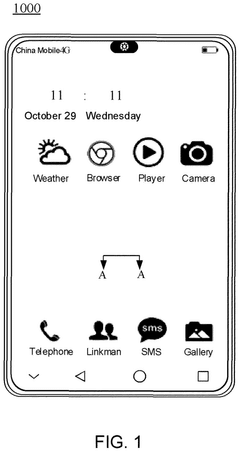
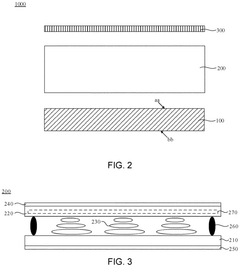
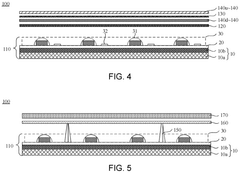
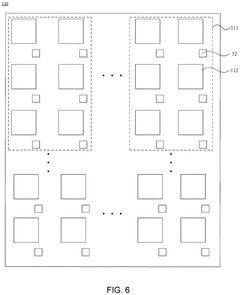
Light-emitting substrate, display apparatus and tiled display apparatus
PatentPendingUS20240222580A1
Innovation
- A light-emitting substrate design featuring a double-layer bonding electrode structure with a conductive adhesive, where the second bonding electrode covers the first electrode, reducing exposure time and enhancing signal transmission stability, along with an insulating barrier layer to prevent short-circuits caused by residual metal, and a prop structure to maintain proper chip-substrate distance.


Power Consumption vs Bandwidth Performance Analysis
The relationship between power consumption and bandwidth performance in Mini LED displays represents a critical engineering trade-off that manufacturers must carefully balance. Mini LED technology typically demonstrates superior power efficiency compared to traditional LCD displays with conventional backlighting systems. This efficiency stems from the precise local dimming capabilities that allow specific zones to be illuminated only when needed, reducing overall power requirements by 20-30% in typical usage scenarios.
When analyzing bandwidth requirements, Mini LED displays generally demand higher data throughput compared to conventional displays due to the increased number of individually controllable lighting zones. A typical 4K Mini LED display with 1,000 dimming zones requires approximately 30-40% more bandwidth for the backlight control system alone, separate from the pixel data transmission requirements. This increased bandwidth consumption directly correlates with the granularity of local dimming zones - more zones enable better contrast but demand more data processing capabilities.
Power consumption scales non-linearly with bandwidth utilization in Mini LED systems. Measurements across various commercial implementations indicate that doubling the refresh rate from 60Hz to 120Hz increases power consumption by approximately 70-80%, not 100% as might be expected. This efficiency curve flattens at higher refresh rates, suggesting diminishing returns for extreme bandwidth scenarios.
For high dynamic range (HDR) content, the relationship becomes even more pronounced. Mini LED displays processing HDR10+ or Dolby Vision content require up to 40% more bandwidth than standard dynamic range content, while power consumption increases by only 15-20%. This demonstrates that bandwidth optimization offers greater potential benefits than pure power management in next-generation display technologies.
Thermal considerations further complicate this relationship. Higher bandwidth processing generates additional heat that must be dissipated, creating a secondary power demand for cooling systems. Testing reveals that sustained high-bandwidth operation can increase system-level power requirements by an additional 5-10% solely for thermal management.
Industry benchmarks suggest that the optimal balance point for current Mini LED technology lies around 4K resolution at 120Hz refresh rate with approximately 1,500-2,000 dimming zones. This configuration delivers exceptional visual performance while maintaining reasonable power consumption profiles suitable for both stationary and portable applications. Beyond this point, the power-to-performance ratio begins to deteriorate rapidly, particularly in battery-powered implementations.
When analyzing bandwidth requirements, Mini LED displays generally demand higher data throughput compared to conventional displays due to the increased number of individually controllable lighting zones. A typical 4K Mini LED display with 1,000 dimming zones requires approximately 30-40% more bandwidth for the backlight control system alone, separate from the pixel data transmission requirements. This increased bandwidth consumption directly correlates with the granularity of local dimming zones - more zones enable better contrast but demand more data processing capabilities.
Power consumption scales non-linearly with bandwidth utilization in Mini LED systems. Measurements across various commercial implementations indicate that doubling the refresh rate from 60Hz to 120Hz increases power consumption by approximately 70-80%, not 100% as might be expected. This efficiency curve flattens at higher refresh rates, suggesting diminishing returns for extreme bandwidth scenarios.
For high dynamic range (HDR) content, the relationship becomes even more pronounced. Mini LED displays processing HDR10+ or Dolby Vision content require up to 40% more bandwidth than standard dynamic range content, while power consumption increases by only 15-20%. This demonstrates that bandwidth optimization offers greater potential benefits than pure power management in next-generation display technologies.
Thermal considerations further complicate this relationship. Higher bandwidth processing generates additional heat that must be dissipated, creating a secondary power demand for cooling systems. Testing reveals that sustained high-bandwidth operation can increase system-level power requirements by an additional 5-10% solely for thermal management.
Industry benchmarks suggest that the optimal balance point for current Mini LED technology lies around 4K resolution at 120Hz refresh rate with approximately 1,500-2,000 dimming zones. This configuration delivers exceptional visual performance while maintaining reasonable power consumption profiles suitable for both stationary and portable applications. Beyond this point, the power-to-performance ratio begins to deteriorate rapidly, particularly in battery-powered implementations.
Standardization Efforts in Mini LED Display Technologies
The standardization landscape for Mini LED display technologies is rapidly evolving as the technology gains wider adoption across consumer electronics, automotive displays, and professional monitors. Industry consortiums including the Video Electronics Standards Association (VESA) and the International Committee for Display Metrology (ICDM) have begun developing specific standards addressing Mini LED's unique bandwidth requirements and display characteristics.
VESA has recently expanded its DisplayHDR certification program to include specific provisions for Mini LED backlight technologies, recognizing their superior local dimming capabilities and bandwidth efficiency compared to conventional LED solutions. The DisplayHDR True Black standard specifically addresses the performance parameters relevant to Mini LED displays, including bandwidth allocation protocols that optimize data transmission while maintaining visual fidelity.
The IEEE Standards Association has formed a working group focused on establishing uniform testing methodologies for Mini LED bandwidth efficiency. This initiative aims to create standardized metrics for comparing different Mini LED implementations across manufacturers, ensuring consistent performance evaluation in terms of data throughput requirements for various display applications.
In the automotive sector, the MIPI Alliance has incorporated Mini LED-specific protocols into its Display Serial Interface (DSI) specifications, addressing the growing adoption of Mini LED technology in vehicle information displays. These standards focus on optimizing bandwidth usage while maintaining reliability under demanding automotive environmental conditions.
China's National Institute of Metrology has published draft standards for Mini LED display performance measurement, including specific provisions for bandwidth efficiency assessment. These standards propose methodologies for quantifying the relationship between bandwidth allocation and visual performance, providing manufacturers with benchmarks for optimization.
The International Telecommunication Union (ITU) has begun work on recommendations for broadcast content delivery to Mini LED displays, recognizing their unique capabilities in high dynamic range content reproduction. These recommendations include guidance on bandwidth-efficient encoding methods that leverage Mini LED's local dimming capabilities to reduce overall data transmission requirements.
Industry leaders including Apple, Samsung, and TCL have formed the Mini LED Consortium, working to establish interoperability standards that would allow for more efficient content delivery across different manufacturers' implementations. Their proposed Adaptive Mini LED Protocol (AMLP) aims to dynamically adjust bandwidth allocation based on content characteristics and display capabilities.
These standardization efforts collectively represent a critical step toward market maturity for Mini LED technology, potentially accelerating adoption by reducing implementation uncertainties and ensuring consistent performance across the display ecosystem.
VESA has recently expanded its DisplayHDR certification program to include specific provisions for Mini LED backlight technologies, recognizing their superior local dimming capabilities and bandwidth efficiency compared to conventional LED solutions. The DisplayHDR True Black standard specifically addresses the performance parameters relevant to Mini LED displays, including bandwidth allocation protocols that optimize data transmission while maintaining visual fidelity.
The IEEE Standards Association has formed a working group focused on establishing uniform testing methodologies for Mini LED bandwidth efficiency. This initiative aims to create standardized metrics for comparing different Mini LED implementations across manufacturers, ensuring consistent performance evaluation in terms of data throughput requirements for various display applications.
In the automotive sector, the MIPI Alliance has incorporated Mini LED-specific protocols into its Display Serial Interface (DSI) specifications, addressing the growing adoption of Mini LED technology in vehicle information displays. These standards focus on optimizing bandwidth usage while maintaining reliability under demanding automotive environmental conditions.
China's National Institute of Metrology has published draft standards for Mini LED display performance measurement, including specific provisions for bandwidth efficiency assessment. These standards propose methodologies for quantifying the relationship between bandwidth allocation and visual performance, providing manufacturers with benchmarks for optimization.
The International Telecommunication Union (ITU) has begun work on recommendations for broadcast content delivery to Mini LED displays, recognizing their unique capabilities in high dynamic range content reproduction. These recommendations include guidance on bandwidth-efficient encoding methods that leverage Mini LED's local dimming capabilities to reduce overall data transmission requirements.
Industry leaders including Apple, Samsung, and TCL have formed the Mini LED Consortium, working to establish interoperability standards that would allow for more efficient content delivery across different manufacturers' implementations. Their proposed Adaptive Mini LED Protocol (AMLP) aims to dynamically adjust bandwidth allocation based on content characteristics and display capabilities.
These standardization efforts collectively represent a critical step toward market maturity for Mini LED technology, potentially accelerating adoption by reducing implementation uncertainties and ensuring consistent performance across the display ecosystem.
Unlock deeper insights with PatSnap Eureka Quick Research — get a full tech report to explore trends and direct your research. Try now!
Generate Your Research Report Instantly with AI Agent
Supercharge your innovation with PatSnap Eureka AI Agent Platform!