Directed Energy Deposition Technologies: Navigating Compliance Needs
OCT 10, 20259 MIN READ
Generate Your Research Report Instantly with AI Agent
PatSnap Eureka helps you evaluate technical feasibility & market potential.
DED Technology Evolution and Objectives
Directed Energy Deposition (DED) emerged in the late 1990s as an additive manufacturing technology capable of producing near-net-shape metal components. Initially developed for repair applications in aerospace and defense sectors, DED has evolved significantly over the past two decades, transitioning from experimental prototyping to industrial production capabilities. The technology's evolution has been characterized by continuous improvements in process control, material compatibility, and build precision.
The fundamental principle of DED involves focusing thermal energy to melt materials as they are deposited. Early systems utilized laser power sources with limited control mechanisms, resulting in inconsistent material properties and dimensional accuracy. Modern DED systems incorporate sophisticated multi-axis motion systems, closed-loop feedback controls, and advanced thermal management, enabling the production of components with superior mechanical properties and reduced post-processing requirements.
A significant milestone in DED evolution was the development of multi-material deposition capabilities around 2010, allowing for functionally graded materials and novel alloy combinations previously unachievable through conventional manufacturing methods. This advancement expanded DED applications into high-value sectors including medical implants, high-performance tooling, and custom aerospace components.
The current technological trajectory focuses on addressing several key objectives: enhancing deposition rates while maintaining precision, expanding the range of compatible materials, improving surface finish to reduce post-processing requirements, and developing robust in-situ monitoring systems for quality assurance. These objectives align with industry demands for more efficient, flexible, and reliable manufacturing processes.
Compliance considerations have become increasingly central to DED technology development. As applications expand into regulated industries such as aerospace, medical, and nuclear, DED systems must meet stringent quality standards and certification requirements. This has driven the development of process monitoring technologies that provide comprehensive documentation of build parameters and material properties, enabling traceability and verification essential for regulatory approval.
Looking forward, DED technology objectives include achieving closed-loop control systems capable of real-time defect detection and correction, standardization of process parameters across different machine platforms, and integration with hybrid manufacturing systems combining additive and subtractive processes. These advancements aim to position DED as a mature manufacturing technology capable of meeting diverse industrial requirements while navigating increasingly complex compliance landscapes.
The fundamental principle of DED involves focusing thermal energy to melt materials as they are deposited. Early systems utilized laser power sources with limited control mechanisms, resulting in inconsistent material properties and dimensional accuracy. Modern DED systems incorporate sophisticated multi-axis motion systems, closed-loop feedback controls, and advanced thermal management, enabling the production of components with superior mechanical properties and reduced post-processing requirements.
A significant milestone in DED evolution was the development of multi-material deposition capabilities around 2010, allowing for functionally graded materials and novel alloy combinations previously unachievable through conventional manufacturing methods. This advancement expanded DED applications into high-value sectors including medical implants, high-performance tooling, and custom aerospace components.
The current technological trajectory focuses on addressing several key objectives: enhancing deposition rates while maintaining precision, expanding the range of compatible materials, improving surface finish to reduce post-processing requirements, and developing robust in-situ monitoring systems for quality assurance. These objectives align with industry demands for more efficient, flexible, and reliable manufacturing processes.
Compliance considerations have become increasingly central to DED technology development. As applications expand into regulated industries such as aerospace, medical, and nuclear, DED systems must meet stringent quality standards and certification requirements. This has driven the development of process monitoring technologies that provide comprehensive documentation of build parameters and material properties, enabling traceability and verification essential for regulatory approval.
Looking forward, DED technology objectives include achieving closed-loop control systems capable of real-time defect detection and correction, standardization of process parameters across different machine platforms, and integration with hybrid manufacturing systems combining additive and subtractive processes. These advancements aim to position DED as a mature manufacturing technology capable of meeting diverse industrial requirements while navigating increasingly complex compliance landscapes.
Market Applications and Growth Potential
The Directed Energy Deposition (DED) market is experiencing significant growth across multiple industrial sectors, driven by its unique capabilities in additive manufacturing. The aerospace industry represents one of the largest application areas, where DED technologies enable the production of complex components with superior mechanical properties and reduced material waste. Major aerospace manufacturers are increasingly adopting DED for fabricating turbine blades, structural components, and repair applications, with the market in this sector projected to grow at a compound annual rate exceeding 15% through 2028.
The medical device industry has emerged as another promising application area for DED technologies. The ability to create patient-specific implants with biocompatible materials has revolutionized personalized healthcare solutions. Titanium-based medical implants produced via DED processes demonstrate excellent osseointegration properties while allowing for complex geometries that traditional manufacturing methods cannot achieve. This segment is expected to witness accelerated adoption as regulatory frameworks for additive manufacturing in healthcare continue to mature.
In the automotive sector, DED technologies are gaining traction for both prototyping and production applications. The technology enables rapid tooling development and the manufacturing of lightweight components that contribute to improved fuel efficiency. Several leading automotive manufacturers have established dedicated additive manufacturing facilities incorporating DED systems, signaling strong industry confidence in this technology's potential.
The energy sector presents substantial growth opportunities for DED technologies, particularly in oil and gas, power generation, and renewable energy applications. The ability to repair high-value components in-situ rather than replacing them entirely offers compelling economic advantages. DED-based repair solutions for turbine components, drill bits, and pressure vessels have demonstrated cost savings of up to 70% compared to replacement costs.
Regional market analysis indicates that North America currently holds the largest market share for DED technologies, followed by Europe and Asia-Pacific. However, the Asia-Pacific region is expected to witness the highest growth rate over the next five years, driven by substantial investments in advanced manufacturing capabilities in China, Japan, and South Korea.
The global DED market size was valued at approximately $500 million in 2022 and is projected to reach $1.2 billion by 2027. This growth trajectory is supported by increasing industrial adoption, technological advancements improving deposition precision and material compatibility, and the development of hybrid systems that combine DED with traditional machining capabilities.
The medical device industry has emerged as another promising application area for DED technologies. The ability to create patient-specific implants with biocompatible materials has revolutionized personalized healthcare solutions. Titanium-based medical implants produced via DED processes demonstrate excellent osseointegration properties while allowing for complex geometries that traditional manufacturing methods cannot achieve. This segment is expected to witness accelerated adoption as regulatory frameworks for additive manufacturing in healthcare continue to mature.
In the automotive sector, DED technologies are gaining traction for both prototyping and production applications. The technology enables rapid tooling development and the manufacturing of lightweight components that contribute to improved fuel efficiency. Several leading automotive manufacturers have established dedicated additive manufacturing facilities incorporating DED systems, signaling strong industry confidence in this technology's potential.
The energy sector presents substantial growth opportunities for DED technologies, particularly in oil and gas, power generation, and renewable energy applications. The ability to repair high-value components in-situ rather than replacing them entirely offers compelling economic advantages. DED-based repair solutions for turbine components, drill bits, and pressure vessels have demonstrated cost savings of up to 70% compared to replacement costs.
Regional market analysis indicates that North America currently holds the largest market share for DED technologies, followed by Europe and Asia-Pacific. However, the Asia-Pacific region is expected to witness the highest growth rate over the next five years, driven by substantial investments in advanced manufacturing capabilities in China, Japan, and South Korea.
The global DED market size was valued at approximately $500 million in 2022 and is projected to reach $1.2 billion by 2027. This growth trajectory is supported by increasing industrial adoption, technological advancements improving deposition precision and material compatibility, and the development of hybrid systems that combine DED with traditional machining capabilities.
Global DED Development Status and Barriers
Directed Energy Deposition (DED) technology has experienced significant global development in recent years, with varying levels of adoption and advancement across different regions. North America, particularly the United States, leads in DED research and implementation, with substantial investments from both government agencies like NASA and DARPA, and private aerospace and defense companies. The region's strong focus on qualification standards and process control has established benchmark practices for the industry.
Europe follows closely, with countries like Germany, the UK, and France demonstrating considerable progress in DED technology development. The European approach emphasizes precision engineering and integration with traditional manufacturing processes, resulting in hybrid systems that combine DED with conventional machining. The European Commission has funded numerous research initiatives through programs like Horizon Europe to accelerate DED adoption.
The Asia-Pacific region, led by China, Japan, and South Korea, has shown rapid growth in DED technology adoption. China, in particular, has made strategic investments in metal additive manufacturing as part of its "Made in China 2025" initiative, resulting in a surge of patent filings and research publications related to DED technologies.
Despite global progress, several significant barriers impede wider DED technology adoption. Technical challenges remain prominent, including inconsistent material properties, build quality variability, and limited process repeatability. The complex thermal dynamics during deposition often lead to residual stresses and distortion in fabricated parts, requiring sophisticated monitoring and control systems that are still evolving.
Standardization represents another major hurdle. The lack of universally accepted standards for DED processes, materials, and quality assurance protocols creates uncertainty for potential adopters. Organizations like ASTM International and ISO are working to develop comprehensive standards, but the process is time-consuming due to the technology's complexity and rapid evolution.
Economic barriers also persist, with high equipment costs and operational expenses limiting adoption to large enterprises and specialized applications. The return on investment remains challenging to quantify for many potential users, particularly in industries with established manufacturing processes.
Workforce development presents another significant challenge, as DED technologies require specialized knowledge spanning materials science, mechanical engineering, and computer programming. The shortage of qualified personnel capable of operating and optimizing DED systems restricts implementation, especially in regions with limited access to advanced technical education.
Regulatory compliance varies significantly across jurisdictions, creating additional complexity for global companies seeking to implement DED technologies across multiple facilities. Environmental and safety regulations regarding metal powders, laser operations, and waste management differ substantially between regions, necessitating customized compliance strategies.
Europe follows closely, with countries like Germany, the UK, and France demonstrating considerable progress in DED technology development. The European approach emphasizes precision engineering and integration with traditional manufacturing processes, resulting in hybrid systems that combine DED with conventional machining. The European Commission has funded numerous research initiatives through programs like Horizon Europe to accelerate DED adoption.
The Asia-Pacific region, led by China, Japan, and South Korea, has shown rapid growth in DED technology adoption. China, in particular, has made strategic investments in metal additive manufacturing as part of its "Made in China 2025" initiative, resulting in a surge of patent filings and research publications related to DED technologies.
Despite global progress, several significant barriers impede wider DED technology adoption. Technical challenges remain prominent, including inconsistent material properties, build quality variability, and limited process repeatability. The complex thermal dynamics during deposition often lead to residual stresses and distortion in fabricated parts, requiring sophisticated monitoring and control systems that are still evolving.
Standardization represents another major hurdle. The lack of universally accepted standards for DED processes, materials, and quality assurance protocols creates uncertainty for potential adopters. Organizations like ASTM International and ISO are working to develop comprehensive standards, but the process is time-consuming due to the technology's complexity and rapid evolution.
Economic barriers also persist, with high equipment costs and operational expenses limiting adoption to large enterprises and specialized applications. The return on investment remains challenging to quantify for many potential users, particularly in industries with established manufacturing processes.
Workforce development presents another significant challenge, as DED technologies require specialized knowledge spanning materials science, mechanical engineering, and computer programming. The shortage of qualified personnel capable of operating and optimizing DED systems restricts implementation, especially in regions with limited access to advanced technical education.
Regulatory compliance varies significantly across jurisdictions, creating additional complexity for global companies seeking to implement DED technologies across multiple facilities. Environmental and safety regulations regarding metal powders, laser operations, and waste management differ substantially between regions, necessitating customized compliance strategies.
Current DED Process Solutions and Parameters
01 Regulatory compliance frameworks for DED technologies
Directed Energy Deposition (DED) technologies must adhere to specific regulatory frameworks to ensure safety and quality standards. These frameworks include compliance with industry standards, certification requirements, and quality management systems. Companies implementing DED technologies need to establish proper documentation and verification processes to demonstrate compliance with relevant regulations, which may vary across different jurisdictions and applications.- Regulatory compliance frameworks for DED technologies: Directed Energy Deposition technologies must adhere to specific regulatory frameworks that govern their implementation and operation. These frameworks include safety standards, quality control measures, and certification requirements that ensure the technologies meet industry and governmental regulations. Compliance systems often involve documentation processes, regular audits, and validation protocols to maintain operational approval and legal standing.
- Material qualification and process validation for DED compliance: Material qualification and process validation are critical aspects of DED technology compliance. This involves testing and certifying that materials used in the deposition process meet specified requirements and that the manufacturing processes consistently produce components that conform to predetermined quality standards. Validation protocols include material characterization, process parameter optimization, and performance testing to ensure compliance with industry specifications.
- Quality assurance systems for DED manufacturing: Quality assurance systems for Directed Energy Deposition manufacturing involve comprehensive monitoring and control mechanisms to ensure consistent product quality. These systems include in-process monitoring, non-destructive testing, and statistical process control methods that help maintain compliance with quality standards. Advanced sensor technologies and data analytics are employed to detect defects and process variations in real-time, allowing for immediate corrective actions.
- Environmental and safety compliance for DED operations: Environmental and safety compliance for DED operations encompasses measures to protect workers and minimize environmental impact. This includes proper handling of powdered materials, management of waste streams, and control of emissions and energy consumption. Safety protocols address laser or electron beam hazards, thermal risks, and potential exposure to metal powders. Compliance in this area requires adherence to occupational health standards and environmental regulations specific to additive manufacturing processes.
- Digital compliance and data management for DED technologies: Digital compliance and data management for DED technologies involve systems for maintaining the integrity, security, and traceability of manufacturing data. This includes digital thread implementation, cybersecurity measures for protecting proprietary designs, and data storage solutions that comply with industry standards. Proper documentation of process parameters, material properties, and quality inspection results is essential for demonstrating compliance and enabling product certification.
02 Material qualification and process validation for DED compliance
Material qualification and process validation are critical aspects of DED technology compliance. This involves testing and documenting the properties of materials used in the deposition process, establishing process parameters that ensure consistent quality, and implementing validation protocols to verify that the manufactured parts meet specified requirements. Proper material qualification helps ensure the structural integrity and performance of DED-manufactured components.Expand Specific Solutions03 Environmental and safety compliance in DED operations
DED technologies must comply with environmental and safety regulations to protect operators and minimize environmental impact. This includes proper handling of metal powders and other materials, implementation of safety protocols for laser or electron beam operations, management of emissions and waste, and ensuring adequate ventilation and protective equipment. Compliance in this area often requires regular monitoring, documentation, and reporting to regulatory authorities.Expand Specific Solutions04 Quality control systems for DED manufacturing compliance
Quality control systems are essential for ensuring compliance in DED manufacturing processes. These systems include in-process monitoring technologies, non-destructive testing methods, statistical process control, and documentation procedures. Advanced monitoring techniques such as thermal imaging and layer-by-layer inspection help maintain consistent quality and detect defects early in the manufacturing process, ensuring compliance with industry standards and customer specifications.Expand Specific Solutions05 Certification and standardization of DED processes
Certification and standardization are key elements in DED technology compliance. This involves adherence to established industry standards such as those developed by ASTM, ISO, and other organizations specific to additive manufacturing. The certification process typically includes documentation of process parameters, material properties, equipment calibration, and operator qualifications. Standardization efforts help ensure consistency across the industry and facilitate broader adoption of DED technologies in critical applications.Expand Specific Solutions
Leading DED Technology Providers and Ecosystem
Directed Energy Deposition (DED) technologies are currently in a growth phase, with the market expanding due to increasing applications in aerospace, automotive, and energy sectors. The global market size is estimated to reach $1.5 billion by 2027, growing at approximately 14% CAGR. Technologically, DED is maturing rapidly with key players demonstrating varying levels of expertise. Companies like GE Avio, Norsk Titanium, and Rolls-Royce lead in aerospace applications, while Mercedes-Benz and Honda focus on automotive implementations. Research institutions including Nanjing University of Science & Technology and Huazhong University of Science & Technology are advancing fundamental capabilities. Applied Materials and Microfabrica are developing specialized equipment, while regulatory compliance remains a challenge as standards evolve alongside technological capabilities.
GE Avio Srl
Technical Solution: GE Avio has developed a comprehensive DED compliance framework focused on their proprietary Direct Metal Laser Melting (DMLM) technology for aerospace propulsion components. Their approach integrates powder-fed laser DED systems with sophisticated process monitoring and control systems specifically designed to meet aerospace regulatory requirements. GE Avio's compliance strategy includes a digital thread that maintains material and process traceability from powder characterization through final part inspection. Their system incorporates multiple in-situ monitoring technologies including thermal imaging, optical emissions spectroscopy, and layer-by-layer visual inspection to create a complete digital record of the build process. GE Avio has developed specialized post-processing protocols including heat treatment cycles optimized for DED microstructures and surface finishing techniques that maintain geometric accuracy while ensuring surface integrity. Their compliance approach addresses the unique challenges of DED for rotating components, with specific attention to fatigue properties and defect detection.
Strengths: Fully integrated with GE's broader additive manufacturing ecosystem, established certification pathways with aviation authorities, and advanced material science capabilities for superalloy applications. Weaknesses: Significant capital investment required, complex implementation process, and challenges with scaling to larger components.
Norsk Titanium AS
Technical Solution: Norsk Titanium has developed Rapid Plasma Deposition™ (RPD™), a proprietary DED technology specifically designed for titanium aerospace components. Their approach uses plasma torches to melt titanium wire feedstock in an inert argon environment, building near-net-shape parts layer by layer. The company has implemented comprehensive compliance systems addressing aerospace requirements including FAA certification for structural flight components. Their RPD™ process includes real-time monitoring with multiple sensors tracking over 600 parameters during deposition, ensuring traceability and quality assurance. Norsk has established a digital thread connecting design, manufacturing, and quality control systems that maintains data integrity throughout the production lifecycle, critical for regulatory compliance in aerospace applications.
Strengths: Significant material savings (up to 80% compared to traditional methods), reduced lead times (75% faster than forging), and established aerospace certification pathways. Weaknesses: Limited to titanium materials, requires substantial post-processing for critical surfaces, and has higher equipment costs compared to powder-based systems.
Critical Patents and Research in DED Technology
Standoff distance monitoring and control for directed energy deposition additive manufacturing systems
PatentWO2021001429A1
Innovation
- Implementing a real-time standoff distance monitoring and control system using laser triangulation or laser line scanners to dynamically adjust the distance between the plasma torch and the workpiece, enabling precise and automated control of plasma arc characteristics.


Directed energy deposition system and methods for component repairs
PatentPendingEP4609971A1
Innovation
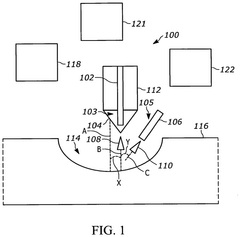
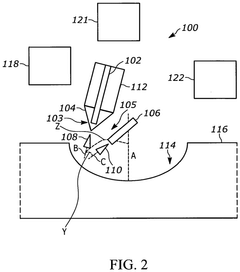
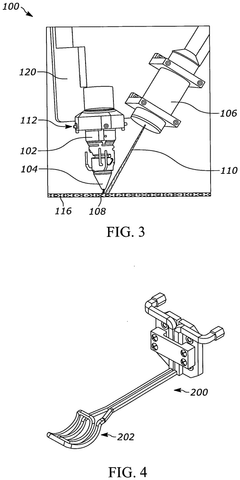
- A DED system employing multiple energy sources and a bi-directional spiral deposition pattern, combined with induction heating, to melt and uniformly fill concave cavities with angled walls, using titanium aluminide powder, ensuring thermal distribution and adhesion.
Regulatory Compliance Framework for DED Implementation
The regulatory landscape for Directed Energy Deposition (DED) technologies presents a complex matrix of requirements that manufacturers and implementers must navigate. At the international level, organizations such as ISO and ASTM have developed standards specifically addressing additive manufacturing processes, with ISO/ASTM 52900 providing fundamental terminology and ASTM F3187 establishing quality assurance protocols for DED systems. These standards form the foundation of a compliance framework that ensures consistency and safety across global implementations.
Within the United States, regulatory oversight primarily falls under the jurisdiction of OSHA for workplace safety considerations and the FDA for medical applications of DED technologies. OSHA regulations address hazards specific to DED processes, including laser safety (29 CFR 1910.97), metal powder handling (29 CFR 1910.1200), and ventilation requirements (29 CFR 1910.94). Companies implementing DED must develop comprehensive safety protocols aligned with these regulations.
The European Union maintains its own regulatory framework through the Machinery Directive 2006/42/EC and the harmonized standard EN ISO 13849-1 for safety-related control systems. Additionally, the EU's REACH regulation governs the handling of chemical substances used in DED processes, requiring thorough documentation and risk assessment procedures. Manufacturers seeking to deploy DED technologies in European markets must obtain CE marking, demonstrating compliance with all applicable directives.
Environmental compliance represents another critical dimension of the regulatory framework. Emissions from DED processes are subject to Clean Air Act provisions in the US and similar environmental protection regulations globally. Waste management protocols must address the disposal of metal powders and other materials used in DED manufacturing, with particular attention to potentially hazardous substances.
Quality management systems form an integral component of DED compliance, with ISO 9001 serving as the baseline standard for general quality management. For more specialized applications, industry-specific standards apply: AS9100 for aerospace, IATF 16949 for automotive, and ISO 13485 for medical devices. These standards mandate rigorous documentation, process validation, and continuous monitoring protocols.
Emerging regulatory considerations include cybersecurity requirements for networked DED systems and intellectual property protections for digital design files. As DED technologies continue to evolve, regulatory frameworks are expected to adapt accordingly, potentially introducing new compliance requirements related to material traceability, part certification, and sustainability metrics.
Within the United States, regulatory oversight primarily falls under the jurisdiction of OSHA for workplace safety considerations and the FDA for medical applications of DED technologies. OSHA regulations address hazards specific to DED processes, including laser safety (29 CFR 1910.97), metal powder handling (29 CFR 1910.1200), and ventilation requirements (29 CFR 1910.94). Companies implementing DED must develop comprehensive safety protocols aligned with these regulations.
The European Union maintains its own regulatory framework through the Machinery Directive 2006/42/EC and the harmonized standard EN ISO 13849-1 for safety-related control systems. Additionally, the EU's REACH regulation governs the handling of chemical substances used in DED processes, requiring thorough documentation and risk assessment procedures. Manufacturers seeking to deploy DED technologies in European markets must obtain CE marking, demonstrating compliance with all applicable directives.
Environmental compliance represents another critical dimension of the regulatory framework. Emissions from DED processes are subject to Clean Air Act provisions in the US and similar environmental protection regulations globally. Waste management protocols must address the disposal of metal powders and other materials used in DED manufacturing, with particular attention to potentially hazardous substances.
Quality management systems form an integral component of DED compliance, with ISO 9001 serving as the baseline standard for general quality management. For more specialized applications, industry-specific standards apply: AS9100 for aerospace, IATF 16949 for automotive, and ISO 13485 for medical devices. These standards mandate rigorous documentation, process validation, and continuous monitoring protocols.
Emerging regulatory considerations include cybersecurity requirements for networked DED systems and intellectual property protections for digital design files. As DED technologies continue to evolve, regulatory frameworks are expected to adapt accordingly, potentially introducing new compliance requirements related to material traceability, part certification, and sustainability metrics.
Material Qualification Standards for DED Manufacturing
Material qualification standards for Directed Energy Deposition (DED) manufacturing represent a critical framework for ensuring the reliability, safety, and performance of components produced using this advanced additive manufacturing technique. Currently, the standards landscape for DED materials exhibits considerable fragmentation across different industries and regulatory bodies. Organizations such as ASTM International, SAE, and ISO have developed various standards that address aspects of metal additive manufacturing, though many are not specifically tailored to the unique characteristics of DED processes.
The qualification process typically encompasses several key dimensions: chemical composition verification, mechanical property testing, microstructural analysis, and process parameter validation. For DED-specific applications, standards must address the distinctive thermal history experienced by materials during deposition, which significantly influences final material properties. This includes consideration of layer-by-layer heat accumulation, directional solidification effects, and potential anisotropic behavior in the finished components.
Industry-specific requirements further complicate the standards landscape. Aerospace applications, governed by entities like the FAA and NASA, demand rigorous certification protocols focusing on fatigue performance and fracture mechanics. Medical device manufacturers must adhere to FDA guidelines emphasizing biocompatibility and long-term stability. Defense applications require standards addressing ballistic performance and environmental resistance, while automotive standards focus on crash worthiness and durability under cyclic loading.
A significant challenge in DED material qualification is the development of in-situ monitoring standards that can provide real-time quality assurance during the manufacturing process. Current efforts are exploring correlations between process signatures (thermal profiles, melt pool dynamics) and resultant material properties, aiming to establish predictive models that could streamline qualification procedures.
Powder feedstock qualification represents another critical aspect of DED material standards. Requirements for particle size distribution, morphology, flowability, and chemical homogeneity must be precisely defined to ensure consistent deposition quality. Recycling protocols for unused powder must also be standardized to maintain material integrity across multiple build cycles.
The emerging trend toward digital qualification frameworks promises to accelerate material certification through computational modeling and simulation. These approaches aim to reduce empirical testing requirements by establishing validated material models that can predict performance across various process parameters and geometries. However, regulatory acceptance of such digital qualification methods remains limited, requiring extensive validation against physical test data.
The qualification process typically encompasses several key dimensions: chemical composition verification, mechanical property testing, microstructural analysis, and process parameter validation. For DED-specific applications, standards must address the distinctive thermal history experienced by materials during deposition, which significantly influences final material properties. This includes consideration of layer-by-layer heat accumulation, directional solidification effects, and potential anisotropic behavior in the finished components.
Industry-specific requirements further complicate the standards landscape. Aerospace applications, governed by entities like the FAA and NASA, demand rigorous certification protocols focusing on fatigue performance and fracture mechanics. Medical device manufacturers must adhere to FDA guidelines emphasizing biocompatibility and long-term stability. Defense applications require standards addressing ballistic performance and environmental resistance, while automotive standards focus on crash worthiness and durability under cyclic loading.
A significant challenge in DED material qualification is the development of in-situ monitoring standards that can provide real-time quality assurance during the manufacturing process. Current efforts are exploring correlations between process signatures (thermal profiles, melt pool dynamics) and resultant material properties, aiming to establish predictive models that could streamline qualification procedures.
Powder feedstock qualification represents another critical aspect of DED material standards. Requirements for particle size distribution, morphology, flowability, and chemical homogeneity must be precisely defined to ensure consistent deposition quality. Recycling protocols for unused powder must also be standardized to maintain material integrity across multiple build cycles.
The emerging trend toward digital qualification frameworks promises to accelerate material certification through computational modeling and simulation. These approaches aim to reduce empirical testing requirements by establishing validated material models that can predict performance across various process parameters and geometries. However, regulatory acceptance of such digital qualification methods remains limited, requiring extensive validation against physical test data.
Unlock deeper insights with PatSnap Eureka Quick Research — get a full tech report to explore trends and direct your research. Try now!
Generate Your Research Report Instantly with AI Agent
Supercharge your innovation with PatSnap Eureka AI Agent Platform!