

Electrochemical Cell Vs Capacitor: Energy Storage Efficiency
AUG 28, 20259 MIN READ
Generate Your Research Report Instantly with AI Agent
PatSnap Eureka helps you evaluate technical feasibility & market potential.
Energy Storage Evolution and Objectives
Energy storage technology has evolved significantly over the past century, transitioning from rudimentary batteries to sophisticated electrochemical systems and capacitors. The journey began with Alessandro Volta's invention of the first true battery in 1800, which laid the foundation for modern electrochemical cells. By the mid-20th century, advancements in materials science and engineering principles accelerated development, leading to lithium-ion batteries in the 1990s that revolutionized portable electronics and later electric vehicles.
Capacitor technology has followed a parallel but distinct evolutionary path. From basic Leyden jars to today's supercapacitors, these devices have continuously improved in energy density while maintaining their characteristic rapid charge-discharge capabilities. The convergence of these technologies represents a critical frontier in energy storage research, as engineers seek to combine the high energy density of electrochemical cells with the power density and cycle life of capacitors.
The primary objective in comparing electrochemical cells and capacitors is to optimize energy storage efficiency across multiple parameters. This includes maximizing energy density (Wh/kg), power density (W/kg), cycle life, charge-discharge efficiency, and minimizing self-discharge rates. Additionally, researchers aim to understand the fundamental mechanisms that govern energy storage in both systems to develop hybrid solutions that leverage the strengths of each technology.
Current technological objectives focus on bridging the performance gap between these storage methods. For electrochemical cells, researchers seek to enhance power density and cycle life while maintaining high energy density. For capacitors, particularly supercapacitors, the goal is to increase energy density without sacrificing their inherent rapid charge-discharge capabilities and exceptional cycle life.
Environmental considerations have also become increasingly important in energy storage evolution. The industry is moving toward more sustainable materials, reduced toxic components, and improved recyclability. This shift is driven by both regulatory pressures and market demands for greener technologies, particularly as energy storage becomes central to renewable energy integration and electrification of transportation.
The ultimate technological objective is to develop energy storage solutions that offer the best of both worlds: the high energy density of batteries with the rapid charging, long cycle life, and safety of capacitors. This convergence represents not just an incremental improvement but a potential paradigm shift in how we store and utilize electrical energy across sectors ranging from consumer electronics to grid-scale applications.
Capacitor technology has followed a parallel but distinct evolutionary path. From basic Leyden jars to today's supercapacitors, these devices have continuously improved in energy density while maintaining their characteristic rapid charge-discharge capabilities. The convergence of these technologies represents a critical frontier in energy storage research, as engineers seek to combine the high energy density of electrochemical cells with the power density and cycle life of capacitors.
The primary objective in comparing electrochemical cells and capacitors is to optimize energy storage efficiency across multiple parameters. This includes maximizing energy density (Wh/kg), power density (W/kg), cycle life, charge-discharge efficiency, and minimizing self-discharge rates. Additionally, researchers aim to understand the fundamental mechanisms that govern energy storage in both systems to develop hybrid solutions that leverage the strengths of each technology.
Current technological objectives focus on bridging the performance gap between these storage methods. For electrochemical cells, researchers seek to enhance power density and cycle life while maintaining high energy density. For capacitors, particularly supercapacitors, the goal is to increase energy density without sacrificing their inherent rapid charge-discharge capabilities and exceptional cycle life.
Environmental considerations have also become increasingly important in energy storage evolution. The industry is moving toward more sustainable materials, reduced toxic components, and improved recyclability. This shift is driven by both regulatory pressures and market demands for greener technologies, particularly as energy storage becomes central to renewable energy integration and electrification of transportation.
The ultimate technological objective is to develop energy storage solutions that offer the best of both worlds: the high energy density of batteries with the rapid charging, long cycle life, and safety of capacitors. This convergence represents not just an incremental improvement but a potential paradigm shift in how we store and utilize electrical energy across sectors ranging from consumer electronics to grid-scale applications.
Market Analysis for Energy Storage Solutions
The global energy storage market is experiencing unprecedented growth, driven by the increasing integration of renewable energy sources, grid modernization efforts, and the rising demand for electric vehicles. As of 2023, the market valuation stands at approximately $211 billion, with projections indicating a compound annual growth rate of 8.2% through 2030. This robust expansion underscores the critical importance of efficient energy storage technologies in the modern energy landscape.
When comparing electrochemical cells and capacitors, distinct market segments and applications emerge. The electrochemical cell market, dominated by lithium-ion batteries, commands roughly 70% of the total energy storage market share. This dominance is particularly evident in electric vehicle applications, where the energy density advantages of lithium-ion technology have proven decisive. The stationary storage sector also heavily favors electrochemical solutions, with utility-scale installations growing at 27% annually.
Capacitor technologies, while representing a smaller market segment at approximately $30 billion, demonstrate impressive growth in specialized applications. Supercapacitors, in particular, are experiencing 20% annual growth, driven by their adoption in hybrid energy systems, regenerative braking applications, and grid stabilization solutions. Their rapid charge-discharge capabilities address needs unmet by traditional battery technologies.
Regional market dynamics reveal interesting patterns in technology adoption. Asia-Pacific leads in electrochemical cell manufacturing and deployment, accounting for 65% of global production capacity. North America and Europe, meanwhile, are witnessing accelerated investment in advanced capacitor technologies, with particular emphasis on enhancing power density and cycle life characteristics.
Consumer electronics represents another significant market segment, with an increasing preference for hybrid storage solutions that leverage the complementary strengths of both technologies. This trend is evidenced by the 35% year-over-year growth in patents related to integrated storage systems combining electrochemical cells and capacitors.
Market forecasts suggest that while electrochemical cells will maintain their dominant position in high-energy applications, capacitor technologies will continue to capture market share in high-power, rapid-cycling use cases. The fastest growth is anticipated in hybrid systems that strategically deploy both technologies to optimize overall system performance and efficiency.
Investment patterns further illuminate market trajectories, with venture capital funding for advanced capacitor technologies reaching $4.2 billion in 2022, a 40% increase from the previous year. Meanwhile, corporate R&D spending on next-generation electrochemical cells continues to outpace other energy technologies, reflecting industry confidence in their long-term market potential.
When comparing electrochemical cells and capacitors, distinct market segments and applications emerge. The electrochemical cell market, dominated by lithium-ion batteries, commands roughly 70% of the total energy storage market share. This dominance is particularly evident in electric vehicle applications, where the energy density advantages of lithium-ion technology have proven decisive. The stationary storage sector also heavily favors electrochemical solutions, with utility-scale installations growing at 27% annually.
Capacitor technologies, while representing a smaller market segment at approximately $30 billion, demonstrate impressive growth in specialized applications. Supercapacitors, in particular, are experiencing 20% annual growth, driven by their adoption in hybrid energy systems, regenerative braking applications, and grid stabilization solutions. Their rapid charge-discharge capabilities address needs unmet by traditional battery technologies.
Regional market dynamics reveal interesting patterns in technology adoption. Asia-Pacific leads in electrochemical cell manufacturing and deployment, accounting for 65% of global production capacity. North America and Europe, meanwhile, are witnessing accelerated investment in advanced capacitor technologies, with particular emphasis on enhancing power density and cycle life characteristics.
Consumer electronics represents another significant market segment, with an increasing preference for hybrid storage solutions that leverage the complementary strengths of both technologies. This trend is evidenced by the 35% year-over-year growth in patents related to integrated storage systems combining electrochemical cells and capacitors.
Market forecasts suggest that while electrochemical cells will maintain their dominant position in high-energy applications, capacitor technologies will continue to capture market share in high-power, rapid-cycling use cases. The fastest growth is anticipated in hybrid systems that strategically deploy both technologies to optimize overall system performance and efficiency.
Investment patterns further illuminate market trajectories, with venture capital funding for advanced capacitor technologies reaching $4.2 billion in 2022, a 40% increase from the previous year. Meanwhile, corporate R&D spending on next-generation electrochemical cells continues to outpace other energy technologies, reflecting industry confidence in their long-term market potential.
Technical Comparison and Challenges
Electrochemical cells and capacitors represent two fundamentally different approaches to energy storage, each with distinct efficiency characteristics and operational principles. Electrochemical cells, including batteries, store energy through chemical reactions that involve electron transfer between electrodes via an electrolyte. This process enables high energy density but often at the cost of power density. Conversely, capacitors store energy electrostatically in an electric field between conductive plates, offering superior power density but limited energy storage capacity.
The efficiency comparison between these technologies reveals significant differences. Electrochemical cells typically achieve energy densities of 100-265 Wh/kg for lithium-ion batteries, while supercapacitors generally range from 5-15 Wh/kg. However, capacitors demonstrate charging efficiencies of 95-98% compared to batteries' 80-90%, highlighting their superior performance in rapid charge-discharge cycles.
A critical challenge for electrochemical cells lies in their degradation mechanisms. Chemical reactions during charge-discharge cycles lead to electrode material breakdown, electrolyte decomposition, and solid-electrolyte interphase formation. These processes result in capacity fade and increased internal resistance over time, limiting operational lifespan to typically 500-2000 cycles for lithium-ion batteries.
Capacitors face different challenges, primarily related to self-discharge rates and voltage limitations. Traditional capacitors experience self-discharge rates of 5-40% per day, significantly higher than batteries' 2-10% per month. Additionally, the energy stored in capacitors scales with the square of voltage, making voltage management crucial for efficiency optimization.
Temperature sensitivity presents challenges for both technologies but affects them differently. Electrochemical cells experience severely reduced performance at low temperatures and accelerated degradation at high temperatures. Capacitors maintain better performance across temperature ranges but still face efficiency reductions at extremes.
Recent technological advancements have begun addressing these limitations. Hybrid systems combining electrochemical cells with capacitors leverage the strengths of both technologies. Lithium-ion capacitors and sodium-ion hybrid capacitors represent promising developments, offering improved energy density while maintaining high power capabilities.
Material science innovations are also reshaping the efficiency landscape. Advanced electrode materials like silicon-graphene composites for batteries and graphene-based materials for supercapacitors are pushing theoretical limits. Meanwhile, solid-state electrolytes are addressing safety concerns while potentially improving energy density and cycle life in next-generation storage systems.
The efficiency gap between these technologies continues to narrow as researchers develop novel architectures and materials, suggesting future energy storage solutions may increasingly blur the traditional distinctions between electrochemical cells and capacitors.
The efficiency comparison between these technologies reveals significant differences. Electrochemical cells typically achieve energy densities of 100-265 Wh/kg for lithium-ion batteries, while supercapacitors generally range from 5-15 Wh/kg. However, capacitors demonstrate charging efficiencies of 95-98% compared to batteries' 80-90%, highlighting their superior performance in rapid charge-discharge cycles.
A critical challenge for electrochemical cells lies in their degradation mechanisms. Chemical reactions during charge-discharge cycles lead to electrode material breakdown, electrolyte decomposition, and solid-electrolyte interphase formation. These processes result in capacity fade and increased internal resistance over time, limiting operational lifespan to typically 500-2000 cycles for lithium-ion batteries.
Capacitors face different challenges, primarily related to self-discharge rates and voltage limitations. Traditional capacitors experience self-discharge rates of 5-40% per day, significantly higher than batteries' 2-10% per month. Additionally, the energy stored in capacitors scales with the square of voltage, making voltage management crucial for efficiency optimization.
Temperature sensitivity presents challenges for both technologies but affects them differently. Electrochemical cells experience severely reduced performance at low temperatures and accelerated degradation at high temperatures. Capacitors maintain better performance across temperature ranges but still face efficiency reductions at extremes.
Recent technological advancements have begun addressing these limitations. Hybrid systems combining electrochemical cells with capacitors leverage the strengths of both technologies. Lithium-ion capacitors and sodium-ion hybrid capacitors represent promising developments, offering improved energy density while maintaining high power capabilities.
Material science innovations are also reshaping the efficiency landscape. Advanced electrode materials like silicon-graphene composites for batteries and graphene-based materials for supercapacitors are pushing theoretical limits. Meanwhile, solid-state electrolytes are addressing safety concerns while potentially improving energy density and cycle life in next-generation storage systems.
The efficiency gap between these technologies continues to narrow as researchers develop novel architectures and materials, suggesting future energy storage solutions may increasingly blur the traditional distinctions between electrochemical cells and capacitors.
Current Efficiency Optimization Approaches
01 Advanced electrode materials for improved energy density
Novel electrode materials can significantly enhance the energy storage efficiency of electrochemical cells and capacitors. These materials include advanced carbon-based structures, metal oxides, and composite materials that offer higher specific capacity, better conductivity, and improved charge-discharge rates. The optimization of electrode surface area and porosity allows for increased energy density while maintaining power performance, making these systems more efficient for various energy storage applications.- Advanced electrode materials for improved energy density: Novel electrode materials can significantly enhance the energy storage efficiency of electrochemical cells and capacitors. These materials include nanostructured carbon, metal oxides, and composite materials that offer increased surface area and improved charge storage capabilities. The advanced electrode designs facilitate faster ion transport and electron transfer, resulting in higher energy density and improved overall performance of energy storage devices.
- Electrolyte optimization for enhanced conductivity: The composition and properties of electrolytes play a crucial role in determining the efficiency of electrochemical cells and capacitors. Optimized electrolyte formulations can reduce internal resistance, improve ion mobility, and enhance charge transfer at electrode interfaces. Advanced electrolytes, including ionic liquids and gel-polymer systems, offer improved thermal stability, wider operating voltage windows, and better compatibility with electrode materials, leading to higher energy storage efficiency.
- Cell design and architecture innovations: Innovative cell designs and architectures can significantly improve energy storage efficiency by optimizing the spatial arrangement of components and enhancing the utilization of active materials. These innovations include novel separator designs, optimized current collector configurations, and improved cell packaging techniques. Advanced cell architectures minimize internal resistance, reduce dead space, and facilitate more efficient ion transport pathways, resulting in higher energy density and improved cycle life.
- Hybrid and integrated energy storage systems: Hybrid energy storage systems combine the advantages of different storage technologies, such as batteries and supercapacitors, to achieve optimal performance characteristics. These integrated systems leverage the high energy density of batteries and the high power density of capacitors to create more efficient energy storage solutions. By intelligently managing the energy flow between different storage components, hybrid systems can provide improved efficiency across various operating conditions and applications.
- Advanced monitoring and management systems: Sophisticated monitoring and management systems can significantly enhance the efficiency of electrochemical cells and capacitors by optimizing operating conditions and preventing degradation. These systems employ sensors, algorithms, and control strategies to monitor key parameters such as temperature, voltage, and state of charge. By maintaining optimal operating conditions and implementing intelligent charging/discharging protocols, these management systems extend the lifespan of energy storage devices and maximize their energy efficiency.
02 Electrolyte innovations for enhanced efficiency
Electrolyte formulations play a crucial role in determining the energy storage efficiency of electrochemical devices. Advanced electrolytes with improved ionic conductivity, wider electrochemical stability windows, and better thermal properties can significantly reduce internal resistance and self-discharge rates. These innovations include novel ionic liquids, solid-state electrolytes, and electrolyte additives that enhance the overall performance and efficiency of energy storage systems while improving safety characteristics.Expand Specific Solutions03 Cell design and architecture optimization
The physical design and architecture of electrochemical cells and capacitors significantly impact their energy storage efficiency. Innovations in cell configuration, component arrangement, and packaging techniques can minimize internal resistance, improve thermal management, and enhance charge distribution. Advanced designs include bipolar configurations, stacked architectures, and optimized current collector geometries that collectively improve energy density, power capability, and overall system efficiency.Expand Specific Solutions04 Hybrid and integrated energy storage systems
Hybrid systems that combine different energy storage technologies can leverage the advantages of each to achieve superior overall efficiency. These include battery-capacitor hybrids, integrated energy harvesting systems, and multi-functional storage devices. By strategically combining technologies with complementary characteristics, these systems can provide optimal performance across various operating conditions, offering improved energy density, power capability, and cycle life compared to single-technology solutions.Expand Specific Solutions05 Advanced monitoring and management systems
Sophisticated monitoring and management systems can significantly enhance the operational efficiency of electrochemical cells and capacitors. These technologies include advanced battery management systems, state-of-charge estimation algorithms, and predictive maintenance tools that optimize charging protocols, balance cell performance, and prevent degradation. By ensuring optimal operating conditions and preventing inefficient operation modes, these systems maximize energy utilization and extend the useful life of storage devices.Expand Specific Solutions
Leading Manufacturers and Research Institutions
The electrochemical cell versus capacitor energy storage efficiency landscape is currently in a growth phase, with the global market expected to reach $400 billion by 2030. While electrochemical cells offer higher energy density, capacitors provide superior power density and cycle life. Companies like Tesla and Samsung Electro-Mechanics lead in traditional battery technology, while specialized players such as Capacitor Sciences and UCAP Power are advancing supercapacitor innovations. Research institutions including Naval Research Laboratory and King Abdullah University collaborate with industry leaders like Robert Bosch and Applied Materials to develop hybrid solutions combining the advantages of both technologies. The competitive landscape is diversifying as manufacturers seek optimal energy storage solutions balancing efficiency, cost, and application-specific requirements.
Capacitor Sciences, Inc.
Technical Solution: Capacitor Sciences has developed proprietary meta-dielectric materials that enable high energy density capacitors. Their technology utilizes polarizable molecules with high dipole moments arranged in ordered structures to maximize energy storage capacity. These meta-dielectric layer capacitors (MDLC) can achieve energy densities approaching those of lithium-ion batteries while maintaining the power density advantages of traditional capacitors. The company's approach involves synthesizing organic compounds with extended conjugated structures that can be precisely engineered at the molecular level to optimize dielectric properties. This allows for capacitors with energy densities exceeding 100 Wh/kg, significantly higher than conventional capacitors while maintaining rapid charge-discharge capabilities.
Strengths: Combines high energy density approaching batteries with the rapid charge-discharge capabilities of capacitors; environmentally friendly materials compared to battery chemistries; potentially longer cycle life than electrochemical cells. Weaknesses: Still in development phase with limited commercial deployment; higher production costs than conventional capacitors; energy density still lower than advanced lithium-ion batteries.
Samsung Electro-Mechanics Co., Ltd.
Technical Solution: Samsung Electro-Mechanics has developed advanced hybrid capacitor technology that combines the high energy density of lithium-ion batteries with the rapid charge-discharge capabilities of supercapacitors. Their lithium-ion capacitors (LICs) utilize a pre-doped carbon-based negative electrode and an activated carbon positive electrode, with an organic electrolyte containing lithium ions. This hybrid approach enables energy densities 3-5 times higher than conventional supercapacitors while maintaining power densities significantly higher than batteries. Samsung's manufacturing innovations include nano-engineered electrode materials with optimized pore structures and advanced electrolyte formulations that enhance ion mobility. Their LICs demonstrate exceptional cycle stability (>100,000 cycles) and operate efficiently across a wide temperature range (-30°C to +70°C). The company has also developed sophisticated module designs with integrated thermal management and balancing systems to optimize performance in high-power applications such as industrial equipment, renewable energy storage, and advanced automotive systems.
Strengths: Excellent balance between energy density and power density; superior cycle life compared to batteries; wide operating temperature range; rapid charging capability; established manufacturing infrastructure. Weaknesses: Higher cost than conventional capacitors; lower energy density than advanced lithium-ion batteries; requires sophisticated management systems for optimal performance.
Key Patents in Electrochemical and Capacitive Storage
Electrochemical energy storage devices
PatentActiveUS20230282891A1
Innovation
- A seal comprising a ceramic material resistant to reactive metals and molten salts, combined with a metal collar and active metal braze, provides chemical resistance and thermal stability, ensuring the containment of reactive materials at elevated temperatures.

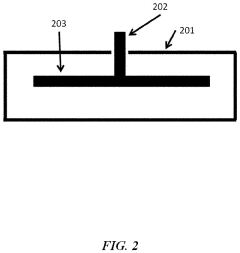


Electro-polarizable complex compound and capacitor
PatentInactiveUS20170372842A1
Innovation
- An electro-polarizable complex compound with a four-valence metal and electrically resistive fragments forms a resistive envelope around the metal-coordinating atoms, preventing percolation and enhancing breakdown voltage, used in a meta-capacitor design with a meta-dielectric layer between electrodes.


Materials Science Advancements
Recent advancements in materials science have revolutionized energy storage technologies, significantly impacting the efficiency comparison between electrochemical cells and capacitors. Nanomaterials development has emerged as a critical frontier, with graphene and carbon nanotubes demonstrating exceptional electrical conductivity and surface area characteristics that enhance both technologies. These materials have enabled the development of supercapacitors that bridge the gap between traditional capacitors and batteries.
Novel electrode materials represent another breakthrough area, with researchers developing high-capacity cathode materials like lithium-rich layered oxides and high-voltage spinel structures that increase energy density in electrochemical cells. Simultaneously, advanced carbon-based materials with tailored pore structures have improved capacitor performance by optimizing ion transport pathways and maximizing effective surface area.
Electrolyte innovations have addressed fundamental limitations in both technologies. Solid-state electrolytes with superior ionic conductivity and stability have enhanced electrochemical cell safety and longevity, while ionic liquid electrolytes have expanded capacitors' voltage windows, directly increasing their energy density according to the E=½CV² relationship.
Interface engineering has become increasingly sophisticated, with researchers developing specialized coatings and functional interlayers that mitigate degradation mechanisms at electrode-electrolyte interfaces. These innovations have extended cycle life in both technologies while maintaining high efficiency during charge-discharge processes.
Composite and hybrid materials represent perhaps the most promising direction, combining the high energy density of battery-type materials with the power density of capacitive materials. These include lithium-ion capacitors and sodium-ion hybrid devices that leverage faradaic and non-faradaic processes simultaneously, offering performance metrics that exceed the capabilities of either technology alone.
Manufacturing techniques have evolved to support these material innovations, with atomic layer deposition and advanced solution processing enabling precise control over material morphology and composition. These techniques have facilitated the commercial viability of next-generation energy storage devices with optimized microstructures and reduced defect concentrations.
The convergence of computational materials science with experimental approaches has accelerated discovery timelines, with machine learning algorithms identifying promising material candidates and predicting performance characteristics before synthesis. This approach has yielded several breakthrough materials that have significantly narrowed the efficiency gap between electrochemical cells and capacitors.
Novel electrode materials represent another breakthrough area, with researchers developing high-capacity cathode materials like lithium-rich layered oxides and high-voltage spinel structures that increase energy density in electrochemical cells. Simultaneously, advanced carbon-based materials with tailored pore structures have improved capacitor performance by optimizing ion transport pathways and maximizing effective surface area.
Electrolyte innovations have addressed fundamental limitations in both technologies. Solid-state electrolytes with superior ionic conductivity and stability have enhanced electrochemical cell safety and longevity, while ionic liquid electrolytes have expanded capacitors' voltage windows, directly increasing their energy density according to the E=½CV² relationship.
Interface engineering has become increasingly sophisticated, with researchers developing specialized coatings and functional interlayers that mitigate degradation mechanisms at electrode-electrolyte interfaces. These innovations have extended cycle life in both technologies while maintaining high efficiency during charge-discharge processes.
Composite and hybrid materials represent perhaps the most promising direction, combining the high energy density of battery-type materials with the power density of capacitive materials. These include lithium-ion capacitors and sodium-ion hybrid devices that leverage faradaic and non-faradaic processes simultaneously, offering performance metrics that exceed the capabilities of either technology alone.
Manufacturing techniques have evolved to support these material innovations, with atomic layer deposition and advanced solution processing enabling precise control over material morphology and composition. These techniques have facilitated the commercial viability of next-generation energy storage devices with optimized microstructures and reduced defect concentrations.
The convergence of computational materials science with experimental approaches has accelerated discovery timelines, with machine learning algorithms identifying promising material candidates and predicting performance characteristics before synthesis. This approach has yielded several breakthrough materials that have significantly narrowed the efficiency gap between electrochemical cells and capacitors.
Sustainability and Lifecycle Assessment
The sustainability assessment of energy storage technologies requires comprehensive evaluation of environmental impacts throughout their entire lifecycle. Electrochemical cells and capacitors present distinct sustainability profiles that significantly influence their overall efficiency and environmental footprint.
Electrochemical cells, particularly lithium-ion batteries, face sustainability challenges related to raw material extraction. The mining of lithium, cobalt, and nickel creates substantial environmental disruption, including habitat destruction, water pollution, and high carbon emissions. These materials are often sourced from regions with limited environmental regulations, exacerbating their ecological impact. Additionally, the manufacturing process for electrochemical cells is energy-intensive, contributing significantly to their carbon footprint before they store their first electron.
Capacitors, particularly supercapacitors, generally utilize more abundant and less environmentally problematic materials such as activated carbon, aluminum, and various metal oxides. Their production processes typically require fewer toxic chemicals and generate less hazardous waste compared to battery manufacturing. This results in a generally lower environmental impact during the production phase.
The operational lifespan represents another critical sustainability factor. Electrochemical cells typically endure 500-2000 charge cycles before significant degradation occurs, necessitating replacement after 3-7 years in many applications. Conversely, capacitors can withstand hundreds of thousands to millions of charge cycles, potentially functioning for decades with minimal performance degradation. This extended operational lifetime significantly reduces waste generation and resource consumption over time.
End-of-life management presents distinct challenges for both technologies. Battery recycling remains complex and energy-intensive, with current processes recovering only a portion of valuable materials. Many electrochemical cells still end up in landfills, creating potential for toxic leaching. Capacitor recycling, while not without challenges, generally involves simpler processes with higher material recovery rates and fewer hazardous components to manage.
Energy return on investment (EROI) calculations reveal that capacitors typically recoup their embodied energy faster than electrochemical cells due to their higher cycle efficiency and longer operational lifespan. This advantage becomes particularly significant in applications requiring frequent charge-discharge cycles, where the cumulative energy savings over the device lifetime substantially outweigh the initial manufacturing energy investment.
Future sustainability improvements for both technologies will likely focus on developing closed-loop manufacturing systems, utilizing renewable energy in production processes, and designing products specifically for disassembly and material recovery. These advancements will be essential to minimize the environmental footprint of energy storage technologies as their deployment continues to accelerate globally.
Electrochemical cells, particularly lithium-ion batteries, face sustainability challenges related to raw material extraction. The mining of lithium, cobalt, and nickel creates substantial environmental disruption, including habitat destruction, water pollution, and high carbon emissions. These materials are often sourced from regions with limited environmental regulations, exacerbating their ecological impact. Additionally, the manufacturing process for electrochemical cells is energy-intensive, contributing significantly to their carbon footprint before they store their first electron.
Capacitors, particularly supercapacitors, generally utilize more abundant and less environmentally problematic materials such as activated carbon, aluminum, and various metal oxides. Their production processes typically require fewer toxic chemicals and generate less hazardous waste compared to battery manufacturing. This results in a generally lower environmental impact during the production phase.
The operational lifespan represents another critical sustainability factor. Electrochemical cells typically endure 500-2000 charge cycles before significant degradation occurs, necessitating replacement after 3-7 years in many applications. Conversely, capacitors can withstand hundreds of thousands to millions of charge cycles, potentially functioning for decades with minimal performance degradation. This extended operational lifetime significantly reduces waste generation and resource consumption over time.
End-of-life management presents distinct challenges for both technologies. Battery recycling remains complex and energy-intensive, with current processes recovering only a portion of valuable materials. Many electrochemical cells still end up in landfills, creating potential for toxic leaching. Capacitor recycling, while not without challenges, generally involves simpler processes with higher material recovery rates and fewer hazardous components to manage.
Energy return on investment (EROI) calculations reveal that capacitors typically recoup their embodied energy faster than electrochemical cells due to their higher cycle efficiency and longer operational lifespan. This advantage becomes particularly significant in applications requiring frequent charge-discharge cycles, where the cumulative energy savings over the device lifetime substantially outweigh the initial manufacturing energy investment.
Future sustainability improvements for both technologies will likely focus on developing closed-loop manufacturing systems, utilizing renewable energy in production processes, and designing products specifically for disassembly and material recovery. These advancements will be essential to minimize the environmental footprint of energy storage technologies as their deployment continues to accelerate globally.
Unlock deeper insights with PatSnap Eureka Quick Research — get a full tech report to explore trends and direct your research. Try now!
Generate Your Research Report Instantly with AI Agent
Supercharge your innovation with PatSnap Eureka AI Agent Platform!