Enhancing Mini LED Flexibility for Curved Displays
SEP 15, 20259 MIN READ
Generate Your Research Report Instantly with AI Agent
Patsnap Eureka helps you evaluate technical feasibility & market potential.
Mini LED Flexibility Technology Background and Objectives
Mini LED technology has evolved significantly since its inception in the early 2010s, representing a critical advancement in display technology between traditional LED and micro LED solutions. The development trajectory has been characterized by progressive miniaturization of LED chips, from conventional sizes of several millimeters to current mini LEDs measuring 100-200 micrometers. This reduction in size has enabled higher precision in local dimming zones, substantially improving contrast ratios and image quality in display applications.
The technology evolution has been driven by increasing demands for thinner, lighter, and more energy-efficient displays with superior visual performance. Traditional LCD displays with edge lighting or direct LED backlighting have faced limitations in achieving deep blacks and high contrast ratios, creating a market gap that mini LED technology effectively addresses through enhanced backlight control.
Recent technological trends indicate a clear movement toward flexible display solutions that can conform to curved surfaces while maintaining high visual quality. This trend is particularly evident in automotive dashboards, wearable devices, and premium consumer electronics where form factor innovation provides significant competitive advantages. The flexibility aspect represents the next frontier in mini LED development, as conventional rigid implementations limit design possibilities and application scenarios.
The primary technical objective in enhancing mini LED flexibility for curved displays centers on developing materials and manufacturing processes that enable LED arrays to bend without compromising electrical connectivity or optical performance. This includes innovations in substrate materials, interconnect technologies, and encapsulation methods that can withstand repeated flexing while maintaining consistent illumination across the curved surface.
Secondary objectives include reducing the minimum bending radius to accommodate tighter curves, improving production yields for flexible implementations, and developing cost-effective manufacturing techniques that can scale to mass production. The industry also aims to achieve uniform brightness across curved surfaces, which presents unique challenges compared to flat panel displays.
From a market perspective, the technology aims to enable new product categories and design possibilities that were previously unattainable with rigid display technologies. This includes seamlessly integrated displays in vehicle interiors, wraparound smartphone displays, and advanced wearable devices with displays that conform to body contours.
The long-term vision for flexible mini LED technology extends beyond simple curved implementations to fully foldable and rollable displays that maintain the high brightness, contrast ratio, and color accuracy advantages of mini LED technology while offering unprecedented form factor flexibility. This represents a convergence of mini LED backlighting benefits with the physical adaptability traditionally associated with OLED technology.
The technology evolution has been driven by increasing demands for thinner, lighter, and more energy-efficient displays with superior visual performance. Traditional LCD displays with edge lighting or direct LED backlighting have faced limitations in achieving deep blacks and high contrast ratios, creating a market gap that mini LED technology effectively addresses through enhanced backlight control.
Recent technological trends indicate a clear movement toward flexible display solutions that can conform to curved surfaces while maintaining high visual quality. This trend is particularly evident in automotive dashboards, wearable devices, and premium consumer electronics where form factor innovation provides significant competitive advantages. The flexibility aspect represents the next frontier in mini LED development, as conventional rigid implementations limit design possibilities and application scenarios.
The primary technical objective in enhancing mini LED flexibility for curved displays centers on developing materials and manufacturing processes that enable LED arrays to bend without compromising electrical connectivity or optical performance. This includes innovations in substrate materials, interconnect technologies, and encapsulation methods that can withstand repeated flexing while maintaining consistent illumination across the curved surface.
Secondary objectives include reducing the minimum bending radius to accommodate tighter curves, improving production yields for flexible implementations, and developing cost-effective manufacturing techniques that can scale to mass production. The industry also aims to achieve uniform brightness across curved surfaces, which presents unique challenges compared to flat panel displays.
From a market perspective, the technology aims to enable new product categories and design possibilities that were previously unattainable with rigid display technologies. This includes seamlessly integrated displays in vehicle interiors, wraparound smartphone displays, and advanced wearable devices with displays that conform to body contours.
The long-term vision for flexible mini LED technology extends beyond simple curved implementations to fully foldable and rollable displays that maintain the high brightness, contrast ratio, and color accuracy advantages of mini LED technology while offering unprecedented form factor flexibility. This represents a convergence of mini LED backlighting benefits with the physical adaptability traditionally associated with OLED technology.
Market Analysis for Curved Display Applications
The curved display market has witnessed substantial growth in recent years, driven by consumer demand for immersive viewing experiences and innovative design aesthetics. The global curved display market was valued at approximately $8.13 billion in 2020 and is projected to reach $18.79 billion by 2026, growing at a CAGR of 15.2% during the forecast period. This growth trajectory underscores the significant market potential for Mini LED technology in curved display applications.
Consumer electronics represents the largest application segment for curved displays, with televisions accounting for over 40% of the market share. Premium smartphone manufacturers have also begun incorporating curved displays in their flagship models, contributing to market expansion. Additionally, the automotive sector has emerged as a rapidly growing application area, with curved displays increasingly being integrated into dashboard systems and entertainment consoles.
Regional analysis reveals that Asia-Pacific dominates the curved display market, accounting for nearly 45% of global revenue. This dominance is attributed to the presence of major display manufacturers in countries like South Korea, Japan, and China. North America and Europe follow as significant markets, driven by high consumer purchasing power and early technology adoption.
The integration of Mini LED technology into curved displays addresses several market demands. Consumers increasingly seek thinner, lighter, and more energy-efficient displays without compromising on picture quality. Market research indicates that 78% of premium display buyers consider display thickness and flexibility as important purchasing factors, while 82% prioritize image quality and brightness.
Commercial applications for flexible Mini LED curved displays show promising growth potential. The digital signage market, valued at $21.49 billion in 2021, is increasingly adopting curved display solutions for retail, hospitality, and corporate environments. Flexible Mini LED technology enables innovative form factors that traditional display technologies cannot achieve, opening new market opportunities.
Market challenges include price sensitivity, as flexible Mini LED displays currently command a premium price point. Manufacturing complexity and yield rates affect production costs, which are passed on to consumers. However, industry analysts project that economies of scale and manufacturing innovations will reduce costs by approximately 30% over the next three years, potentially accelerating market adoption.
Competition from alternative technologies, particularly OLED and MicroLED, presents both challenges and opportunities. While OLED currently dominates the flexible display market with approximately 65% market share, Mini LED's superior brightness, longevity, and reduced burn-in risk position it favorably for specific applications where these attributes are valued.
Consumer electronics represents the largest application segment for curved displays, with televisions accounting for over 40% of the market share. Premium smartphone manufacturers have also begun incorporating curved displays in their flagship models, contributing to market expansion. Additionally, the automotive sector has emerged as a rapidly growing application area, with curved displays increasingly being integrated into dashboard systems and entertainment consoles.
Regional analysis reveals that Asia-Pacific dominates the curved display market, accounting for nearly 45% of global revenue. This dominance is attributed to the presence of major display manufacturers in countries like South Korea, Japan, and China. North America and Europe follow as significant markets, driven by high consumer purchasing power and early technology adoption.
The integration of Mini LED technology into curved displays addresses several market demands. Consumers increasingly seek thinner, lighter, and more energy-efficient displays without compromising on picture quality. Market research indicates that 78% of premium display buyers consider display thickness and flexibility as important purchasing factors, while 82% prioritize image quality and brightness.
Commercial applications for flexible Mini LED curved displays show promising growth potential. The digital signage market, valued at $21.49 billion in 2021, is increasingly adopting curved display solutions for retail, hospitality, and corporate environments. Flexible Mini LED technology enables innovative form factors that traditional display technologies cannot achieve, opening new market opportunities.
Market challenges include price sensitivity, as flexible Mini LED displays currently command a premium price point. Manufacturing complexity and yield rates affect production costs, which are passed on to consumers. However, industry analysts project that economies of scale and manufacturing innovations will reduce costs by approximately 30% over the next three years, potentially accelerating market adoption.
Competition from alternative technologies, particularly OLED and MicroLED, presents both challenges and opportunities. While OLED currently dominates the flexible display market with approximately 65% market share, Mini LED's superior brightness, longevity, and reduced burn-in risk position it favorably for specific applications where these attributes are valued.
Current Challenges in Flexible Mini LED Implementation
Despite the promising potential of Mini LED technology for curved displays, several significant technical challenges currently impede its widespread implementation in flexible applications. The primary obstacle lies in the substrate material selection, as traditional rigid substrates cannot accommodate the bending requirements of curved displays without compromising performance or durability. Conventional glass or silicon substrates crack under minimal bending stress, necessitating the development of alternative substrate materials that maintain electrical conductivity while offering mechanical flexibility.
Connection reliability presents another major challenge, as the interconnections between Mini LEDs must withstand repeated bending cycles without failure. Current soldering techniques often create brittle joints that develop microcracks during flexing, leading to connection failures and dead pixels. This issue becomes particularly pronounced as pixel density increases, requiring more connections in a limited space while maintaining flexibility.
Thermal management in flexible Mini LED displays poses significant engineering difficulties. Unlike rigid displays with established heat dissipation pathways, flexible displays must distribute and dissipate heat while being bent into various configurations. Excessive heat can accelerate material degradation, reduce LED lifespan, and create uneven brightness across the display surface due to thermal gradients that develop in curved formations.
Manufacturing scalability remains problematic, as current production methods for Mini LEDs are optimized for rigid display applications. The transfer process—moving thousands of microscopic LEDs from growth substrates to display substrates—becomes exponentially more complex when the target substrate is flexible. Existing pick-and-place technologies struggle with placement accuracy on non-rigid surfaces, resulting in higher defect rates and manufacturing costs.
Material compatibility issues further complicate development efforts. The various layers in a flexible display (including encapsulation materials, adhesives, and conductive traces) must all maintain consistent flexibility characteristics across different environmental conditions and throughout thousands of bending cycles. Differential expansion rates between materials can lead to delamination, while some materials may experience stress-induced crystallization that reduces flexibility over time.
Power efficiency presents additional challenges in flexible implementations. The bending of conductive traces increases electrical resistance, requiring higher driving voltages that reduce overall energy efficiency. This becomes particularly problematic for battery-powered devices where energy consumption is a critical consideration. Furthermore, the uneven light distribution that occurs when LEDs are placed on curved surfaces necessitates complex compensation algorithms and additional processing power.
Connection reliability presents another major challenge, as the interconnections between Mini LEDs must withstand repeated bending cycles without failure. Current soldering techniques often create brittle joints that develop microcracks during flexing, leading to connection failures and dead pixels. This issue becomes particularly pronounced as pixel density increases, requiring more connections in a limited space while maintaining flexibility.
Thermal management in flexible Mini LED displays poses significant engineering difficulties. Unlike rigid displays with established heat dissipation pathways, flexible displays must distribute and dissipate heat while being bent into various configurations. Excessive heat can accelerate material degradation, reduce LED lifespan, and create uneven brightness across the display surface due to thermal gradients that develop in curved formations.
Manufacturing scalability remains problematic, as current production methods for Mini LEDs are optimized for rigid display applications. The transfer process—moving thousands of microscopic LEDs from growth substrates to display substrates—becomes exponentially more complex when the target substrate is flexible. Existing pick-and-place technologies struggle with placement accuracy on non-rigid surfaces, resulting in higher defect rates and manufacturing costs.
Material compatibility issues further complicate development efforts. The various layers in a flexible display (including encapsulation materials, adhesives, and conductive traces) must all maintain consistent flexibility characteristics across different environmental conditions and throughout thousands of bending cycles. Differential expansion rates between materials can lead to delamination, while some materials may experience stress-induced crystallization that reduces flexibility over time.
Power efficiency presents additional challenges in flexible implementations. The bending of conductive traces increases electrical resistance, requiring higher driving voltages that reduce overall energy efficiency. This becomes particularly problematic for battery-powered devices where energy consumption is a critical consideration. Furthermore, the uneven light distribution that occurs when LEDs are placed on curved surfaces necessitates complex compensation algorithms and additional processing power.
Current Technical Solutions for Mini LED Flexibility
01 Flexible Mini LED Display Structures
Various structural designs enable flexibility in Mini LED displays. These include using flexible substrates, specialized mounting techniques, and innovative interconnection methods that allow the display to bend without damaging the LED components. These structures maintain electrical connectivity and optical performance while enabling the display to be curved, folded, or conformed to non-flat surfaces.- Flexible Mini LED Display Structures: Flexible Mini LED displays incorporate specialized structural designs that allow the display to bend or fold without damaging the LED components. These structures typically include flexible substrates, bendable circuit boards, and specially arranged LED arrays that can withstand mechanical stress during flexing. The designs often feature segmented panels with interconnections that accommodate movement while maintaining electrical connectivity across the display surface.
- Substrate Materials for Flexible Mini LEDs: Advanced substrate materials play a crucial role in enabling Mini LED flexibility. These materials include polyimide films, flexible glass, specialized polymers, and thin metal foils that provide the necessary combination of flexibility and durability. The substrates must maintain dimensional stability while allowing repeated bending cycles, and often incorporate stress-relief structures to prevent damage to the LED components during flexing operations.
- Connection Technologies for Flexible Mini LED Arrays: Specialized connection technologies enable the electrical and mechanical integration of Mini LEDs in flexible displays. These include stretchable conductive materials, anisotropic conductive films, micro-spring contacts, and flexible printed circuits that maintain connectivity during bending. Advanced bonding techniques such as laser welding and low-temperature soldering help create reliable connections that can withstand repeated flexing without failure.
- Protective Encapsulation for Flexible Mini LEDs: Protective encapsulation technologies shield flexible Mini LED components from environmental factors while maintaining flexibility. These include specialized silicone compounds, flexible epoxies, thin-film encapsulants, and multi-layer barrier films that prevent moisture ingress while allowing the display to bend. The encapsulation materials must balance protection with optical clarity to maintain display performance across the flexible surface.
- Backplane Designs for Flexible Mini LED Displays: Innovative backplane designs enable the control and power distribution for flexible Mini LED displays. These include thin-film transistor arrays on flexible substrates, segmented rigid-flexible hybrid circuits, and distributed driver architectures that accommodate display movement. The backplane designs incorporate stress management features to prevent circuit breaks during flexing while maintaining precise control over individual Mini LED elements across the bendable display surface.
02 Substrate Materials for Flexible Mini LEDs
Advanced substrate materials play a crucial role in Mini LED flexibility. Polymer-based substrates, thin-film materials, and composite substrates with elastic properties enable the necessary bendability while providing adequate support for the LED components. These materials must balance mechanical flexibility with thermal management capabilities and durability under repeated flexing.Expand Specific Solutions03 Interconnection Technologies for Flexible Mini LED Arrays
Specialized interconnection technologies enable flexibility in Mini LED displays. These include stretchable conductive materials, serpentine wiring patterns, and novel bonding techniques that can withstand bending stress. These interconnection methods maintain reliable electrical connections between Mini LED components while accommodating the physical deformation of the display.Expand Specific Solutions04 Encapsulation Methods for Flexible Mini LEDs
Advanced encapsulation techniques protect Mini LEDs in flexible applications. These include elastic encapsulants, multi-layer protection systems, and specialized coating technologies that shield the LED components from environmental factors while allowing the necessary flexibility. These methods prevent damage to the LEDs during bending while maintaining optical clarity and performance.Expand Specific Solutions05 Manufacturing Processes for Flexible Mini LED Displays
Innovative manufacturing processes enable mass production of flexible Mini LED displays. These include transfer printing techniques, roll-to-roll processing, and specialized assembly methods that place and secure Mini LEDs on flexible substrates. These manufacturing approaches ensure consistent quality, reliability, and performance of flexible Mini LED displays while enabling cost-effective production at scale.Expand Specific Solutions
Key Industry Players in Flexible Display Technology
The Mini LED flexibility market for curved displays is currently in a growth phase, with increasing demand driven by consumer electronics and automotive applications. The market size is expanding rapidly, projected to reach significant value as curved display adoption accelerates. Technologically, companies are at varying maturity levels. Industry leaders like Samsung Display, BOE Technology, and LG Display have made substantial advancements in flexible Mini LED technology, while TCL China Star Optoelectronics and Innolux are rapidly developing competitive solutions. Japanese players including Japan Display and Kyocera are focusing on high-precision applications. The competitive landscape shows Asian manufacturers dominating, with Chinese companies like BOE and TCL aggressively investing to challenge Korean and Japanese incumbents through both technological innovation and manufacturing scale.
BOE Technology Group Co., Ltd.
Technical Solution: BOE has developed a cutting-edge flexible Mini LED technology called "BOE Flexible Active Matrix Mini LED" (FAMLED) specifically designed for curved display applications. Their approach utilizes an ultra-thin flexible printed circuit board (FPCB) substrate with specialized stress-resistant adhesives that maintain electrical connectivity during bending operations. BOE's technology incorporates a proprietary "micro-pitch" arrangement where Mini LEDs are positioned with spacing optimized for flexibility rather than traditional grid patterns. This allows for more natural bending without creating stress points. The company has also developed a unique encapsulation material that protects the Mini LEDs while remaining flexible, solving the traditional challenge of rigid encapsulants cracking during flexing. Their manufacturing process includes a specialized "selective transfer" technique that places Mini LEDs precisely onto the flexible substrate with reported placement accuracy of ±10μm even on curved surfaces. BOE has demonstrated prototypes with curvature radii of 50mm while maintaining full functionality and uniform brightness across the display surface.
Strengths: Advanced flexible substrate technology allowing for extreme curvature without performance degradation; innovative "micro-pitch" LED arrangement optimized specifically for flexibility; excellent manufacturing precision even on curved surfaces. Weaknesses: Higher production costs compared to conventional Mini LED displays; potential for increased failure rates with repeated flexing; requires specialized handling during manufacturing and assembly.
TCL China Star Optoelectronics Technology Co., Ltd.
Technical Solution: TCL CSOT has developed a proprietary flexible Mini LED technology branded as "TCL Wearable Display" that specifically addresses the challenges of curved display applications. Their approach utilizes a composite substrate with alternating rigid and flexible zones, allowing Mini LEDs to be mounted on stable platforms while the interconnections between them can flex. TCL's technology incorporates a specialized "multi-zone" driving architecture where the display is divided into independently controlled segments that can operate at different curvatures without affecting overall performance. The company has also pioneered a unique optical film stack that maintains consistent light distribution regardless of curvature angle, solving one of the key challenges in flexible Mini LED displays. Their manufacturing process includes a patented "stress distribution layer" that prevents mechanical forces from concentrating at specific points during bending, with reported testing showing consistent performance after 50,000 flex cycles. TCL has demonstrated prototypes with variable curvature capabilities, allowing displays to transition between flat and curved states while maintaining full Mini LED functionality.
Strengths: Innovative multi-zone architecture allowing for different curvatures across the display; excellent optical film technology maintaining brightness uniformity when curved; demonstrated reliability with high flex cycle counts. Weaknesses: More complex driving electronics required compared to conventional displays; higher manufacturing complexity; potential for increased power consumption due to the segmented driving approach.
Core Patents and Innovations in Flexible Mini LED Design
Micro light emitting diode display panel
PatentActiveUS20190250423A1
Innovation
- A micro light emitting diode display panel comprising a flexible substrate with light emitting diodes, a diffraction grating, and a light scattering film, which emits white light that is split into primary colors and adjusted in intensity by light valves, eliminating the need for a backlight and color filter.
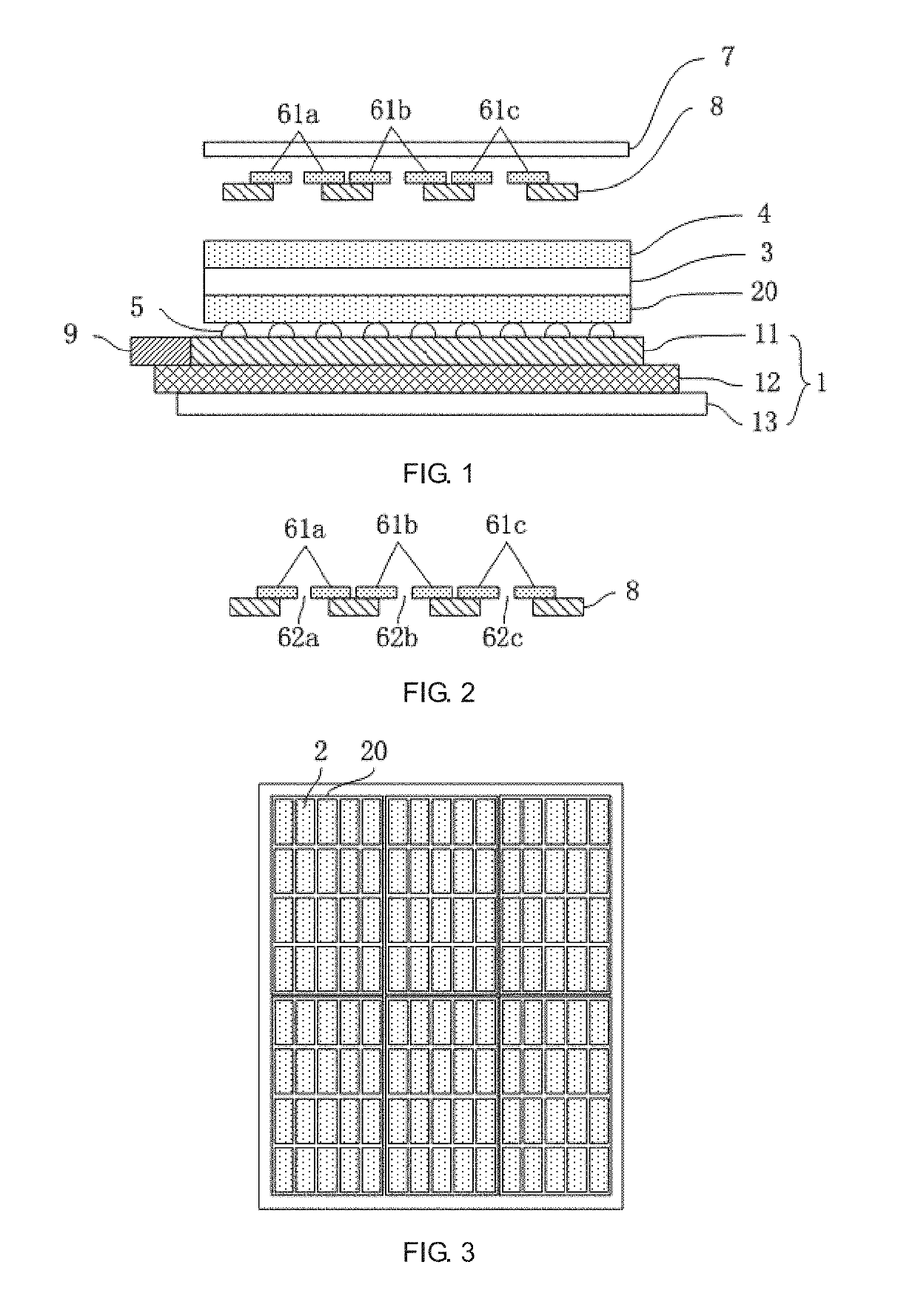
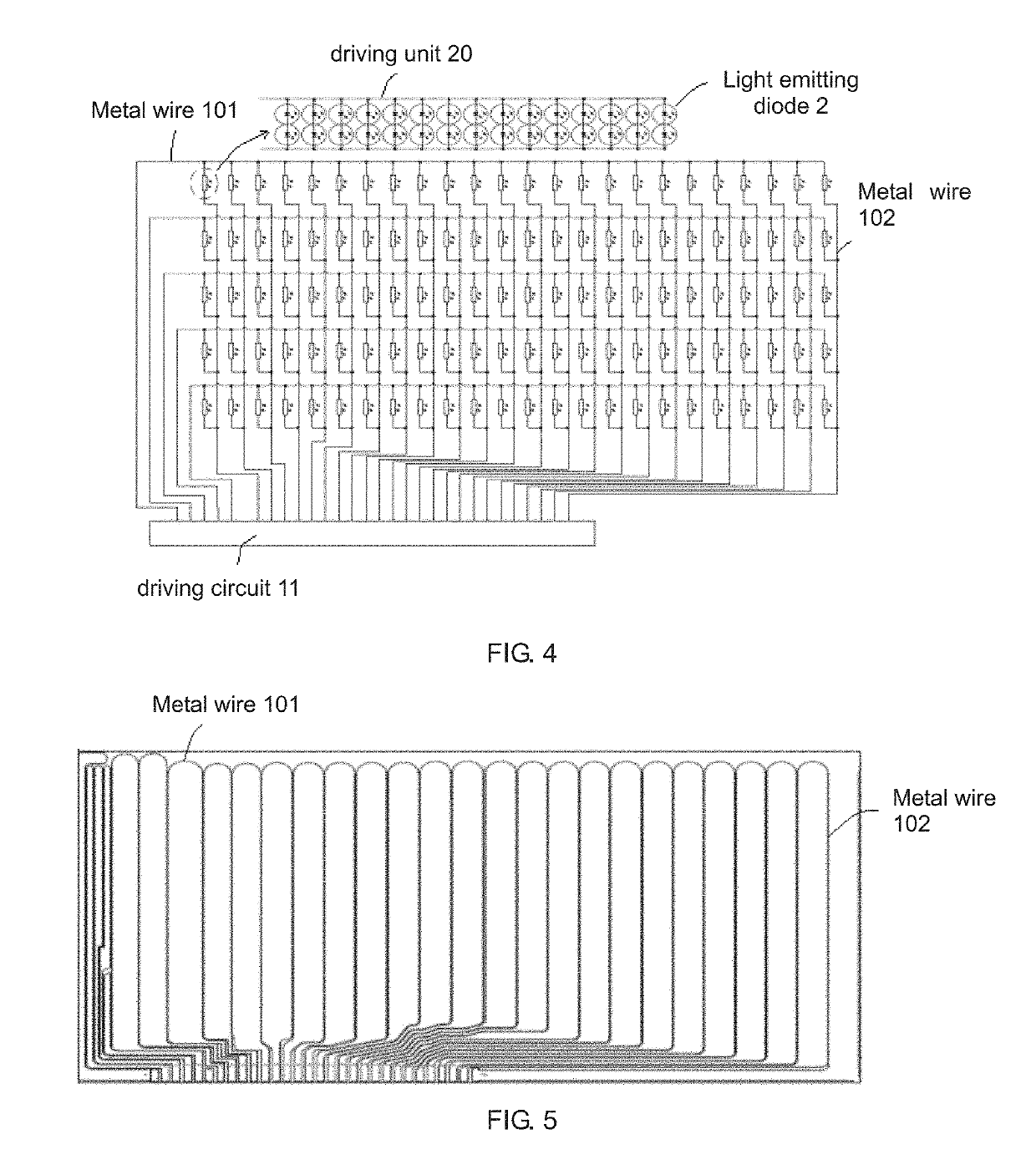
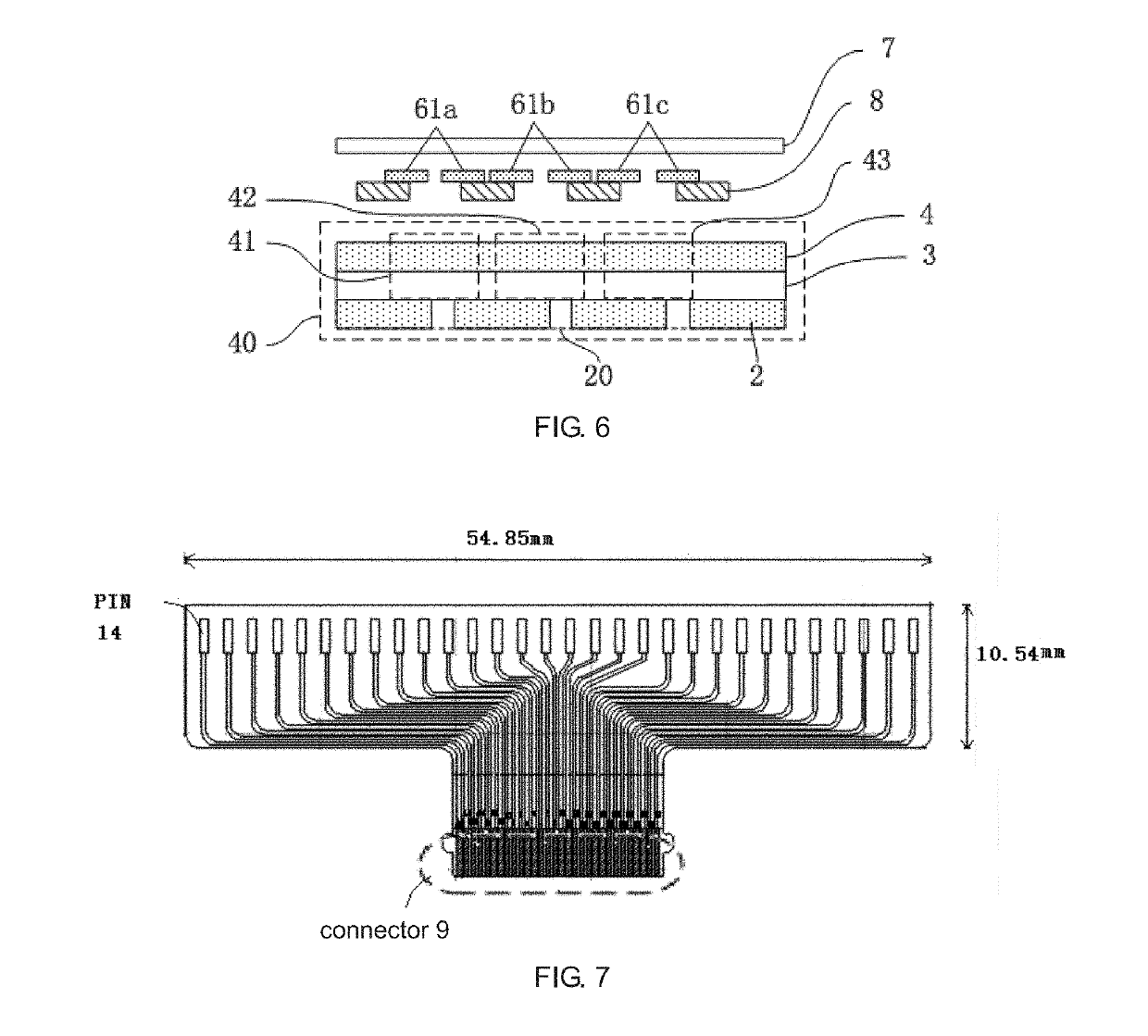
Driving substrate, light-emitting device and preparation method thereof
PatentPendingCN113380779A
Innovation
- The method of first bending the flexible film and then forming a connecting lead layer on the side of the electrode layer away from the base substrate is used to avoid an increase in stress on the connecting leads during the bending process, thereby ensuring the connection stability of the connecting leads.


Material Science Advancements for Bendable Mini LEDs
Recent advancements in material science have revolutionized the development of bendable Mini LEDs for curved display applications. Traditional rigid LED structures have been reimagined through innovative material combinations that maintain electrical performance while enabling mechanical flexibility. These developments represent a significant breakthrough in addressing the fundamental challenge of creating truly flexible display technologies.
Polymer-based substrates have emerged as a critical component in flexible Mini LED designs. High-performance polymers such as polyimide (PI) and polyethylene terephthalate (PET) offer excellent thermal stability and mechanical flexibility while providing the necessary electrical insulation properties. These materials can withstand repeated bending cycles without significant degradation, making them ideal candidates for curved display applications.
Conductive materials have also undergone substantial innovation to accommodate flexibility requirements. Silver nanowire networks and carbon-based nanomaterials (including graphene and carbon nanotubes) have demonstrated superior electrical conductivity while maintaining mechanical flexibility. These materials can be deposited as thin films on flexible substrates, creating bendable electrode structures that maintain performance under deformation conditions.
Encapsulation technologies have evolved to protect Mini LEDs from environmental factors while preserving flexibility. Thin-film encapsulation using alternating organic and inorganic layers provides effective moisture barriers while remaining bendable. Advanced atomic layer deposition (ALD) techniques enable the creation of ultra-thin protective layers that conform to curved surfaces without cracking or delamination.
Composite materials combining inorganic phosphors with flexible polymers have addressed the challenge of creating bendable color conversion layers. These materials maintain photoluminescent efficiency while accommodating mechanical stress, enabling consistent color performance across curved surfaces. Quantum dot-polymer composites have shown particular promise in this area, offering narrow emission spectra and high color purity even when subjected to bending forces.
Stretchable interconnect technologies represent another crucial advancement, allowing electrical connections to maintain integrity during bending. Serpentine metal traces, liquid metal alloys, and conductive elastomers provide reliable electrical pathways that can accommodate the mechanical deformation inherent in curved displays. These interconnects effectively distribute strain, preventing localized stress concentrations that could lead to electrical failure.
Adhesive technologies have also progressed significantly, with the development of flexible bonding materials that maintain strong adhesion under mechanical stress. These specialized adhesives ensure that the various layers of flexible Mini LED displays remain securely attached during repeated bending cycles, preventing delamination and maintaining optical alignment across curved surfaces.
Polymer-based substrates have emerged as a critical component in flexible Mini LED designs. High-performance polymers such as polyimide (PI) and polyethylene terephthalate (PET) offer excellent thermal stability and mechanical flexibility while providing the necessary electrical insulation properties. These materials can withstand repeated bending cycles without significant degradation, making them ideal candidates for curved display applications.
Conductive materials have also undergone substantial innovation to accommodate flexibility requirements. Silver nanowire networks and carbon-based nanomaterials (including graphene and carbon nanotubes) have demonstrated superior electrical conductivity while maintaining mechanical flexibility. These materials can be deposited as thin films on flexible substrates, creating bendable electrode structures that maintain performance under deformation conditions.
Encapsulation technologies have evolved to protect Mini LEDs from environmental factors while preserving flexibility. Thin-film encapsulation using alternating organic and inorganic layers provides effective moisture barriers while remaining bendable. Advanced atomic layer deposition (ALD) techniques enable the creation of ultra-thin protective layers that conform to curved surfaces without cracking or delamination.
Composite materials combining inorganic phosphors with flexible polymers have addressed the challenge of creating bendable color conversion layers. These materials maintain photoluminescent efficiency while accommodating mechanical stress, enabling consistent color performance across curved surfaces. Quantum dot-polymer composites have shown particular promise in this area, offering narrow emission spectra and high color purity even when subjected to bending forces.
Stretchable interconnect technologies represent another crucial advancement, allowing electrical connections to maintain integrity during bending. Serpentine metal traces, liquid metal alloys, and conductive elastomers provide reliable electrical pathways that can accommodate the mechanical deformation inherent in curved displays. These interconnects effectively distribute strain, preventing localized stress concentrations that could lead to electrical failure.
Adhesive technologies have also progressed significantly, with the development of flexible bonding materials that maintain strong adhesion under mechanical stress. These specialized adhesives ensure that the various layers of flexible Mini LED displays remain securely attached during repeated bending cycles, preventing delamination and maintaining optical alignment across curved surfaces.
Manufacturing Process Optimization for Curved Displays
Manufacturing process optimization for curved Mini LED displays requires significant advancements in both materials science and production techniques. Current manufacturing processes face challenges in maintaining consistent LED performance when bent or curved. The traditional rigid PCB substrates must be replaced with flexible alternatives such as polyimide films or specialized flexible circuit boards that can withstand repeated bending without performance degradation.
A critical optimization area involves the bonding techniques between Mini LEDs and flexible substrates. Conventional soldering methods often create stress points that fail during bending. Advanced techniques like anisotropic conductive film (ACF) bonding and laser-assisted bonding show promising results by creating more resilient connections while maintaining electrical performance across curved surfaces.
Thermal management represents another significant challenge in the manufacturing process. As displays curve, heat dissipation pathways become more complex and less efficient. Innovative approaches incorporate graphene-based thermal interface materials and micro-channel cooling systems directly into the flexible substrate. These solutions help maintain optimal operating temperatures even when the display is bent into various configurations.
The deposition and patterning processes for Mini LED arrays on flexible substrates require precision beyond current industry standards. Modified photolithography techniques and advanced pick-and-place equipment with six-axis movement capabilities enable accurate positioning of Mini LEDs on non-planar surfaces. Some manufacturers have developed proprietary "transfer printing" methods that can simultaneously place hundreds of Mini LEDs with micron-level accuracy onto curved substrates.
Encapsulation and protection layers must also be optimized for flexibility. Traditional rigid encapsulants crack under bending stress, exposing sensitive components to environmental damage. New silicone-based and elastomeric encapsulation materials maintain transparency and protection while accommodating the mechanical deformation of curved displays.
Quality control processes require adaptation for curved surfaces. Automated optical inspection systems with multiple cameras and advanced image processing algorithms can detect defects across curved surfaces that traditional flat-panel inspection systems would miss. Real-time monitoring during the manufacturing process helps identify potential failure points before final assembly.
Yield improvement represents the final frontier in manufacturing optimization. Current flexible Mini LED production yields remain significantly lower than rigid display manufacturing. Implementing statistical process control and machine learning algorithms to analyze production data helps identify critical parameters affecting yield and quality in curved display manufacturing.
A critical optimization area involves the bonding techniques between Mini LEDs and flexible substrates. Conventional soldering methods often create stress points that fail during bending. Advanced techniques like anisotropic conductive film (ACF) bonding and laser-assisted bonding show promising results by creating more resilient connections while maintaining electrical performance across curved surfaces.
Thermal management represents another significant challenge in the manufacturing process. As displays curve, heat dissipation pathways become more complex and less efficient. Innovative approaches incorporate graphene-based thermal interface materials and micro-channel cooling systems directly into the flexible substrate. These solutions help maintain optimal operating temperatures even when the display is bent into various configurations.
The deposition and patterning processes for Mini LED arrays on flexible substrates require precision beyond current industry standards. Modified photolithography techniques and advanced pick-and-place equipment with six-axis movement capabilities enable accurate positioning of Mini LEDs on non-planar surfaces. Some manufacturers have developed proprietary "transfer printing" methods that can simultaneously place hundreds of Mini LEDs with micron-level accuracy onto curved substrates.
Encapsulation and protection layers must also be optimized for flexibility. Traditional rigid encapsulants crack under bending stress, exposing sensitive components to environmental damage. New silicone-based and elastomeric encapsulation materials maintain transparency and protection while accommodating the mechanical deformation of curved displays.
Quality control processes require adaptation for curved surfaces. Automated optical inspection systems with multiple cameras and advanced image processing algorithms can detect defects across curved surfaces that traditional flat-panel inspection systems would miss. Real-time monitoring during the manufacturing process helps identify potential failure points before final assembly.
Yield improvement represents the final frontier in manufacturing optimization. Current flexible Mini LED production yields remain significantly lower than rigid display manufacturing. Implementing statistical process control and machine learning algorithms to analyze production data helps identify critical parameters affecting yield and quality in curved display manufacturing.
Unlock deeper insights with Patsnap Eureka Quick Research — get a full tech report to explore trends and direct your research. Try now!
Generate Your Research Report Instantly with AI Agent
Supercharge your innovation with Patsnap Eureka AI Agent Platform!