Enhancing Performance of ICP-MS in Handling Complex Matrices
SEP 19, 20259 MIN READ
Generate Your Research Report Instantly with AI Agent
Patsnap Eureka helps you evaluate technical feasibility & market potential.
ICP-MS Technology Evolution and Objectives
Inductively Coupled Plasma Mass Spectrometry (ICP-MS) has evolved significantly since its commercial introduction in the early 1980s. Initially developed as an analytical technique for elemental analysis, ICP-MS has transformed from a specialized research tool into a mainstream analytical instrument used across various industries including environmental monitoring, pharmaceuticals, food safety, and semiconductor manufacturing. The evolution of ICP-MS technology has been driven by the increasing demand for lower detection limits, higher sample throughput, and the ability to handle increasingly complex sample matrices.
The fundamental principle of ICP-MS involves the ionization of sample atoms in a high-temperature plasma, followed by mass spectrometric separation and detection of the resulting ions. Early ICP-MS systems faced significant challenges when analyzing complex matrices due to spectral interferences, matrix effects, and limited dynamic range. These limitations prompted continuous technological advancements aimed at enhancing the instrument's performance in handling complex samples.
Key technological milestones in ICP-MS development include the introduction of collision/reaction cell technology in the late 1990s, which significantly reduced polyatomic interferences; the development of high-resolution mass analyzers that enabled better separation of interfering species; and the integration of sample introduction systems designed specifically for challenging matrices. More recent innovations include triple quadrupole systems that offer enhanced interference removal capabilities and time-of-flight mass analyzers that provide simultaneous multi-element detection with minimal spectral overlap.
The primary objective of current ICP-MS technology development is to overcome the persistent challenges associated with complex matrix analysis. These challenges include spectral interferences from polyatomic species formed in the plasma, matrix-induced signal suppression or enhancement, and physical interferences caused by high dissolved solid content. Additionally, there is a growing need for improved sensitivity, precision, and accuracy, particularly for ultra-trace analysis in complex environmental and biological samples.
Future technological objectives focus on developing more robust plasma generation systems, advanced interference management strategies, and innovative sample introduction techniques. There is also significant interest in miniaturization and automation to reduce sample and reagent consumption while increasing throughput. The integration of artificial intelligence and machine learning algorithms for data processing and interpretation represents another frontier in ICP-MS technology evolution, potentially enabling more accurate analysis of complex matrices through improved pattern recognition and interference correction.
The fundamental principle of ICP-MS involves the ionization of sample atoms in a high-temperature plasma, followed by mass spectrometric separation and detection of the resulting ions. Early ICP-MS systems faced significant challenges when analyzing complex matrices due to spectral interferences, matrix effects, and limited dynamic range. These limitations prompted continuous technological advancements aimed at enhancing the instrument's performance in handling complex samples.
Key technological milestones in ICP-MS development include the introduction of collision/reaction cell technology in the late 1990s, which significantly reduced polyatomic interferences; the development of high-resolution mass analyzers that enabled better separation of interfering species; and the integration of sample introduction systems designed specifically for challenging matrices. More recent innovations include triple quadrupole systems that offer enhanced interference removal capabilities and time-of-flight mass analyzers that provide simultaneous multi-element detection with minimal spectral overlap.
The primary objective of current ICP-MS technology development is to overcome the persistent challenges associated with complex matrix analysis. These challenges include spectral interferences from polyatomic species formed in the plasma, matrix-induced signal suppression or enhancement, and physical interferences caused by high dissolved solid content. Additionally, there is a growing need for improved sensitivity, precision, and accuracy, particularly for ultra-trace analysis in complex environmental and biological samples.
Future technological objectives focus on developing more robust plasma generation systems, advanced interference management strategies, and innovative sample introduction techniques. There is also significant interest in miniaturization and automation to reduce sample and reagent consumption while increasing throughput. The integration of artificial intelligence and machine learning algorithms for data processing and interpretation represents another frontier in ICP-MS technology evolution, potentially enabling more accurate analysis of complex matrices through improved pattern recognition and interference correction.
Market Analysis for Advanced Analytical Instrumentation
The global market for advanced analytical instrumentation continues to experience robust growth, driven by increasing demand for precise analytical capabilities across various industries. The ICP-MS (Inductively Coupled Plasma Mass Spectrometry) segment represents a significant portion of this market, valued at approximately $1.2 billion in 2022 with projections to reach $1.8 billion by 2027, growing at a CAGR of 8.5%.
Key industries driving this growth include environmental testing, pharmaceuticals, food safety, mining, and semiconductor manufacturing. These sectors increasingly require sophisticated analytical tools capable of handling complex matrices while maintaining high sensitivity and accuracy. The pharmaceutical sector alone accounts for nearly 24% of the ICP-MS market, followed closely by environmental testing at 22%.
Regional analysis reveals North America currently holds the largest market share at 38%, followed by Europe (29%) and Asia-Pacific (26%). However, the Asia-Pacific region is experiencing the fastest growth rate at 10.2% annually, primarily due to expanding industrial activities in China, India, and South Korea, coupled with strengthening regulatory frameworks for environmental and product safety.
Market segmentation by instrument type shows high-resolution ICP-MS systems gaining significant traction, with a market share increase from 18% to 23% over the past three years. This trend reflects the growing need for instruments capable of resolving complex spectral interferences in challenging sample matrices.
Competitive landscape analysis identifies five major players controlling approximately 65% of the global ICP-MS market. These companies are increasingly focusing on developing advanced matrix handling capabilities as a key differentiator. Recent market surveys indicate that 78% of end-users rank "ability to handle complex matrices" among their top three purchasing criteria, highlighting a clear market demand for enhanced performance in this area.
Price sensitivity varies significantly by region and industry segment. Academic and governmental research institutions demonstrate higher price sensitivity, while pharmaceutical and semiconductor industries prioritize performance over cost. The average selling price for advanced ICP-MS systems has increased by 12% over the past five years, reflecting the incorporation of more sophisticated matrix handling technologies.
Customer feedback analysis reveals growing demand for automated sample preparation systems integrated with ICP-MS instruments, with 67% of users citing sample preparation as the most time-consuming aspect of their analytical workflow when dealing with complex matrices.
Key industries driving this growth include environmental testing, pharmaceuticals, food safety, mining, and semiconductor manufacturing. These sectors increasingly require sophisticated analytical tools capable of handling complex matrices while maintaining high sensitivity and accuracy. The pharmaceutical sector alone accounts for nearly 24% of the ICP-MS market, followed closely by environmental testing at 22%.
Regional analysis reveals North America currently holds the largest market share at 38%, followed by Europe (29%) and Asia-Pacific (26%). However, the Asia-Pacific region is experiencing the fastest growth rate at 10.2% annually, primarily due to expanding industrial activities in China, India, and South Korea, coupled with strengthening regulatory frameworks for environmental and product safety.
Market segmentation by instrument type shows high-resolution ICP-MS systems gaining significant traction, with a market share increase from 18% to 23% over the past three years. This trend reflects the growing need for instruments capable of resolving complex spectral interferences in challenging sample matrices.
Competitive landscape analysis identifies five major players controlling approximately 65% of the global ICP-MS market. These companies are increasingly focusing on developing advanced matrix handling capabilities as a key differentiator. Recent market surveys indicate that 78% of end-users rank "ability to handle complex matrices" among their top three purchasing criteria, highlighting a clear market demand for enhanced performance in this area.
Price sensitivity varies significantly by region and industry segment. Academic and governmental research institutions demonstrate higher price sensitivity, while pharmaceutical and semiconductor industries prioritize performance over cost. The average selling price for advanced ICP-MS systems has increased by 12% over the past five years, reflecting the incorporation of more sophisticated matrix handling technologies.
Customer feedback analysis reveals growing demand for automated sample preparation systems integrated with ICP-MS instruments, with 67% of users citing sample preparation as the most time-consuming aspect of their analytical workflow when dealing with complex matrices.
Current Challenges in Complex Matrix Analysis
The analysis of complex matrices presents significant challenges for ICP-MS technology, limiting its effectiveness in various applications. Complex matrices, including biological samples, environmental specimens, and industrial materials, contain high concentrations of dissolved solids, organic compounds, and interfering elements that can compromise analytical accuracy and instrument performance.
Matrix effects represent the primary challenge, manifesting as signal suppression or enhancement due to the physical and chemical properties of the sample matrix. These effects can alter ionization efficiency in the plasma, leading to unpredictable analytical responses and compromised quantification. For instance, high-salt matrices can cause up to 50-80% signal depression for certain elements, while organic-rich samples may enhance signals for others, creating a complex analytical landscape.
Spectral interferences further complicate analysis, occurring when polyatomic ions or isobars have the same mass-to-charge ratio as the analyte of interest. Common examples include 40Ar16O+ interfering with 56Fe+ and 40Ar35Cl+ with 75As+. These interferences are particularly problematic in environmental and geological samples where the matrix composition is highly variable and often unpredictable.
Physical interferences also present significant obstacles. Sample introduction systems can become clogged with high-dissolved solids, leading to drift in sensitivity and precision over analytical runs. Salt deposits on sampling cones and ion lenses reduce ion transmission efficiency and require frequent maintenance, increasing downtime and operational costs. Studies indicate that samples with total dissolved solids exceeding 0.2% can cause significant signal instability within hours of operation.
Memory effects pose additional challenges, particularly with elements like mercury, boron, and iodine, which can adsorb onto sample introduction components and slowly release during subsequent analyses. This phenomenon creates elevated backgrounds and potential cross-contamination between samples, compromising detection limits and analytical accuracy.
The diversity of matrix types encountered in real-world applications further complicates standardization efforts. Each matrix type—whether biological fluids, environmental waters, or industrial materials—presents unique challenges requiring specialized sample preparation protocols and instrument configurations. This diversity makes it difficult to develop universal analytical methods applicable across different sample types.
Current sample preparation techniques, while helpful, often introduce additional variables and potential contamination sources. Dilution reduces matrix effects but sacrifices detection limits, while acid digestion may not completely eliminate organic interferences and can introduce new contaminants. These limitations highlight the need for more robust and efficient approaches to complex matrix handling in ICP-MS analysis.
Matrix effects represent the primary challenge, manifesting as signal suppression or enhancement due to the physical and chemical properties of the sample matrix. These effects can alter ionization efficiency in the plasma, leading to unpredictable analytical responses and compromised quantification. For instance, high-salt matrices can cause up to 50-80% signal depression for certain elements, while organic-rich samples may enhance signals for others, creating a complex analytical landscape.
Spectral interferences further complicate analysis, occurring when polyatomic ions or isobars have the same mass-to-charge ratio as the analyte of interest. Common examples include 40Ar16O+ interfering with 56Fe+ and 40Ar35Cl+ with 75As+. These interferences are particularly problematic in environmental and geological samples where the matrix composition is highly variable and often unpredictable.
Physical interferences also present significant obstacles. Sample introduction systems can become clogged with high-dissolved solids, leading to drift in sensitivity and precision over analytical runs. Salt deposits on sampling cones and ion lenses reduce ion transmission efficiency and require frequent maintenance, increasing downtime and operational costs. Studies indicate that samples with total dissolved solids exceeding 0.2% can cause significant signal instability within hours of operation.
Memory effects pose additional challenges, particularly with elements like mercury, boron, and iodine, which can adsorb onto sample introduction components and slowly release during subsequent analyses. This phenomenon creates elevated backgrounds and potential cross-contamination between samples, compromising detection limits and analytical accuracy.
The diversity of matrix types encountered in real-world applications further complicates standardization efforts. Each matrix type—whether biological fluids, environmental waters, or industrial materials—presents unique challenges requiring specialized sample preparation protocols and instrument configurations. This diversity makes it difficult to develop universal analytical methods applicable across different sample types.
Current sample preparation techniques, while helpful, often introduce additional variables and potential contamination sources. Dilution reduces matrix effects but sacrifices detection limits, while acid digestion may not completely eliminate organic interferences and can introduce new contaminants. These limitations highlight the need for more robust and efficient approaches to complex matrix handling in ICP-MS analysis.
Current Matrix Interference Mitigation Strategies
01 ICP-MS System Design and Components
Innovations in the design and components of ICP-MS systems to enhance performance. These include improved ion source configurations, interface designs, and detector systems that increase sensitivity, stability, and reliability. Advanced components such as specialized plasma torches, sample introduction systems, and ion optics contribute to better analytical performance and reduced interference.- ICP-MS System Design and Components: Innovations in the design and components of ICP-MS systems to enhance overall performance. These include improved plasma torch designs, interface configurations, ion optics, and detector systems that collectively contribute to better sensitivity, stability, and reliability of measurements. Advanced system architectures optimize ion transmission and reduce interferences, resulting in more accurate elemental analysis.
- Sample Introduction and Preparation Techniques: Methods and devices for optimizing sample introduction and preparation for ICP-MS analysis. These innovations focus on improving nebulization efficiency, aerosol generation, and sample transport to the plasma. Advanced sample preparation techniques help minimize matrix effects, reduce contamination, and enhance the stability of analytes, leading to more reliable and sensitive measurements across various sample types.
- Interference Reduction and Elimination Methods: Techniques for reducing or eliminating spectral and non-spectral interferences in ICP-MS analysis. These include collision/reaction cell technologies, mathematical correction models, and specialized sample introduction systems. By effectively managing polyatomic interferences, matrix effects, and isobaric overlaps, these methods significantly improve measurement accuracy, especially for complex samples and challenging elements.
- Calibration and Quantification Strategies: Advanced calibration and quantification approaches to enhance the accuracy and precision of ICP-MS measurements. These include internal standardization techniques, isotope dilution methods, standard addition procedures, and matrix-matched calibration strategies. Improved calibration methodologies help compensate for matrix effects, instrument drift, and sensitivity variations, resulting in more reliable quantitative analysis across diverse sample types.
- Specialized Applications and Hyphenated Techniques: Integration of ICP-MS with other analytical techniques and specialized applications to expand analytical capabilities. These include coupling with chromatographic methods (LC-ICP-MS, GC-ICP-MS), laser ablation systems (LA-ICP-MS), and field flow fractionation. These hyphenated techniques enable speciation analysis, nanoparticle characterization, imaging applications, and other advanced analytical workflows that enhance the information obtained from samples.
02 Sample Introduction and Preparation Techniques
Methods for optimizing sample introduction and preparation for ICP-MS analysis. These techniques include specialized nebulizers, spray chambers, and sample dilution protocols that improve sample transport efficiency and stability. Automated sample preparation systems and microfluidic devices enable more consistent results and higher throughput while reducing contamination risks and matrix effects.Expand Specific Solutions03 Interference Reduction and Elimination Methods
Techniques for reducing or eliminating spectral and non-spectral interferences in ICP-MS analysis. These include collision/reaction cell technologies, mathematical correction algorithms, and specialized sample preparation methods. Advanced plasma control parameters and ion filtering techniques help improve detection limits and accuracy for challenging sample matrices and elements.Expand Specific Solutions04 Calibration and Quantification Strategies
Innovative calibration and quantification approaches for improving ICP-MS measurement accuracy and precision. These include internal standardization techniques, isotope dilution methods, and matrix-matched calibration strategies. Advanced software algorithms for data processing and automated calibration systems help enhance analytical performance and reliability across different sample types.Expand Specific Solutions05 Specialized Applications and Hyphenated Techniques
Integration of ICP-MS with other analytical techniques and specialized applications to expand capabilities. These include coupling with chromatography systems (LC-ICP-MS, GC-ICP-MS), laser ablation systems (LA-ICP-MS), and field flow fractionation. These hyphenated techniques enable speciation analysis, nanoparticle characterization, imaging applications, and improved detection limits for specific analytical challenges.Expand Specific Solutions
Leading Manufacturers and Research Institutions
The ICP-MS complex matrices performance enhancement market is currently in a growth phase, with increasing demand across analytical chemistry, environmental monitoring, and pharmaceutical sectors. The global market size for advanced ICP-MS technologies is expanding at approximately 6-8% annually, driven by rising requirements for trace element analysis in complex samples. Leading players include established analytical instrumentation companies like Agilent Technologies, Thermo Fisher Scientific (Bremen), and Shimadzu Corporation, who have developed mature matrix tolerance technologies. Emerging competitors such as PerkinElmer Health Sciences are introducing innovative sample introduction systems and collision/reaction cell technologies. The technology is approaching maturity in standard applications but continues to evolve for challenging matrices, with university collaborations (Wuhan University, Sun Yat-sen University) accelerating innovation in interference removal and sensitivity enhancement techniques.
Thermo Fisher Scientific (Bremen) GmbH
Technical Solution: Thermo Fisher Scientific has developed advanced ICP-MS systems with collision/reaction cell technology that effectively removes polyatomic interferences in complex matrices. Their iCAP RQ ICP-MS platform incorporates QCell collision/reaction cell technology with helium collision mode and kinetic energy discrimination to eliminate polyatomic species while maintaining analyte sensitivity. The system features intelligent autotuning capabilities that optimize performance parameters based on sample matrix composition, ensuring consistent results across varying sample types. Additionally, their Triple Quadrupole ICP-MS (iCAP TQ) technology provides enhanced selectivity through MS/MS capabilities, allowing for effective handling of complex matrices by removing both spectral and non-spectral interferences. The system's integrated software includes matrix-specific protocols that automatically adjust acquisition parameters to compensate for matrix effects in challenging samples.
Strengths: Industry-leading sensitivity and interference removal capabilities through advanced collision/reaction cell technology; comprehensive software solutions for automated matrix handling; robust plasma generation that maintains stability with high dissolved solid content. Weaknesses: Higher acquisition and operational costs compared to some competitors; requires specialized training for optimal utilization of advanced features; consumable parts may need more frequent replacement when continuously analyzing complex matrices.
Agilent Technologies, Inc.
Technical Solution: Agilent Technologies has pioneered the Octopole Reaction System (ORS) for their ICP-MS instruments, specifically designed to handle complex matrices. Their 7900 ICP-MS incorporates fourth-generation ORS technology with helium mode capability that effectively removes polyatomic interferences through kinetic energy discrimination while maintaining high sensitivity. For ultra-trace analysis in complex matrices, Agilent's 8900 Triple Quadrupole ICP-MS employs MS/MS technology that provides unprecedented control of reaction chemistry in the collision/reaction cell, enabling effective removal of spectral interferences that cannot be addressed by conventional single-quadrupole systems. Agilent has also developed High Matrix Introduction (HMI) technology that dilutes the sample aerosol before it enters the plasma, allowing direct analysis of samples containing up to 3% total dissolved solids without manual dilution. Their Ultra High Matrix Introduction (UHMI) system extends this capability to samples with up to 25% dissolved solids, significantly expanding the application range for complex matrices.
Strengths: Exceptional matrix tolerance through HMI/UHMI technology; highly effective interference removal with ORS technology; robust hardware design that minimizes maintenance requirements even with challenging samples. Weaknesses: Complex operational parameters may require advanced user training; premium pricing structure compared to basic ICP-MS systems; optimization for specific matrix types may require specialized method development.
Key Innovations in Collision/Reaction Cell Technology
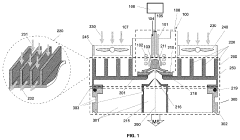
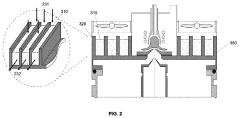
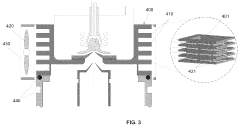
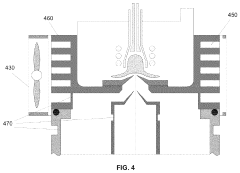
Air-cooled interface for inductively coupled plasma mass spectrometer (ICP-MS)
PatentActiveUS11864303B2
Innovation
- An air-cooled interface for ICP-MS systems using fins, open-cell metal foams, compact heat exchangers, or heat pipes to manage heat dissipation, with adjustable thermal resistors to direct heat away from sensitive components and prevent recombination, utilizing natural or forced convection to enhance cooling efficiency.
Plasma sampling interface for inductively coupled plasma-mass spectrometry (ICP-MS)
PatentInactiveUS5218204A
Innovation
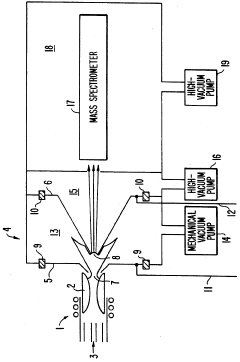
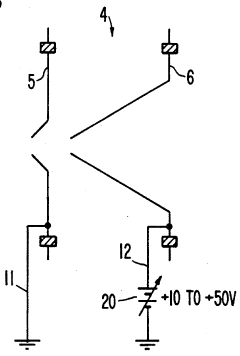
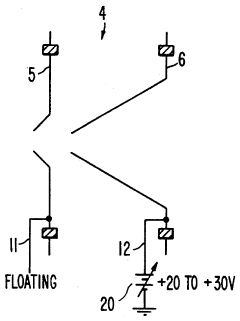
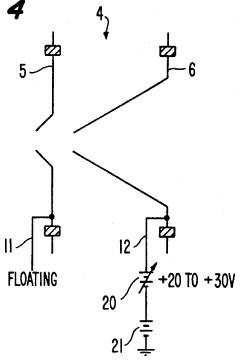
- A plasma sampling interface with insulating spacers and an adjustable DC bias voltage source applying a DC bias voltage of 10 to 50 V to the skimmer, allowing the sampler to float or grounding it, enhances ion transmission by using a DC offset voltage for mass spectrometers requiring higher initial ion energy.
Regulatory Standards for Trace Element Analysis
Regulatory standards for trace element analysis in complex matrices have evolved significantly over the past decades, driven by increasing awareness of environmental contamination and its impact on human health. Organizations such as the Environmental Protection Agency (EPA), Food and Drug Administration (FDA), and international bodies like the World Health Organization (WHO) have established comprehensive frameworks for monitoring trace elements across various matrices.
The EPA's Method 6020B specifically addresses ICP-MS analysis for trace elements in environmental samples, setting forth stringent quality control requirements and detection limits. This method acknowledges the challenges posed by complex matrices and provides detailed protocols for sample preparation, interference reduction, and validation procedures. Similarly, the FDA has developed specialized methods for food and pharmaceutical products, recognizing the unique matrix effects encountered in these samples.
European regulations, particularly those established by the European Food Safety Authority (EFSA), have implemented some of the world's most rigorous standards for trace element analysis. The EU Water Framework Directive (2000/60/EC) and Drinking Water Directive (98/83/EC) mandate extremely low detection limits for toxic elements like arsenic, cadmium, and lead, necessitating advanced ICP-MS methodologies capable of handling matrix interferences.
In clinical diagnostics, the Clinical Laboratory Improvement Amendments (CLIA) and College of American Pathologists (CAP) have established protocols for trace element analysis in biological fluids. These standards emphasize the importance of accuracy and precision when analyzing complex biological matrices, where protein binding and varying salt concentrations can significantly impact measurement reliability.
ISO standards, particularly ISO 17025 for testing laboratories, provide a framework for method validation and quality assurance in trace element analysis. These standards require laboratories to demonstrate their ability to consistently produce accurate results despite matrix challenges, through rigorous validation studies and participation in proficiency testing programs.
Emerging regulations are increasingly focusing on speciation analysis rather than total element concentrations, recognizing that the toxicity and bioavailability of elements vary significantly depending on their chemical form. This trend is pushing ICP-MS technology toward more sophisticated coupling techniques, such as LC-ICP-MS and GC-ICP-MS, to meet regulatory requirements for species-specific quantification in complex matrices.
Compliance with these evolving regulatory standards necessitates continuous improvement in ICP-MS methodologies, particularly in addressing matrix effects through advanced sample preparation techniques, collision/reaction cell technologies, and mathematical correction models.
The EPA's Method 6020B specifically addresses ICP-MS analysis for trace elements in environmental samples, setting forth stringent quality control requirements and detection limits. This method acknowledges the challenges posed by complex matrices and provides detailed protocols for sample preparation, interference reduction, and validation procedures. Similarly, the FDA has developed specialized methods for food and pharmaceutical products, recognizing the unique matrix effects encountered in these samples.
European regulations, particularly those established by the European Food Safety Authority (EFSA), have implemented some of the world's most rigorous standards for trace element analysis. The EU Water Framework Directive (2000/60/EC) and Drinking Water Directive (98/83/EC) mandate extremely low detection limits for toxic elements like arsenic, cadmium, and lead, necessitating advanced ICP-MS methodologies capable of handling matrix interferences.
In clinical diagnostics, the Clinical Laboratory Improvement Amendments (CLIA) and College of American Pathologists (CAP) have established protocols for trace element analysis in biological fluids. These standards emphasize the importance of accuracy and precision when analyzing complex biological matrices, where protein binding and varying salt concentrations can significantly impact measurement reliability.
ISO standards, particularly ISO 17025 for testing laboratories, provide a framework for method validation and quality assurance in trace element analysis. These standards require laboratories to demonstrate their ability to consistently produce accurate results despite matrix challenges, through rigorous validation studies and participation in proficiency testing programs.
Emerging regulations are increasingly focusing on speciation analysis rather than total element concentrations, recognizing that the toxicity and bioavailability of elements vary significantly depending on their chemical form. This trend is pushing ICP-MS technology toward more sophisticated coupling techniques, such as LC-ICP-MS and GC-ICP-MS, to meet regulatory requirements for species-specific quantification in complex matrices.
Compliance with these evolving regulatory standards necessitates continuous improvement in ICP-MS methodologies, particularly in addressing matrix effects through advanced sample preparation techniques, collision/reaction cell technologies, and mathematical correction models.
Environmental Applications and Sustainability Impact
ICP-MS technology has emerged as a critical tool in environmental monitoring and analysis, offering unprecedented sensitivity for detecting trace elements in various environmental matrices. The application of enhanced ICP-MS methodologies in environmental science directly contributes to more accurate pollution assessment, enabling scientists to detect contaminants at previously undetectable levels. This advancement is particularly valuable for monitoring heavy metals and other toxic elements in water bodies, soil samples, and atmospheric particulates.
The sustainability impact of improved ICP-MS performance extends beyond mere detection capabilities. By enabling more precise quantification of pollutants in complex environmental matrices, regulatory agencies can establish more informed environmental quality standards. This precision allows for the development of targeted remediation strategies that address specific contaminants rather than employing broader, less efficient approaches. The result is more cost-effective environmental management and conservation efforts.
In agricultural applications, enhanced ICP-MS techniques facilitate better understanding of soil composition and contamination, supporting sustainable farming practices. Farmers can optimize fertilizer application based on precise soil element analysis, reducing unnecessary chemical inputs and minimizing environmental impact while maintaining crop yields. This represents a significant contribution to sustainable agriculture and food security.
The technology also plays a crucial role in climate change research by enabling the analysis of ice cores, sediments, and other environmental archives with complex matrices. These analyses provide valuable data on historical climate patterns and anthropogenic impacts, informing climate models and mitigation strategies. The ability to handle complex matrices in these samples ensures more reliable paleoclimate reconstructions.
Urban environmental monitoring benefits substantially from advanced ICP-MS capabilities. Municipal authorities can implement more comprehensive monitoring programs for drinking water, urban soil, and air quality. The technology's improved performance with complex urban environmental samples supports public health protection through early detection of contamination events and long-term exposure assessment.
Additionally, enhanced ICP-MS methodologies contribute to circular economy initiatives by enabling more effective recycling processes. Precise elemental analysis of waste materials facilitates better sorting and recovery of valuable elements, reducing resource extraction demands. This application directly supports sustainability goals by extending resource lifecycles and minimizing waste.
The sustainability impact of improved ICP-MS performance extends beyond mere detection capabilities. By enabling more precise quantification of pollutants in complex environmental matrices, regulatory agencies can establish more informed environmental quality standards. This precision allows for the development of targeted remediation strategies that address specific contaminants rather than employing broader, less efficient approaches. The result is more cost-effective environmental management and conservation efforts.
In agricultural applications, enhanced ICP-MS techniques facilitate better understanding of soil composition and contamination, supporting sustainable farming practices. Farmers can optimize fertilizer application based on precise soil element analysis, reducing unnecessary chemical inputs and minimizing environmental impact while maintaining crop yields. This represents a significant contribution to sustainable agriculture and food security.
The technology also plays a crucial role in climate change research by enabling the analysis of ice cores, sediments, and other environmental archives with complex matrices. These analyses provide valuable data on historical climate patterns and anthropogenic impacts, informing climate models and mitigation strategies. The ability to handle complex matrices in these samples ensures more reliable paleoclimate reconstructions.
Urban environmental monitoring benefits substantially from advanced ICP-MS capabilities. Municipal authorities can implement more comprehensive monitoring programs for drinking water, urban soil, and air quality. The technology's improved performance with complex urban environmental samples supports public health protection through early detection of contamination events and long-term exposure assessment.
Additionally, enhanced ICP-MS methodologies contribute to circular economy initiatives by enabling more effective recycling processes. Precise elemental analysis of waste materials facilitates better sorting and recovery of valuable elements, reducing resource extraction demands. This application directly supports sustainability goals by extending resource lifecycles and minimizing waste.
Unlock deeper insights with Patsnap Eureka Quick Research — get a full tech report to explore trends and direct your research. Try now!
Generate Your Research Report Instantly with AI Agent
Supercharge your innovation with Patsnap Eureka AI Agent Platform!