

GDI Engine Transients Performance Optimization Methods
AUG 28, 20259 MIN READ
Generate Your Research Report Instantly with AI Agent
PatSnap Eureka helps you evaluate technical feasibility & market potential.
GDI Engine Transient Performance Background and Objectives
Gasoline Direct Injection (GDI) engine technology has evolved significantly over the past three decades, revolutionizing the automotive industry with its superior fuel efficiency and reduced emissions. The development trajectory began in the late 1990s with first-generation systems focused primarily on stratified charge operation. By the mid-2000s, second-generation GDI systems emerged with improved injector designs and more sophisticated control strategies, enabling wider operating ranges and better performance.
The current third-generation GDI systems incorporate advanced spray-guided designs, multiple injection capabilities, and integration with other technologies such as turbocharging and variable valve timing. This evolution has been driven by increasingly stringent global emission regulations, consumer demand for fuel efficiency, and the competitive automotive market landscape.
Despite these advancements, GDI engines continue to face significant challenges during transient operations - the dynamic periods of acceleration, deceleration, and load changes. These transient conditions represent a substantial portion of real-world driving scenarios and often result in suboptimal performance, increased emissions, and reduced drivability compared to steady-state operation.
The primary technical challenges during transients include wall wetting phenomena, air-fuel ratio excursions, combustion instability, and particulate matter formation. These issues are particularly pronounced during cold starts, tip-in/tip-out maneuvers, and rapid load changes. The complexity arises from the multiphysics nature of the problem, involving fuel spray dynamics, air-fuel mixing, combustion chemistry, and thermal management - all occurring within millisecond timeframes.
The objective of GDI engine transient performance optimization is to develop robust control strategies and hardware solutions that maintain optimal combustion efficiency and emissions compliance across all operating conditions. This includes minimizing response delays, reducing calibration complexity, and ensuring consistent performance regardless of environmental conditions or driver behavior.
Key technical goals include developing predictive control algorithms that anticipate transient events, implementing hardware modifications to improve fuel atomization and mixture formation during dynamic conditions, and creating integrated systems approaches that coordinate multiple engine subsystems during transients. Additionally, there is a focus on leveraging advanced sensing technologies and real-time computational methods to enable faster and more precise adjustments during transient operations.
The ultimate aim is to close the performance gap between steady-state and transient operation, ensuring that the theoretical benefits of GDI technology are fully realized in practical driving scenarios while meeting increasingly stringent emissions standards worldwide.
The current third-generation GDI systems incorporate advanced spray-guided designs, multiple injection capabilities, and integration with other technologies such as turbocharging and variable valve timing. This evolution has been driven by increasingly stringent global emission regulations, consumer demand for fuel efficiency, and the competitive automotive market landscape.
Despite these advancements, GDI engines continue to face significant challenges during transient operations - the dynamic periods of acceleration, deceleration, and load changes. These transient conditions represent a substantial portion of real-world driving scenarios and often result in suboptimal performance, increased emissions, and reduced drivability compared to steady-state operation.
The primary technical challenges during transients include wall wetting phenomena, air-fuel ratio excursions, combustion instability, and particulate matter formation. These issues are particularly pronounced during cold starts, tip-in/tip-out maneuvers, and rapid load changes. The complexity arises from the multiphysics nature of the problem, involving fuel spray dynamics, air-fuel mixing, combustion chemistry, and thermal management - all occurring within millisecond timeframes.
The objective of GDI engine transient performance optimization is to develop robust control strategies and hardware solutions that maintain optimal combustion efficiency and emissions compliance across all operating conditions. This includes minimizing response delays, reducing calibration complexity, and ensuring consistent performance regardless of environmental conditions or driver behavior.
Key technical goals include developing predictive control algorithms that anticipate transient events, implementing hardware modifications to improve fuel atomization and mixture formation during dynamic conditions, and creating integrated systems approaches that coordinate multiple engine subsystems during transients. Additionally, there is a focus on leveraging advanced sensing technologies and real-time computational methods to enable faster and more precise adjustments during transient operations.
The ultimate aim is to close the performance gap between steady-state and transient operation, ensuring that the theoretical benefits of GDI technology are fully realized in practical driving scenarios while meeting increasingly stringent emissions standards worldwide.
Market Demand Analysis for Optimized GDI Engine Performance
The global automotive industry is witnessing a significant shift towards more efficient and environmentally friendly vehicles, driving substantial market demand for optimized Gasoline Direct Injection (GDI) engine performance. This demand is particularly focused on transient performance optimization, which addresses the critical moments of acceleration, deceleration, and load changes where emissions and efficiency typically suffer.
Market research indicates that the GDI engine market was valued at approximately $41.7 billion in 2022 and is projected to grow at a compound annual growth rate of 6.8% through 2030. This growth is primarily driven by stringent emission regulations worldwide, including Euro 7 in Europe, China 6b standards, and Corporate Average Fuel Economy (CAFE) standards in the United States, which are pushing manufacturers to enhance engine efficiency during all operating conditions.
Consumer preferences are also evolving, with increasing demand for vehicles that offer both performance and fuel economy. A recent survey of new vehicle buyers revealed that 78% consider fuel efficiency a top priority, while 65% are unwilling to compromise on acceleration and responsiveness. This dual requirement places transient performance optimization at the center of market demands.
Fleet operators and commercial vehicle manufacturers represent another significant market segment, with fuel costs constituting up to 30% of their operating expenses. Optimization technologies that can reduce fuel consumption during frequent stop-start cycles and varying load conditions offer substantial economic benefits to this sector.
The aftermarket for GDI optimization solutions is also expanding, with a market size of $3.2 billion in 2022. This includes software updates, replacement components, and calibration services aimed at improving transient performance in existing vehicles.
Regional analysis shows varying market dynamics. In mature markets like North America and Europe, the focus is on premium solutions that offer marginal improvements in already advanced engines. In contrast, emerging markets in Asia-Pacific and Latin America show stronger growth potential for cost-effective optimization technologies that can be widely implemented across various vehicle segments.
The electric vehicle transition paradoxically strengthens the market for GDI optimization in the medium term. As manufacturers allocate resources to electrification, they seek cost-effective ways to improve their conventional powertrains during the transition period, estimated to last 15-20 years in most markets. This creates a specific demand window for technologies that can be implemented without requiring complete powertrain redesigns.
Market forecasts suggest that technologies specifically addressing transient performance optimization could capture a specialized segment worth $5.8 billion by 2028, representing a high-value opportunity for companies with expertise in this niche area.
Market research indicates that the GDI engine market was valued at approximately $41.7 billion in 2022 and is projected to grow at a compound annual growth rate of 6.8% through 2030. This growth is primarily driven by stringent emission regulations worldwide, including Euro 7 in Europe, China 6b standards, and Corporate Average Fuel Economy (CAFE) standards in the United States, which are pushing manufacturers to enhance engine efficiency during all operating conditions.
Consumer preferences are also evolving, with increasing demand for vehicles that offer both performance and fuel economy. A recent survey of new vehicle buyers revealed that 78% consider fuel efficiency a top priority, while 65% are unwilling to compromise on acceleration and responsiveness. This dual requirement places transient performance optimization at the center of market demands.
Fleet operators and commercial vehicle manufacturers represent another significant market segment, with fuel costs constituting up to 30% of their operating expenses. Optimization technologies that can reduce fuel consumption during frequent stop-start cycles and varying load conditions offer substantial economic benefits to this sector.
The aftermarket for GDI optimization solutions is also expanding, with a market size of $3.2 billion in 2022. This includes software updates, replacement components, and calibration services aimed at improving transient performance in existing vehicles.
Regional analysis shows varying market dynamics. In mature markets like North America and Europe, the focus is on premium solutions that offer marginal improvements in already advanced engines. In contrast, emerging markets in Asia-Pacific and Latin America show stronger growth potential for cost-effective optimization technologies that can be widely implemented across various vehicle segments.
The electric vehicle transition paradoxically strengthens the market for GDI optimization in the medium term. As manufacturers allocate resources to electrification, they seek cost-effective ways to improve their conventional powertrains during the transition period, estimated to last 15-20 years in most markets. This creates a specific demand window for technologies that can be implemented without requiring complete powertrain redesigns.
Market forecasts suggest that technologies specifically addressing transient performance optimization could capture a specialized segment worth $5.8 billion by 2028, representing a high-value opportunity for companies with expertise in this niche area.
Current Challenges in GDI Engine Transient Response
Despite significant advancements in Gasoline Direct Injection (GDI) engine technology, transient response optimization remains a critical challenge for automotive engineers. Current GDI engines exhibit several performance issues during transient operations, particularly during rapid acceleration, deceleration, and load changes. These challenges significantly impact fuel economy, emissions control, and overall drivability.
The primary challenge lies in fuel delivery precision during transient events. When engine load or speed changes rapidly, maintaining the optimal air-fuel ratio becomes exceptionally difficult. Current GDI systems struggle with wall-wetting phenomena, where fuel adheres to intake port and cylinder walls rather than fully atomizing, leading to momentary rich or lean conditions that compromise combustion efficiency and increase emissions.
Turbocharger lag presents another substantial hurdle in transient response optimization. The inherent delay between throttle input and turbocharger spool-up creates a noticeable performance gap that affects drivability. This turbo lag is particularly pronounced in downsized GDI engines, where smaller displacement requires greater boost pressure to achieve target performance levels.
Combustion stability during transients represents a significant technical barrier. As air-fuel mixtures fluctuate during rapid load changes, maintaining stable combustion becomes problematic. Current systems often compensate with fuel enrichment strategies that negatively impact fuel economy and emissions performance, creating a technical compromise that fails to satisfy increasingly stringent regulatory requirements.
Control system limitations further exacerbate transient response challenges. Most production engine control units (ECUs) rely on map-based control strategies with limited real-time adaptation capabilities. These systems typically operate using pre-calibrated lookup tables that cannot fully account for the complex, dynamic conditions occurring during transient events, resulting in suboptimal performance.
Thermal management during transients also presents significant difficulties. Rapid load changes create thermal gradients within the engine that can lead to knock tendencies, requiring spark retardation that diminishes performance and efficiency. Current cooling systems and thermal management strategies struggle to maintain optimal operating temperatures during aggressive transient operations.
Emissions control during transients remains perhaps the most pressing challenge. Current aftertreatment systems are designed primarily for steady-state operation and struggle to maintain conversion efficiency during the rapid exhaust temperature and flow rate changes that occur during transients. This results in emissions spikes that can significantly impact a vehicle's ability to meet increasingly stringent regulatory standards, particularly in real-world driving cycles that emphasize transient operations.
The primary challenge lies in fuel delivery precision during transient events. When engine load or speed changes rapidly, maintaining the optimal air-fuel ratio becomes exceptionally difficult. Current GDI systems struggle with wall-wetting phenomena, where fuel adheres to intake port and cylinder walls rather than fully atomizing, leading to momentary rich or lean conditions that compromise combustion efficiency and increase emissions.
Turbocharger lag presents another substantial hurdle in transient response optimization. The inherent delay between throttle input and turbocharger spool-up creates a noticeable performance gap that affects drivability. This turbo lag is particularly pronounced in downsized GDI engines, where smaller displacement requires greater boost pressure to achieve target performance levels.
Combustion stability during transients represents a significant technical barrier. As air-fuel mixtures fluctuate during rapid load changes, maintaining stable combustion becomes problematic. Current systems often compensate with fuel enrichment strategies that negatively impact fuel economy and emissions performance, creating a technical compromise that fails to satisfy increasingly stringent regulatory requirements.
Control system limitations further exacerbate transient response challenges. Most production engine control units (ECUs) rely on map-based control strategies with limited real-time adaptation capabilities. These systems typically operate using pre-calibrated lookup tables that cannot fully account for the complex, dynamic conditions occurring during transient events, resulting in suboptimal performance.
Thermal management during transients also presents significant difficulties. Rapid load changes create thermal gradients within the engine that can lead to knock tendencies, requiring spark retardation that diminishes performance and efficiency. Current cooling systems and thermal management strategies struggle to maintain optimal operating temperatures during aggressive transient operations.
Emissions control during transients remains perhaps the most pressing challenge. Current aftertreatment systems are designed primarily for steady-state operation and struggle to maintain conversion efficiency during the rapid exhaust temperature and flow rate changes that occur during transients. This results in emissions spikes that can significantly impact a vehicle's ability to meet increasingly stringent regulatory standards, particularly in real-world driving cycles that emphasize transient operations.
Current Optimization Methods for GDI Transient Performance
01 Fuel injection control systems for GDI engines
Advanced fuel injection control systems are essential for optimizing GDI engine transient performance. These systems precisely regulate fuel delivery timing and quantity during acceleration, deceleration, and load changes. By implementing sophisticated control algorithms and feedback mechanisms, these systems can minimize emissions, reduce fuel consumption, and improve throttle response during transient operations. The control systems often incorporate real-time monitoring of engine parameters to adjust injection strategies accordingly.- Fuel injection control strategies for GDI engines during transient operations: Various control strategies for gasoline direct injection (GDI) engines focus on optimizing fuel injection parameters during transient operations such as acceleration and deceleration. These strategies involve precise timing and quantity of fuel injection to maintain optimal air-fuel ratios, reduce emissions, and improve combustion stability during rapid load changes. Advanced control algorithms can adjust injection timing, pressure, and spray patterns to compensate for the lag in air-fuel mixing that typically occurs during transient conditions.
- Turbocharger and boost pressure management for transient response: Improving transient response in GDI engines often involves sophisticated turbocharger and boost pressure management systems. These technologies aim to reduce turbo lag and optimize air delivery during sudden acceleration demands. Solutions include variable geometry turbochargers, twin-scroll designs, electric superchargers, and advanced boost control algorithms that anticipate driver demands. By ensuring proper air supply during transient conditions, these systems help maintain combustion efficiency and power delivery while reducing emissions spikes that typically occur during rapid load changes.
- Combustion control and ignition timing optimization during transients: Advanced combustion control strategies focus on optimizing ignition timing and combustion phasing during engine transients. These approaches use real-time combustion analysis and predictive models to adjust spark timing, multiple injection events, and valve timing to maintain stable combustion during rapid load changes. By implementing cylinder-specific control algorithms and adaptive learning systems, these technologies can compensate for cylinder-to-cylinder variations that become more pronounced during transient operations, resulting in improved drivability and reduced emissions.
- Sensor and feedback systems for transient performance enhancement: High-speed sensor technologies and sophisticated feedback systems are crucial for improving GDI engine transient performance. These systems include in-cylinder pressure sensors, fast-response oxygen sensors, intake air mass flow meters, and accelerometers that provide real-time data to the engine control unit. By implementing closed-loop control strategies based on these sensor inputs, the engine management system can rapidly adjust operating parameters to optimize performance during transient conditions, reducing the response time between driver input and engine output.
- Thermal management and emissions control during transient operations: Effective thermal management and emissions control systems are essential for maintaining GDI engine performance during transient operations. These technologies include rapid catalyst light-off strategies, exhaust gas recirculation control, and particulate filter management specifically designed for transient conditions. Advanced thermal management systems can optimize engine and catalyst temperatures during cold starts and sudden load changes, while specialized emissions control strategies target the reduction of particulate matter and NOx emissions that typically spike during acceleration events.
02 Combustion optimization during transient conditions
Optimizing combustion processes during transient operations is crucial for GDI engine performance. This involves strategies for maintaining proper air-fuel ratios, ignition timing adjustments, and combustion stability when engine load or speed changes rapidly. Advanced combustion control techniques can reduce particulate emissions and torque fluctuations during transients. These approaches often utilize predictive models and adaptive control strategies to anticipate and respond to changing operating conditions.Expand Specific Solutions03 Turbocharging and boost control for transient response
Turbocharging systems with sophisticated boost control mechanisms significantly improve GDI engine transient response. These systems address turbo lag and provide faster torque delivery during acceleration events. Variable geometry turbochargers, twin-scroll designs, and electronic wastegate controls are employed to optimize air delivery across different operating conditions. Integration of boost control with engine management systems ensures appropriate air supply during rapid load changes, enhancing overall transient performance.Expand Specific Solutions04 Electronic throttle control and air management
Electronic throttle control systems play a vital role in GDI engine transient performance by precisely regulating airflow. These systems incorporate fast-response actuators and sophisticated control algorithms to manage air intake during acceleration and deceleration events. Advanced air management strategies, including variable valve timing and intake geometry modifications, further enhance transient response. By coordinating throttle position with fuel injection and ignition timing, these systems provide smoother power delivery and improved drivability during transient operations.Expand Specific Solutions05 Sensor technology and feedback systems
High-precision sensor technologies and feedback systems are critical for monitoring and improving GDI engine transient performance. Advanced sensors measure parameters such as oxygen levels, intake air temperature, manifold pressure, and exhaust gas composition in real-time. These measurements enable rapid adjustments to fuel injection, ignition timing, and air management during transient operations. Integrated feedback systems process sensor data to implement corrective actions, ensuring optimal engine performance across varying operating conditions and minimizing emissions during load transitions.Expand Specific Solutions
Key Industry Players in GDI Engine Technology
The GDI Engine Transients Performance Optimization market is currently in a growth phase, with increasing focus on fuel efficiency and emissions reduction driving innovation. The market size is expanding as automotive manufacturers prioritize engine performance optimization to meet stringent regulatory standards. Leading players include established OEMs like Mercedes-Benz, BMW, Ford, and Hyundai, alongside specialized engineering firms such as AVL List and Southwest Research Institute. Technical maturity varies, with companies like Rolls-Royce, Siemens, and ZF Friedrichshafen demonstrating advanced capabilities in transient performance optimization through sophisticated control algorithms and hardware solutions. Engine manufacturers including Weichai Power, Hino Motors, and Yuchai are actively developing proprietary technologies to improve GDI transient response while reducing emissions and fuel consumption.
Mercedes-Benz Group AG
Technical Solution: Mercedes-Benz has developed a comprehensive GDI engine transient optimization strategy focusing on multi-phase injection control and dynamic air-fuel ratio management. Their system employs predictive algorithms that anticipate load changes and adjust injection parameters within milliseconds. The technology incorporates cylinder pressure sensors providing real-time feedback to the engine control unit, enabling precise adjustment of injection timing and quantity during transient operations. Their CAMTRONIC variable valve timing system works in conjunction with direct injection to optimize air-fuel mixture formation during rapid load changes, reducing particulate emissions by up to 40% during acceleration events. Mercedes has also implemented a dual-path EGR system that maintains optimal dilution rates during transients, significantly improving NOx control while maintaining responsiveness.
Strengths: Superior integration with transmission control systems for holistic powertrain optimization; exceptional particulate control during cold-start and acceleration; advanced sensor fusion for precise control. Weaknesses: Higher system complexity increases manufacturing costs; requires more sophisticated calibration processes; potential reliability concerns with additional sensor hardware.
Ford Global Technologies LLC
Technical Solution: Ford has pioneered a transient GDI optimization approach centered on their EcoBoost engine platform, featuring advanced spray-guided direct injection with multiple injection events per cycle. Their system utilizes high-speed solenoid injectors capable of up to six injection events per combustion cycle, allowing precise fuel delivery during rapid load transitions. Ford's transient control strategy incorporates predictive torque management that anticipates driver demands and pre-positions actuators to minimize response lag. Their patented "Transient Fuel Compensation" algorithm dynamically adjusts wall-wetting compensation factors based on engine thermal state and acceleration rate, significantly reducing over-fueling during cold transients. Ford has also implemented cylinder deactivation technology that can rapidly switch between different cylinder counts within 20 milliseconds, maintaining optimal efficiency during varying load conditions while preserving transient response.
Strengths: Excellent cold-start emissions control; superior fuel economy during real-world driving cycles with frequent transients; robust calibration methodology for production variability. Weaknesses: Higher complexity in control software increases development time; requires more precise component manufacturing tolerances; potential durability concerns with high-pressure fuel system components under frequent transient operation.
Critical Patents and Research in GDI Transient Control
Gasoline direct injection engine
PatentInactiveCN102080604A
Innovation
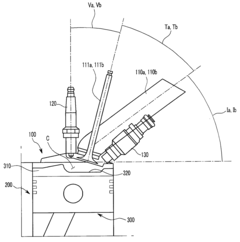
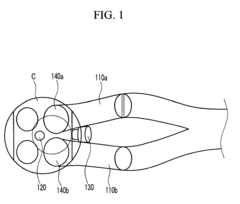
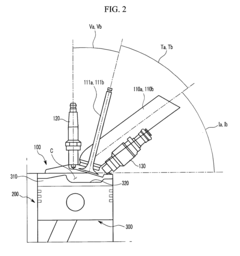
- By designing the recess and groove structure on the piston head, the fuel injected by the injector is returned to the intake valve, and a violent vortex is formed through the protrusion, ensuring the concentration of the fuel-air mixture around the spark plug, thereby ensuring high load operation under high load conditions. Maintain efficient gas mixture flow.


Gasoline Direct Injection Engine
PatentInactiveUS20100108013A1
Innovation
- The engine design includes specific angle configurations between the piston, intake manifold, intake valve, and injector, such as acute valve, tumble, and incidence angles, along with a cavity on the piston to optimize fuel and air mixing, reducing interference and promoting effective tumble and swirl generation.
Emissions Compliance Impact on GDI Transient Strategies
Emissions regulations have become increasingly stringent worldwide, significantly influencing the development of GDI (Gasoline Direct Injection) engine transient control strategies. The Euro 7, China 7, and US Tier 3 standards have established more demanding limits on particulate matter (PM), NOx, and CO emissions during dynamic driving conditions, directly impacting how engineers approach transient operation optimization.
These regulations specifically target emissions during rapid acceleration events and cold starts, which historically have been responsible for the majority of total trip emissions. For GDI engines, transient operation presents unique challenges as the rapid changes in air-fuel ratio can lead to momentary rich or lean conditions that significantly increase emissions output.
The implementation of Real Driving Emissions (RDE) testing has further complicated compliance strategies, as engines must now maintain emissions control across a much wider range of operating conditions than traditional laboratory cycles. This has necessitated more sophisticated transient control algorithms that can anticipate and respond to dynamic driving scenarios while maintaining emissions compliance.
Manufacturers have responded by developing multi-phase transient strategies that prioritize emissions control during critical transition periods. These include modified fuel injection timing patterns during acceleration events, adaptive spark timing control, and variable valve timing adjustments that specifically target transient conditions to minimize emissions spikes.
Cold-start emissions management has become particularly crucial, with specialized transient strategies implemented for the first 120 seconds of operation. These often include catalyst heating modes that temporarily sacrifice fuel efficiency to rapidly bring aftertreatment systems to operating temperature, significantly reducing overall trip emissions.
The trade-off between transient performance and emissions compliance has led to the development of model-based controllers that can predict emissions formation in real-time and adjust engine parameters accordingly. These systems typically utilize cylinder pressure sensors and exhaust gas oxygen sensors to provide feedback for closed-loop control during transient events.
The integration of 48V mild hybrid systems has emerged as a complementary approach to managing transient emissions, allowing electric torque assistance during acceleration events when the combustion engine would otherwise operate in emissions-unfavorable conditions. This electrification strategy effectively reduces the emissions burden during the most challenging transient operations while maintaining or improving vehicle responsiveness.
These regulations specifically target emissions during rapid acceleration events and cold starts, which historically have been responsible for the majority of total trip emissions. For GDI engines, transient operation presents unique challenges as the rapid changes in air-fuel ratio can lead to momentary rich or lean conditions that significantly increase emissions output.
The implementation of Real Driving Emissions (RDE) testing has further complicated compliance strategies, as engines must now maintain emissions control across a much wider range of operating conditions than traditional laboratory cycles. This has necessitated more sophisticated transient control algorithms that can anticipate and respond to dynamic driving scenarios while maintaining emissions compliance.
Manufacturers have responded by developing multi-phase transient strategies that prioritize emissions control during critical transition periods. These include modified fuel injection timing patterns during acceleration events, adaptive spark timing control, and variable valve timing adjustments that specifically target transient conditions to minimize emissions spikes.
Cold-start emissions management has become particularly crucial, with specialized transient strategies implemented for the first 120 seconds of operation. These often include catalyst heating modes that temporarily sacrifice fuel efficiency to rapidly bring aftertreatment systems to operating temperature, significantly reducing overall trip emissions.
The trade-off between transient performance and emissions compliance has led to the development of model-based controllers that can predict emissions formation in real-time and adjust engine parameters accordingly. These systems typically utilize cylinder pressure sensors and exhaust gas oxygen sensors to provide feedback for closed-loop control during transient events.
The integration of 48V mild hybrid systems has emerged as a complementary approach to managing transient emissions, allowing electric torque assistance during acceleration events when the combustion engine would otherwise operate in emissions-unfavorable conditions. This electrification strategy effectively reduces the emissions burden during the most challenging transient operations while maintaining or improving vehicle responsiveness.
Cost-Benefit Analysis of GDI Optimization Technologies
The cost-benefit analysis of GDI (Gasoline Direct Injection) optimization technologies requires a comprehensive evaluation of both financial investments and performance returns. When examining transient performance optimization methods, manufacturers must consider implementation costs against potential gains in fuel efficiency, emissions reduction, and vehicle drivability.
Initial investment costs for GDI optimization include research and development expenditures, manufacturing process modifications, and additional hardware components. Advanced control algorithms for transient operation typically require significant computational resources, potentially necessitating more powerful ECUs (Engine Control Units) with associated cost increases ranging from $50-200 per unit depending on complexity.
Hardware modifications such as improved injectors with faster response times represent another substantial cost factor. High-precision injectors capable of multiple injections per cycle with optimized spray patterns typically add $80-150 per engine, while enhanced pressure control systems may contribute an additional $100-200 per unit.
Against these costs, manufacturers must weigh several quantifiable benefits. Fuel economy improvements from optimized transient operation typically range from 3-7% in real-world driving conditions, translating to lifetime fuel savings of $500-1200 per vehicle (based on average vehicle lifespan and current fuel prices). Emissions reductions during transients can help manufacturers avoid regulatory penalties, potentially saving $50-100 per vehicle in compliance costs.
Customer satisfaction benefits, though harder to quantify, include improved drivability, reduced NVH (Noise, Vibration, Harshness), and more responsive acceleration. These factors can contribute to brand premium and customer loyalty, estimated to add $200-400 in perceived value per vehicle.
The return on investment timeline varies significantly based on production volume. High-volume manufacturers typically achieve ROI within 2-3 years, while specialty or low-volume producers may require 4-5 years to recoup investments. This timeline is accelerated when considering regulatory pressures that increasingly penalize poor transient emissions performance.
Sensitivity analysis indicates that fuel price fluctuations significantly impact the cost-benefit equation. A 20% increase in fuel prices can improve ROI timelines by approximately 15%, while technological advancements that reduce implementation costs by 25% could improve payback periods by nearly 30%.
The most economically viable optimization approaches combine software improvements with targeted hardware upgrades, focusing on components with the highest performance-to-cost ratios such as injection timing control and pressure regulation systems.
Initial investment costs for GDI optimization include research and development expenditures, manufacturing process modifications, and additional hardware components. Advanced control algorithms for transient operation typically require significant computational resources, potentially necessitating more powerful ECUs (Engine Control Units) with associated cost increases ranging from $50-200 per unit depending on complexity.
Hardware modifications such as improved injectors with faster response times represent another substantial cost factor. High-precision injectors capable of multiple injections per cycle with optimized spray patterns typically add $80-150 per engine, while enhanced pressure control systems may contribute an additional $100-200 per unit.
Against these costs, manufacturers must weigh several quantifiable benefits. Fuel economy improvements from optimized transient operation typically range from 3-7% in real-world driving conditions, translating to lifetime fuel savings of $500-1200 per vehicle (based on average vehicle lifespan and current fuel prices). Emissions reductions during transients can help manufacturers avoid regulatory penalties, potentially saving $50-100 per vehicle in compliance costs.
Customer satisfaction benefits, though harder to quantify, include improved drivability, reduced NVH (Noise, Vibration, Harshness), and more responsive acceleration. These factors can contribute to brand premium and customer loyalty, estimated to add $200-400 in perceived value per vehicle.
The return on investment timeline varies significantly based on production volume. High-volume manufacturers typically achieve ROI within 2-3 years, while specialty or low-volume producers may require 4-5 years to recoup investments. This timeline is accelerated when considering regulatory pressures that increasingly penalize poor transient emissions performance.
Sensitivity analysis indicates that fuel price fluctuations significantly impact the cost-benefit equation. A 20% increase in fuel prices can improve ROI timelines by approximately 15%, while technological advancements that reduce implementation costs by 25% could improve payback periods by nearly 30%.
The most economically viable optimization approaches combine software improvements with targeted hardware upgrades, focusing on components with the highest performance-to-cost ratios such as injection timing control and pressure regulation systems.
Unlock deeper insights with PatSnap Eureka Quick Research — get a full tech report to explore trends and direct your research. Try now!
Generate Your Research Report Instantly with AI Agent
Supercharge your innovation with PatSnap Eureka AI Agent Platform!