How to Improve GDI Engine Emission Filtering Systems
AUG 28, 20259 MIN READ
Generate Your Research Report Instantly with AI Agent
PatSnap Eureka helps you evaluate technical feasibility & market potential.
GDI Emission Control Technology Background and Objectives
Gasoline Direct Injection (GDI) technology has emerged as a pivotal advancement in internal combustion engine design since its commercial introduction in the late 1990s. This technology represents a significant evolution from traditional port fuel injection systems by delivering fuel directly into the combustion chamber, enabling precise control over fuel delivery timing and quantity. The development trajectory of GDI systems has been characterized by continuous refinement aimed at improving fuel efficiency and reducing emissions while maintaining or enhancing engine performance.
Despite these advantages, GDI engines face unique challenges related to particulate matter (PM) emissions, particularly ultrafine particles that pose significant environmental and health concerns. These emissions result from the direct injection process, which can create fuel-rich zones and incomplete combustion within the cylinder. As global emission standards become increasingly stringent, addressing these particulate emissions has become a critical focus area for automotive manufacturers and suppliers.
The evolution of GDI emission control technologies has progressed through several generations, from basic systems focused primarily on NOx reduction to more sophisticated integrated approaches that target multiple pollutants simultaneously. Current technological trends indicate a movement toward multi-faceted emission control strategies that combine in-cylinder optimization with advanced aftertreatment systems.
The primary objective of GDI emission filtering system improvement is to develop cost-effective solutions that can reduce particulate matter emissions to meet or exceed regulatory requirements while maintaining the performance and efficiency benefits that make GDI engines attractive. This includes exploring innovations in both engine design parameters and aftertreatment technologies to address the formation and capture of particulates.
Secondary objectives include minimizing the system's impact on vehicle cost, packaging requirements, and durability, as well as ensuring compatibility with existing engine architectures to facilitate widespread adoption. Additionally, there is growing interest in solutions that can be retrofitted to existing GDI engines to address emissions concerns in the current vehicle fleet.
Looking forward, the technology roadmap for GDI emission control must anticipate future regulatory frameworks, including potential Euro 7 standards in Europe and Tier 4 standards in North America, which are expected to impose even more stringent limits on particulate number and mass emissions. This necessitates not only incremental improvements to existing technologies but also potentially disruptive innovations that fundamentally rethink the approach to particulate formation and capture in GDI engines.
Despite these advantages, GDI engines face unique challenges related to particulate matter (PM) emissions, particularly ultrafine particles that pose significant environmental and health concerns. These emissions result from the direct injection process, which can create fuel-rich zones and incomplete combustion within the cylinder. As global emission standards become increasingly stringent, addressing these particulate emissions has become a critical focus area for automotive manufacturers and suppliers.
The evolution of GDI emission control technologies has progressed through several generations, from basic systems focused primarily on NOx reduction to more sophisticated integrated approaches that target multiple pollutants simultaneously. Current technological trends indicate a movement toward multi-faceted emission control strategies that combine in-cylinder optimization with advanced aftertreatment systems.
The primary objective of GDI emission filtering system improvement is to develop cost-effective solutions that can reduce particulate matter emissions to meet or exceed regulatory requirements while maintaining the performance and efficiency benefits that make GDI engines attractive. This includes exploring innovations in both engine design parameters and aftertreatment technologies to address the formation and capture of particulates.
Secondary objectives include minimizing the system's impact on vehicle cost, packaging requirements, and durability, as well as ensuring compatibility with existing engine architectures to facilitate widespread adoption. Additionally, there is growing interest in solutions that can be retrofitted to existing GDI engines to address emissions concerns in the current vehicle fleet.
Looking forward, the technology roadmap for GDI emission control must anticipate future regulatory frameworks, including potential Euro 7 standards in Europe and Tier 4 standards in North America, which are expected to impose even more stringent limits on particulate number and mass emissions. This necessitates not only incremental improvements to existing technologies but also potentially disruptive innovations that fundamentally rethink the approach to particulate formation and capture in GDI engines.
Market Analysis for Advanced GDI Filtering Solutions
The global market for advanced GDI (Gasoline Direct Injection) emission filtering systems is experiencing robust growth, driven primarily by increasingly stringent emission regulations across major automotive markets. The current market size is estimated at $5.2 billion in 2023, with projections indicating a compound annual growth rate of 7.8% through 2030, potentially reaching $8.9 billion by the end of the forecast period.
Regional analysis reveals significant variations in market demand. Europe leads with approximately 38% market share due to its early adoption of Euro 6d and upcoming Euro 7 standards. North America follows at 29%, with Asia-Pacific showing the fastest growth trajectory at 11.2% annually, primarily fueled by China's implementation of China 6 emission standards and India's BS-VI regulations.
Consumer demand patterns indicate a growing preference for vehicles with improved fuel efficiency without compromising performance. This trend has accelerated GDI technology adoption, with market penetration reaching 65% in new passenger vehicles globally, up from 45% five years ago. However, this creates a parallel demand for more effective particulate filtering solutions to address the inherent particulate matter challenges of GDI engines.
The aftermarket segment for GDI filtering systems is expanding at 9.3% annually, outpacing OEM installations. This growth is attributed to retrofit solutions becoming increasingly popular in regions with aging vehicle fleets transitioning to stricter emission zones, particularly in European urban centers and select Asian megacities.
Price sensitivity analysis indicates that while premium automotive segments readily absorb the cost of advanced filtering technologies, mass-market vehicle manufacturers face significant pressure to reduce implementation costs. The current average cost addition per vehicle ranges from $180-$350 depending on system complexity and region.
Market forecasting models suggest three distinct growth scenarios based on regulatory timelines. The accelerated scenario projects 10.5% growth if proposed regulations in key markets advance their implementation schedules. The baseline scenario maintains the 7.8% projection, while a conservative scenario estimates 5.2% growth if regulatory enforcement faces delays or modifications.
Customer segmentation reveals that OEMs represent 72% of the market, with aftermarket solutions accounting for 23% and specialized fleet applications comprising the remaining 5%. Within OEMs, premium vehicle manufacturers demonstrate 85% adoption rates for advanced filtering solutions, while mass-market manufacturers show more variable implementation at 40-60% depending on vehicle positioning and target markets.
Regional analysis reveals significant variations in market demand. Europe leads with approximately 38% market share due to its early adoption of Euro 6d and upcoming Euro 7 standards. North America follows at 29%, with Asia-Pacific showing the fastest growth trajectory at 11.2% annually, primarily fueled by China's implementation of China 6 emission standards and India's BS-VI regulations.
Consumer demand patterns indicate a growing preference for vehicles with improved fuel efficiency without compromising performance. This trend has accelerated GDI technology adoption, with market penetration reaching 65% in new passenger vehicles globally, up from 45% five years ago. However, this creates a parallel demand for more effective particulate filtering solutions to address the inherent particulate matter challenges of GDI engines.
The aftermarket segment for GDI filtering systems is expanding at 9.3% annually, outpacing OEM installations. This growth is attributed to retrofit solutions becoming increasingly popular in regions with aging vehicle fleets transitioning to stricter emission zones, particularly in European urban centers and select Asian megacities.
Price sensitivity analysis indicates that while premium automotive segments readily absorb the cost of advanced filtering technologies, mass-market vehicle manufacturers face significant pressure to reduce implementation costs. The current average cost addition per vehicle ranges from $180-$350 depending on system complexity and region.
Market forecasting models suggest three distinct growth scenarios based on regulatory timelines. The accelerated scenario projects 10.5% growth if proposed regulations in key markets advance their implementation schedules. The baseline scenario maintains the 7.8% projection, while a conservative scenario estimates 5.2% growth if regulatory enforcement faces delays or modifications.
Customer segmentation reveals that OEMs represent 72% of the market, with aftermarket solutions accounting for 23% and specialized fleet applications comprising the remaining 5%. Within OEMs, premium vehicle manufacturers demonstrate 85% adoption rates for advanced filtering solutions, while mass-market manufacturers show more variable implementation at 40-60% depending on vehicle positioning and target markets.
Current Challenges in GDI Particulate Matter Reduction
Gasoline Direct Injection (GDI) engines have gained significant market share due to their improved fuel efficiency and reduced CO2 emissions. However, they face substantial challenges in particulate matter (PM) reduction. The primary issue stems from the direct fuel injection process, which creates fuel-rich zones in the combustion chamber, leading to incomplete combustion and increased particulate formation compared to traditional port fuel injection systems.
One of the most pressing challenges is the formation of ultrafine particles (UFPs) with diameters below 100 nanometers. These particles pose greater health risks than larger particles as they can penetrate deeper into the respiratory system and even enter the bloodstream. Current filtration technologies struggle to efficiently capture these ultrafine particles without creating excessive backpressure in the exhaust system.
Cold-start emissions represent another significant hurdle. During cold-start conditions, fuel vaporization is poor, resulting in incomplete combustion and substantially higher PM emissions. These emissions can account for up to 80% of total PM emissions in standardized driving cycles, despite representing only a small fraction of the total operating time.
The trade-off between NOx reduction and PM control presents a complex engineering challenge. Strategies that reduce combustion temperatures to limit NOx formation often lead to increased PM emissions due to incomplete combustion. This interdependence makes simultaneous reduction of both pollutants technically difficult without sophisticated aftertreatment systems.
Durability and maintenance of particulate filters constitute another major challenge. Gasoline Particulate Filters (GPFs) must withstand high exhaust temperatures and frequent regeneration cycles without degradation. The accumulation of ash (non-combustible material) in these filters over time reduces their effectiveness and increases backpressure, negatively impacting engine performance and fuel economy.
Real-world driving conditions present additional complications. Laboratory testing cycles often fail to capture the full range of operating conditions encountered in actual use, leading to discrepancies between certified and real-world emissions. Transient operations, such as rapid acceleration and high-load conditions, can produce emission spikes that are particularly difficult to control.
Cost constraints further complicate PM reduction efforts. Advanced filtration systems, sophisticated engine control strategies, and high-precision injectors add significant cost to vehicle production. Manufacturers must balance emission compliance with competitive pricing, especially in price-sensitive market segments.
Regulatory challenges also exist, with increasingly stringent emission standards worldwide requiring continuous technological advancement. The introduction of Real Driving Emissions (RDE) testing in many regions has further raised the bar for emission control systems, requiring effective performance across a wider range of operating conditions.
One of the most pressing challenges is the formation of ultrafine particles (UFPs) with diameters below 100 nanometers. These particles pose greater health risks than larger particles as they can penetrate deeper into the respiratory system and even enter the bloodstream. Current filtration technologies struggle to efficiently capture these ultrafine particles without creating excessive backpressure in the exhaust system.
Cold-start emissions represent another significant hurdle. During cold-start conditions, fuel vaporization is poor, resulting in incomplete combustion and substantially higher PM emissions. These emissions can account for up to 80% of total PM emissions in standardized driving cycles, despite representing only a small fraction of the total operating time.
The trade-off between NOx reduction and PM control presents a complex engineering challenge. Strategies that reduce combustion temperatures to limit NOx formation often lead to increased PM emissions due to incomplete combustion. This interdependence makes simultaneous reduction of both pollutants technically difficult without sophisticated aftertreatment systems.
Durability and maintenance of particulate filters constitute another major challenge. Gasoline Particulate Filters (GPFs) must withstand high exhaust temperatures and frequent regeneration cycles without degradation. The accumulation of ash (non-combustible material) in these filters over time reduces their effectiveness and increases backpressure, negatively impacting engine performance and fuel economy.
Real-world driving conditions present additional complications. Laboratory testing cycles often fail to capture the full range of operating conditions encountered in actual use, leading to discrepancies between certified and real-world emissions. Transient operations, such as rapid acceleration and high-load conditions, can produce emission spikes that are particularly difficult to control.
Cost constraints further complicate PM reduction efforts. Advanced filtration systems, sophisticated engine control strategies, and high-precision injectors add significant cost to vehicle production. Manufacturers must balance emission compliance with competitive pricing, especially in price-sensitive market segments.
Regulatory challenges also exist, with increasingly stringent emission standards worldwide requiring continuous technological advancement. The introduction of Real Driving Emissions (RDE) testing in many regions has further raised the bar for emission control systems, requiring effective performance across a wider range of operating conditions.
Existing GDI Particulate Filter Design Approaches
01 Particulate filter systems for GDI engines
Gasoline Direct Injection (GDI) engines require specialized particulate filter systems to capture and remove soot and other particulate matter from exhaust emissions. These systems typically include filter elements designed specifically for the higher temperature and different particulate composition of gasoline engine exhaust compared to diesel engines. The filters can be integrated into the exhaust system to effectively reduce particulate emissions while maintaining engine performance.- Particulate filtration systems for GDI engines: Gasoline Direct Injection (GDI) engines produce particulate matter that requires specialized filtration systems. These systems typically include particulate filters designed to capture and remove soot and other solid emissions from the exhaust stream. The filtration technology helps reduce harmful emissions while maintaining engine performance and fuel efficiency. Advanced particulate filters can be integrated into the exhaust system to meet increasingly stringent emission standards.
- Catalytic conversion systems for GDI emissions: Catalytic conversion systems are essential components in GDI engine emission control. These systems utilize catalytic converters containing precious metals that facilitate chemical reactions to convert harmful pollutants into less harmful substances. The catalysts help transform carbon monoxide, unburned hydrocarbons, and nitrogen oxides into carbon dioxide, water, and nitrogen. Advanced catalytic systems may incorporate multiple stages of treatment to address the specific emission profile of GDI engines.
- Integrated emission control systems for GDI engines: Integrated emission control systems combine multiple filtering and treatment technologies to comprehensively address GDI engine emissions. These systems may incorporate particulate filters, catalytic converters, exhaust gas recirculation, and electronic control units that work together to optimize emission reduction. The integration allows for more efficient packaging, reduced backpressure, and improved overall emission performance. These systems are designed to meet or exceed regulatory requirements while maintaining engine performance and fuel economy.
- Thermal management for GDI emission systems: Thermal management is crucial for the effective operation of GDI emission filtering systems. These technologies include active and passive heating strategies to ensure optimal operating temperatures for catalysts and filters. Proper thermal management helps facilitate filter regeneration processes, where accumulated particulates are oxidized and removed from the filter. Advanced systems may incorporate temperature sensors, heating elements, and control algorithms to maintain ideal operating conditions across various driving scenarios and ambient conditions.
- Electronic control and monitoring of GDI emission systems: Electronic control and monitoring systems play a vital role in optimizing GDI emission filtering performance. These systems utilize sensors to monitor exhaust composition, temperature, pressure, and filter loading status. The collected data is processed by engine control units to adjust engine parameters and emission system operation in real-time. Advanced monitoring systems can predict maintenance needs, detect malfunctions, and ensure compliance with emission regulations. Some systems also incorporate on-board diagnostics to alert drivers of potential issues with the emission control system.
02 Catalytic conversion technologies for GDI emissions
Catalytic conversion systems play a crucial role in reducing harmful emissions from GDI engines. These technologies utilize various catalytic materials to convert carbon monoxide, unburned hydrocarbons, and nitrogen oxides into less harmful substances. Advanced catalytic converters specifically designed for GDI engines can address the unique emission profile of these engines, including higher particulate matter and different exhaust gas temperatures compared to conventional port fuel injection engines.Expand Specific Solutions03 Integrated exhaust gas recirculation and filtering systems
Integrated systems that combine exhaust gas recirculation (EGR) with filtering technologies offer comprehensive emission control for GDI engines. These systems recirculate a portion of the exhaust gas back into the combustion chamber to reduce nitrogen oxide formation while simultaneously filtering particulates from the exhaust stream. The integration of these functions improves overall emission reduction efficiency while potentially reducing system complexity and cost.Expand Specific Solutions04 Advanced sensor and control systems for emission management
Modern GDI emission filtering systems incorporate sophisticated sensors and control systems to optimize filtration performance. These systems monitor parameters such as exhaust gas composition, temperature, and filter loading to dynamically adjust engine operation and regeneration cycles. Advanced control algorithms can predict filter loading conditions and initiate regeneration processes at optimal times, improving both emission control effectiveness and fuel efficiency.Expand Specific Solutions05 Novel filter materials and structures for enhanced filtration
Innovative filter materials and structural designs are being developed specifically for GDI engine applications. These include ceramic composites, metallic substrates, and hybrid materials that offer improved filtration efficiency, reduced backpressure, and enhanced durability under the specific conditions of GDI exhaust. Some designs incorporate multiple filtration stages or gradient porosity structures to optimize the capture of different particle sizes while maintaining acceptable flow characteristics.Expand Specific Solutions
Key Industry Players in Automotive Emission Control Systems
The GDI engine emission filtering systems market is in a growth phase, driven by increasingly stringent global emissions regulations. The market is expected to expand significantly as automotive manufacturers seek to meet Euro 7, China 6b, and US EPA standards. Key players form a competitive landscape divided between automotive OEMs (Ford, GM, Hyundai, Volkswagen, Honda) and specialized component suppliers (Johnson Matthey, BASF, Corning, Lubrizol). Technology maturity varies, with established players like Johnson Matthey and BASF leading in catalyst technology, while Ford and GM focus on integrated system approaches. Emerging innovations come from university collaborations (Tianjin University, Beihang) and specialized firms like Afton Chemical, creating a dynamic ecosystem balancing proven solutions with next-generation filtering technologies.
Ford Global Technologies LLC
Technical Solution: Ford has developed an advanced Three-Way Catalyst (TWC) system specifically optimized for GDI engines that incorporates a dual-layer structure with enhanced oxygen storage capacity. Their technology integrates particulate filtration capabilities directly into the catalytic converter through a specialized substrate design that captures particulate matter while simultaneously treating gaseous emissions. Ford's system employs advanced washcoat formulations with higher precious metal loading strategically distributed to address the unique emission profile of GDI engines, particularly during cold starts and high-load operation. Additionally, they've implemented intelligent thermal management systems that optimize catalyst temperature for maximum efficiency across various driving conditions, utilizing engine control strategies to maintain ideal operating temperatures for both NOx reduction and particulate oxidation.
Strengths: Excellent integration with existing vehicle architecture; comprehensive approach addressing both particulate and gaseous emissions simultaneously; proven durability in real-world applications. Weaknesses: Higher precious metal content increases system cost; may require more frequent regeneration cycles in certain driving conditions; thermal management complexity adds to overall system complexity.
Corning, Inc.
Technical Solution: Corning has developed advanced ceramic substrate technologies specifically engineered for GDI emission control systems. Their DuraTrap® GC gasoline particulate filters feature an innovative cellular ceramic design with alternating channels that force exhaust gases through porous walls, capturing over 95% of particulate matter while maintaining minimal backpressure. The proprietary thin-wall technology maximizes filtration area while reducing thermal mass, enabling faster light-off times critical for GDI cold-start emissions. Corning's substrates incorporate advanced cordierite formulations with enhanced thermal shock resistance capable of withstanding the higher temperature spikes characteristic of GDI operation. Their latest innovation includes asymmetric cell technology that optimizes the balance between filtration efficiency and pressure drop, addressing one of the key challenges in GDI emission control. Additionally, Corning has developed specialized coating technologies that improve catalyst adhesion and distribution across the substrate surface.
Strengths: Exceptional durability under thermal cycling; industry-leading filtration efficiency with minimal backpressure penalty; manufacturing consistency at scale. Weaknesses: Higher initial cost compared to conventional substrates; requires specialized coating processes; limited flexibility in physical dimensions due to manufacturing constraints.
Critical Patents in GDI Emission Reduction Technology
LPG direct injection engine
PatentWO2015155359A1
Innovation
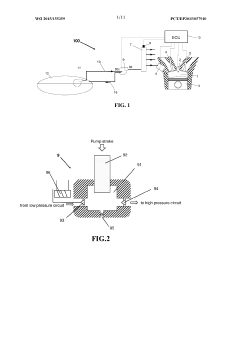
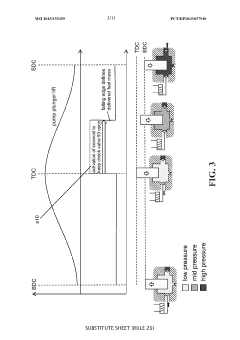
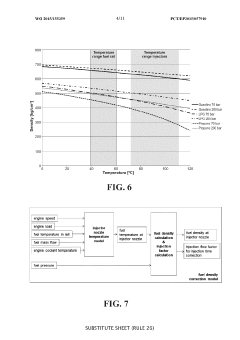
- An LPG direct injection engine with a high-pressure pump and electronic control unit for precise liquefied petroleum gas injection between 360° and 60° BTDC, optimized valve overlap, and cylinder deactivation system to reduce emissions and improve efficiency.
Fuel Additives and Formulations for Improving Performance of Gasoline Direct Injection Engines
PatentActiveUS20240141244A1
Innovation
- A novel fuel additive composition comprising an acylated detergent, a Mannich detergent, and a polyether and/or polyetheramine, which are specifically formulated to reduce carbonaceous deposits in gasoline engines by preventing or removing them, and are effective in both port fuel injection and direct injection engines.
Environmental Regulations Impact on GDI Technology Development
Environmental regulations have become a primary driver for technological advancements in Gasoline Direct Injection (GDI) engine systems over the past two decades. The implementation of increasingly stringent emission standards, such as Euro 6d in Europe, China 6 in Asia, and Tier 3 in the United States, has fundamentally reshaped the development trajectory of GDI emission filtering technologies. These regulations have progressively lowered the permissible limits for particulate matter (PM), nitrogen oxides (NOx), and carbon dioxide (CO2), compelling manufacturers to innovate beyond conventional solutions.
The regulatory landscape has evolved from focusing primarily on CO2 reduction to adopting a more comprehensive approach that addresses ultrafine particulate emissions characteristic of GDI engines. This shift has necessitated the integration of Gasoline Particulate Filters (GPFs) as standard equipment in most markets. The timeline of implementation varies regionally, with Europe leading adoption followed by China and North America, creating a complex global compliance framework for automotive manufacturers.
Real Driving Emissions (RDE) testing protocols introduced in regulatory frameworks have significantly impacted GDI technology development by exposing the gap between laboratory performance and real-world emissions. This regulatory approach has accelerated the development of more sophisticated engine management systems and catalytic converter technologies capable of maintaining emission compliance across diverse driving conditions and ambient temperatures.
Cost-benefit analyses conducted by regulatory bodies have shaped the technical requirements for GDI emission systems. These analyses typically balance environmental benefits against implementation costs, influencing the pace of technology adoption. The California Air Resources Board (CARB) and European Commission studies have been particularly influential in establishing technical benchmarks that drive innovation in filtration efficiency and durability.
Regulatory frameworks have also begun addressing non-regulated emissions and secondary pollutants, expanding the scope of GDI emission control systems. This includes increased attention to ammonia emissions, secondary organic aerosols, and ultrafine particles below 23nm, which are expected to be regulated in upcoming standards. These emerging concerns are pushing research toward multi-functional filtering systems capable of addressing a broader spectrum of emissions.
The global harmonization trend in emission standards, while incomplete, has encouraged the development of scalable and adaptable GDI emission technologies. This regulatory convergence has enabled manufacturers to develop more standardized filtering solutions that can be deployed across multiple markets with minimal modification, improving economies of scale and accelerating technology diffusion.
The regulatory landscape has evolved from focusing primarily on CO2 reduction to adopting a more comprehensive approach that addresses ultrafine particulate emissions characteristic of GDI engines. This shift has necessitated the integration of Gasoline Particulate Filters (GPFs) as standard equipment in most markets. The timeline of implementation varies regionally, with Europe leading adoption followed by China and North America, creating a complex global compliance framework for automotive manufacturers.
Real Driving Emissions (RDE) testing protocols introduced in regulatory frameworks have significantly impacted GDI technology development by exposing the gap between laboratory performance and real-world emissions. This regulatory approach has accelerated the development of more sophisticated engine management systems and catalytic converter technologies capable of maintaining emission compliance across diverse driving conditions and ambient temperatures.
Cost-benefit analyses conducted by regulatory bodies have shaped the technical requirements for GDI emission systems. These analyses typically balance environmental benefits against implementation costs, influencing the pace of technology adoption. The California Air Resources Board (CARB) and European Commission studies have been particularly influential in establishing technical benchmarks that drive innovation in filtration efficiency and durability.
Regulatory frameworks have also begun addressing non-regulated emissions and secondary pollutants, expanding the scope of GDI emission control systems. This includes increased attention to ammonia emissions, secondary organic aerosols, and ultrafine particles below 23nm, which are expected to be regulated in upcoming standards. These emerging concerns are pushing research toward multi-functional filtering systems capable of addressing a broader spectrum of emissions.
The global harmonization trend in emission standards, while incomplete, has encouraged the development of scalable and adaptable GDI emission technologies. This regulatory convergence has enabled manufacturers to develop more standardized filtering solutions that can be deployed across multiple markets with minimal modification, improving economies of scale and accelerating technology diffusion.
Cost-Benefit Analysis of Advanced GDI Filtering Solutions
The implementation of advanced GDI (Gasoline Direct Injection) emission filtering systems requires careful economic evaluation to determine their viability in the automotive market. Initial investment costs for advanced particulate filters range from $150 to $400 per unit, depending on the complexity and materials used. This represents a significant cost addition to vehicle manufacturing, potentially increasing the final consumer price by 1-3% for mid-range vehicles.
Operating costs must also be considered, as advanced filtering systems may impact fuel efficiency. Current data suggests a fuel economy penalty of 0.5-2% with first-generation GPF (Gasoline Particulate Filter) systems, though newer designs have reduced this to under 0.5% in optimal conditions. This translates to approximately $20-80 in additional fuel costs annually for average drivers.
Maintenance expenses present another economic consideration. While traditional systems require minimal maintenance, advanced filtering solutions may necessitate periodic cleaning or replacement, adding $100-300 to vehicle lifetime maintenance costs. However, this is offset by increased durability of engine components due to reduced contamination, potentially saving $200-500 in long-term engine maintenance.
From an environmental perspective, the benefits are substantial. Advanced GDI filtering systems can reduce particulate emissions by 70-95% compared to unfiltered systems. When monetizing these environmental benefits through reduced healthcare costs and environmental damage, studies estimate savings of $150-400 per vehicle over its lifetime, though these benefits are societal rather than directly realized by manufacturers or consumers.
Regulatory compliance represents a critical economic factor. As emission standards continue to tighten globally, particularly in Europe, China, and North America, non-compliant vehicles face exclusion from major markets. The cost of regulatory penalties or market exclusion far exceeds implementation costs, making advanced filtering systems economically necessary despite their upfront expense.
Return on investment calculations indicate that manufacturers can expect to recover development costs within 3-5 years for high-volume models. Consumer payback periods range from 5-8 years when considering fuel economy impacts and maintenance costs, though this timeline shortens as technology matures and production scales increase.
The most cost-effective implementation strategy appears to be integrating advanced filtering systems during major model redesigns rather than as mid-cycle updates, allowing for optimized system integration and shared development costs across multiple vehicle platforms.
Operating costs must also be considered, as advanced filtering systems may impact fuel efficiency. Current data suggests a fuel economy penalty of 0.5-2% with first-generation GPF (Gasoline Particulate Filter) systems, though newer designs have reduced this to under 0.5% in optimal conditions. This translates to approximately $20-80 in additional fuel costs annually for average drivers.
Maintenance expenses present another economic consideration. While traditional systems require minimal maintenance, advanced filtering solutions may necessitate periodic cleaning or replacement, adding $100-300 to vehicle lifetime maintenance costs. However, this is offset by increased durability of engine components due to reduced contamination, potentially saving $200-500 in long-term engine maintenance.
From an environmental perspective, the benefits are substantial. Advanced GDI filtering systems can reduce particulate emissions by 70-95% compared to unfiltered systems. When monetizing these environmental benefits through reduced healthcare costs and environmental damage, studies estimate savings of $150-400 per vehicle over its lifetime, though these benefits are societal rather than directly realized by manufacturers or consumers.
Regulatory compliance represents a critical economic factor. As emission standards continue to tighten globally, particularly in Europe, China, and North America, non-compliant vehicles face exclusion from major markets. The cost of regulatory penalties or market exclusion far exceeds implementation costs, making advanced filtering systems economically necessary despite their upfront expense.
Return on investment calculations indicate that manufacturers can expect to recover development costs within 3-5 years for high-volume models. Consumer payback periods range from 5-8 years when considering fuel economy impacts and maintenance costs, though this timeline shortens as technology matures and production scales increase.
The most cost-effective implementation strategy appears to be integrating advanced filtering systems during major model redesigns rather than as mid-cycle updates, allowing for optimized system integration and shared development costs across multiple vehicle platforms.
Unlock deeper insights with PatSnap Eureka Quick Research — get a full tech report to explore trends and direct your research. Try now!
Generate Your Research Report Instantly with AI Agent
Supercharge your innovation with PatSnap Eureka AI Agent Platform!