
Single-Atom Catalysis in Polymer Electrolyte Membranes
OCT 15, 20259 MIN READ
Generate Your Research Report Instantly with AI Agent
Patsnap Eureka helps you evaluate technical feasibility & market potential.
SAC-PEM Technology Background and Objectives
Single-atom catalysis (SAC) represents a revolutionary frontier in heterogeneous catalysis, where individual metal atoms are dispersed on support materials to maximize atomic efficiency. The integration of SAC with polymer electrolyte membranes (PEMs) has emerged as a promising technological convergence over the past decade, particularly for energy conversion and storage applications.
The evolution of this technology can be traced back to the early 2000s when researchers first demonstrated the feasibility of atomically dispersed catalysts. However, it was not until the 2010s that significant breakthroughs in characterization techniques, particularly aberration-corrected electron microscopy and X-ray absorption spectroscopy, enabled precise identification and study of single-atom catalysts. The marriage of SAC with PEMs represents a natural progression in the quest for more efficient and sustainable energy technologies.
The fundamental advantage of SAC-PEM systems lies in their ability to combine the exceptional catalytic activity of single-atom catalysts with the ion-conducting properties of polymer membranes. This synergy addresses critical limitations in conventional catalytic systems, including low atom utilization efficiency, poor stability, and high precious metal loading requirements.
Current technological trajectories indicate a growing interest in SAC-PEM applications across multiple sectors, including fuel cells, electrolyzers, and selective separation processes. The development path has been characterized by incremental improvements in catalyst stability, membrane durability, and interface engineering between the single atoms and polymer matrices.
The primary technical objectives for SAC-PEM technology development include: enhancing the stability of single-atom catalysts under operating conditions; improving the uniform dispersion of catalytic sites throughout the membrane; optimizing the coordination environment of metal atoms to achieve desired selectivity; and developing scalable, cost-effective synthesis methods suitable for industrial implementation.
Long-term goals focus on achieving breakthrough performance in renewable energy applications, particularly hydrogen production and utilization. Researchers aim to develop SAC-PEM systems capable of operating at lower precious metal loadings (below 0.1 mg/cm²), higher current densities (exceeding 2 A/cm²), and extended durability (>10,000 hours) under practical operating conditions.
The convergence of advanced computational modeling, in-situ characterization techniques, and precision synthesis methods is expected to accelerate progress in this field. As SAC-PEM technology matures, it holds the potential to revolutionize energy conversion efficiency, particularly in applications where reaction selectivity and atom economy are paramount considerations.
The evolution of this technology can be traced back to the early 2000s when researchers first demonstrated the feasibility of atomically dispersed catalysts. However, it was not until the 2010s that significant breakthroughs in characterization techniques, particularly aberration-corrected electron microscopy and X-ray absorption spectroscopy, enabled precise identification and study of single-atom catalysts. The marriage of SAC with PEMs represents a natural progression in the quest for more efficient and sustainable energy technologies.
The fundamental advantage of SAC-PEM systems lies in their ability to combine the exceptional catalytic activity of single-atom catalysts with the ion-conducting properties of polymer membranes. This synergy addresses critical limitations in conventional catalytic systems, including low atom utilization efficiency, poor stability, and high precious metal loading requirements.
Current technological trajectories indicate a growing interest in SAC-PEM applications across multiple sectors, including fuel cells, electrolyzers, and selective separation processes. The development path has been characterized by incremental improvements in catalyst stability, membrane durability, and interface engineering between the single atoms and polymer matrices.
The primary technical objectives for SAC-PEM technology development include: enhancing the stability of single-atom catalysts under operating conditions; improving the uniform dispersion of catalytic sites throughout the membrane; optimizing the coordination environment of metal atoms to achieve desired selectivity; and developing scalable, cost-effective synthesis methods suitable for industrial implementation.
Long-term goals focus on achieving breakthrough performance in renewable energy applications, particularly hydrogen production and utilization. Researchers aim to develop SAC-PEM systems capable of operating at lower precious metal loadings (below 0.1 mg/cm²), higher current densities (exceeding 2 A/cm²), and extended durability (>10,000 hours) under practical operating conditions.
The convergence of advanced computational modeling, in-situ characterization techniques, and precision synthesis methods is expected to accelerate progress in this field. As SAC-PEM technology matures, it holds the potential to revolutionize energy conversion efficiency, particularly in applications where reaction selectivity and atom economy are paramount considerations.
Market Analysis for Single-Atom Catalysis Applications
The global market for single-atom catalysis (SAC) applications is experiencing robust growth, driven by increasing demand for sustainable and efficient catalytic solutions across multiple industries. The market size for advanced catalytic materials, including SACs, was valued at approximately $6.8 billion in 2022 and is projected to reach $10.5 billion by 2028, representing a compound annual growth rate of 7.5%.
Polymer electrolyte membrane (PEM) fuel cells represent a particularly promising application area for single-atom catalysts, with the global PEM fuel cell market expected to grow from $4.1 billion in 2022 to $9.7 billion by 2030. Within this segment, catalysts account for nearly 40% of the total system cost, highlighting the significant economic potential for cost-effective SAC solutions.
The automotive sector currently dominates demand for SAC applications in PEM fuel cells, accounting for approximately 45% of market share. Major automotive manufacturers including Toyota, Hyundai, and Honda have increased investments in hydrogen fuel cell vehicles, creating substantial pull for advanced catalyst technologies that can reduce platinum group metal usage while maintaining or improving performance.
Stationary power generation represents the second-largest application segment at 30% market share, with growing interest in distributed energy systems and backup power solutions utilizing PEM fuel cells. This sector is expected to see accelerated growth as energy resilience concerns drive adoption of alternative power sources.
Regionally, Asia-Pacific leads the market with 42% share, driven by strong government support for hydrogen technologies in Japan, South Korea, and increasingly China. North America follows at 28%, with Europe at 25%. Both regions have established regulatory frameworks promoting low-carbon technologies, creating favorable conditions for SAC adoption.
From a competitive landscape perspective, the market features both established catalyst manufacturers and emerging technology startups. Traditional catalyst companies like Johnson Matthey, BASF, and Umicore have made strategic investments in single-atom catalyst research, while specialized firms like SulfiCat, Pajarito Powder, and Nisshinbo Holdings have developed proprietary SAC technologies specifically for PEM applications.
Customer demand is increasingly focused on three key performance metrics: catalyst durability under dynamic operating conditions, activity per mass of precious metal, and resistance to contaminants. Market research indicates customers are willing to pay premium prices for catalysts that can demonstrate 5,000+ hours of stable operation with less than 10% performance degradation.
The market outlook remains highly positive, with technological advancements in atomic-level characterization and computational modeling accelerating development cycles. However, challenges in scaling production methods from laboratory to industrial volumes represent a significant barrier to widespread commercialization that must be addressed to fully capitalize on market opportunities.
Polymer electrolyte membrane (PEM) fuel cells represent a particularly promising application area for single-atom catalysts, with the global PEM fuel cell market expected to grow from $4.1 billion in 2022 to $9.7 billion by 2030. Within this segment, catalysts account for nearly 40% of the total system cost, highlighting the significant economic potential for cost-effective SAC solutions.
The automotive sector currently dominates demand for SAC applications in PEM fuel cells, accounting for approximately 45% of market share. Major automotive manufacturers including Toyota, Hyundai, and Honda have increased investments in hydrogen fuel cell vehicles, creating substantial pull for advanced catalyst technologies that can reduce platinum group metal usage while maintaining or improving performance.
Stationary power generation represents the second-largest application segment at 30% market share, with growing interest in distributed energy systems and backup power solutions utilizing PEM fuel cells. This sector is expected to see accelerated growth as energy resilience concerns drive adoption of alternative power sources.
Regionally, Asia-Pacific leads the market with 42% share, driven by strong government support for hydrogen technologies in Japan, South Korea, and increasingly China. North America follows at 28%, with Europe at 25%. Both regions have established regulatory frameworks promoting low-carbon technologies, creating favorable conditions for SAC adoption.
From a competitive landscape perspective, the market features both established catalyst manufacturers and emerging technology startups. Traditional catalyst companies like Johnson Matthey, BASF, and Umicore have made strategic investments in single-atom catalyst research, while specialized firms like SulfiCat, Pajarito Powder, and Nisshinbo Holdings have developed proprietary SAC technologies specifically for PEM applications.
Customer demand is increasingly focused on three key performance metrics: catalyst durability under dynamic operating conditions, activity per mass of precious metal, and resistance to contaminants. Market research indicates customers are willing to pay premium prices for catalysts that can demonstrate 5,000+ hours of stable operation with less than 10% performance degradation.
The market outlook remains highly positive, with technological advancements in atomic-level characterization and computational modeling accelerating development cycles. However, challenges in scaling production methods from laboratory to industrial volumes represent a significant barrier to widespread commercialization that must be addressed to fully capitalize on market opportunities.
Current Status and Technical Barriers in SAC-PEM
Single-atom catalysis in polymer electrolyte membranes (SAC-PEM) represents a frontier technology that has gained significant attention in recent years. Currently, the global research landscape shows varying degrees of advancement, with leading institutions in North America, Europe, and East Asia making substantial contributions. The integration of single-atom catalysts within polymer electrolyte membranes has demonstrated promising results in laboratory settings, particularly for fuel cell applications, electrochemical CO2 reduction, and water splitting processes.
Despite these advancements, several critical technical barriers impede widespread implementation and commercialization. The primary challenge remains catalyst stability under operating conditions, with single-atom sites prone to aggregation or leaching during extended operation cycles. This instability significantly reduces catalytic performance over time and presents a major hurdle for practical applications requiring thousands of operational hours.
Another substantial barrier is the scalable synthesis of SAC-PEMs with consistent performance. Current laboratory-scale preparation methods often involve complex procedures that are difficult to translate to industrial production. The precise control of atomic dispersion across large membrane areas remains particularly challenging, resulting in performance variability that hinders commercial viability.
The interface between single-atom catalysts and polymer matrices presents additional complications. Poor integration often leads to inadequate electron transfer pathways, limiting catalytic efficiency. Furthermore, the polymer environment can alter the electronic structure of single-atom active sites, sometimes diminishing their intrinsic catalytic properties compared to performance observed in other support materials.
Characterization limitations constitute another significant barrier. The atomic-scale nature of these catalysts makes in-situ and operando studies exceptionally difficult, particularly within the complex polymer environment. This hampers fundamental understanding of reaction mechanisms and catalyst degradation pathways, consequently slowing rational design improvements.
Economic considerations also present challenges, as current synthesis approaches often require precious metals and specialized equipment. The cost-performance ratio remains unfavorable compared to conventional catalytic systems, despite the theoretical advantages of atom efficiency.
Geographically, research leadership is distributed unevenly, with notable clusters in the United States (particularly at national laboratories and universities in California and the Northeast), Germany, China, and Japan. These regions have established specialized infrastructure for advanced characterization and testing of SAC-PEM systems, creating potential barriers to entry for emerging research groups in other locations.
Despite these advancements, several critical technical barriers impede widespread implementation and commercialization. The primary challenge remains catalyst stability under operating conditions, with single-atom sites prone to aggregation or leaching during extended operation cycles. This instability significantly reduces catalytic performance over time and presents a major hurdle for practical applications requiring thousands of operational hours.
Another substantial barrier is the scalable synthesis of SAC-PEMs with consistent performance. Current laboratory-scale preparation methods often involve complex procedures that are difficult to translate to industrial production. The precise control of atomic dispersion across large membrane areas remains particularly challenging, resulting in performance variability that hinders commercial viability.
The interface between single-atom catalysts and polymer matrices presents additional complications. Poor integration often leads to inadequate electron transfer pathways, limiting catalytic efficiency. Furthermore, the polymer environment can alter the electronic structure of single-atom active sites, sometimes diminishing their intrinsic catalytic properties compared to performance observed in other support materials.
Characterization limitations constitute another significant barrier. The atomic-scale nature of these catalysts makes in-situ and operando studies exceptionally difficult, particularly within the complex polymer environment. This hampers fundamental understanding of reaction mechanisms and catalyst degradation pathways, consequently slowing rational design improvements.
Economic considerations also present challenges, as current synthesis approaches often require precious metals and specialized equipment. The cost-performance ratio remains unfavorable compared to conventional catalytic systems, despite the theoretical advantages of atom efficiency.
Geographically, research leadership is distributed unevenly, with notable clusters in the United States (particularly at national laboratories and universities in California and the Northeast), Germany, China, and Japan. These regions have established specialized infrastructure for advanced characterization and testing of SAC-PEM systems, creating potential barriers to entry for emerging research groups in other locations.
State-of-the-Art SAC-PEM Solutions
01 Single-atom catalysts for enhanced PEM fuel cell performance
Single-atom catalysts (SACs) dispersed on polymer electrolyte membranes provide superior catalytic activity due to their maximized atom efficiency and unique electronic properties. These catalysts offer higher active site density compared to traditional nanoparticle catalysts, resulting in improved power density and efficiency in PEM fuel cells. The atomic dispersion allows for better utilization of precious metals like platinum, reducing overall catalyst loading while maintaining or enhancing performance.- Single-atom catalysts for enhanced fuel cell performance: Single-atom catalysts dispersed on polymer electrolyte membranes can significantly improve fuel cell efficiency and durability. These catalysts feature isolated metal atoms anchored to the membrane structure, providing maximum atom utilization and superior catalytic activity compared to traditional nanoparticle catalysts. The atomic dispersion enables better electron transfer and reduces the amount of precious metals needed, making fuel cells more cost-effective while maintaining high power density.
- Fabrication methods for single-atom catalysts on polymer membranes: Various techniques have been developed to synthesize and deposit single-atom catalysts onto polymer electrolyte membranes. These methods include atomic layer deposition, wet chemical approaches, and electrochemical deposition that ensure uniform distribution of catalyst atoms. The fabrication processes often involve precise control of precursor concentrations, temperature, and reaction conditions to achieve optimal atomic dispersion and prevent aggregation, resulting in membranes with enhanced catalytic properties.
- Polymer membrane modifications for single-atom catalyst integration: Polymer electrolyte membranes can be modified to better accommodate and stabilize single-atom catalysts. These modifications include introducing functional groups that serve as anchoring sites for metal atoms, adjusting membrane porosity, and incorporating support materials. Such structural and chemical modifications enhance the interaction between the catalyst atoms and the membrane, preventing catalyst migration and agglomeration while improving proton conductivity and overall membrane durability.
- Performance optimization of single-atom catalyzed membranes: Optimizing the performance of polymer electrolyte membranes with single-atom catalysts involves balancing multiple factors including catalyst loading, membrane thickness, and operating conditions. Research has shown that controlling the electronic environment around catalyst atoms, managing water content in the membrane, and mitigating degradation mechanisms are crucial for maximizing efficiency. Advanced characterization techniques help identify optimal configurations that enhance catalytic activity while maintaining membrane stability under various operating conditions.
- Novel applications of single-atom catalysis in specialized membrane systems: Beyond traditional fuel cells, single-atom catalysis in polymer electrolyte membranes is finding applications in emerging technologies such as water electrolyzers, CO2 reduction systems, and selective separation processes. These specialized membrane systems leverage the unique properties of atomically dispersed catalysts to enable new reactions or improve existing processes. The combination of tailored polymer membranes with precisely positioned single-atom catalysts creates multifunctional materials with potential applications in renewable energy storage, environmental remediation, and chemical synthesis.
02 Synthesis methods for single-atom catalysts on polymer membranes
Various synthesis approaches are employed to achieve atomic dispersion of catalytic metals on polymer electrolyte membranes. These include atomic layer deposition, wet chemical methods with strong metal-support interactions, and electrochemical deposition techniques. The synthesis protocols focus on preventing metal aggregation through the use of anchoring sites on the membrane surface or incorporating stabilizing agents. These methods enable precise control over the catalyst loading and distribution across the membrane.Expand Specific Solutions03 Stability enhancement of single-atom catalysts in PEM environments
Improving the durability of single-atom catalysts in the harsh operating conditions of polymer electrolyte membrane fuel cells is critical for commercial viability. Approaches include engineering strong coordination environments between the metal atoms and the support, developing core-shell structures, and incorporating stabilizing ligands. These strategies prevent catalyst migration, agglomeration, and leaching during long-term operation, maintaining the atomic dispersion and catalytic activity under varying voltage conditions and temperature fluctuations.Expand Specific Solutions04 Non-precious metal single-atom catalysts for PEM applications
Development of non-precious metal single-atom catalysts as alternatives to platinum for polymer electrolyte membrane applications addresses cost barriers to widespread commercialization. Transition metals such as iron, cobalt, and nickel, when atomically dispersed on suitable supports, can exhibit remarkable catalytic activity for oxygen reduction and hydrogen evolution reactions. These catalysts are engineered with specific coordination environments to mimic the activity of precious metals while significantly reducing material costs.Expand Specific Solutions05 Polymer membrane modifications for improved single-atom catalyst integration
Modifications to polymer electrolyte membranes enhance their compatibility with single-atom catalysts and improve overall performance. These modifications include incorporating functional groups that serve as anchoring sites for metal atoms, adjusting membrane porosity to optimize mass transport, and developing composite structures with improved conductivity. Such engineered membranes provide better interfaces between the catalyst and the electrolyte, resulting in enhanced proton conductivity, reduced interfacial resistance, and improved water management.Expand Specific Solutions
Leading Researchers and Companies in SAC-PEM Field
Single-atom catalysis in polymer electrolyte membranes represents an emerging field at the intersection of materials science and energy technology, currently in its early growth phase. The global market for this technology is expanding rapidly, projected to reach significant scale as clean energy solutions gain traction. Technologically, research institutions like Tsinghua University, Dalian Institute of Chemical Physics, and University of California are leading fundamental research, while commercial development is being pursued by major industrial players including ExxonMobil Chemical, Robert Bosch GmbH, and Siemens Energy. Companies like Blue Solutions and Dioxycle are focusing on specialized applications, particularly in energy storage and carbon dioxide conversion. The technology shows promising maturity in laboratory settings but requires further development for widespread commercial implementation, with collaborative efforts between academic institutions and industry partners accelerating progress toward practical applications.
Institute of Advanced Technology, University of Science and Technology of China
Technical Solution: The Institute of Advanced Technology at USTC has developed a revolutionary "polymer-confined electrochemical atom trapping" (PCEAT) technique for creating single-atom catalysts within polymer electrolyte membranes. Their approach utilizes the sulfonic acid groups in Nafion as natural anchoring sites for metal ions, followed by a precisely controlled electrochemical reduction process that prevents atom aggregation. The resulting catalysts feature isolated metal atoms (primarily Pt, Pd, Ru) coordinated with sulfur and oxygen atoms from the polymer backbone, creating unique M-S-O active sites with modified electronic structures. Their catalysts demonstrate exceptional performance for hydrogen evolution and oxygen reduction reactions, with mass activities exceeding 10 A/mg for HER - approximately 15 times higher than commercial catalysts. USTC researchers have further enhanced their technology by incorporating secondary metals as electronic promoters, creating asymmetric electronic environments that optimize binding energies for specific reaction intermediates. Their latest innovation involves "switchable" single-atom catalysts whose selectivity can be dynamically tuned through applied potential or membrane hydration level.
Strengths: Direct synthesis within commercial membrane materials; excellent stability under operating conditions; tunable catalytic properties through secondary metal incorporation; simplified manufacturing compared to other SAC approaches. Weaknesses: Limited to metals with strong affinity for sulfonic acid groups; potential challenges in achieving high metal loading; possible degradation under extreme pH conditions; requires precise control of reduction conditions to prevent aggregation.
Dalian Institute of Chemical Physics of CAS
Technical Solution: Dalian Institute of Chemical Physics (DICP) has pioneered innovative approaches to single-atom catalysis in polymer electrolyte membranes, focusing on atomically dispersed metal catalysts embedded in perfluorosulfonic acid (PFSA) membranes. Their proprietary technique involves controlled ion-exchange followed by in-situ reduction to create M-N-C coordination structures where single metal atoms (Pt, Fe, Co) are anchored to nitrogen-doped carbon supports within the membrane matrix. This approach has demonstrated remarkable activity for oxygen reduction reactions (ORR) with platinum loadings as low as 0.05 mg/cm², achieving performance comparable to conventional catalysts using 4-5 times more platinum. Their recent breakthrough involves creating dual-metal single-atom catalysts that exhibit synergistic effects, enhancing both catalytic activity and durability in acidic environments typical of PEM fuel cells. DICP has also developed specialized characterization protocols combining aberration-corrected STEM, XAFS, and in-situ spectroscopic techniques to precisely identify single-atom active sites during operation.
Strengths: Exceptional atom utilization efficiency (nearly 100% atomic dispersion); significantly reduced precious metal loading; enhanced durability in acidic conditions; precise structural characterization capabilities. Weaknesses: Complex synthesis procedures may limit large-scale production; potential metal leaching during long-term operation; challenges in maintaining single-atom dispersion under high current density conditions.
Critical Patents and Literature in Single-Atom Catalysis
Single-atom catalyst structure and preparation method thereof
PatentPendingUS20230420693A1
Innovation
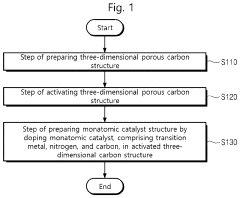
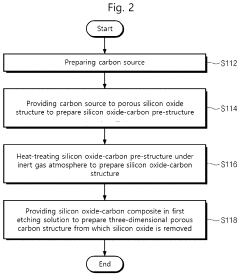
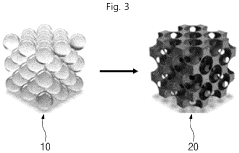
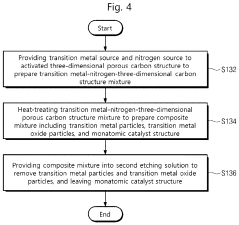
- A single-atom catalyst structure is developed by doping transition metal, nitrogen, and carbon into a three-dimensional ordered mesoporous carbon structure, which includes silicon, enhancing oxygen reduction reaction activity and reducing platinum usage, while maintaining low preparation costs and enabling mass production.
Patent
Innovation
- Single-atom catalysts (SACs) anchored on polymer electrolyte membranes, providing enhanced catalytic activity while maintaining high ion conductivity.
- Novel synthesis method for uniform dispersion of single metal atoms within the polymer matrix, preventing aggregation and ensuring long-term stability.
- Dual-functionality design where the membrane serves as both an ion conductor and catalyst support, reducing system complexity and improving overall efficiency.
Sustainability and Cost Analysis of SAC-PEM Systems
The economic viability and environmental impact of Single-Atom Catalysis in Polymer Electrolyte Membranes (SAC-PEM) systems represent critical factors for their widespread adoption. Current cost analysis indicates that SAC-PEM technologies require significant initial investment, primarily due to the precise fabrication processes needed to achieve atomic dispersion of catalytic metals and the specialized equipment for characterization and quality control.
Material costs constitute approximately 40-50% of total production expenses, with precious metals like platinum, palladium, and iridium representing the most substantial component. However, SAC technology demonstrates a remarkable advantage by utilizing metal atoms with nearly 100% atom efficiency, potentially reducing precious metal loading by 70-90% compared to conventional catalysts. This efficiency translates to estimated cost savings of $15-25 per kW for fuel cell applications.
Manufacturing scalability remains challenging, with current production methods primarily confined to laboratory scale. Industrial-scale production would require significant process engineering innovations to maintain atomic dispersion while increasing throughput. Economic modeling suggests that achieving cost parity with conventional technologies necessitates production volumes exceeding 100,000 units annually.
From a sustainability perspective, SAC-PEM systems offer considerable environmental benefits. Life cycle assessments indicate a potential reduction in carbon footprint by 30-45% compared to traditional catalytic systems, primarily due to decreased mining activities and reduced energy consumption in catalyst preparation. The extended catalyst lifetime—projected at 1.5-2 times longer than conventional catalysts—further enhances sustainability metrics through reduced replacement frequency.
Resource efficiency represents another significant advantage, with SAC-PEM systems requiring 80-95% less critical raw materials than conventional alternatives. This reduction addresses growing concerns regarding supply chain vulnerabilities and resource depletion, particularly for elements facing geopolitical supply constraints.
End-of-life considerations reveal both challenges and opportunities. While recovery of atomically dispersed metals presents technical difficulties, emerging recycling technologies demonstrate promising recovery rates of 75-85% for precious metals from spent SAC-PEM components. These recycling pathways could establish circular economy models that further enhance long-term sustainability.
Policy implications must also be considered, as carbon pricing mechanisms and sustainability regulations increasingly favor technologies with reduced environmental footprints. Economic modeling suggests that carbon pricing above $40-50 per ton would significantly accelerate SAC-PEM adoption by improving cost competitiveness against conventional alternatives.
Material costs constitute approximately 40-50% of total production expenses, with precious metals like platinum, palladium, and iridium representing the most substantial component. However, SAC technology demonstrates a remarkable advantage by utilizing metal atoms with nearly 100% atom efficiency, potentially reducing precious metal loading by 70-90% compared to conventional catalysts. This efficiency translates to estimated cost savings of $15-25 per kW for fuel cell applications.
Manufacturing scalability remains challenging, with current production methods primarily confined to laboratory scale. Industrial-scale production would require significant process engineering innovations to maintain atomic dispersion while increasing throughput. Economic modeling suggests that achieving cost parity with conventional technologies necessitates production volumes exceeding 100,000 units annually.
From a sustainability perspective, SAC-PEM systems offer considerable environmental benefits. Life cycle assessments indicate a potential reduction in carbon footprint by 30-45% compared to traditional catalytic systems, primarily due to decreased mining activities and reduced energy consumption in catalyst preparation. The extended catalyst lifetime—projected at 1.5-2 times longer than conventional catalysts—further enhances sustainability metrics through reduced replacement frequency.
Resource efficiency represents another significant advantage, with SAC-PEM systems requiring 80-95% less critical raw materials than conventional alternatives. This reduction addresses growing concerns regarding supply chain vulnerabilities and resource depletion, particularly for elements facing geopolitical supply constraints.
End-of-life considerations reveal both challenges and opportunities. While recovery of atomically dispersed metals presents technical difficulties, emerging recycling technologies demonstrate promising recovery rates of 75-85% for precious metals from spent SAC-PEM components. These recycling pathways could establish circular economy models that further enhance long-term sustainability.
Policy implications must also be considered, as carbon pricing mechanisms and sustainability regulations increasingly favor technologies with reduced environmental footprints. Economic modeling suggests that carbon pricing above $40-50 per ton would significantly accelerate SAC-PEM adoption by improving cost competitiveness against conventional alternatives.
Performance Benchmarking and Standardization Methods
Establishing standardized performance benchmarking methods for Single-Atom Catalysis (SAC) in Polymer Electrolyte Membranes (PEMs) remains a significant challenge due to the complexity and multidisciplinary nature of this emerging technology. Current benchmarking approaches vary considerably across research institutions and industrial laboratories, making direct comparisons of catalytic performance difficult and potentially misleading.
The most widely adopted performance metrics for SAC in PEMs include turnover frequency (TOF), mass activity, specific activity, and long-term stability measurements. However, testing conditions—such as temperature, pressure, membrane hydration levels, and reactant concentrations—often differ substantially between studies, complicating meaningful comparisons. This inconsistency highlights the urgent need for standardized testing protocols that can enable reliable assessment of catalytic innovations.
Several international organizations, including the International Union of Pure and Applied Chemistry (IUPAC) and the International Electrotechnical Commission (IEC), have initiated efforts to develop standardized testing frameworks specifically for single-atom catalysts in membrane applications. These frameworks aim to establish uniform conditions for catalyst evaluation, including standardized membrane preparation methods, controlled testing environments, and consistent analytical techniques for characterizing atomic dispersion and coordination environments.
Recent collaborative initiatives between academic institutions and industry partners have proposed a three-tier benchmarking approach. The first tier involves fundamental characterization of the single-atom catalyst structure using advanced techniques such as X-ray absorption spectroscopy (XAS), scanning transmission electron microscopy (STEM), and X-ray photoelectron spectroscopy (XPS) to confirm true single-atom dispersion. The second tier focuses on standardized activity measurements under well-defined reaction conditions. The third tier addresses long-term stability and performance under realistic operating conditions that simulate actual device implementation.
Round-robin testing programs, where identical catalyst samples are evaluated across multiple laboratories using standardized protocols, have emerged as a valuable approach to validate benchmarking methods. These programs have revealed significant variations in measurement techniques and highlighted the importance of standardized sample preparation and handling procedures to ensure reproducibility.
Accelerated stress tests (ASTs) have been developed to predict long-term stability without requiring prohibitively lengthy testing periods. These protocols typically involve cycling between extreme operating conditions to simulate extended use. However, the correlation between AST results and actual long-term performance remains an active area of research, particularly for single-atom catalysts where atom migration and agglomeration mechanisms may differ from traditional catalysts.
The most widely adopted performance metrics for SAC in PEMs include turnover frequency (TOF), mass activity, specific activity, and long-term stability measurements. However, testing conditions—such as temperature, pressure, membrane hydration levels, and reactant concentrations—often differ substantially between studies, complicating meaningful comparisons. This inconsistency highlights the urgent need for standardized testing protocols that can enable reliable assessment of catalytic innovations.
Several international organizations, including the International Union of Pure and Applied Chemistry (IUPAC) and the International Electrotechnical Commission (IEC), have initiated efforts to develop standardized testing frameworks specifically for single-atom catalysts in membrane applications. These frameworks aim to establish uniform conditions for catalyst evaluation, including standardized membrane preparation methods, controlled testing environments, and consistent analytical techniques for characterizing atomic dispersion and coordination environments.
Recent collaborative initiatives between academic institutions and industry partners have proposed a three-tier benchmarking approach. The first tier involves fundamental characterization of the single-atom catalyst structure using advanced techniques such as X-ray absorption spectroscopy (XAS), scanning transmission electron microscopy (STEM), and X-ray photoelectron spectroscopy (XPS) to confirm true single-atom dispersion. The second tier focuses on standardized activity measurements under well-defined reaction conditions. The third tier addresses long-term stability and performance under realistic operating conditions that simulate actual device implementation.
Round-robin testing programs, where identical catalyst samples are evaluated across multiple laboratories using standardized protocols, have emerged as a valuable approach to validate benchmarking methods. These programs have revealed significant variations in measurement techniques and highlighted the importance of standardized sample preparation and handling procedures to ensure reproducibility.
Accelerated stress tests (ASTs) have been developed to predict long-term stability without requiring prohibitively lengthy testing periods. These protocols typically involve cycling between extreme operating conditions to simulate extended use. However, the correlation between AST results and actual long-term performance remains an active area of research, particularly for single-atom catalysts where atom migration and agglomeration mechanisms may differ from traditional catalysts.
Unlock deeper insights with Patsnap Eureka Quick Research — get a full tech report to explore trends and direct your research. Try now!
Generate Your Research Report Instantly with AI Agent
Supercharge your innovation with Patsnap Eureka AI Agent Platform!