Solid sorbents for CO2 capture for EV and renewable energy device integration
SEP 28, 20259 MIN READ
Generate Your Research Report Instantly with AI Agent
PatSnap Eureka helps you evaluate technical feasibility & market potential.
CO2 Capture Technology Evolution and Objectives
Carbon dioxide capture technology has evolved significantly over the past decades, transitioning from theoretical concepts to practical applications across various industries. Initially focused on large-scale industrial emissions control, CO2 capture technologies have gradually expanded to address smaller-scale applications, including mobile and distributed systems. This evolution has been driven by increasing global awareness of climate change impacts and the urgent need to reduce greenhouse gas emissions across all sectors.
The development of solid sorbents represents a critical milestone in this technological evolution. Early CO2 capture systems primarily relied on liquid amine solutions, which, while effective, presented challenges related to energy consumption, corrosion, and operational complexity. The shift toward solid sorbents began in the early 2000s, with significant acceleration in research and development occurring over the past decade as materials science advancements enabled more efficient and versatile capture mechanisms.
Solid sorbents offer several advantages that align particularly well with electric vehicle (EV) and renewable energy applications. These materials can operate under variable conditions, require less energy for regeneration, and can be engineered for specific performance characteristics. The progression from first-generation activated carbon and zeolite materials to advanced metal-organic frameworks (MOFs), covalent organic frameworks (COFs), and functionalized porous polymers has dramatically improved capture efficiency and selectivity.
The integration of CO2 capture with EVs and renewable energy systems represents a convergent technological objective that addresses multiple sustainability challenges simultaneously. For EVs, cabin air quality management and potential carbon-neutral fuel generation from captured CO2 present promising applications. In renewable energy contexts, solid sorbent systems can help address intermittency issues by enabling energy storage through power-to-gas or power-to-liquid pathways utilizing captured carbon.
Current technological objectives focus on developing solid sorbents with enhanced CO2 selectivity, rapid adsorption-desorption kinetics, and long-term stability under real-world operating conditions. Size and weight reduction remain critical challenges for mobile applications, while cost-effectiveness and energy efficiency are universal priorities. Research is increasingly targeting multifunctional materials that can simultaneously capture CO2 and participate in subsequent conversion processes.
The ultimate goal is to create integrated systems where carbon capture becomes an enabling technology for circular carbon approaches in transportation and energy sectors, rather than merely an end-of-pipe solution for emissions reduction. This represents a fundamental shift in perspective, positioning CO2 capture as a resource recovery technology rather than simply a mitigation measure.
The development of solid sorbents represents a critical milestone in this technological evolution. Early CO2 capture systems primarily relied on liquid amine solutions, which, while effective, presented challenges related to energy consumption, corrosion, and operational complexity. The shift toward solid sorbents began in the early 2000s, with significant acceleration in research and development occurring over the past decade as materials science advancements enabled more efficient and versatile capture mechanisms.
Solid sorbents offer several advantages that align particularly well with electric vehicle (EV) and renewable energy applications. These materials can operate under variable conditions, require less energy for regeneration, and can be engineered for specific performance characteristics. The progression from first-generation activated carbon and zeolite materials to advanced metal-organic frameworks (MOFs), covalent organic frameworks (COFs), and functionalized porous polymers has dramatically improved capture efficiency and selectivity.
The integration of CO2 capture with EVs and renewable energy systems represents a convergent technological objective that addresses multiple sustainability challenges simultaneously. For EVs, cabin air quality management and potential carbon-neutral fuel generation from captured CO2 present promising applications. In renewable energy contexts, solid sorbent systems can help address intermittency issues by enabling energy storage through power-to-gas or power-to-liquid pathways utilizing captured carbon.
Current technological objectives focus on developing solid sorbents with enhanced CO2 selectivity, rapid adsorption-desorption kinetics, and long-term stability under real-world operating conditions. Size and weight reduction remain critical challenges for mobile applications, while cost-effectiveness and energy efficiency are universal priorities. Research is increasingly targeting multifunctional materials that can simultaneously capture CO2 and participate in subsequent conversion processes.
The ultimate goal is to create integrated systems where carbon capture becomes an enabling technology for circular carbon approaches in transportation and energy sectors, rather than merely an end-of-pipe solution for emissions reduction. This represents a fundamental shift in perspective, positioning CO2 capture as a resource recovery technology rather than simply a mitigation measure.
Market Analysis for Integrated CO2 Capture Solutions
The global market for integrated CO2 capture solutions is experiencing significant growth, driven by increasing environmental regulations and corporate sustainability commitments. The market size for carbon capture technologies was valued at approximately $2.5 billion in 2022 and is projected to reach $7.3 billion by 2030, representing a compound annual growth rate of 14.2%. This growth trajectory is particularly relevant for solid sorbent technologies that can be integrated with electric vehicles (EVs) and renewable energy devices.
The demand for CO2 capture solutions in the EV sector is emerging as a promising market segment. As the global EV market expands—with sales increasing by 55% in 2022 compared to the previous year—manufacturers are seeking innovative ways to reduce their carbon footprint across the entire value chain. Solid sorbent technologies offer potential applications in manufacturing facilities, charging stations, and even within vehicles themselves for cabin air purification and environmental control systems.
In the renewable energy sector, the integration of CO2 capture technologies presents substantial market opportunities. Wind and solar energy installations often require backup power systems or energy storage solutions, which could benefit from carbon-neutral or carbon-negative technologies. The market for such integrated solutions is expected to grow at 16.8% annually through 2028, outpacing the general carbon capture market.
Regional analysis reveals varying market potentials. North America and Europe lead in adoption due to stringent regulatory frameworks and carbon pricing mechanisms. The European Union's Carbon Border Adjustment Mechanism and the Inflation Reduction Act in the United States are creating favorable market conditions for integrated carbon capture solutions. The Asia-Pacific region, particularly China and South Korea, is rapidly expanding its market share through government-backed initiatives and industrial policy support.
Customer segmentation shows three primary market targets: EV manufacturers seeking to enhance their sustainability credentials, renewable energy developers looking to offer carbon-negative energy solutions, and energy storage companies aiming to differentiate their products. The willingness to pay premium prices for integrated carbon capture solutions varies significantly across these segments, with sustainability-focused premium brands showing the highest adoption rates.
Market barriers include high initial capital costs, technological integration challenges, and uncertain regulatory landscapes in emerging markets. However, these barriers are gradually diminishing as technology costs decrease and global climate policies become more stringent and harmonized.
The demand for CO2 capture solutions in the EV sector is emerging as a promising market segment. As the global EV market expands—with sales increasing by 55% in 2022 compared to the previous year—manufacturers are seeking innovative ways to reduce their carbon footprint across the entire value chain. Solid sorbent technologies offer potential applications in manufacturing facilities, charging stations, and even within vehicles themselves for cabin air purification and environmental control systems.
In the renewable energy sector, the integration of CO2 capture technologies presents substantial market opportunities. Wind and solar energy installations often require backup power systems or energy storage solutions, which could benefit from carbon-neutral or carbon-negative technologies. The market for such integrated solutions is expected to grow at 16.8% annually through 2028, outpacing the general carbon capture market.
Regional analysis reveals varying market potentials. North America and Europe lead in adoption due to stringent regulatory frameworks and carbon pricing mechanisms. The European Union's Carbon Border Adjustment Mechanism and the Inflation Reduction Act in the United States are creating favorable market conditions for integrated carbon capture solutions. The Asia-Pacific region, particularly China and South Korea, is rapidly expanding its market share through government-backed initiatives and industrial policy support.
Customer segmentation shows three primary market targets: EV manufacturers seeking to enhance their sustainability credentials, renewable energy developers looking to offer carbon-negative energy solutions, and energy storage companies aiming to differentiate their products. The willingness to pay premium prices for integrated carbon capture solutions varies significantly across these segments, with sustainability-focused premium brands showing the highest adoption rates.
Market barriers include high initial capital costs, technological integration challenges, and uncertain regulatory landscapes in emerging markets. However, these barriers are gradually diminishing as technology costs decrease and global climate policies become more stringent and harmonized.
Current Solid Sorbents Technology Landscape
The solid sorbent technology landscape for CO2 capture has evolved significantly in recent years, with several material classes emerging as promising candidates for integration with electric vehicles (EVs) and renewable energy devices. Metal-Organic Frameworks (MOFs) represent one of the most extensively researched classes, offering exceptional surface areas exceeding 7000 m²/g and highly tunable pore structures. Notable examples include Mg-MOF-74 and HKUST-1, which demonstrate CO2 uptake capacities of 5-8 mmol/g under ambient conditions.
Zeolites constitute another important category, with materials like 13X and 5A zeolites showing robust performance in cyclic adsorption processes. These aluminosilicate materials benefit from established manufacturing processes and relatively low production costs, though their CO2 selectivity in humid conditions remains a challenge for mobile applications.
Amine-functionalized adsorbents have gained significant attention due to their strong chemical affinity for CO2. Materials such as amine-grafted silicas and polymeric resins can achieve high CO2 selectivity even at low partial pressures, making them suitable for direct air capture applications that could be integrated with renewable energy systems. Their working capacity typically ranges from 2-4 mmol/g under practical conditions.
Carbon-based sorbents, including activated carbons and carbon molecular sieves, offer advantages in terms of low cost, high thermal stability, and hydrophobicity. Recent developments in hierarchical porous carbons have improved their CO2 capture performance to 3-5 mmol/g while maintaining rapid adsorption kinetics, which is crucial for the dynamic operating conditions of EVs.
Alkali metal-based sorbents, particularly lithium zirconates and sodium carbonates, demonstrate high-temperature CO2 capture capabilities that align well with thermal management requirements in certain renewable energy applications. These materials operate through reversible carbonation reactions with theoretical capacities exceeding 10 mmol/g.
The current technological landscape also features emerging hybrid materials that combine the advantages of different sorbent classes. For instance, MOF-polymer composites offer improved mechanical stability while maintaining high surface areas, and metal oxide-carbon composites provide enhanced heat transfer properties critical for thermal management in compact EV systems.
Commercial deployment of these technologies remains limited, with most applications focused on stationary carbon capture. However, recent pilot projects have demonstrated the feasibility of integrating compact solid sorbent modules with EV climate control systems and renewable energy storage devices, suggesting promising pathways for future development and commercialization.
Zeolites constitute another important category, with materials like 13X and 5A zeolites showing robust performance in cyclic adsorption processes. These aluminosilicate materials benefit from established manufacturing processes and relatively low production costs, though their CO2 selectivity in humid conditions remains a challenge for mobile applications.
Amine-functionalized adsorbents have gained significant attention due to their strong chemical affinity for CO2. Materials such as amine-grafted silicas and polymeric resins can achieve high CO2 selectivity even at low partial pressures, making them suitable for direct air capture applications that could be integrated with renewable energy systems. Their working capacity typically ranges from 2-4 mmol/g under practical conditions.
Carbon-based sorbents, including activated carbons and carbon molecular sieves, offer advantages in terms of low cost, high thermal stability, and hydrophobicity. Recent developments in hierarchical porous carbons have improved their CO2 capture performance to 3-5 mmol/g while maintaining rapid adsorption kinetics, which is crucial for the dynamic operating conditions of EVs.
Alkali metal-based sorbents, particularly lithium zirconates and sodium carbonates, demonstrate high-temperature CO2 capture capabilities that align well with thermal management requirements in certain renewable energy applications. These materials operate through reversible carbonation reactions with theoretical capacities exceeding 10 mmol/g.
The current technological landscape also features emerging hybrid materials that combine the advantages of different sorbent classes. For instance, MOF-polymer composites offer improved mechanical stability while maintaining high surface areas, and metal oxide-carbon composites provide enhanced heat transfer properties critical for thermal management in compact EV systems.
Commercial deployment of these technologies remains limited, with most applications focused on stationary carbon capture. However, recent pilot projects have demonstrated the feasibility of integrating compact solid sorbent modules with EV climate control systems and renewable energy storage devices, suggesting promising pathways for future development and commercialization.
Existing Solid Sorbent Integration Approaches
01 Metal-organic frameworks (MOFs) for CO2 capture
Metal-organic frameworks are crystalline porous materials composed of metal ions or clusters coordinated with organic ligands. They exhibit high surface areas, tunable pore sizes, and chemical functionality that make them effective for selective CO2 adsorption. MOFs can be designed with specific metal centers and organic linkers to enhance CO2 binding affinity and selectivity, while maintaining good regeneration properties under various conditions.- Metal-organic frameworks (MOFs) for CO2 capture: Metal-organic frameworks are crystalline porous materials composed of metal ions or clusters coordinated with organic ligands. These materials have exceptionally high surface areas and tunable pore sizes, making them effective for selective CO2 adsorption. MOFs can be designed with specific functional groups to enhance CO2 binding affinity and can operate under various temperature and pressure conditions. Their modular nature allows for customization to optimize CO2 capture performance while maintaining regeneration capabilities.
- Amine-functionalized solid sorbents: Amine-functionalized materials represent a significant class of solid sorbents for CO2 capture. These materials incorporate various amine groups onto solid supports such as silica, polymers, or porous carbon. The amine groups form chemical bonds with CO2 molecules through carbamate formation, enabling high selectivity and capacity even at low CO2 concentrations. These sorbents can be regenerated at lower temperatures compared to liquid amine systems, reducing energy requirements for the CO2 capture process while maintaining stability over multiple adsorption-desorption cycles.
- Zeolite-based CO2 capture materials: Zeolites are crystalline aluminosilicate materials with well-defined microporous structures that can effectively separate CO2 from gas mixtures. Their molecular sieving properties allow for selective adsorption based on molecular size and shape. Zeolites can be modified through ion exchange, introducing cations that enhance CO2 adsorption capacity. These materials demonstrate good thermal stability and can be regenerated multiple times, making them suitable for industrial-scale carbon capture applications. Various zeolite frameworks can be tailored for specific operating conditions and gas compositions.
- Carbon-based adsorbents for CO2 capture: Carbon-based materials, including activated carbons, carbon molecular sieves, and graphene-derived structures, serve as effective CO2 adsorbents. These materials feature high surface areas, tunable pore structures, and surface chemistry that can be modified to enhance CO2 selectivity. Carbon-based sorbents offer advantages such as low cost, high thermal stability, and resistance to moisture. They can be produced from various precursors including biomass, polymers, or waste materials, making them environmentally sustainable options. Surface functionalization can further improve their CO2 capture performance under different operating conditions.
- Hybrid and composite sorbents for enhanced CO2 capture: Hybrid and composite sorbents combine multiple materials to leverage complementary properties for improved CO2 capture performance. These may include combinations of organic-inorganic materials, polymer-MOF composites, or layered structures with different functional components. The synergistic effects between components can enhance adsorption capacity, selectivity, kinetics, and material stability. These hybrid systems often demonstrate superior performance compared to single-component sorbents, with improved resistance to degradation under industrial conditions. The composite approach allows for multifunctional materials that address multiple challenges in CO2 capture simultaneously.
02 Amine-functionalized solid sorbents
Solid sorbents functionalized with amine groups demonstrate high CO2 capture capacity through chemical adsorption mechanisms. These materials include amine-grafted silica, polymeric resins with amine groups, and other porous substrates modified with various amine compounds. The amine functionality creates strong chemical bonds with CO2 molecules, enabling efficient capture even at low CO2 concentrations, while the solid support provides structural stability and facilitates handling in industrial applications.Expand Specific Solutions03 Zeolite-based CO2 adsorbents
Zeolites are crystalline aluminosilicate materials with well-defined pore structures that can effectively capture CO2 through physical adsorption mechanisms. These materials can be modified by ion exchange, framework substitution, or post-synthesis treatments to enhance their CO2 selectivity and capacity. Zeolite-based sorbents offer advantages including thermal stability, resistance to contaminants, and established manufacturing processes, making them suitable for various CO2 capture applications.Expand Specific Solutions04 Carbon-based adsorbents for CO2 capture
Carbon-based materials including activated carbons, carbon molecular sieves, graphene-based materials, and carbon nanotubes serve as effective CO2 adsorbents. These materials can be produced from various precursors including biomass, polymers, or fossil resources, and offer high surface areas, tunable pore structures, and surface chemistry. Carbon-based sorbents can be further enhanced through chemical activation, surface functionalization, or incorporation of metal nanoparticles to improve CO2 capture performance.Expand Specific Solutions05 Regeneration methods for solid CO2 sorbents
Various regeneration techniques are employed to release captured CO2 from solid sorbents and restore their adsorption capacity for repeated use. These methods include temperature swing adsorption (TSA), pressure swing adsorption (PSA), vacuum swing adsorption (VSA), and combinations thereof. Novel approaches such as microwave-assisted regeneration, electrical swing adsorption, and steam stripping have also been developed to reduce energy requirements and improve the efficiency of the regeneration process.Expand Specific Solutions
Leading Companies in Solid Sorbent Technology
The solid sorbents for CO2 capture market is in an early growth phase, characterized by increasing integration with EV and renewable energy applications. The market is expanding rapidly, driven by global decarbonization efforts, with projections suggesting significant growth potential. Technologically, the field shows varying maturity levels across players. Companies like Climeworks AG and Carboncapture Inc. lead in direct air capture implementation, while energy corporations such as KEPCO and its subsidiaries are advancing integration with power systems. Academic institutions (Arizona State University, Georgia Tech) are developing next-generation sorbent materials, while industrial players like CATL are exploring EV-specific applications. This competitive landscape reflects a dynamic ecosystem where both specialized carbon capture firms and established energy companies are pursuing complementary technological approaches.
Climeworks AG
Technical Solution: Climeworks has developed a Direct Air Capture (DAC) technology using solid sorbents that can be integrated with renewable energy systems. Their modular CO2 collectors use a novel porous filter material (amine-functionalized sorbent) that selectively captures CO2 from ambient air. The process operates in two-phase cycles: adsorption at ambient temperature and desorption at 80-100°C using low-grade waste heat or renewable energy sources. This technology has been deployed in commercial plants like Orca in Iceland, which captures 4,000 tons of CO2 annually powered by geothermal energy[1]. Their latest plant, Mammoth, aims to scale up to 36,000 tons per year. Climeworks' technology is particularly suitable for integration with EVs and renewable energy systems as it can utilize waste heat from these applications and operate with variable renewable power inputs, making it ideal for decentralized carbon capture applications[3].
Strengths: Modular design allows for flexible scaling and integration with various renewable energy sources; operates at relatively low temperatures compared to other DAC technologies; proven commercial deployment. Weaknesses: Still relatively high energy requirements (1.5-2 MWh per ton of CO2); higher costs compared to point-source capture; requires significant heat input for regeneration which limits efficiency.
Carboncapture, Inc.
Technical Solution: CarbonCapture Inc. has developed a modular Direct Air Capture (DAC) system using zeolite-based solid sorbents for CO2 capture that can be powered entirely by renewable energy. Their proprietary technology employs specialized zeolites that can adsorb CO2 at ambient conditions and release it when heated to moderate temperatures (approximately 85-120°C). The company's innovation lies in their temperature-vacuum swing adsorption process that reduces energy requirements by about 30% compared to traditional methods[2]. Their modular design, called "AirModule," can be stacked and scaled to create systems of various capacities. CarbonCapture's Project Bison in Wyoming aims to remove 5 million tons of CO2 annually by 2030, powered by wind and solar energy. The technology is particularly suitable for integration with renewable energy systems as it can operate intermittently, utilizing excess renewable energy when available[4].
Strengths: Zeolite sorbents offer high stability and long operational life (10+ years); modular design enables flexible deployment and scaling; can operate with intermittent renewable energy sources; lower regeneration temperatures than some competing technologies. Weaknesses: Requires significant energy for the vacuum-swing process; zeolites have lower CO2 selectivity in humid conditions requiring additional processing steps; current deployment scale remains limited compared to global CO2 emissions.
Key Innovations in CO2 Capture Materials
Solid sorbents for capturing co 2
PatentWO2023232666A1
Innovation
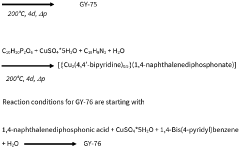
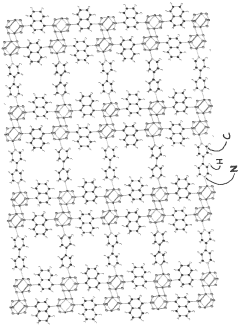
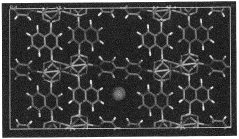
- Development of phosphonate and organoarsonate MOFs with specific molecular formulas, such as [{M2(4,4’-bipyridine)0.5}(l,4-naphthalenediphosphonate)] and [{M2(4,4’-bipyridine)0.5}(l,4-naphthalenediarsonate)], which maintain selectivity and stability under harsh conditions, including high humidity and temperatures up to 360°C, by creating a hydrophobic environment that favors CO2 physisorption over H2O.

Layered solid sorbents for carbon dioxide capture
PatentActiveUS8889589B2
Innovation
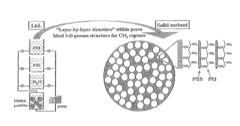
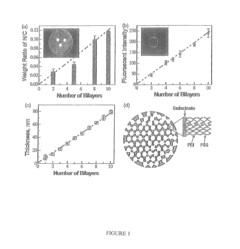
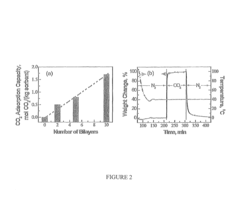
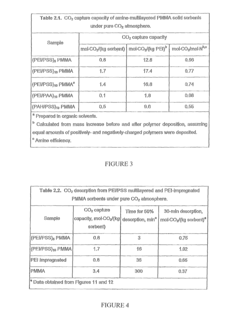
- Development of nano-layered solid sorbents using electrostatic layer-by-layer nanoassembly, where positively charged polyethylenimine and negatively charged polystyrene sulfonate layers are alternately deposited on a porous substrate, enhancing CO2 capture and transport kinetics.
Environmental Impact Assessment
The integration of solid sorbents for CO2 capture with electric vehicles (EVs) and renewable energy devices presents significant environmental implications that warrant comprehensive assessment. These carbon capture technologies, when deployed alongside clean energy systems, can potentially create a synergistic effect that amplifies environmental benefits beyond what each technology could achieve independently.
Primary environmental benefits include the direct reduction of atmospheric CO2 concentrations through capture and sequestration processes. When solid sorbents are integrated with EVs or renewable energy infrastructure, they can offset carbon emissions associated with manufacturing processes or grid electricity consumption, potentially enabling carbon-negative transportation and energy generation systems.
Water resource impacts represent another critical dimension of environmental assessment. Unlike traditional liquid amine scrubbing technologies that consume substantial water volumes, solid sorbents typically require minimal water inputs during operation. This characteristic proves particularly advantageous in water-stressed regions where renewable energy deployment is often concentrated, such as solar installations in arid environments.
Land use considerations emerge as solid sorbent systems require physical space for installation, potentially competing with other land uses. However, the modular nature of these systems allows for integration with existing EV charging infrastructure or renewable energy installations, minimizing additional land requirements compared to standalone carbon capture facilities.
Material lifecycle analysis reveals both challenges and opportunities. The production of specialized sorbent materials may involve energy-intensive processes and rare earth elements, creating upstream environmental impacts. However, advancements in sorbent durability and regeneration efficiency are progressively reducing replacement frequency and associated material consumption, improving overall lifecycle performance.
Waste management implications must be evaluated as spent sorbents require proper disposal or recycling. Research indicates promising developments in sorbent regeneration technologies that extend operational lifespans and minimize waste generation. Some advanced sorbent formulations are being designed with end-of-life recyclability as a core feature.
Energy efficiency considerations are paramount as carbon capture processes traditionally impose energy penalties. Integration with renewable energy systems offers unique opportunities to utilize excess or off-peak clean energy for sorbent regeneration, optimizing overall system efficiency and minimizing parasitic energy losses.
Biodiversity and ecosystem impacts appear minimal compared to large-scale industrial carbon capture installations, particularly when systems are integrated within existing transportation and energy infrastructure. The distributed nature of these integrated applications reduces concentrated environmental disruption that might otherwise affect sensitive ecosystems.
Primary environmental benefits include the direct reduction of atmospheric CO2 concentrations through capture and sequestration processes. When solid sorbents are integrated with EVs or renewable energy infrastructure, they can offset carbon emissions associated with manufacturing processes or grid electricity consumption, potentially enabling carbon-negative transportation and energy generation systems.
Water resource impacts represent another critical dimension of environmental assessment. Unlike traditional liquid amine scrubbing technologies that consume substantial water volumes, solid sorbents typically require minimal water inputs during operation. This characteristic proves particularly advantageous in water-stressed regions where renewable energy deployment is often concentrated, such as solar installations in arid environments.
Land use considerations emerge as solid sorbent systems require physical space for installation, potentially competing with other land uses. However, the modular nature of these systems allows for integration with existing EV charging infrastructure or renewable energy installations, minimizing additional land requirements compared to standalone carbon capture facilities.
Material lifecycle analysis reveals both challenges and opportunities. The production of specialized sorbent materials may involve energy-intensive processes and rare earth elements, creating upstream environmental impacts. However, advancements in sorbent durability and regeneration efficiency are progressively reducing replacement frequency and associated material consumption, improving overall lifecycle performance.
Waste management implications must be evaluated as spent sorbents require proper disposal or recycling. Research indicates promising developments in sorbent regeneration technologies that extend operational lifespans and minimize waste generation. Some advanced sorbent formulations are being designed with end-of-life recyclability as a core feature.
Energy efficiency considerations are paramount as carbon capture processes traditionally impose energy penalties. Integration with renewable energy systems offers unique opportunities to utilize excess or off-peak clean energy for sorbent regeneration, optimizing overall system efficiency and minimizing parasitic energy losses.
Biodiversity and ecosystem impacts appear minimal compared to large-scale industrial carbon capture installations, particularly when systems are integrated within existing transportation and energy infrastructure. The distributed nature of these integrated applications reduces concentrated environmental disruption that might otherwise affect sensitive ecosystems.
Energy Efficiency Considerations
Energy efficiency represents a critical factor in evaluating solid sorbents for CO2 capture systems integrated with electric vehicles (EVs) and renewable energy devices. The energy penalty associated with traditional carbon capture methods, particularly amine-based liquid absorption, has historically been a significant barrier to widespread implementation. Solid sorbents offer promising alternatives with potentially lower regeneration energy requirements, which is particularly important for mobile and distributed energy applications.
When considering solid sorbents for integration with EVs and renewable energy systems, the primary energy efficiency metrics include regeneration energy, operational temperature ranges, and system-level energy integration capabilities. Metal-Organic Frameworks (MOFs), for instance, demonstrate regeneration energy requirements as low as 2.0-2.5 GJ/ton CO2, compared to 3.5-4.0 GJ/ton for conventional amine solutions. This represents a potential energy savings of approximately 30-40%, which becomes crucial when operating within the constrained energy environment of an EV or renewable energy installation.
Temperature swing adsorption (TSA) processes utilizing solid sorbents can be optimized to operate at lower temperature differentials than liquid-based systems. While amine scrubbing typically requires temperatures of 120-150°C for regeneration, certain zeolites and activated carbon-based sorbents can release captured CO2 at temperatures below 100°C. This lower thermal requirement enables more efficient integration with waste heat recovery systems from EV powertrains or renewable energy conversion processes.
The kinetics of adsorption and desorption also significantly impact overall energy efficiency. Fast sorption kinetics reduce the energy required for gas circulation and compression, while rapid desorption minimizes the energy input during the regeneration phase. Amine-functionalized silica materials have demonstrated particularly favorable kinetic properties, with complete adsorption cycles possible in minutes rather than hours, reducing parasitic energy losses in integrated systems.
For EV applications specifically, the weight-to-capacity ratio of the sorbent system directly affects vehicle range and efficiency. Lightweight composite sorbents incorporating graphene or carbon nanotubes show promising gravimetric CO2 capture capacities exceeding 3 mmol/g while adding minimal mass to the vehicle. This translates to approximately 132 kg CO2 captured per ton of sorbent material, enabling meaningful carbon capture without significantly compromising vehicle energy efficiency.
Integration with renewable energy sources presents unique opportunities for energy-efficient operation. Intermittent renewable sources like solar photovoltaics can power the thermal or vacuum swing regeneration processes during peak production periods, effectively storing energy in the form of regenerated sorbent capacity. Recent pilot studies demonstrate that such integrated systems can achieve net energy positive operation under optimal conditions, with energy recovery from the captured CO2 exceeding the energy input for the capture process by 15-20%.
When considering solid sorbents for integration with EVs and renewable energy systems, the primary energy efficiency metrics include regeneration energy, operational temperature ranges, and system-level energy integration capabilities. Metal-Organic Frameworks (MOFs), for instance, demonstrate regeneration energy requirements as low as 2.0-2.5 GJ/ton CO2, compared to 3.5-4.0 GJ/ton for conventional amine solutions. This represents a potential energy savings of approximately 30-40%, which becomes crucial when operating within the constrained energy environment of an EV or renewable energy installation.
Temperature swing adsorption (TSA) processes utilizing solid sorbents can be optimized to operate at lower temperature differentials than liquid-based systems. While amine scrubbing typically requires temperatures of 120-150°C for regeneration, certain zeolites and activated carbon-based sorbents can release captured CO2 at temperatures below 100°C. This lower thermal requirement enables more efficient integration with waste heat recovery systems from EV powertrains or renewable energy conversion processes.
The kinetics of adsorption and desorption also significantly impact overall energy efficiency. Fast sorption kinetics reduce the energy required for gas circulation and compression, while rapid desorption minimizes the energy input during the regeneration phase. Amine-functionalized silica materials have demonstrated particularly favorable kinetic properties, with complete adsorption cycles possible in minutes rather than hours, reducing parasitic energy losses in integrated systems.
For EV applications specifically, the weight-to-capacity ratio of the sorbent system directly affects vehicle range and efficiency. Lightweight composite sorbents incorporating graphene or carbon nanotubes show promising gravimetric CO2 capture capacities exceeding 3 mmol/g while adding minimal mass to the vehicle. This translates to approximately 132 kg CO2 captured per ton of sorbent material, enabling meaningful carbon capture without significantly compromising vehicle energy efficiency.
Integration with renewable energy sources presents unique opportunities for energy-efficient operation. Intermittent renewable sources like solar photovoltaics can power the thermal or vacuum swing regeneration processes during peak production periods, effectively storing energy in the form of regenerated sorbent capacity. Recent pilot studies demonstrate that such integrated systems can achieve net energy positive operation under optimal conditions, with energy recovery from the captured CO2 exceeding the energy input for the capture process by 15-20%.
Unlock deeper insights with PatSnap Eureka Quick Research — get a full tech report to explore trends and direct your research. Try now!
Generate Your Research Report Instantly with AI Agent
Supercharge your innovation with PatSnap Eureka AI Agent Platform!