

Tunnel Diode vs PIN Diode: Signal Processing Capabilities
SEP 23, 20259 MIN READ
Generate Your Research Report Instantly with AI Agent
PatSnap Eureka helps you evaluate technical feasibility & market potential.
Diode Technology Background and Objectives
Diode technology has evolved significantly since its inception in the early 20th century, with specialized variants emerging to address specific application needs in electronic circuits. Tunnel diodes and PIN diodes represent two distinct branches in this evolution, each offering unique signal processing capabilities that have shaped modern electronics and telecommunications.
The tunnel diode, discovered by Leo Esaki in 1957 (earning him the Nobel Prize in Physics in 1973), leverages quantum mechanical tunneling effects to achieve negative resistance characteristics. This revolutionary property enabled high-frequency operations previously unattainable with conventional semiconductor devices. The technology saw rapid development during the 1960s, particularly in microwave applications and ultra-fast switching circuits.
PIN diodes, consisting of P-type and N-type semiconductor regions separated by an intrinsic semiconductor layer, emerged as a parallel development focused on different signal processing objectives. Their structure, refined throughout the 1950s and 1960s, provided superior characteristics for RF switching, attenuating, and modulating applications, establishing them as fundamental components in communication systems.
The technological trajectory of both diode types has been driven by increasing demands for higher frequency operation, improved power handling, reduced parasitic effects, and integration capabilities with modern semiconductor fabrication processes. The miniaturization trend in electronics has further pushed development toward smaller form factors while maintaining or enhancing performance characteristics.
Current technical objectives in the field focus on several key areas: enhancing the frequency response of both diode types to meet the demands of 5G and future 6G communications; improving linearity for complex signal processing applications; reducing power consumption for mobile and IoT applications; and developing novel materials and structures to overcome the limitations of traditional silicon-based implementations.
Research efforts are particularly concentrated on exploring compound semiconductor materials like gallium nitride (GaN) and silicon carbide (SiC) to extend the operational boundaries of these diodes. Additionally, there is significant interest in hybrid approaches that combine the distinct advantages of tunnel and PIN diodes to create versatile signal processing components.
The comparative analysis of tunnel diodes versus PIN diodes represents a critical area of investigation, as system designers seek to optimize signal processing chains for specific applications ranging from high-speed data communications to radar systems and quantum computing interfaces. Understanding the relative strengths, limitations, and complementary aspects of these technologies is essential for advancing next-generation electronic systems.
The tunnel diode, discovered by Leo Esaki in 1957 (earning him the Nobel Prize in Physics in 1973), leverages quantum mechanical tunneling effects to achieve negative resistance characteristics. This revolutionary property enabled high-frequency operations previously unattainable with conventional semiconductor devices. The technology saw rapid development during the 1960s, particularly in microwave applications and ultra-fast switching circuits.
PIN diodes, consisting of P-type and N-type semiconductor regions separated by an intrinsic semiconductor layer, emerged as a parallel development focused on different signal processing objectives. Their structure, refined throughout the 1950s and 1960s, provided superior characteristics for RF switching, attenuating, and modulating applications, establishing them as fundamental components in communication systems.
The technological trajectory of both diode types has been driven by increasing demands for higher frequency operation, improved power handling, reduced parasitic effects, and integration capabilities with modern semiconductor fabrication processes. The miniaturization trend in electronics has further pushed development toward smaller form factors while maintaining or enhancing performance characteristics.
Current technical objectives in the field focus on several key areas: enhancing the frequency response of both diode types to meet the demands of 5G and future 6G communications; improving linearity for complex signal processing applications; reducing power consumption for mobile and IoT applications; and developing novel materials and structures to overcome the limitations of traditional silicon-based implementations.
Research efforts are particularly concentrated on exploring compound semiconductor materials like gallium nitride (GaN) and silicon carbide (SiC) to extend the operational boundaries of these diodes. Additionally, there is significant interest in hybrid approaches that combine the distinct advantages of tunnel and PIN diodes to create versatile signal processing components.
The comparative analysis of tunnel diodes versus PIN diodes represents a critical area of investigation, as system designers seek to optimize signal processing chains for specific applications ranging from high-speed data communications to radar systems and quantum computing interfaces. Understanding the relative strengths, limitations, and complementary aspects of these technologies is essential for advancing next-generation electronic systems.
Market Applications Analysis for Signal Processing Diodes
Signal processing diodes represent a critical component in modern electronic systems, with tunnel diodes and PIN diodes offering distinct capabilities for various applications. The market for these specialized components continues to expand as demand for high-frequency communications, radar systems, and advanced sensing technologies grows across multiple industries.
The telecommunications sector represents the largest market segment for signal processing diodes, particularly PIN diodes which excel in RF switching, attenuating, and phase shifting applications. With 5G infrastructure deployment accelerating globally, the demand for high-performance PIN diodes has seen substantial growth, especially in base station equipment where their low distortion characteristics are highly valued.
Tunnel diodes, despite being less widely deployed than PIN diodes, maintain significant market presence in specialized high-frequency oscillator applications, particularly in military and aerospace sectors. Their negative resistance characteristics enable unique signal processing capabilities that remain valuable in niche applications where ultra-fast switching is required.
The automotive industry represents an emerging market for both diode types, with advanced driver assistance systems (ADAS) and autonomous vehicle technologies creating new demand for radar and sensing components. PIN diodes are increasingly incorporated into automotive radar systems operating at 77 GHz and 79 GHz bands, while tunnel diodes find applications in specialized sensing circuits.
Medical equipment manufacturers constitute another significant market segment, utilizing both diode types in diagnostic imaging equipment, patient monitoring systems, and therapeutic devices. PIN diodes are commonly employed in MRI systems for RF switching, while tunnel diodes serve specialized functions in certain monitoring equipment.
Consumer electronics represents a volume-driven market for signal processing diodes, particularly PIN diodes used in smartphones, tablets, and IoT devices. The miniaturization trend in consumer electronics has driven demand for smaller package sizes while maintaining performance characteristics.
Geographically, North America and Asia-Pacific dominate the market for signal processing diodes. North America leads in aerospace and defense applications, while Asia-Pacific, particularly China, Japan, and South Korea, represents the largest market for telecommunications and consumer electronics applications.
Market forecasts indicate continued growth for signal processing diodes, with PIN diodes expected to maintain larger market share due to their versatility across multiple applications. Tunnel diodes, while more specialized, are projected to see stable demand in high-performance applications where their unique characteristics provide irreplaceable functionality.
The telecommunications sector represents the largest market segment for signal processing diodes, particularly PIN diodes which excel in RF switching, attenuating, and phase shifting applications. With 5G infrastructure deployment accelerating globally, the demand for high-performance PIN diodes has seen substantial growth, especially in base station equipment where their low distortion characteristics are highly valued.
Tunnel diodes, despite being less widely deployed than PIN diodes, maintain significant market presence in specialized high-frequency oscillator applications, particularly in military and aerospace sectors. Their negative resistance characteristics enable unique signal processing capabilities that remain valuable in niche applications where ultra-fast switching is required.
The automotive industry represents an emerging market for both diode types, with advanced driver assistance systems (ADAS) and autonomous vehicle technologies creating new demand for radar and sensing components. PIN diodes are increasingly incorporated into automotive radar systems operating at 77 GHz and 79 GHz bands, while tunnel diodes find applications in specialized sensing circuits.
Medical equipment manufacturers constitute another significant market segment, utilizing both diode types in diagnostic imaging equipment, patient monitoring systems, and therapeutic devices. PIN diodes are commonly employed in MRI systems for RF switching, while tunnel diodes serve specialized functions in certain monitoring equipment.
Consumer electronics represents a volume-driven market for signal processing diodes, particularly PIN diodes used in smartphones, tablets, and IoT devices. The miniaturization trend in consumer electronics has driven demand for smaller package sizes while maintaining performance characteristics.
Geographically, North America and Asia-Pacific dominate the market for signal processing diodes. North America leads in aerospace and defense applications, while Asia-Pacific, particularly China, Japan, and South Korea, represents the largest market for telecommunications and consumer electronics applications.
Market forecasts indicate continued growth for signal processing diodes, with PIN diodes expected to maintain larger market share due to their versatility across multiple applications. Tunnel diodes, while more specialized, are projected to see stable demand in high-performance applications where their unique characteristics provide irreplaceable functionality.
Current Technical Challenges in Tunnel and PIN Diodes
Despite significant advancements in semiconductor technology, both tunnel diodes and PIN diodes face several technical challenges that limit their signal processing capabilities. Tunnel diodes, which operate based on quantum tunneling effects, struggle with temperature sensitivity issues that cause performance variations across operating environments. This thermal instability affects the negative resistance region critical for oscillation and switching applications, resulting in unpredictable behavior in signal processing circuits.
Manufacturing consistency presents another major challenge for tunnel diodes. The precise doping concentrations required to create the tunneling effect are difficult to control in mass production, leading to device-to-device variations that complicate circuit design and reduce yield rates. These inconsistencies make tunnel diodes less attractive for commercial signal processing applications despite their theoretical advantages in high-frequency operations.
For PIN diodes, the primary technical hurdle involves switching speed limitations. While they excel as RF switches and attenuators, their relatively slow recovery time from forward to reverse bias conditions restricts their use in ultra-high-frequency applications. This limitation becomes particularly problematic in modern communication systems requiring nanosecond switching capabilities.
Power handling capabilities represent another significant challenge. PIN diodes exhibit non-linear behavior under high-power conditions, introducing signal distortion that compromises processing accuracy. Engineers must implement complex compensation circuits to mitigate these effects, increasing system complexity and cost.
Both diode types face integration challenges with modern semiconductor processes. Tunnel diodes require specialized fabrication techniques that don't align well with standard CMOS processes, creating compatibility issues when integrating with other circuit components. Similarly, PIN diodes require specific layer structures that complicate their incorporation into highly integrated signal processing systems.
Reliability under extreme conditions remains problematic for both technologies. Tunnel diodes are particularly susceptible to performance degradation under radiation exposure, limiting their application in aerospace and military signal processing systems. PIN diodes, while more robust, experience lifetime degradation issues when subjected to repeated high-power switching cycles, affecting long-term reliability in critical applications.
From a commercial perspective, both technologies face competition from newer semiconductor devices. GaN-based transistors and silicon carbide devices offer superior performance characteristics for many signal processing applications, challenging the relevance of these older diode technologies in cutting-edge systems. This market pressure has resulted in reduced research investment, slowing the pace of innovation in addressing these fundamental technical limitations.
Manufacturing consistency presents another major challenge for tunnel diodes. The precise doping concentrations required to create the tunneling effect are difficult to control in mass production, leading to device-to-device variations that complicate circuit design and reduce yield rates. These inconsistencies make tunnel diodes less attractive for commercial signal processing applications despite their theoretical advantages in high-frequency operations.
For PIN diodes, the primary technical hurdle involves switching speed limitations. While they excel as RF switches and attenuators, their relatively slow recovery time from forward to reverse bias conditions restricts their use in ultra-high-frequency applications. This limitation becomes particularly problematic in modern communication systems requiring nanosecond switching capabilities.
Power handling capabilities represent another significant challenge. PIN diodes exhibit non-linear behavior under high-power conditions, introducing signal distortion that compromises processing accuracy. Engineers must implement complex compensation circuits to mitigate these effects, increasing system complexity and cost.
Both diode types face integration challenges with modern semiconductor processes. Tunnel diodes require specialized fabrication techniques that don't align well with standard CMOS processes, creating compatibility issues when integrating with other circuit components. Similarly, PIN diodes require specific layer structures that complicate their incorporation into highly integrated signal processing systems.
Reliability under extreme conditions remains problematic for both technologies. Tunnel diodes are particularly susceptible to performance degradation under radiation exposure, limiting their application in aerospace and military signal processing systems. PIN diodes, while more robust, experience lifetime degradation issues when subjected to repeated high-power switching cycles, affecting long-term reliability in critical applications.
From a commercial perspective, both technologies face competition from newer semiconductor devices. GaN-based transistors and silicon carbide devices offer superior performance characteristics for many signal processing applications, challenging the relevance of these older diode technologies in cutting-edge systems. This market pressure has resulted in reduced research investment, slowing the pace of innovation in addressing these fundamental technical limitations.
Comparative Analysis of Tunnel vs PIN Diode Solutions
01 Tunnel diode applications in signal processing
Tunnel diodes are utilized in signal processing applications due to their negative resistance characteristics and fast switching capabilities. These properties make them suitable for high-frequency oscillators, amplifiers, and mixers. The negative resistance region of tunnel diodes allows them to generate and process signals with minimal noise, making them valuable in sensitive detection circuits and high-speed switching applications.- Tunnel Diode Applications in Signal Processing: Tunnel diodes are utilized in signal processing applications due to their negative resistance characteristics and fast switching capabilities. These properties make them suitable for high-frequency oscillators, amplifiers, and switching circuits. The negative resistance region of tunnel diodes allows for efficient signal amplification and generation, particularly in microwave frequency applications where conventional transistors may be less effective.
- PIN Diode RF and Microwave Signal Control: PIN diodes excel in RF and microwave signal control applications due to their unique structure and behavior at high frequencies. They function effectively as variable resistors in RF circuits, enabling applications such as switching, attenuating, phase shifting, and modulating signals. Their low capacitance in reverse bias and low resistance in forward bias make them ideal for controlling high-frequency signals with minimal distortion and insertion loss.
- Hybrid Circuits Combining Tunnel and PIN Diodes: Hybrid circuits that combine both tunnel diodes and PIN diodes leverage the complementary characteristics of each component for enhanced signal processing capabilities. Tunnel diodes contribute negative resistance and ultra-fast switching, while PIN diodes provide superior RF control and power handling. These hybrid configurations enable complex signal processing functions such as frequency conversion, pulse shaping, and advanced modulation schemes with improved performance metrics.
- High-Speed Switching and Pulse Generation: Both tunnel and PIN diodes demonstrate exceptional capabilities in high-speed switching and pulse generation applications. Tunnel diodes can generate extremely short pulses due to their negative resistance region and fast electron tunneling mechanism. PIN diodes offer controlled switching with low distortion at high frequencies. These properties enable applications in radar systems, digital communications, pulse-forming networks, and timing circuits where nanosecond or sub-nanosecond switching is required.
- Temperature and Radiation Resistant Signal Processing: Tunnel and PIN diodes exhibit superior performance in extreme environmental conditions, making them valuable for signal processing in harsh environments. These diodes maintain reliable operation under temperature extremes and radiation exposure that would compromise conventional semiconductor devices. This resilience enables their use in aerospace, nuclear, and military applications where signal integrity must be maintained despite challenging environmental factors.
02 PIN diode switching and modulation capabilities
PIN diodes excel in RF and microwave signal switching and modulation applications. Their unique structure allows them to function as variable resistors at high frequencies, enabling precise control of signal amplitude and phase. These diodes can rapidly switch between conducting and non-conducting states, making them ideal for pulse modulation, signal attenuation, and phase shifting in communication systems.Expand Specific Solutions03 Hybrid circuits combining tunnel and PIN diodes
Hybrid circuits that integrate both tunnel diodes and PIN diodes leverage the complementary properties of each component to enhance signal processing capabilities. Tunnel diodes contribute negative resistance and fast switching, while PIN diodes provide controlled impedance and power handling. These hybrid configurations are used in advanced signal detection, mixing, and amplification circuits where both high sensitivity and power handling are required.Expand Specific Solutions04 High-frequency and microwave applications
Both tunnel diodes and PIN diodes are extensively used in high-frequency and microwave signal processing. Tunnel diodes can operate at frequencies up to the terahertz range due to their quantum tunneling mechanism, while PIN diodes offer excellent linearity and isolation at microwave frequencies. These characteristics make them suitable for radar systems, satellite communications, and high-speed data transmission applications.Expand Specific Solutions05 Temperature compensation and stability techniques
Signal processing circuits using tunnel and PIN diodes often incorporate temperature compensation and stability enhancement techniques. These methods include biasing networks, feedback mechanisms, and specialized circuit topologies that maintain consistent performance across varying environmental conditions. Such techniques are crucial for ensuring reliable operation in applications where signal integrity must be preserved despite temperature fluctuations.Expand Specific Solutions
Leading Manufacturers and Research Institutions
The tunnel diode vs PIN diode signal processing capabilities market is currently in a growth phase, with an estimated global market size of $3.5 billion and projected annual growth of 7-9%. The competitive landscape is dominated by established semiconductor manufacturers like Infineon Technologies, MACOM Technology Solutions, and Skyworks Solutions, who leverage their extensive R&D capabilities to enhance diode performance for high-frequency applications. Technical maturity varies significantly between applications, with tunnel diodes showing advanced capabilities in oscillator and switching circuits, while PIN diodes demonstrate superior performance in RF switching, attenuators, and phase shifters. Companies like Siemens, Boeing, and Huawei are driving innovation through integration of these technologies in next-generation communication systems, radar applications, and 5G infrastructure, pushing the boundaries of signal processing efficiency and speed.
Infineon Technologies AG
Technical Solution: Infineon has developed advanced PIN diode solutions optimized for RF signal processing applications. Their PIN diodes feature ultra-fast switching capabilities with switching times in the nanosecond range, enabling precise signal routing in high-frequency applications. Infineon's technology implements specialized silicon fabrication processes that create a highly pure intrinsic layer between the P and N regions, resulting in lower capacitance and higher power handling capabilities. Their PIN diodes demonstrate excellent linearity across wide frequency ranges (from MHz to GHz), making them suitable for applications requiring minimal signal distortion. Infineon has also integrated their PIN diodes into complete signal processing modules with integrated bias networks and control circuitry to simplify implementation in complex RF systems.
Strengths: Superior power handling capability, excellent linearity, and reliability in harsh environments. Weaknesses: Higher forward resistance compared to tunnel diodes, requiring more complex biasing networks and higher power consumption in some applications.
MACOM Technology Solutions Holdings, Inc.
Technical Solution: MACOM has pioneered specialized PIN diode technology for signal processing applications with their patented HMIC (Heterolithic Microwave Integrated Circuit) process. This approach combines the benefits of both monolithic and hybrid circuit techniques to create high-performance PIN diode switches, attenuators, and phase shifters. Their PIN diodes feature extremely low capacitance (as low as 0.02 pF) and high power handling capabilities (up to 100W continuous wave). MACOM's signal processing solutions employ PIN diodes in various configurations including series, shunt, and series-shunt topologies to achieve isolation values exceeding 60 dB across wide bandwidths. For specialized applications, they've developed PIN diode limiters that can handle peak powers of several kilowatts while maintaining low insertion loss during normal operation.
Strengths: Exceptional isolation characteristics, high power handling, and broad bandwidth operation make them ideal for demanding RF applications. Weaknesses: Relatively slow switching speeds compared to tunnel diodes and higher cost for specialized high-performance variants.
Key Patents and Technical Innovations
Type II interband heterostructure backward diodes
PatentInactiveUS7170105B1
Innovation
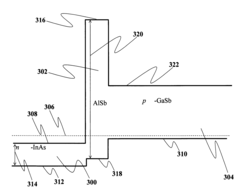
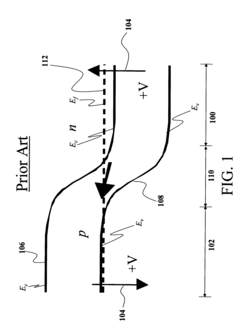
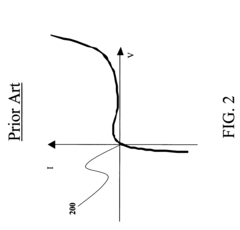
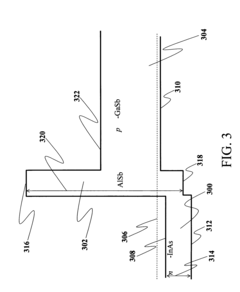
- The semiconductor device employs an InAs/AlSb/GaSb heterostructure with tailored layer doping and band-edge configurations, utilizing AlSb and AlGaSb layers to control the current-voltage curve and current density, enhancing non-linearity near zero bias.
PIN diode network for multiband RF coupling
PatentActiveUS7639106B2
Innovation
- A PIN diode network is configured with parallel inductors that self-resonate at specific frequencies with the stray capacitance of the PIN diode, forming equivalent tank circuits to enhance isolation, allowing the use of less expensive PIN diodes with higher stray capacitance by counteracting their capacitance with carefully selected inductance values.


Performance Metrics and Benchmarking
To effectively compare tunnel diodes and PIN diodes for signal processing applications, comprehensive performance metrics and benchmarking are essential. These metrics provide quantitative foundations for evaluating the relative strengths and limitations of each technology across various operational parameters.
Frequency response represents a critical performance indicator, with tunnel diodes demonstrating superior performance at extremely high frequencies (up to 100 GHz) compared to PIN diodes (typically limited to 50 GHz). This difference becomes particularly significant in millimeter-wave applications where tunnel diodes maintain lower noise figures and higher gain stability.
Switching speed measurements reveal that tunnel diodes exhibit significantly faster response times, typically in the picosecond range, while PIN diodes operate in the nanosecond range. This performance gap of nearly three orders of magnitude makes tunnel diodes preferable for ultra-high-speed digital signal processing and sampling applications.
Power handling capabilities present a contrasting picture, with PIN diodes demonstrating substantial advantages. Standard PIN diodes can handle power levels of 10-100W, whereas tunnel diodes are typically limited to milliwatt ranges. This limitation restricts tunnel diode applications in high-power transmission systems where PIN diodes excel.
Temperature stability benchmarks indicate that PIN diodes maintain more consistent performance across wider temperature ranges (-55°C to +150°C) compared to tunnel diodes, which show more pronounced parameter drift, particularly in negative resistance characteristics as temperatures fluctuate.
Linearity measurements reveal that PIN diodes generally offer superior linearity in signal processing applications, with third-order intercept points typically 10-15 dB higher than comparable tunnel diode implementations. This advantage becomes crucial in applications requiring minimal signal distortion.
Noise performance analysis shows tunnel diodes exhibiting lower noise figures (typically 3-5 dB) compared to PIN diodes (5-7 dB) at comparable frequencies, making them advantageous for low-signal detection and amplification in sensitive receiver applications.
Reliability testing data indicates PIN diodes demonstrate superior long-term stability and resistance to electrical stress, with mean time between failures (MTBF) typically exceeding tunnel diodes by factors of 3-5x under equivalent operating conditions. This reliability differential becomes particularly important in mission-critical applications where component failure cannot be tolerated.
Frequency response represents a critical performance indicator, with tunnel diodes demonstrating superior performance at extremely high frequencies (up to 100 GHz) compared to PIN diodes (typically limited to 50 GHz). This difference becomes particularly significant in millimeter-wave applications where tunnel diodes maintain lower noise figures and higher gain stability.
Switching speed measurements reveal that tunnel diodes exhibit significantly faster response times, typically in the picosecond range, while PIN diodes operate in the nanosecond range. This performance gap of nearly three orders of magnitude makes tunnel diodes preferable for ultra-high-speed digital signal processing and sampling applications.
Power handling capabilities present a contrasting picture, with PIN diodes demonstrating substantial advantages. Standard PIN diodes can handle power levels of 10-100W, whereas tunnel diodes are typically limited to milliwatt ranges. This limitation restricts tunnel diode applications in high-power transmission systems where PIN diodes excel.
Temperature stability benchmarks indicate that PIN diodes maintain more consistent performance across wider temperature ranges (-55°C to +150°C) compared to tunnel diodes, which show more pronounced parameter drift, particularly in negative resistance characteristics as temperatures fluctuate.
Linearity measurements reveal that PIN diodes generally offer superior linearity in signal processing applications, with third-order intercept points typically 10-15 dB higher than comparable tunnel diode implementations. This advantage becomes crucial in applications requiring minimal signal distortion.
Noise performance analysis shows tunnel diodes exhibiting lower noise figures (typically 3-5 dB) compared to PIN diodes (5-7 dB) at comparable frequencies, making them advantageous for low-signal detection and amplification in sensitive receiver applications.
Reliability testing data indicates PIN diodes demonstrate superior long-term stability and resistance to electrical stress, with mean time between failures (MTBF) typically exceeding tunnel diodes by factors of 3-5x under equivalent operating conditions. This reliability differential becomes particularly important in mission-critical applications where component failure cannot be tolerated.
Integration Strategies in Modern Circuit Design
The integration of tunnel diodes and PIN diodes into modern circuit designs requires careful consideration of their unique signal processing capabilities and operational characteristics. Circuit designers must evaluate several key integration strategies to optimize performance while managing the inherent limitations of each component.
For tunnel diodes, integration typically leverages their negative resistance region for high-frequency oscillator applications. The most effective implementation involves precise biasing circuits that maintain operation within the negative resistance region, often requiring temperature compensation networks to ensure stability across varying environmental conditions. Modern circuit designs frequently incorporate tunnel diodes in microwave frequency applications where their fast switching capabilities provide significant advantages.
PIN diodes, conversely, are integrated primarily as RF switches and attenuators in signal processing circuits. Their integration strategy centers on controlling the impedance characteristics through appropriate DC biasing networks. The most successful implementations utilize specialized driver circuits that provide rapid transition between conduction states while minimizing power consumption. In modern RF front-end designs, PIN diodes are often arranged in series-shunt configurations to achieve superior isolation characteristics.
Hybrid integration approaches have emerged that combine both diode types to capitalize on their complementary properties. These designs typically position tunnel diodes in oscillator or amplifier stages while employing PIN diodes for signal routing and attenuation control. Such hybrid architectures require careful impedance matching networks to ensure optimal signal transfer between stages and minimize reflections.
Miniaturization presents significant challenges for both diode types. Integration strategies increasingly focus on monolithic implementations where tunnel diodes and PIN diodes are fabricated directly onto semiconductor substrates alongside other circuit elements. This approach reduces parasitic effects but demands precise manufacturing processes to maintain the critical electrical characteristics of each diode type.
Power management considerations differ substantially between the two diode types. Tunnel diodes typically operate with low power consumption, making them suitable for battery-powered applications, while PIN diodes often require higher control currents for effective switching. Integration strategies must account for these differences through appropriate power distribution networks and thermal management solutions.
The emergence of software-defined radio and adaptive RF systems has driven new integration approaches that leverage the programmable nature of PIN diodes for dynamic impedance matching and signal routing. These advanced implementations often incorporate microcontroller-based bias control systems that can dynamically optimize diode performance based on operating conditions and signal requirements.
For tunnel diodes, integration typically leverages their negative resistance region for high-frequency oscillator applications. The most effective implementation involves precise biasing circuits that maintain operation within the negative resistance region, often requiring temperature compensation networks to ensure stability across varying environmental conditions. Modern circuit designs frequently incorporate tunnel diodes in microwave frequency applications where their fast switching capabilities provide significant advantages.
PIN diodes, conversely, are integrated primarily as RF switches and attenuators in signal processing circuits. Their integration strategy centers on controlling the impedance characteristics through appropriate DC biasing networks. The most successful implementations utilize specialized driver circuits that provide rapid transition between conduction states while minimizing power consumption. In modern RF front-end designs, PIN diodes are often arranged in series-shunt configurations to achieve superior isolation characteristics.
Hybrid integration approaches have emerged that combine both diode types to capitalize on their complementary properties. These designs typically position tunnel diodes in oscillator or amplifier stages while employing PIN diodes for signal routing and attenuation control. Such hybrid architectures require careful impedance matching networks to ensure optimal signal transfer between stages and minimize reflections.
Miniaturization presents significant challenges for both diode types. Integration strategies increasingly focus on monolithic implementations where tunnel diodes and PIN diodes are fabricated directly onto semiconductor substrates alongside other circuit elements. This approach reduces parasitic effects but demands precise manufacturing processes to maintain the critical electrical characteristics of each diode type.
Power management considerations differ substantially between the two diode types. Tunnel diodes typically operate with low power consumption, making them suitable for battery-powered applications, while PIN diodes often require higher control currents for effective switching. Integration strategies must account for these differences through appropriate power distribution networks and thermal management solutions.
The emergence of software-defined radio and adaptive RF systems has driven new integration approaches that leverage the programmable nature of PIN diodes for dynamic impedance matching and signal routing. These advanced implementations often incorporate microcontroller-based bias control systems that can dynamically optimize diode performance based on operating conditions and signal requirements.
Unlock deeper insights with PatSnap Eureka Quick Research — get a full tech report to explore trends and direct your research. Try now!
Generate Your Research Report Instantly with AI Agent
Supercharge your innovation with PatSnap Eureka AI Agent Platform!