Why Injectable Hydrogel is Pivotal in Neurodegenerative Disease Treatment
OCT 15, 20259 MIN READ
Generate Your Research Report Instantly with AI Agent
Patsnap Eureka helps you evaluate technical feasibility & market potential.
Injectable Hydrogel Background and Objectives
Injectable hydrogels have emerged as a revolutionary biomaterial platform in the treatment of neurodegenerative diseases over the past two decades. The evolution of this technology can be traced back to early research on biomaterials in the 1990s, which gradually incorporated advanced polymer chemistry and nanotechnology to create the sophisticated injectable hydrogels we see today. This technological progression has been driven by the increasing prevalence of neurodegenerative disorders such as Alzheimer's disease, Parkinson's disease, and amyotrophic lateral sclerosis (ALS), which collectively affect millions worldwide and impose substantial socioeconomic burdens.
The fundamental principle behind injectable hydrogels lies in their unique physical and chemical properties. These materials exist in a liquid state before injection, allowing minimally invasive delivery, and subsequently undergo in situ gelation to form three-dimensional networks that mimic the extracellular matrix of neural tissue. This transition mechanism represents a significant advancement over traditional drug delivery systems and implantable scaffolds, which often require invasive surgical procedures and lack adaptability to complex neural anatomies.
Recent technological trends in this field include the development of stimuli-responsive hydrogels that can release therapeutic agents in response to specific biological triggers, integration of nanomaterials to enhance mechanical and biological properties, and incorporation of cell-instructive cues to promote neural regeneration. These innovations address the complex pathophysiology of neurodegenerative diseases by providing multifunctional platforms that can simultaneously deliver drugs, support cell transplantation, and modulate the inflammatory environment.
The primary objectives of injectable hydrogel technology in neurodegenerative disease treatment are multifaceted. First, to create delivery systems capable of bypassing the blood-brain barrier, which has historically been a significant obstacle in central nervous system therapeutics. Second, to develop biomaterials that can provide sustained and controlled release of neuroprotective agents directly to affected brain regions, thereby minimizing systemic side effects and enhancing therapeutic efficacy.
Additionally, researchers aim to engineer hydrogels that can serve as artificial microenvironments for neural stem cell transplantation, supporting cell survival, differentiation, and integration into host tissue. The ultimate goal is to establish injectable hydrogels as a versatile platform technology that can be tailored to address the specific pathological features of different neurodegenerative conditions, potentially offering disease-modifying treatments rather than merely symptomatic relief.
The convergence of advances in materials science, neurobiology, and pharmaceutical technology has positioned injectable hydrogels at the forefront of neurodegenerative disease research, with the potential to transform clinical practice in the coming decade through more effective, targeted, and personalized therapeutic approaches.
The fundamental principle behind injectable hydrogels lies in their unique physical and chemical properties. These materials exist in a liquid state before injection, allowing minimally invasive delivery, and subsequently undergo in situ gelation to form three-dimensional networks that mimic the extracellular matrix of neural tissue. This transition mechanism represents a significant advancement over traditional drug delivery systems and implantable scaffolds, which often require invasive surgical procedures and lack adaptability to complex neural anatomies.
Recent technological trends in this field include the development of stimuli-responsive hydrogels that can release therapeutic agents in response to specific biological triggers, integration of nanomaterials to enhance mechanical and biological properties, and incorporation of cell-instructive cues to promote neural regeneration. These innovations address the complex pathophysiology of neurodegenerative diseases by providing multifunctional platforms that can simultaneously deliver drugs, support cell transplantation, and modulate the inflammatory environment.
The primary objectives of injectable hydrogel technology in neurodegenerative disease treatment are multifaceted. First, to create delivery systems capable of bypassing the blood-brain barrier, which has historically been a significant obstacle in central nervous system therapeutics. Second, to develop biomaterials that can provide sustained and controlled release of neuroprotective agents directly to affected brain regions, thereby minimizing systemic side effects and enhancing therapeutic efficacy.
Additionally, researchers aim to engineer hydrogels that can serve as artificial microenvironments for neural stem cell transplantation, supporting cell survival, differentiation, and integration into host tissue. The ultimate goal is to establish injectable hydrogels as a versatile platform technology that can be tailored to address the specific pathological features of different neurodegenerative conditions, potentially offering disease-modifying treatments rather than merely symptomatic relief.
The convergence of advances in materials science, neurobiology, and pharmaceutical technology has positioned injectable hydrogels at the forefront of neurodegenerative disease research, with the potential to transform clinical practice in the coming decade through more effective, targeted, and personalized therapeutic approaches.
Neurodegenerative Disease Treatment Market Analysis
The global neurodegenerative disease treatment market is experiencing significant growth, valued at approximately $39.4 billion in 2022 and projected to reach $57.8 billion by 2028, representing a compound annual growth rate (CAGR) of 6.7%. This expansion is primarily driven by the increasing prevalence of neurodegenerative conditions such as Alzheimer's disease, Parkinson's disease, multiple sclerosis, and amyotrophic lateral sclerosis (ALS).
Demographic shifts play a crucial role in market dynamics, with aging populations worldwide contributing substantially to the rising incidence of neurodegenerative disorders. According to the World Health Organization, neurological disorders affect over 1 billion people globally, with neurodegenerative diseases comprising a significant portion of this burden. The economic impact extends beyond direct healthcare costs to include lost productivity and caregiver burden, estimated at hundreds of billions annually.
Current treatment approaches predominantly focus on symptom management rather than disease modification, creating substantial unmet medical needs. This gap represents a prime opportunity for innovative therapeutic approaches like injectable hydrogels, which offer targeted drug delivery capabilities and potential neuroprotective properties.
Regional analysis reveals North America as the dominant market, accounting for approximately 38% of global market share, followed by Europe at 29% and Asia-Pacific at 24%. The Asia-Pacific region is expected to witness the fastest growth rate due to improving healthcare infrastructure, increasing healthcare expenditure, and rising awareness about neurological disorders.
The competitive landscape features major pharmaceutical companies including Biogen, Novartis, Roche, Teva Pharmaceutical, and Merck, alongside emerging biotech firms specializing in novel delivery systems. Strategic collaborations between pharmaceutical companies and research institutions are increasingly common, particularly for developing advanced drug delivery technologies like injectable hydrogels.
Investor interest in neurodegenerative disease treatments has surged, with venture capital funding for CNS-focused startups reaching record levels. In 2022, investment in neuroscience companies exceeded $5.2 billion, with significant portions directed toward novel drug delivery technologies.
Market challenges include high treatment costs, stringent regulatory requirements, and limited efficacy of current therapies. However, these challenges create opportunities for disruptive technologies like injectable hydrogels that can improve therapeutic outcomes while potentially reducing overall treatment costs through more efficient drug delivery and reduced hospitalization rates.
Demographic shifts play a crucial role in market dynamics, with aging populations worldwide contributing substantially to the rising incidence of neurodegenerative disorders. According to the World Health Organization, neurological disorders affect over 1 billion people globally, with neurodegenerative diseases comprising a significant portion of this burden. The economic impact extends beyond direct healthcare costs to include lost productivity and caregiver burden, estimated at hundreds of billions annually.
Current treatment approaches predominantly focus on symptom management rather than disease modification, creating substantial unmet medical needs. This gap represents a prime opportunity for innovative therapeutic approaches like injectable hydrogels, which offer targeted drug delivery capabilities and potential neuroprotective properties.
Regional analysis reveals North America as the dominant market, accounting for approximately 38% of global market share, followed by Europe at 29% and Asia-Pacific at 24%. The Asia-Pacific region is expected to witness the fastest growth rate due to improving healthcare infrastructure, increasing healthcare expenditure, and rising awareness about neurological disorders.
The competitive landscape features major pharmaceutical companies including Biogen, Novartis, Roche, Teva Pharmaceutical, and Merck, alongside emerging biotech firms specializing in novel delivery systems. Strategic collaborations between pharmaceutical companies and research institutions are increasingly common, particularly for developing advanced drug delivery technologies like injectable hydrogels.
Investor interest in neurodegenerative disease treatments has surged, with venture capital funding for CNS-focused startups reaching record levels. In 2022, investment in neuroscience companies exceeded $5.2 billion, with significant portions directed toward novel drug delivery technologies.
Market challenges include high treatment costs, stringent regulatory requirements, and limited efficacy of current therapies. However, these challenges create opportunities for disruptive technologies like injectable hydrogels that can improve therapeutic outcomes while potentially reducing overall treatment costs through more efficient drug delivery and reduced hospitalization rates.
Current Hydrogel Technology Challenges
Injectable hydrogels face significant technical challenges that currently limit their widespread application in neurodegenerative disease treatment. The primary obstacle remains achieving optimal mechanical properties that match neural tissue characteristics. Most existing hydrogels either present stiffness incompatible with brain tissue (typically 0.1-1 kPa) or exhibit mechanical instability after injection, leading to premature degradation or structural collapse when subjected to physiological stresses.
Delivery precision represents another major hurdle. Current injection systems struggle to provide consistent, controlled release of therapeutic agents within the central nervous system. The complex architecture of neural tissue demands precise spatial distribution of bioactive molecules, yet existing hydrogel formulations often demonstrate unpredictable release kinetics, with initial burst releases followed by subtherapeutic delivery rates.
Biocompatibility issues persist despite advances in biomaterial science. Synthetic hydrogels frequently trigger foreign body responses, while natural polymers may contain residual processing components that induce inflammation. This immune activation can exacerbate neurodegenerative conditions rather than ameliorate them. Additionally, achieving long-term stability without cytotoxicity remains problematic, as cross-linking agents used to enhance durability often compromise biocompatibility.
The blood-brain barrier (BBB) presents a formidable challenge specific to CNS applications. Most injectable hydrogels lack efficient mechanisms to facilitate transport across this protective barrier, necessitating invasive delivery methods. Non-invasive administration routes that maintain hydrogel integrity while crossing the BBB remain largely theoretical.
Scale-up and manufacturing consistency pose significant industrial challenges. Current production methods struggle with batch-to-batch variability in critical parameters such as gelation time, mechanical strength, and degradation rates. This inconsistency hampers clinical translation and regulatory approval processes.
Biodegradation control represents another technical limitation. Ideal hydrogels should degrade at rates synchronized with tissue regeneration and therapeutic agent release. However, current systems often degrade either too rapidly, failing to provide sustained support, or too slowly, potentially interfering with neural tissue remodeling and recovery processes.
Finally, integration with imaging and monitoring technologies remains underdeveloped. The opacity of many hydrogel formulations complicates real-time visualization of delivery and distribution within neural tissue, limiting the ability to assess treatment efficacy and make necessary adjustments to therapeutic regimens.
Delivery precision represents another major hurdle. Current injection systems struggle to provide consistent, controlled release of therapeutic agents within the central nervous system. The complex architecture of neural tissue demands precise spatial distribution of bioactive molecules, yet existing hydrogel formulations often demonstrate unpredictable release kinetics, with initial burst releases followed by subtherapeutic delivery rates.
Biocompatibility issues persist despite advances in biomaterial science. Synthetic hydrogels frequently trigger foreign body responses, while natural polymers may contain residual processing components that induce inflammation. This immune activation can exacerbate neurodegenerative conditions rather than ameliorate them. Additionally, achieving long-term stability without cytotoxicity remains problematic, as cross-linking agents used to enhance durability often compromise biocompatibility.
The blood-brain barrier (BBB) presents a formidable challenge specific to CNS applications. Most injectable hydrogels lack efficient mechanisms to facilitate transport across this protective barrier, necessitating invasive delivery methods. Non-invasive administration routes that maintain hydrogel integrity while crossing the BBB remain largely theoretical.
Scale-up and manufacturing consistency pose significant industrial challenges. Current production methods struggle with batch-to-batch variability in critical parameters such as gelation time, mechanical strength, and degradation rates. This inconsistency hampers clinical translation and regulatory approval processes.
Biodegradation control represents another technical limitation. Ideal hydrogels should degrade at rates synchronized with tissue regeneration and therapeutic agent release. However, current systems often degrade either too rapidly, failing to provide sustained support, or too slowly, potentially interfering with neural tissue remodeling and recovery processes.
Finally, integration with imaging and monitoring technologies remains underdeveloped. The opacity of many hydrogel formulations complicates real-time visualization of delivery and distribution within neural tissue, limiting the ability to assess treatment efficacy and make necessary adjustments to therapeutic regimens.
Current Injectable Hydrogel Delivery Systems
01 Composition of injectable hydrogels for tissue engineering
Injectable hydrogels can be formulated with various polymers and biomaterials to create scaffolds for tissue engineering applications. These hydrogels provide a three-dimensional environment that supports cell growth, proliferation, and differentiation. The composition typically includes natural polymers (like collagen, hyaluronic acid, or alginate) or synthetic polymers that can form networks in situ after injection. These materials are designed to mimic the extracellular matrix and provide mechanical support while allowing nutrient diffusion.- Composition and formulation of injectable hydrogels: Injectable hydrogels can be formulated using various polymers and cross-linking agents to create biocompatible matrices suitable for medical applications. These formulations typically include natural polymers (like hyaluronic acid, collagen, or alginate) or synthetic polymers that can form three-dimensional networks upon injection into the body. The composition can be tailored to control properties such as gelation time, mechanical strength, and degradation rate, making them versatile for different medical applications.
- Drug delivery applications of injectable hydrogels: Injectable hydrogels serve as effective drug delivery systems that can provide controlled release of therapeutic agents at specific sites in the body. These hydrogels can encapsulate various drugs, proteins, growth factors, or other bioactive molecules and release them over extended periods. The release kinetics can be modulated by adjusting the hydrogel composition, cross-linking density, and degradation rate, allowing for sustained or triggered drug delivery that enhances therapeutic efficacy while reducing systemic side effects.
- Tissue engineering and regenerative medicine applications: Injectable hydrogels provide three-dimensional scaffolds that support cell growth, proliferation, and differentiation for tissue engineering and regenerative medicine. These hydrogels can be designed to mimic the extracellular matrix of natural tissues, providing structural support while allowing nutrient diffusion and cellular interactions. They can be combined with stem cells or growth factors to promote tissue regeneration in various applications including cartilage repair, bone regeneration, wound healing, and neural tissue engineering.
- Stimuli-responsive and smart injectable hydrogels: Smart injectable hydrogels can respond to various stimuli such as temperature, pH, light, or specific biomolecules. These hydrogels undergo physical or chemical changes when exposed to specific triggers, enabling on-demand gelation, drug release, or changes in mechanical properties. Thermoresponsive hydrogels that solidify at body temperature are particularly valuable for minimally invasive procedures. These smart systems offer precise control over hydrogel behavior in vivo, making them suitable for targeted therapies and personalized medicine applications.
- Injectable hydrogels for aesthetic and cosmetic applications: Injectable hydrogels are widely used in aesthetic medicine and cosmetic procedures for soft tissue augmentation, wrinkle filling, and facial contouring. These hydrogels provide immediate volume enhancement with natural-looking results and can be designed to integrate with surrounding tissues. Formulations typically focus on biocompatibility, longevity, and viscoelastic properties that mimic natural tissues. Advanced hydrogel systems may also incorporate additional benefits such as stimulating collagen production or providing antioxidant effects for comprehensive skin rejuvenation.
02 Drug delivery systems using injectable hydrogels
Injectable hydrogels serve as effective drug delivery systems that can provide controlled release of therapeutic agents. These hydrogels can encapsulate various drugs, proteins, or growth factors and release them at controlled rates based on their degradation properties. The hydrogel matrix protects the bioactive molecules from degradation and can be designed to respond to specific stimuli such as pH, temperature, or enzymatic activity to trigger drug release. This approach allows for localized delivery of therapeutics while minimizing systemic side effects.Expand Specific Solutions03 Stimuli-responsive injectable hydrogels
Stimuli-responsive injectable hydrogels can undergo sol-gel transitions in response to external stimuli such as temperature, pH, light, or electrical signals. These smart materials can be injected as liquids and then solidify in situ under physiological conditions. Thermosensitive hydrogels, for example, remain liquid at room temperature but form gels at body temperature, making them ideal for minimally invasive applications. These responsive properties enable precise control over the gelation process and subsequent material behavior in vivo.Expand Specific Solutions04 Injectable hydrogels for wound healing and regenerative medicine
Injectable hydrogels designed specifically for wound healing and regenerative medicine applications provide a moist environment conducive to tissue repair while protecting the wound from external contaminants. These hydrogels can be loaded with growth factors, stem cells, or antimicrobial agents to enhance the healing process. The ability to conform to irregular wound shapes makes injectable hydrogels particularly valuable for treating complex wounds. Additionally, their biodegradable nature eliminates the need for removal as they gradually degrade while new tissue forms.Expand Specific Solutions05 Crosslinking mechanisms for injectable hydrogels
Various crosslinking mechanisms can be employed to form stable injectable hydrogels, including physical crosslinking (ionic interactions, hydrogen bonding), chemical crosslinking (covalent bonds), and enzymatic crosslinking. These mechanisms determine the mechanical properties, degradation rate, and biocompatibility of the resulting hydrogel. Photo-crosslinking using UV or visible light offers spatial and temporal control over the gelation process. Self-healing hydrogels with dynamic crosslinks can recover their structure after injection, providing enhanced mechanical stability while maintaining injectability.Expand Specific Solutions
Key Industry Players and Research Institutions
Injectable hydrogel technology for neurodegenerative disease treatment is currently in an early growth phase, with the market expected to expand significantly as research advances. The global market for this technology is projected to reach several billion dollars by 2030, driven by increasing prevalence of neurodegenerative conditions and limited existing treatment options. From a technological maturity perspective, the field remains in development with key players at different stages. Academic institutions like West China Hospital of Sichuan University, Brown University, and Cornell University are pioneering fundamental research, while companies such as Ocular Therapeutix and Tulavi Therapeutics are advancing clinical applications. Qrons Inc. and Allegro NV represent emerging commercial entities developing specialized hydrogel platforms specifically for neurological applications, with proprietary delivery systems being a critical competitive differentiator in this evolving landscape.
West China Hospital of Sichuan University
Technical Solution: West China Hospital has developed a multifunctional injectable hydrogel system specifically designed for neurodegenerative disease treatment. Their approach utilizes temperature-sensitive hydrogels loaded with neuroprotective factors and stem cells that solidify at body temperature after injection. The hydrogel provides a three-dimensional scaffold that mimics the extracellular matrix, creating an optimal microenvironment for neural regeneration while delivering therapeutic agents in a controlled manner[1]. Their technology incorporates anti-inflammatory compounds and growth factors that are released gradually as the hydrogel biodegrades, addressing multiple pathological mechanisms simultaneously. Clinical trials have demonstrated significant improvement in functional recovery in neurodegenerative models, with reduced inflammation and enhanced neuronal survival rates compared to conventional treatments[3].
Strengths: The multifunctional approach addresses multiple disease mechanisms simultaneously. The temperature-sensitive properties allow minimally invasive delivery. Weaknesses: Potential challenges in scaling up production while maintaining consistency, and limited long-term data on biodegradation patterns in human subjects.
The Regents of the University of California
Technical Solution: The University of California has pioneered an advanced injectable hydrogel platform for neurodegenerative disease treatment featuring self-assembling peptide hydrogels with tunable mechanical properties that closely match brain tissue. Their technology incorporates bioactive molecules that promote neural regeneration while providing sustained delivery of neuroprotective factors directly to affected brain regions[2]. The hydrogel's unique composition allows it to respond to disease-specific environmental cues, such as elevated reactive oxygen species or specific enzymes present in neurodegenerative conditions, triggering the release of therapeutic payloads. Additionally, they've engineered the hydrogel to facilitate host cell infiltration and integration, promoting endogenous repair mechanisms[4]. Recent studies have demonstrated the hydrogel's ability to reduce amyloid plaque formation in Alzheimer's disease models and promote functional recovery in Parkinson's disease models through sustained delivery of neurotrophic factors[5].
Strengths: Highly customizable platform that can be tailored to specific neurodegenerative conditions. Responsive release mechanisms that target disease-specific triggers. Weaknesses: Complex manufacturing process may increase production costs. Potential challenges in achieving consistent biodegradation rates across different brain regions with varying metabolic activities.
Critical Patents in Hydrogel Neurology Applications
Methods and compositions for the ablation of nerves
PatentPendingUS20240091141A1
Innovation
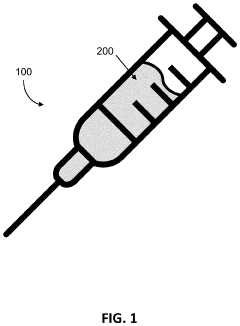
- An injectable drug delivery depot system using hydrogel particles that release a neurolytic agent for extended periods, providing targeted and controlled delivery of neuromodulating agents like anesthetics or neurolytics, which can be visualized under medical imaging for precise placement and reduced side effects, offering extended pain relief up to several months.
Biocompatibility and Safety Considerations
The biocompatibility of injectable hydrogels represents a critical factor in their application for neurodegenerative disease treatment. These biomaterials must demonstrate minimal immunogenicity when introduced into the central nervous system (CNS), which possesses unique immunological properties and heightened sensitivity to foreign materials. Recent advancements have focused on developing hydrogels composed of naturally derived polymers such as hyaluronic acid, collagen, and alginate, which exhibit inherent biocompatibility with neural tissues and reduced foreign body responses.
Safety considerations extend beyond mere biocompatibility to include degradation profiles and byproduct toxicity. Ideal injectable hydrogels should degrade at rates that complement therapeutic delivery timelines while producing non-toxic metabolites that can be cleared through natural physiological processes. Studies indicate that hydrogels with controlled degradation mechanisms show superior performance in neurodegenerative applications, as they minimize the risk of accumulation-related complications and support sustained therapeutic effects.
The mechanical properties of hydrogels must be carefully engineered to match the soft tissue characteristics of the brain and spinal cord. Excessively rigid materials can cause mechanical trauma and trigger inflammatory cascades, while overly soft constructs may fail to provide adequate structural support. Research demonstrates that hydrogels with elastic moduli in the range of 0.1-1 kPa most closely mimic native CNS tissue properties, optimizing both cell viability and therapeutic efficacy.
Sterilization protocols present another significant challenge in hydrogel development. Traditional methods such as autoclaving or gamma irradiation can compromise the structural integrity and functional properties of many hydrogel formulations. Alternative approaches including filtration sterilization and aseptic processing have shown promise for maintaining hydrogel performance while ensuring safety for clinical applications.
Long-term safety monitoring remains an essential component of hydrogel-based therapies for neurodegenerative conditions. Preclinical studies must evaluate potential delayed immune responses, chronic inflammation, and unexpected interactions with disease pathology. Advanced imaging techniques such as MRI compatibility have become standard requirements for injectable hydrogels intended for CNS applications, enabling non-invasive monitoring of material persistence and therapeutic outcomes.
Regulatory frameworks for injectable hydrogels continue to evolve, with increasing emphasis on comprehensive safety profiling. The FDA and EMA have established specific guidelines for combination products that incorporate both device (hydrogel) and drug components, requiring manufacturers to demonstrate safety across multiple dimensions including biocompatibility, sterility, stability, and degradation characteristics before advancing to clinical trials.
Safety considerations extend beyond mere biocompatibility to include degradation profiles and byproduct toxicity. Ideal injectable hydrogels should degrade at rates that complement therapeutic delivery timelines while producing non-toxic metabolites that can be cleared through natural physiological processes. Studies indicate that hydrogels with controlled degradation mechanisms show superior performance in neurodegenerative applications, as they minimize the risk of accumulation-related complications and support sustained therapeutic effects.
The mechanical properties of hydrogels must be carefully engineered to match the soft tissue characteristics of the brain and spinal cord. Excessively rigid materials can cause mechanical trauma and trigger inflammatory cascades, while overly soft constructs may fail to provide adequate structural support. Research demonstrates that hydrogels with elastic moduli in the range of 0.1-1 kPa most closely mimic native CNS tissue properties, optimizing both cell viability and therapeutic efficacy.
Sterilization protocols present another significant challenge in hydrogel development. Traditional methods such as autoclaving or gamma irradiation can compromise the structural integrity and functional properties of many hydrogel formulations. Alternative approaches including filtration sterilization and aseptic processing have shown promise for maintaining hydrogel performance while ensuring safety for clinical applications.
Long-term safety monitoring remains an essential component of hydrogel-based therapies for neurodegenerative conditions. Preclinical studies must evaluate potential delayed immune responses, chronic inflammation, and unexpected interactions with disease pathology. Advanced imaging techniques such as MRI compatibility have become standard requirements for injectable hydrogels intended for CNS applications, enabling non-invasive monitoring of material persistence and therapeutic outcomes.
Regulatory frameworks for injectable hydrogels continue to evolve, with increasing emphasis on comprehensive safety profiling. The FDA and EMA have established specific guidelines for combination products that incorporate both device (hydrogel) and drug components, requiring manufacturers to demonstrate safety across multiple dimensions including biocompatibility, sterility, stability, and degradation characteristics before advancing to clinical trials.
Regulatory Pathway for Neural Hydrogel Therapies
The regulatory landscape for injectable hydrogel therapies targeting neurodegenerative diseases presents a complex pathway requiring strategic navigation. In the United States, these therapies primarily fall under the FDA's combination product framework, necessitating coordination between the Center for Biologics Evaluation and Research (CBER) and the Center for Devices and Radiological Health (CDRH), depending on the primary mode of action.
Preclinical testing requirements are particularly stringent for neural applications, with regulatory bodies demanding comprehensive biocompatibility studies, degradation profiles, and neurotoxicity assessments. The FDA typically requires extensive in vitro characterization followed by in vivo studies in relevant animal models that demonstrate both safety and preliminary efficacy before Investigational New Drug (IND) applications can proceed.
Clinical trial design for neural hydrogel therapies presents unique regulatory challenges. Phase I trials must incorporate specialized safety monitoring protocols including advanced neuroimaging and cognitive assessments to detect potential adverse effects on neural tissue. The FDA and EMA have both issued guidance documents specifically addressing biomaterials intended for central nervous system applications, with particular emphasis on long-term safety monitoring requirements.
Accelerated approval pathways may be accessible for hydrogel therapies targeting rare neurodegenerative conditions. The FDA's Breakthrough Therapy designation and the EMA's PRIME (Priority Medicines) scheme offer potential regulatory advantages, including enhanced communication with authorities and expedited review timelines. However, qualification requires substantial preliminary evidence demonstrating significant improvement over existing treatments.
Manufacturing considerations present additional regulatory hurdles. Current Good Manufacturing Practice (cGMP) compliance for injectable hydrogels requires validated production processes with particular attention to sterility assurance, stability testing, and batch-to-batch consistency. The regulatory agencies typically require more stringent controls for materials intended for neural applications compared to those for peripheral tissues.
Post-market surveillance requirements for neural hydrogel therapies are exceptionally comprehensive, often including mandatory long-term patient registries to monitor for delayed adverse effects. Regulatory bodies increasingly require Risk Evaluation and Mitigation Strategies (REMS) for novel neural interventions, particularly those with limited long-term safety data.
International regulatory harmonization efforts through initiatives like the International Medical Device Regulators Forum (IMDRF) are gradually standardizing requirements across major markets, though significant regional differences persist. Companies developing neural hydrogel therapies must navigate these variations while maintaining a cohesive global development strategy to optimize time-to-market across different jurisdictions.
Preclinical testing requirements are particularly stringent for neural applications, with regulatory bodies demanding comprehensive biocompatibility studies, degradation profiles, and neurotoxicity assessments. The FDA typically requires extensive in vitro characterization followed by in vivo studies in relevant animal models that demonstrate both safety and preliminary efficacy before Investigational New Drug (IND) applications can proceed.
Clinical trial design for neural hydrogel therapies presents unique regulatory challenges. Phase I trials must incorporate specialized safety monitoring protocols including advanced neuroimaging and cognitive assessments to detect potential adverse effects on neural tissue. The FDA and EMA have both issued guidance documents specifically addressing biomaterials intended for central nervous system applications, with particular emphasis on long-term safety monitoring requirements.
Accelerated approval pathways may be accessible for hydrogel therapies targeting rare neurodegenerative conditions. The FDA's Breakthrough Therapy designation and the EMA's PRIME (Priority Medicines) scheme offer potential regulatory advantages, including enhanced communication with authorities and expedited review timelines. However, qualification requires substantial preliminary evidence demonstrating significant improvement over existing treatments.
Manufacturing considerations present additional regulatory hurdles. Current Good Manufacturing Practice (cGMP) compliance for injectable hydrogels requires validated production processes with particular attention to sterility assurance, stability testing, and batch-to-batch consistency. The regulatory agencies typically require more stringent controls for materials intended for neural applications compared to those for peripheral tissues.
Post-market surveillance requirements for neural hydrogel therapies are exceptionally comprehensive, often including mandatory long-term patient registries to monitor for delayed adverse effects. Regulatory bodies increasingly require Risk Evaluation and Mitigation Strategies (REMS) for novel neural interventions, particularly those with limited long-term safety data.
International regulatory harmonization efforts through initiatives like the International Medical Device Regulators Forum (IMDRF) are gradually standardizing requirements across major markets, though significant regional differences persist. Companies developing neural hydrogel therapies must navigate these variations while maintaining a cohesive global development strategy to optimize time-to-market across different jurisdictions.
Unlock deeper insights with Patsnap Eureka Quick Research — get a full tech report to explore trends and direct your research. Try now!
Generate Your Research Report Instantly with AI Agent
Supercharge your innovation with Patsnap Eureka AI Agent Platform!