Content transmitting system using agent content service device

A content server and content technology, which is applied in the field of content delivery network, can solve problems such as content server overload, increased transactions, and complexity

CN100430920CInactive Publication Date: 2008-11-05NEC CORP
1 Cites 0 Cited by

Patent Information

Authority / Receiving Office
CN · China
Patent Type
Patents(China)
Current Assignee / Owner
Publication Date
2008-11-05
Estimated Expiration
Not applicable · inactive patent

Smart Images

  • Figure 1
    Figure 1
  • Figure 2
    Figure 2
  • Figure 3
    Figure 3
Patent Text Reader

Abstract

A proxy content server responds to a request message from a user terminal by determining whether the message is a registration request or a content request. If the message is a registration request, the proxy content server maps the user terminal to a registered content server in a memory. If the message is a content request for requesting a content from a server, the proxy content server requests it to send content data to the user terminal if the content server is registered in the memory and the user terminal is mapped to the registered content server. If the user terminal is not mapped to the requested server, the user is not entitled to access the requested server and informed of this fact.
Need to check novelty before this filing date? Find Prior Art

Description

technical field

[0001] The present invention generally relates to a content delivery network, and more particularly to a content management system. Background technique

[0002] Internet service providers have recently tended to limit the delivery of content by granting only subscribed users access to designated content sites (ie, content servers). By identifying user terminals, Internet service providers can charge their users for delivered content, such as video and audio products that generate multimedia applications. In prior art systems, content servers are responsible for authenticating users, managing their registration / deletion and billing users for content charging items.

[0003] However, with the increase of subscribing users, content access traffic overloads the content server, resulting in increased and complicated transactions.

[0004] In addition, with the increase of wireless communication terminals, it is expected that wireless network providers can also ...

Examples

no. 1 example

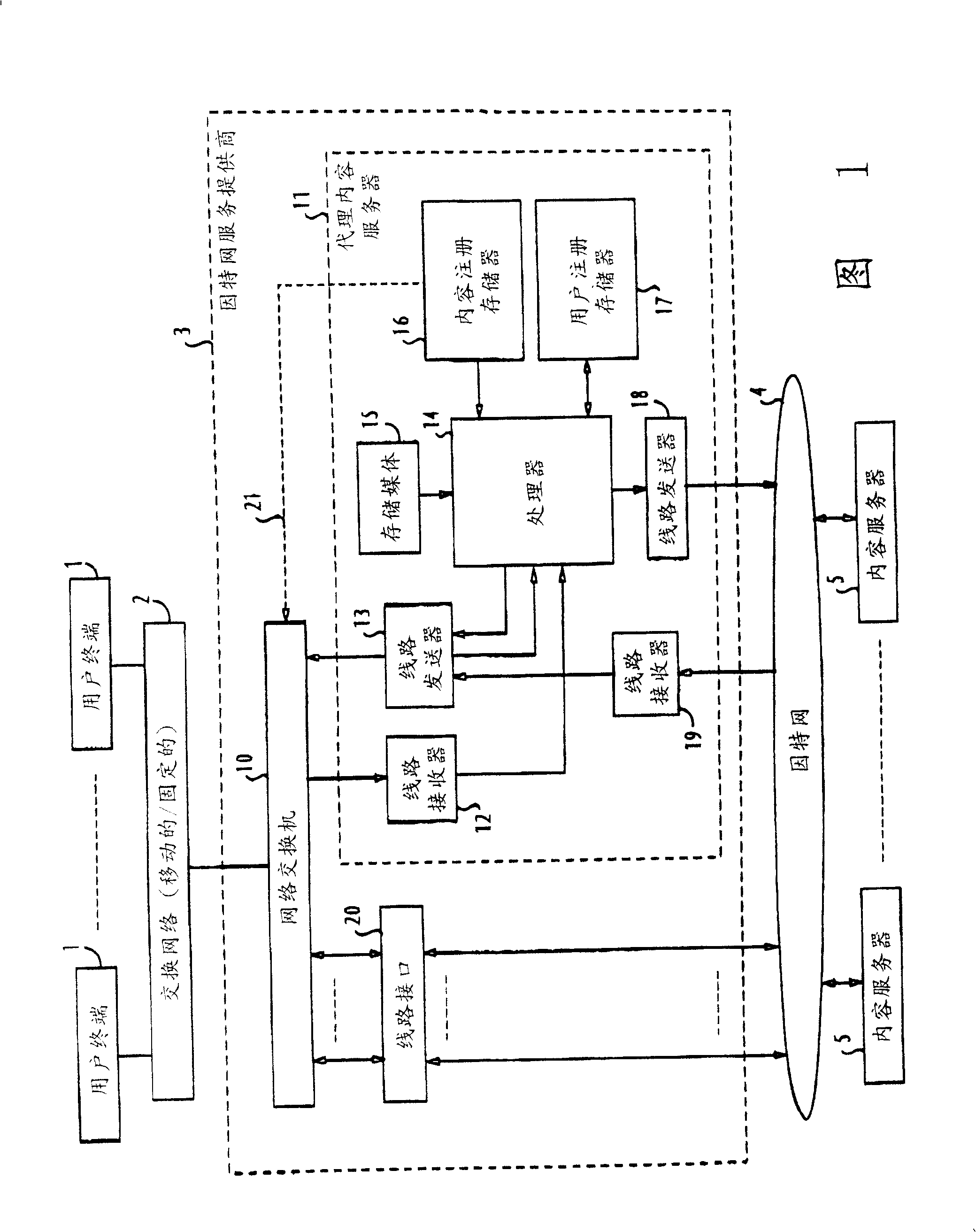
[0027] According to the first embodiment of the present invention, it is assumed that the proxy content server 11 has access to both registered and unregistered content servers, and the user pays on a time charge basis such as a monthly fee.

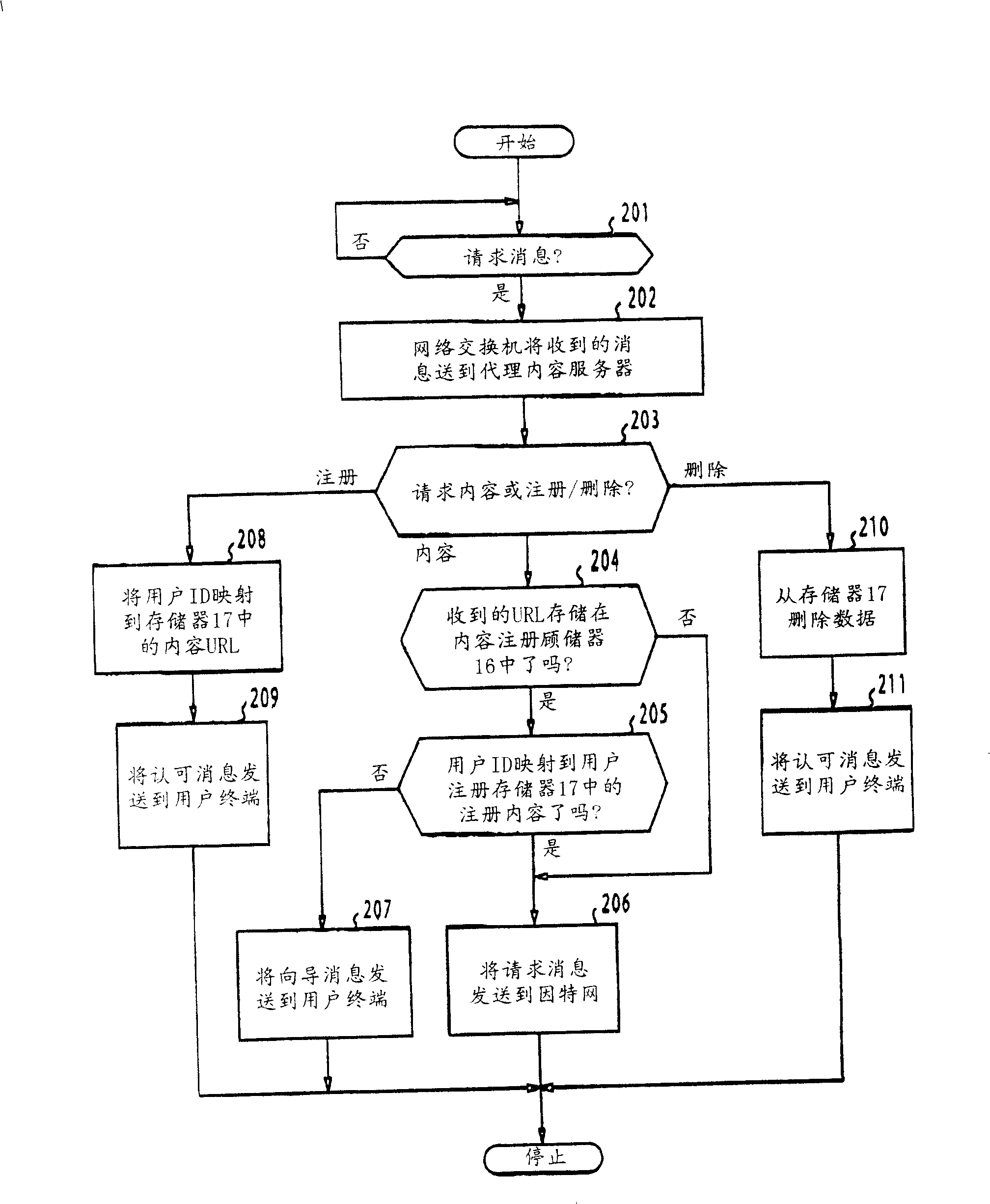
[0028] figure 2 The operation of the proxy content server 11 according to the first embodiment of the present invention has been explained.

[0029] When receiving the request message (step 201), the network switch 10 sends the message to the processor 14 via the line receiver 12 (step 202).

[0030] At step 203, processor 14 determines whether the received message is a content request message or a registration / deletion request message. If the message is a content request message, the processor 14 proceeds to step 204 to read the URL of the content request message and search the content registry 16 for the same content URL. If the same content URL is not found in the memory 16, the flow proceeds to step 206, and the received content re...