Self-adhesive wound care product

A wound care, self-adhesive technology, applied in viscous dressings, dressings, etc., can solve the problems of wounds losing product functions and wound care products being uncomfortable to wear

CN103635166AInactive Publication Date: 2014-03-12MOLNLYCKE HEALTH CARE AB
8 Cites 1 Cited by

Patent Information

Authority / Receiving Office
CN · China
Patent Type
Applications(China)
Current Assignee / Owner
Publication Date
2014-03-12
Estimated Expiration
Not applicable · inactive patent

Smart Images

  • Figure 1
    Figure 1
  • Figure 2
    Figure 2
  • Figure 3
    Figure 3
Patent Text Reader

Abstract

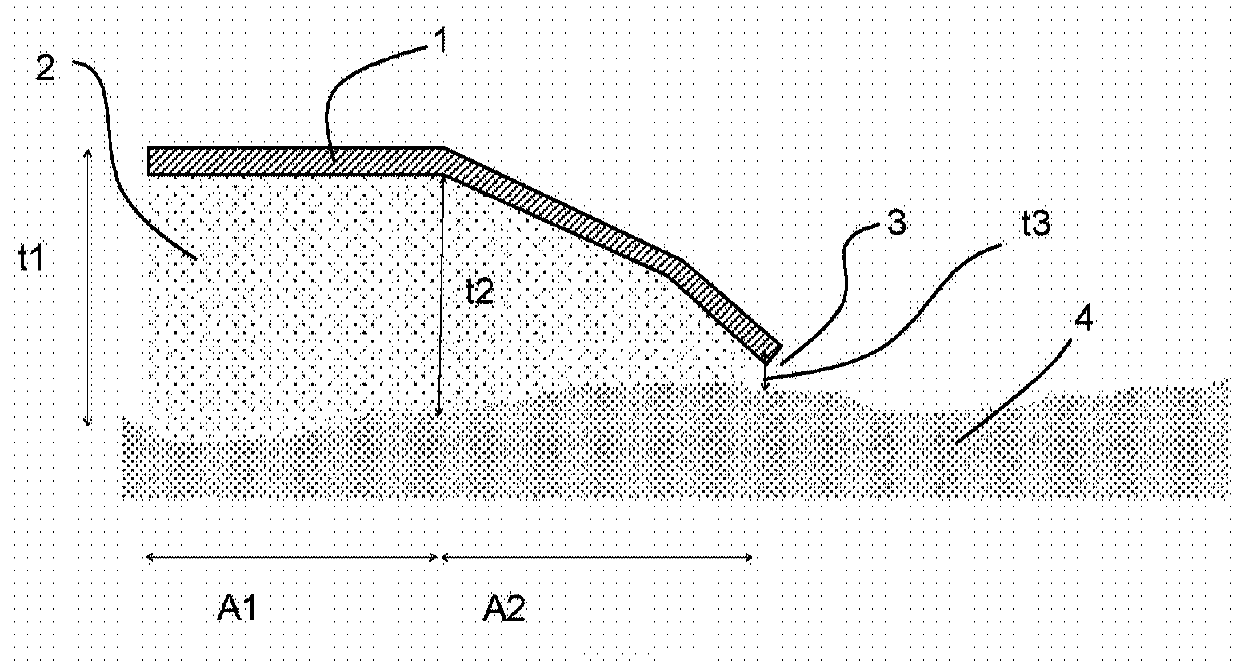
A self-adhesive wound care product, comprising a backing layer (1) having a self-adhesive coating, preferably a silicone-gel adhesive coating (2), the backing layer of the product comprising a first area (A1) in which the adhesive coating has a first thickness (t1), and a second area (A2, A2') along at least a portion of the edges of the product, which second area (A2) has an adhesive coating having a thickness, which is less than said first thickness (t1) and which gradually decreases in a direction towards the edge (3) of the product, from a thickness (t2) which is substantially equal to said first thickness (t1) to a thickness (t3) of 0-0.05 mm; or which second area (A2') is substantially free from adhesive coating.
Need to check novelty before this filing date? Find Prior Art

Description

technical field

[0001] The present invention relates to a self-adhesive wound care product. Background technique

[0002] Self-adhesive wound care products or dressings are commonly used in wound care. Such wound care products typically comprise a flexible backing layer with an adhesive coating. Examples of wound care products of this type are given in WO2006075950 and EP633757.

[0003] Adhesive wound care products often have a tendency for the edges to start to roll up due to friction between the adhesive dressing and materials in contact with the adhesive dressing, such as clothing or bedding. This is of course undesirable as this may result in an uncomfortable wearing of the wound care product and loss of product functionality due to the product not being able to properly cover the wound.

[0004] It would be an advantage to provide an adhesive wound care product with improved stay on capability so that the self-adhesive wound care product does not roll up at the edge...

Examples

Embodiment Construction

[0019] A self-adhesive wound care product comprising a backing layer with a self-adhesive coating, preferably a silicone gel adhesive coating, wherein the outermost edge has a very thin adhesive coating , or substantially no adhesive coating on the outermost edge. Accordingly, the outermost portion of the backing layer will have very low or preferably no adhesive capacity, which means that if or when the outermost portion of the product is unintentionally lifted from the skin, the outermost portion of the product will not Will stick to other surfaces (such as clothing or bedding). The outermost part of the product also does not adhere to the upper surface of the backing layer. Instead, the outermost part will fall back onto the skin. This lack of strong adhesive properties of the outermost part will greatly reduce the risk of edge rolling up of the wound care product. Adhesion can be determined by measuring adhesion to steel according to ASTM D. To be considered non-tacky ...