AI technical title is built by Patsnap AI team. It summarizes the technical point description of the patent document.
A pest, protein technology, applied in the fields of botanical equipment and methods, biochemical equipment and methods, pesticides, etc.
Active Publication Date: 2016-03-23
BEIJING DABEINONG BIOTECHNOLOGY CO LTD
View PDF5 Cites 0 Cited by
Summary
Abstract
Description
Claims
Application Information
AI Technical Summary
This helps you quickly interpret patents by identifying the three key elements:
Problems solved by technology
Method used
Benefits of technology
Problems solved by technology
[0009] It has been proved that plants transgenic for Cry1A.105 can resist the attack of Lepidoptera pests such as corn borer, cotton bollworm, and cutworm. Reports on Harm to Plants by Borer
Method used
the structure of the environmentally friendly knitted fabric provided by the present invention; figure 2 Flow chart of the yarn wrapping machine for environmentally friendly knitted fabrics and storage devices; image 3 Is the parameter map of the yarn covering machine
View more
Image
Smart Image Click on the blue labels to locate them in the text.
Viewing Examples
Smart Image
Click on the blue label to locate the original text in one second.
Reading with bidirectional positioning of images and text.
Smart Image
Examples
Experimental program
Comparison scheme
Effect test
specific Embodiment approach
[0083] The technical scheme of the method for controlling pests of the present invention is further illustrated below through specific examples.
no. 1 example
[0084] The first embodiment, the acquisition and synthesis of Cry1A.105 gene
[0085] 1. Obtain the nucleotide sequence of Cry1A.105
[0086] The amino acid sequence (1177 amino acids) of the Cry1A.105 insecticidal protein, as shown in SEQ ID NO: 1 in the sequence listing; Cry1A.105 nucleosides encoding the amino acid sequence (1177 amino acids) corresponding to the Cry1A.105 insecticidal protein acid sequence (3534 nucleotides), as shown in SEQ ID NO:2 in the sequence listing.
[0087] 2. Obtain the nucleotide sequences of Cry2Ab and Vip3A
[0088] The Cry2Ab nucleotide sequence (1905 nucleotides) encoding the amino acid sequence (634 amino acids) of the Cry2Ab insecticidal protein, as shown in SEQ ID NO: 3 in the sequence listing; the amino acid sequence (789 amino acids) encoding the Vip3A insecticidal protein The Vip3A nucleotide sequence (2370 nucleotides), as shown in SEQ ID NO: 4 in the sequence listing.
[0089] 3. Synthesize the above nucleotide sequence
[0090] ...
no. 2 example
[0091] The second embodiment, construction of recombinant expression vector and transformation of recombinant expression vector into Agrobacterium
[0092] 1. Construction of a recombinant cloning vector containing the Cry1A.105 gene
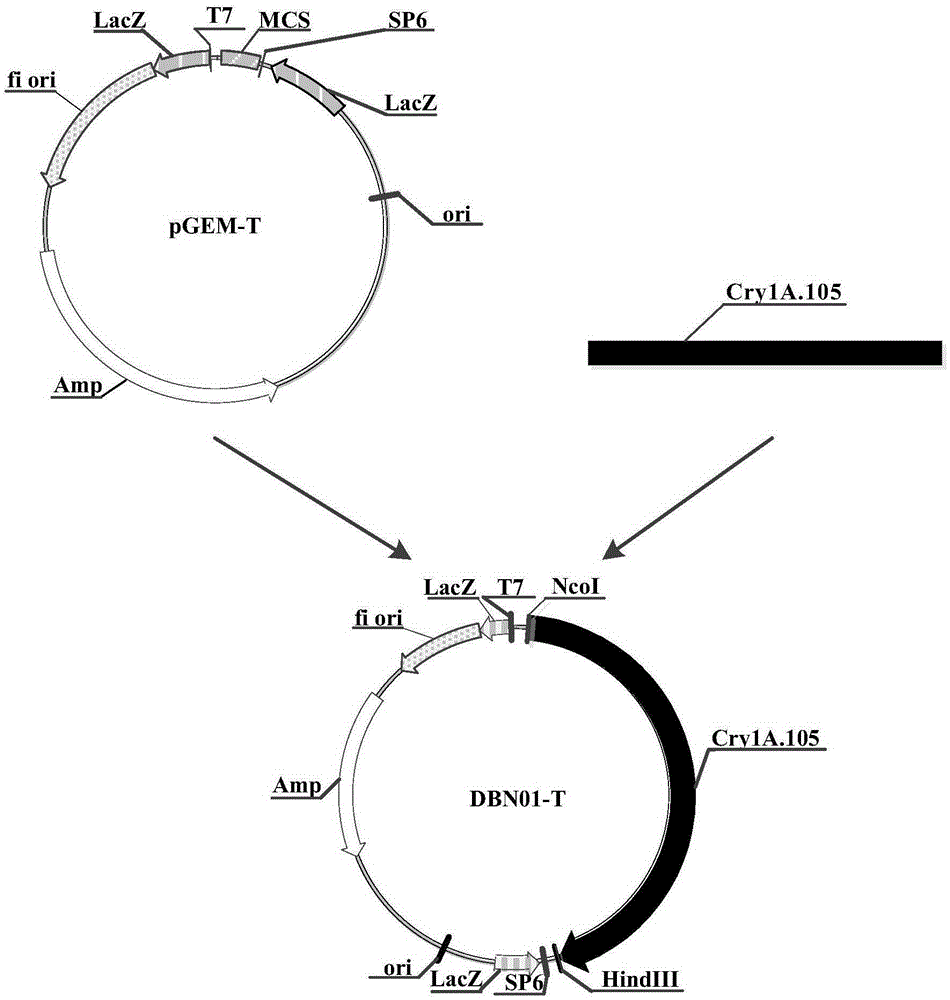
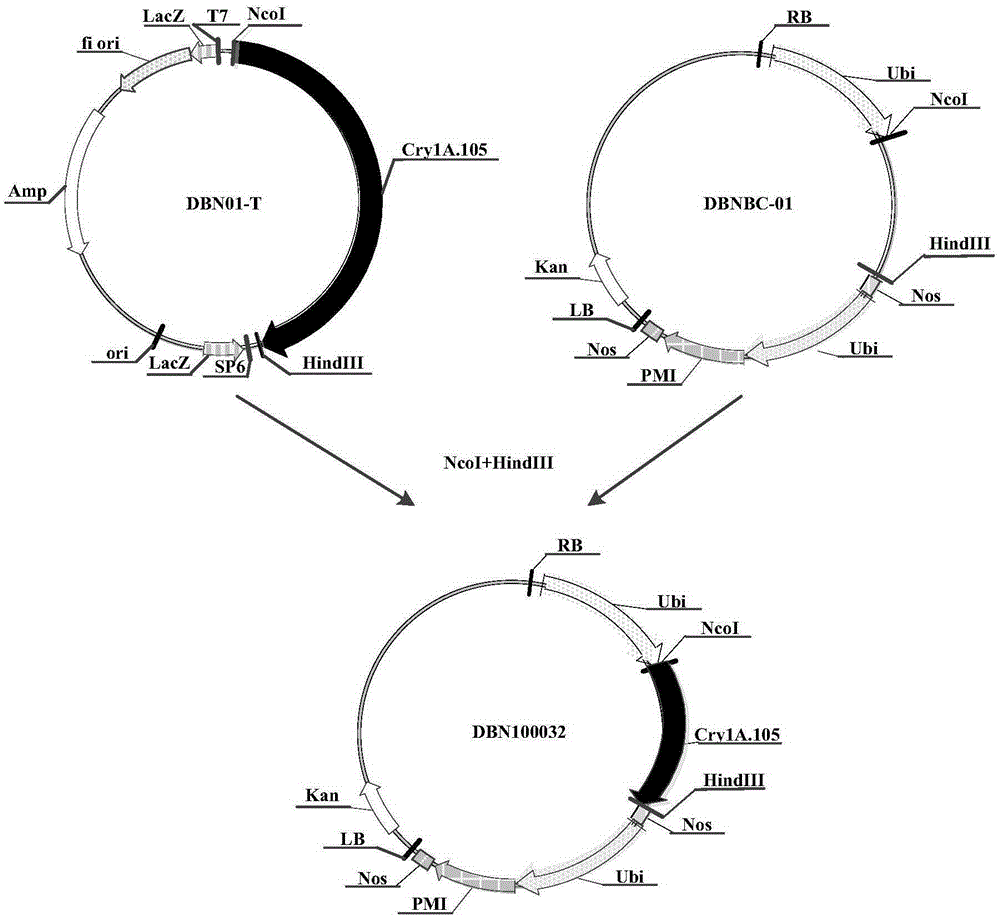
[0093] The synthesized Cry1A.105 nucleotide sequence was connected to the cloning vector pGEM-T (Promega, Madison, USA, CAT: A3600), and the operation steps were carried out according to the instructions of the pGEM-T vector produced by Promega Company to obtain the recombinant cloning vector DBN01-T , its construction process is as follows figure 1 Shown (wherein, Amp represents the ampicillin resistance gene; f1 represents the replication origin of phage f1; LacZ is the LacZ start codon; SP6 is the promoter of SP6 RNA polymerase; T7 is the promoter of T7 RNA polymerase; Cry1A.105 is the promoter of Cry1A .105 nucleotide sequence (SEQ ID NO: 2); MCS is the multiple cloning site).
[0094] Then, the recombinant cloning vector DBN01-T was trans...
the structure of the environmentally friendly knitted fabric provided by the present invention; figure 2 Flow chart of the yarn wrapping machine for environmentally friendly knitted fabrics and storage devices; image 3 Is the parameter map of the yarn covering machine
Login to View More
PUM
Login to View More
Abstract
The invention relates to a method for controlling the pest Conogethes punctiferalis. The method includes contacting the pest Conogethes punctiferalis with Cry1A.105 protein. According to the invention, the pest Conogethes punctiferalis is controlled through the Cry1A.105 protein that is generated in plants and can kill Conogethes punctiferalis. Compared with agricultural control methods, chemical control methods and biological control methods employed in the prior art, the method provided by the invention can achieve whole-plant protection on plants during a whole growth period so as to prevent and treat the attack of the pest Conogethes punctiferalis. Being free of pollution and residual, the method has stable and thorough effects, and is simple, convenient, and economical.
Description
technical field [0001] The invention relates to a method for controlling pests, in particular to a method for using Cry1A.105 protein expressed in plants to control the damage of plants by the peach borer borer. Background technique [0002] The peach borer (Conogethes punctiferalis) belongs to the family Lepidoptera and is an omnivorous pest. In addition to harming crops such as corn and sorghum, it also harms peaches, persimmons, chestnuts and other fruit trees. It is widely distributed in my country, starting from Heilongjiang and Inner Mongolia in the north. It reaches Taiwan, Hainan, Guangdong, Guangxi, and the southern edge of Yunnan in the south, connects with the eastern border of the former Soviet Union and the northern border of Korea in the east, and turns into Sichuan, Yunnan, and Tibet in the west from Shanxi and Shaanxi westward to Ningxia and Gansu. When maize is harmed, it mainly eats the ears and stems, and the plant damage rate reaches 30%-80%. When harming ...
Claims
the structure of the environmentally friendly knitted fabric provided by the present invention; figure 2 Flow chart of the yarn wrapping machine for environmentally friendly knitted fabrics and storage devices; image 3 Is the parameter map of the yarn covering machine
Login to View More
Application Information
Patent Timeline
Application Date:The date an application was filed.
Publication Date:The date a patent or application was officially published.
First Publication Date:The earliest publication date of a patent with the same application number.
Issue Date:Publication date of the patent grant document.
PCT Entry Date:The Entry date of PCT National Phase.
Estimated Expiry Date:The statutory expiry date of a patent right according to the Patent Law, and it is the longest term of protection that the patent right can achieve without the termination of the patent right due to other reasons(Term extension factor has been taken into account ).
Invalid Date:Actual expiry date is based on effective date or publication date of legal transaction data of invalid patent.


 Login to View More
  Login to View More