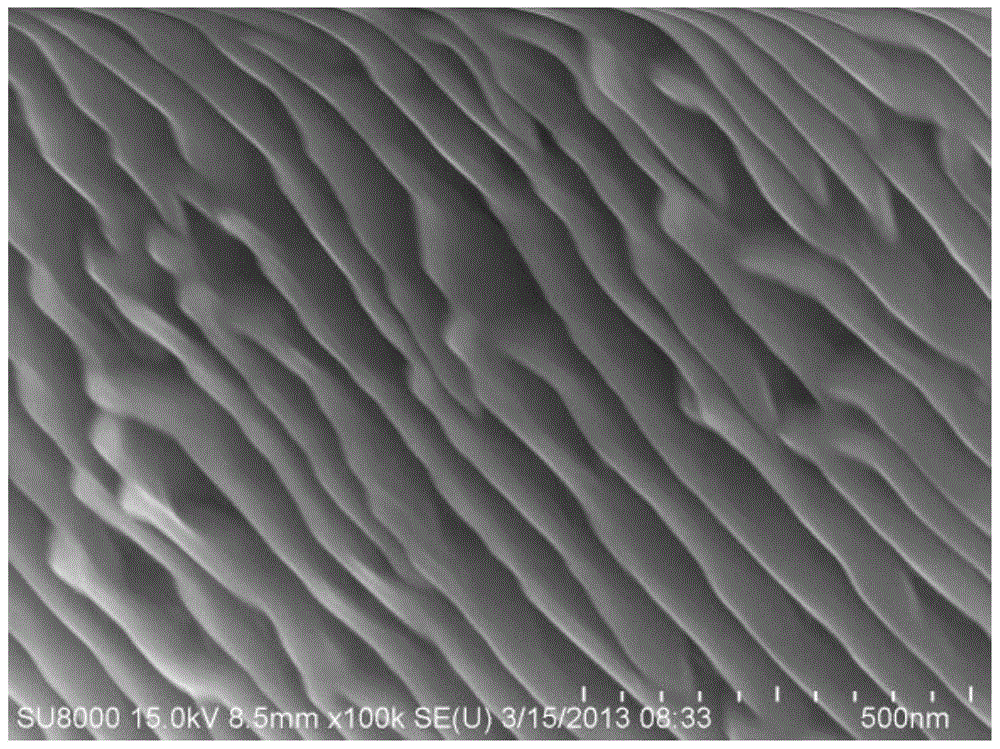
A kind of method for preparing layered tin coating by electrodeposition

A tin coating and electrodeposition technology is applied in the field of electrodeposition to prepare layered tin coating to achieve the effects of increasing lithium intercalation capacity, easy control of electroplating process and improving cycle performance

CN105088290BActive Publication Date: 2017-04-26HARBIN INST OF TECH
2 Cites 1 Cited by

Patent Information

Authority / Receiving Office
CN · China
Patent Type
Patents(China)
Current Assignee / Owner
Publication Date
2017-04-26

Smart Images

  • Figure 1
    Figure 1
Patent Text Reader

Abstract

The invention relates to a method for preparing layered tin coatings in an electrolytic deposition manner. According to the method, the problem that an existing tinning method can only prepare bright compact coatings is solved. The method comprises the steps of removing oil on a coated part in an alkaline manner, rinsing the coated part, and pickling the coated part; then rinsing the coated part again, and drying the coated part to obtain an electroplating negative pole and using elementary substance tin as an electroplating positive pole; and setting the electroplating current density as 2-5A / dm<2>, the electroplating temperature as 10-35 DEG C and the electroplating time as 3-9min to obtain the layered tin coatings. Plating solution comprises stannous mono sulphate, concentrated sulfuric acid, gelatin, additive and ascorbic acid. The method can be used for preparing tin coatings of a layered structure in the electrolytic deposition manner, the plating solution is simple in composition, and the electroplating process is easy to control. The method is applied to the field of material preparing.
Need to check novelty before this filing date? Find Prior Art

Description

technical field

[0001] The invention relates to a method for preparing a layered tin coating by electrodeposition. Background technique

[0002] Tin is a silver-white metal with a low melting point (232°C), high ductility, and easy polishing. The tin coating has good corrosion resistance to humid climates, water-soluble salt solutions and weak acids, and can form alloys with many metals. Therefore, it is widely used in tinplate, alloy manufacturing, printed circuit boards, hardware and other industries.

[0003] Common tin plating solutions are divided into two categories: acid tin plating solution and alkaline tin plating solution. In alkaline tin plating solution, tin exists as tetravalent stannate ions, while in acidic tin plating solution, tin ions exist in the form of divalent cations. The sulfate tin plating process has become the first choice for bright tin plating due to its simple composition, easy availability of raw materials, low cost, fast deposition speed, hi...

Examples

specific Embodiment approach 1

[0009] Specific Embodiment 1: In this embodiment, a method for preparing a layered tin coating by electrodeposition is as follows: alkaline degreasing, water washing, pickling, and water washing of the plated parts, and drying to obtain the electroplated cathode, using elemental tin as the electroplated cathode Anode; the current density of electroplating is 2~5A / dm 2 , the electroplating temperature is 10-35°C, the electroplating time is 3-9min, and the layered tin coating is obtained; the plating solution contains stannous sulfate, concentrated sulfuric acid, gelatin, additives and ascorbic acid, and the final concentration of stannous sulfate in the plating solution is 35-45g / L, the final concentration of concentrated sulfuric acid is 180-182g / L, the final concentration of gelatin is 0.2-1.0g / L, the final concentration of additives is 0.2-1.6mL / L, and the final concentration of ascorbic acid is 0.3-0.5 g / L.

[0010] In this embodiment, the tin coating with a layered struct...

specific Embodiment approach 2

[0011] Embodiment 2: The difference between this embodiment and Embodiment 1 is that an aqueous solution with a mass concentration of 20% HCl is used for pickling. Others are the same as in the first embodiment.

specific Embodiment approach 3

[0012] Embodiment 3: This embodiment differs from Embodiment 1 or Embodiment 2 in that: the final concentration of stannous sulfate in the plating solution is 40 g / L. Others are the same as in the first or second embodiment.