
A low-risk routing method in differentiated services network
A differentiated service, low-risk technology, applied in the field of communication networks, can solve problems such as single level and single failure mode
Patent Information
- Authority / Receiving Office
- CN · China
- Patent Type
- Patents(China)
- Current Assignee / Owner
- Publication Date
- 2018-11-09
- Estimated Expiration
- Not applicable · inactive patent
Smart Images
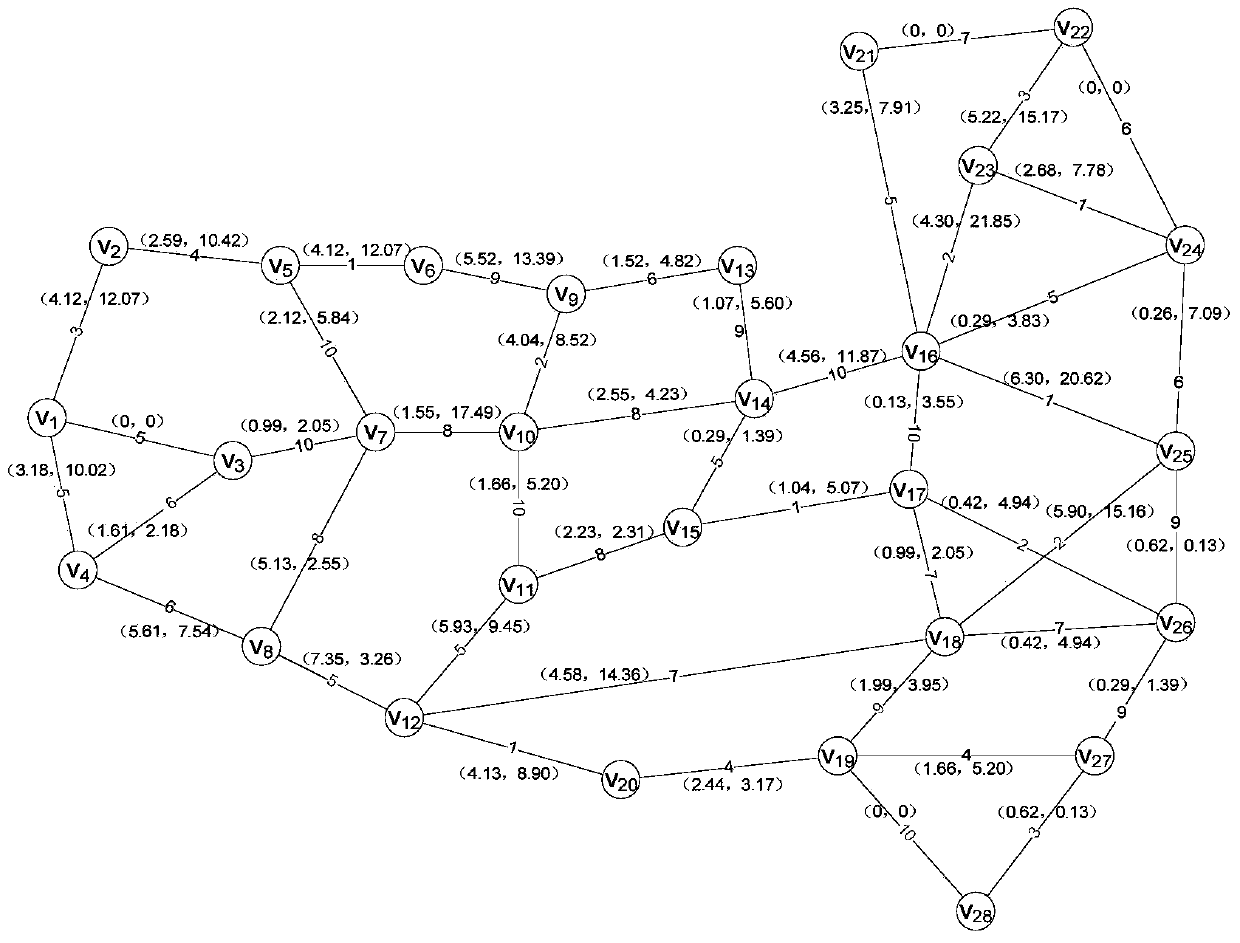
Figure 1 
Figure 2 
Figure 3
Abstract
Description
technical field
[0001] The invention belongs to the technical field of communication networks, and in particular relates to a low-risk routing method in a differentiated service network. Background technique
[0002] Optimizing routes is the most effective way to reduce network risks without changing the network topology. Many researchers have studied the network low-risk routing problem from different levels. Ming Xia, MassimoTornatore and others took the optical network as the research object, described the main risk characteristics of the link by referring to the link at the transport layer, and proposed a risk-aware routing method based on this, which effectively reduces the network service violation of the service level agreement. (SLA) ratio; Sang-WoonJeon et al. proposed a routing method based on the Dijkstra algorithm to achieve the minimum delay in heavy-loaded networks. Its essence is to use all or part of the link information to achieve network load balancing, so...
Examples
Embodiment Construction
[0038] The preferred embodiments will be described in detail below in conjunction with the accompanying drawings. It should be emphasized that the following description is only exemplary and not intended to limit the scope of the invention and its application.
[0039] figure 1 It is a network topology diagram used in the embodiment of the present invention. The network is a LATAX network with 28 nodes and 46 links. In this embodiment, there are 5 types of services in the network, and the corresponding unitized service importances are 0.99, 0.94, 0.62, 0.29 and 0.13 respectively; the corresponding unitized flows are 2.048, 2.048, 0.133, 1.387 and 3.547 respectively. The total number of existing services in the network is 50, the number of each type of service is randomly allocated, the source and sink nodes of each service are randomly allocated, and the paths of existing services are all the shortest paths. figure 1 In , the numbers outside the parentheses on the link indic...