
Image defogging method
An image and maximum pixel technology, applied in image enhancement, image data processing, instruments, etc., can solve problems such as not being particularly perfect, and achieve the effects of improved accuracy, high fidelity, and improved real-time performance
- Summary
- Abstract
- Description
- Claims
- Application Information
AI Technical Summary
Problems solved by technology
Method used
Image

Examples
Embodiment Construction
[0033] The technical solution of the present invention will be described in detail below in conjunction with the accompanying drawings.
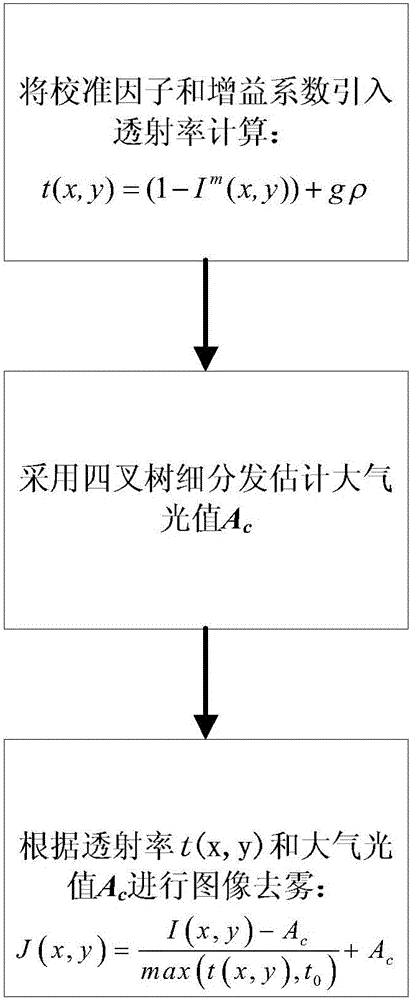
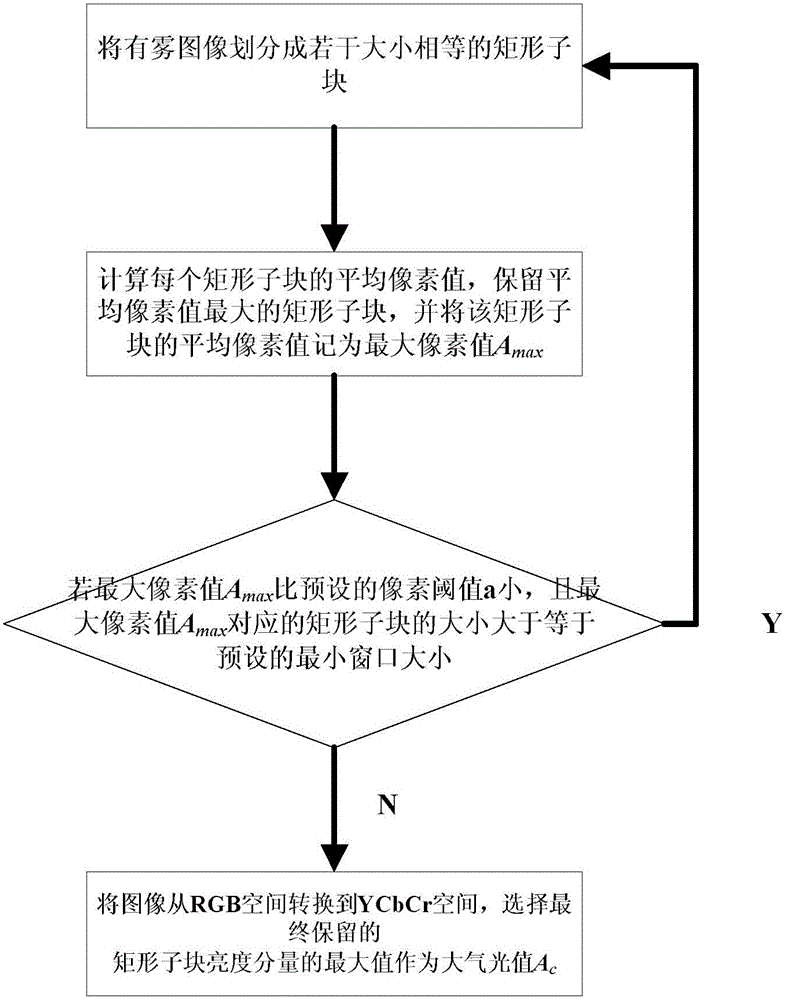
[0034] Such as figure 1 As shown, an image defogging method includes the following steps:
[0035] Step 1. Calculate the transmittance of the foggy image:
[0036] t(x,y)=(1-I m (x,y))+gρ (1)
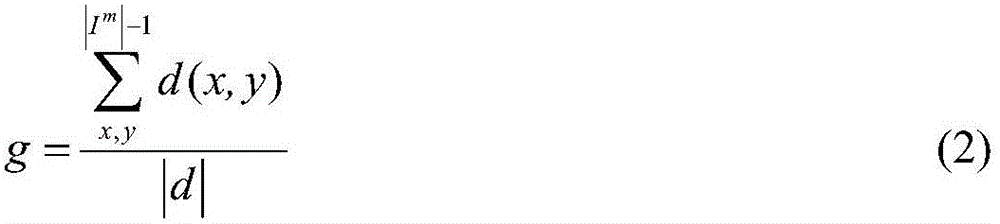
[0037] In formula (1), t(x,y) is the transmittance, (x,y) is the pixel coordinate, ρ is the calibration factor, and the value of ρ is usually in [0.8,1]. In this embodiment, ρ= 0.9, g is the gain constant:
[0038] g = X x , y | I m | - 1 d ( x , y ) | d | - - - ( 2 )
[0039] In formula (2), |I m | And |d| are I respectively m And the total number of pixels of d, corresponding to I m And d:
[0040] I m ( x , y ) = m i n c A { R , G , B } I c ( x , y ) - - - ( 3 )
[0041] d(x,y)=I m (x,y)-I d (x,y) ...
PUM
 Login to View More
 Abstract
Description
Claims
Application Information
 Login to View More