
Probe, primer, detection kit and detection method for detecting arboviruses based on suspension microsphere array system
A detection kit and detection method technology, applied in the field of molecular biology, can solve the problems of many detection indicators and large number of samples tested per unit time, and achieve the effects of simple operation steps, reduction of medical costs, and cost reduction.
- Summary
- Abstract
- Description
- Claims
- Application Information
AI Technical Summary
Problems solved by technology
Method used
Image

Examples
Embodiment 1
[0050] 1. Multiplex PCR primer design:
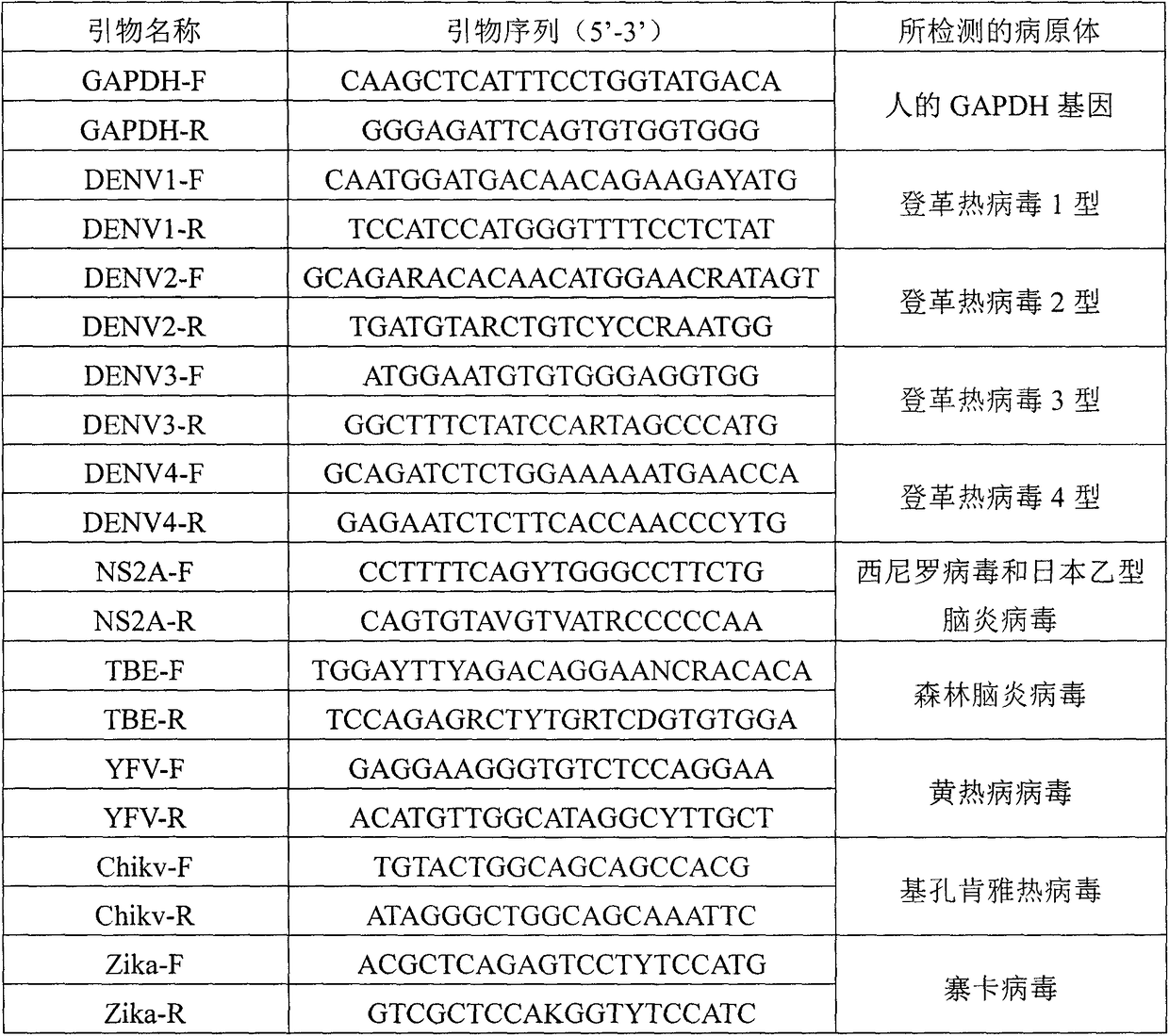
[0051] The above 7 viruses are all RNA viruses, so the multiple reverse transcription PCR of these 7 RNA viruses is designed to react in one tube. The PCR primer sequences corresponding to these 7 viruses and the human GAPDH gene used as internal reference are shown in Table 1 .
[0052] 5 of all reverse primers (i.e. primers GAPDH-R, DENV1-R, DENV2-R, DENV3-R, DENV4-R, NS2A-R, TBE-R, YFV-R, Chikv-R and Zika-R) ' end labeled with biotin. Part of the primer sequence contains degenerate bases, where Y stands for base C or T, R stands for base A or G, V stands for base G or A or C, N stands for base A or T or G or C, D Represents the base G or A or T, K represents the base G or T.
[0053] Table 1. Multiplex PCR primer sequences for detection of RNA viruses
[0054]
[0055] Note: F means forward primer; R means reverse primer
[0056] 2. Probe design:
[0057] The present invention designs a total of 12 probes for 7 kinds of inse...
Embodiment 2
[0091] According to the method of Example 1, 10 positive clinical samples confirmed to be dengue virus type 1 infection by antigen method and PCR method were detected, and the positive detection rate results are shown in Table 5.
[0092] Table 5. The positive detection rate of dengue virus type 1 by optimized primers
[0093]
[0094] It can be seen from Table 5 that after the degenerate base design of the primers, the positive detection rate is significantly improved, and positive samples can be detected to the greatest extent.
Embodiment 3
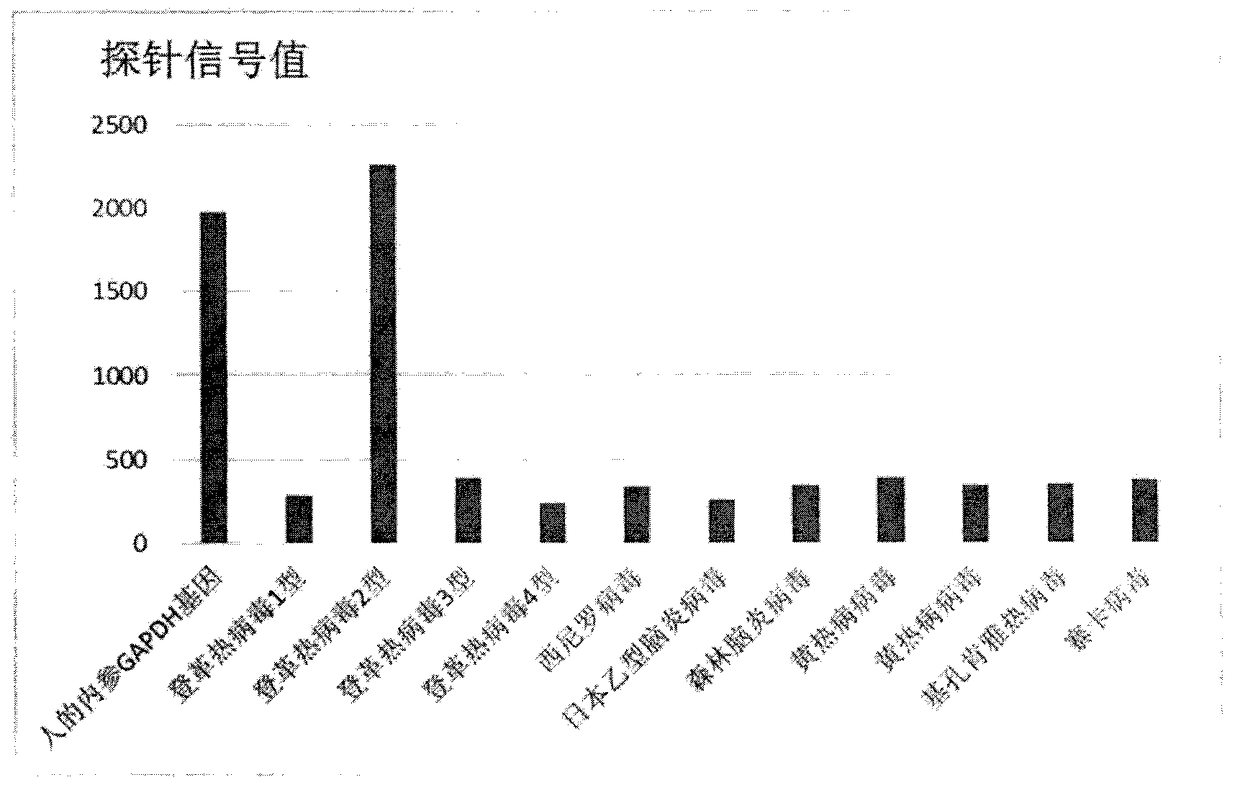
[0096] A pregnant woman with fever and muscle soreness symptoms is detected to be dengue virus positive with the dengue antigen method, but it is not known to be the dengue virus of that type, and it is determined to be dengue type 2 virus according to the method of embodiment 1 (see figure 1 ), the result was the same as the antigen method and PCR method.
PUM
| Property | Measurement | Unit |
|---|---|---|
| Sensitivity | aaaaa | aaaaa |
Abstract
Description
Claims
Application Information
 Login to View More