
A kind of tumor stem cell detection kit
A kit and a specific technology, applied in the field of tumor stem cell detection kits, can solve the problems of low early warning signals, high missed diagnosis rate, and many complications in early detection
- Summary
- Abstract
- Description
- Claims
- Application Information
AI Technical Summary
Problems solved by technology
Method used
Image

Examples
Embodiment 1
[0033] Example 1. Preparation of DCLK1 protein antigen
[0034] The difference between the short isomer of DCLK1 (SEQ ID NO:1) and the long isomer (SEQ ID NO:2) is only that the first 6 amino acids of the short isomer are different from those of the long isomer. Therefore, we used the first 9 amino acids of the short isomer (SEQ ID NO: 3) as an antigen to prepare an antibody that only specifically binds to the short isomer of DCLK1. Artificially synthesized a plasmid containing 6 repeats of SEQ ID NO:3 (purchased from Beijing Qingke Biotechnology Co., Ltd.), denoted as pET-43.1b(+)-sDCLK1-6, the synthesis technology is known in the art. Transform the above plasmids into Escherichia coli competent BL21 (DE3), then add the competent cells to 2ml LB culture containing ampicillin resistance for overnight culture, and inoculate 1% inoculum in 20 mL LB containing ampicillin resistance on the next day In LB medium, shake culture at 37°C for 3 h, then add IPTG with a final concentrat...
Embodiment 2
[0035] Example 2. Preparation and purification of anti-DCLK1 antibody
[0036] The antigen prepared in Example 1 was injected intraperitoneally into female Balb / c mice together with Freund's complete adjuvant that caused an immune response for initial immunization, and then the same amount of antigen was injected into the above-mentioned female Balb / c mice every 2 weeks Mice were immunized intraperitoneally. Finally, the final immunization was carried out 3 days before the fusion with myeloma cells. After mixing 100 μg of the DCLK1 antigen in Example 1 with an immune adjuvant, the mice were given intraperitoneal final immunization. The immunized Balb / c mouse splenocytes were taken and fused with the myeloma Sp2 / 0 cell line, and the fused cells were treated with Iscove medium (0.1 mM hypoxanthine, 0.4 μM aminopterin) containing 10% serum and 16 μM thymidine), diluted to an appropriate concentration, added to a 96-well plate for cultivation. After 10 days, the cell supernatant...
Embodiment 3
[0037] Example 3. Anti-DCLK1 antibody subtype identification
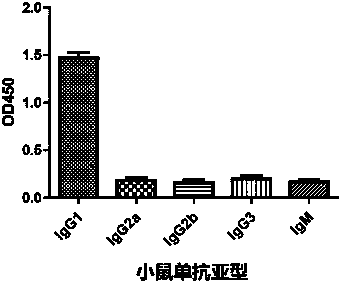
[0038] The mouse monoclonal antibody subtype identification kit (Proteintech) was used to identify the subtype of the anti-DCLK1 monoclonal antibody obtained in Example 2. The ELISA plate provided in the kit is pre-coated with specific antibodies against mouse IgG1, IgG2a, IgG2b, IgG2c, IgG3, IgM, kappa light chain, lambda light chain, and the anti-DCLK1 antibody purified in Example 2 Samples were added to the sample wells, 50 μl per well. Without incubation, add 1X goat anti-mouse IgM+IgG-HRP to the sample wells, 50 μl per well, mix gently, and incubate for 1 h. Remove the liquid in the well and add 1XPBST to wash the well 3 times, and absorb excess water with absorbent paper. Add chromogenic solution, 100 μl per well, develop color for 15 minutes at room temperature in the dark, and add 100 μl stop solution. Detect the OD value at 450nm by microplate reader, the result is as follows figure 1 As shown, the hea...
PUM
 Login to View More
 Abstract
Description
Claims
Application Information
 Login to View More