
Control method for clothes care equipment and clothes care equipment
A technology of clothing care and control method, applied in the control device of washing machine, household dryer, application and other directions, can solve the problem of not having indoor air dehumidification function, etc., to achieve the effect of ensuring dehumidification effect and improving user experience
- Summary
- Abstract
- Description
- Claims
- Application Information
AI Technical Summary
Problems solved by technology
Method used
Image

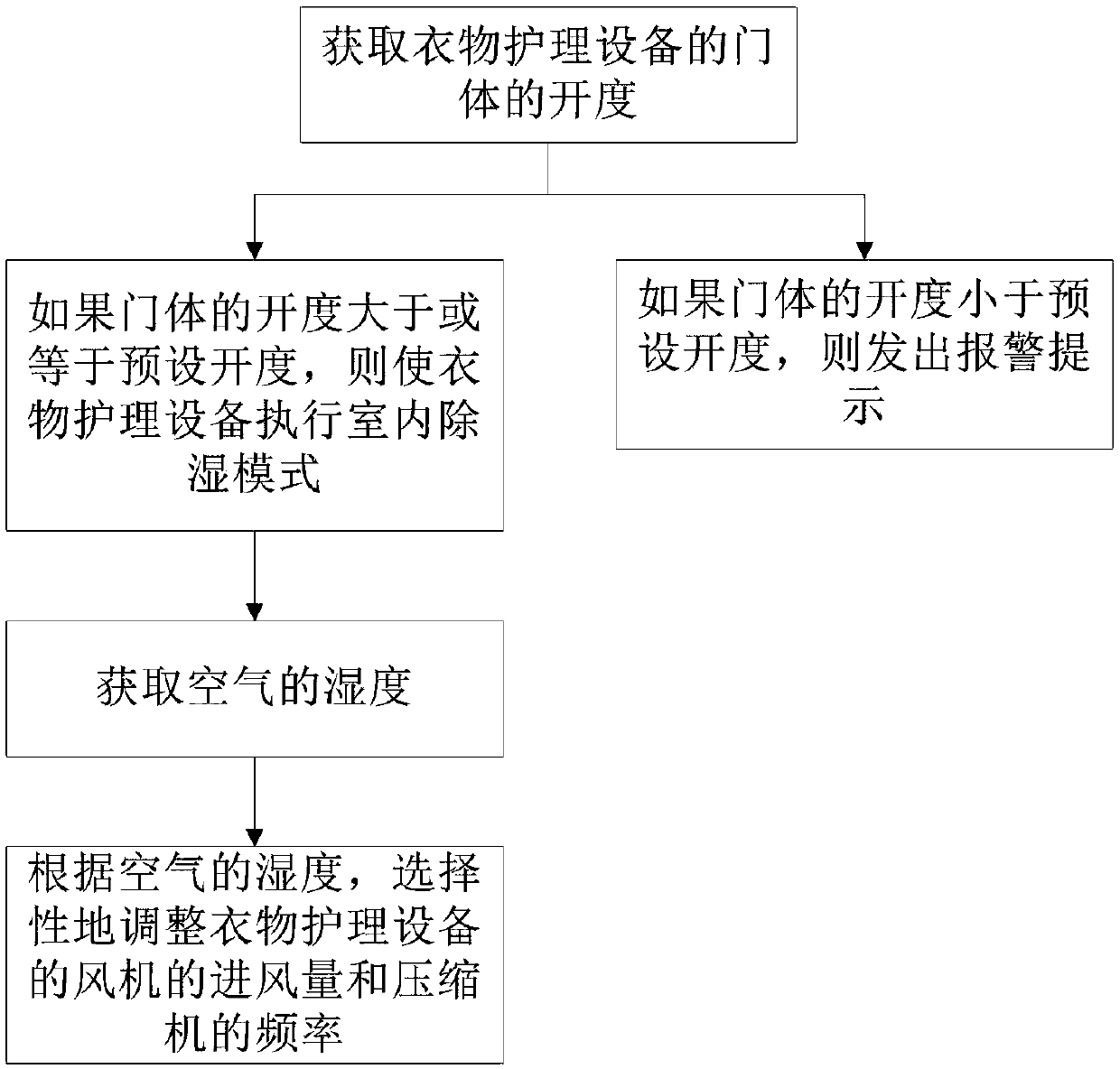
Examples
Embodiment Construction
[0018] Preferred embodiments of the present invention are described below with reference to the accompanying drawings. Those skilled in the art should understand that these embodiments are only used to explain the technical principles of the present invention, and are not intended to limit the protection scope of the present invention.
[0019] It should be noted that, in the description of the present invention, terms such as "middle", "upper", "lower", "inner", "outer" and other indicated directions or positional relationships are based on the directions or positional relationships shown in the drawings. The positional relationship, which is just for convenience of description, does not indicate or imply that the device or element must have a specific orientation, be constructed and operated in a specific orientation, and thus should not be construed as limiting the present invention. In addition, the terms "first" and "second" are used for descriptive purposes only, and sho...
PUM
 Login to View More
 Abstract
Description
Claims
Application Information
 Login to View More