Finger-actuated handgun retention device for holster

a technology of finger-actuated handgun and holster, which is applied in the direction of weapons, arms wearables, weapon components, etc., can solve the problems of affecting the user's ability to quickly draw a handgun, hindering the user's ability to extend his or her index finger away from the trigger, and increasing the chance that the user's index finger may inadvertently come into contact with the trigger

US20050205624A1Inactive Publication Date: 2005-09-22MICHAELS OF OREGON
17 Cites 53 Cited by

Patent Information

Authority / Receiving Office
US · United States
Current Assignee / Owner
Publication Date
2005-09-22
Estimated Expiration
Not applicable · inactive patent

Smart Images

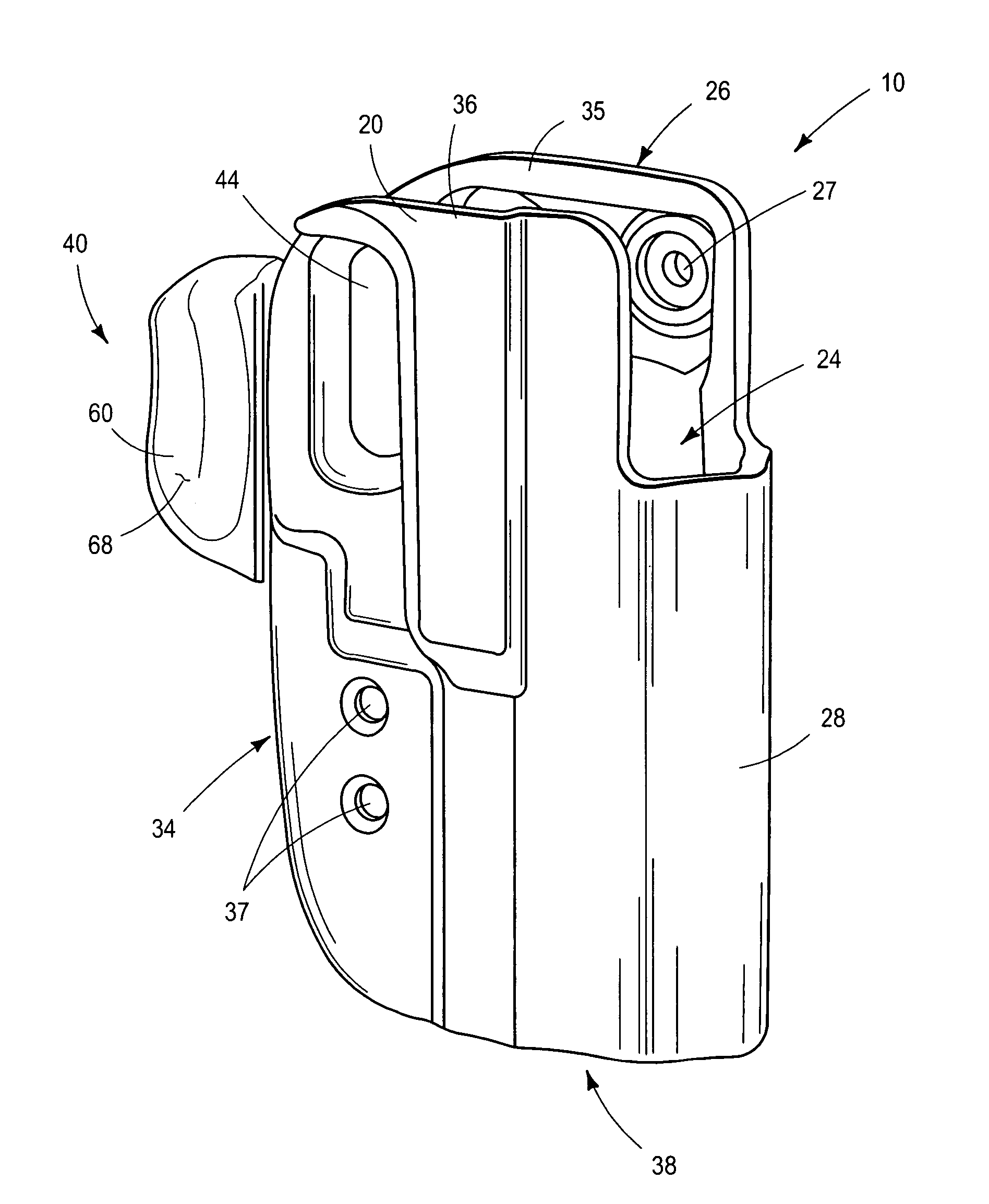
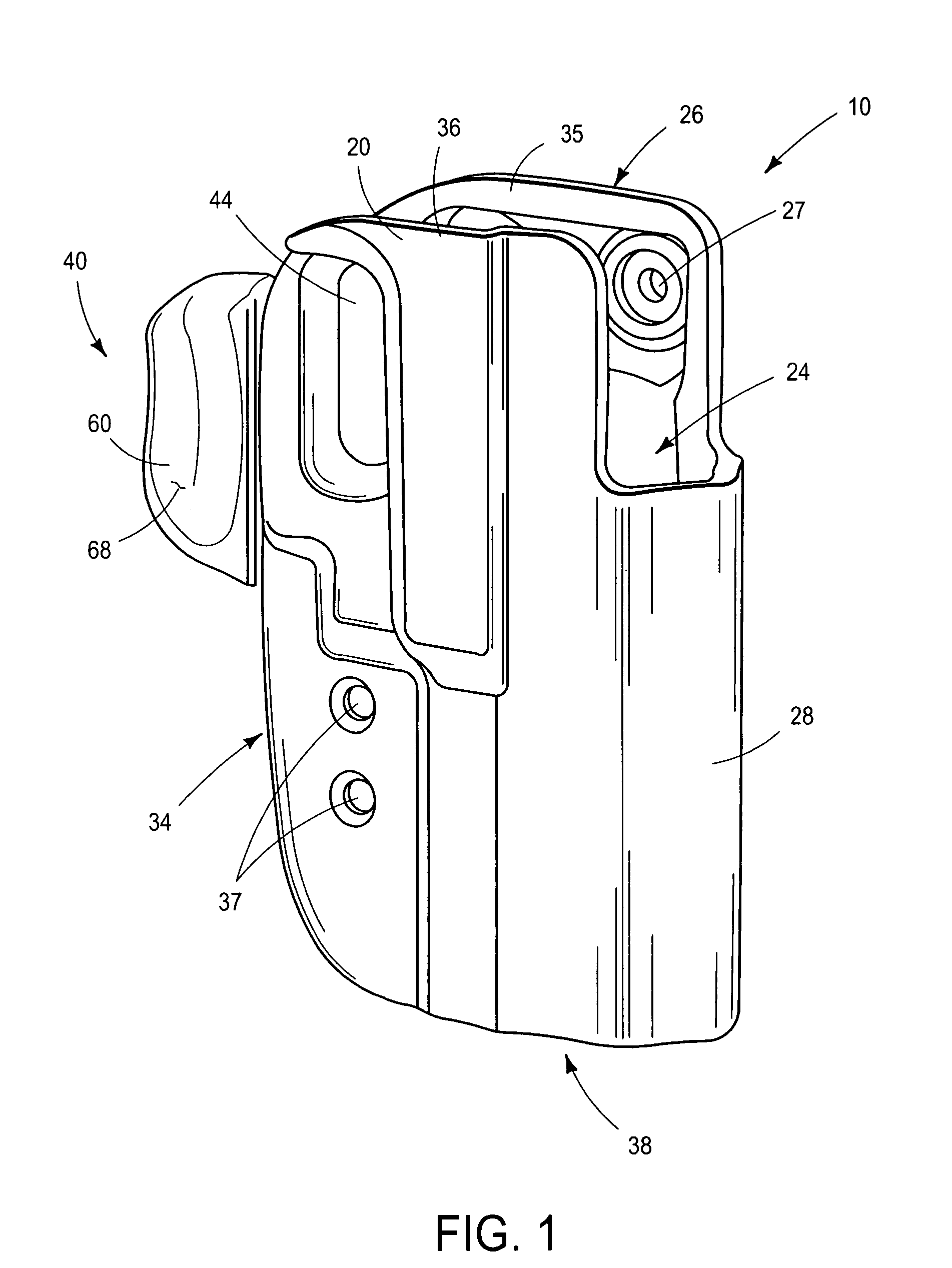
  • Figure 1
    Figure 1
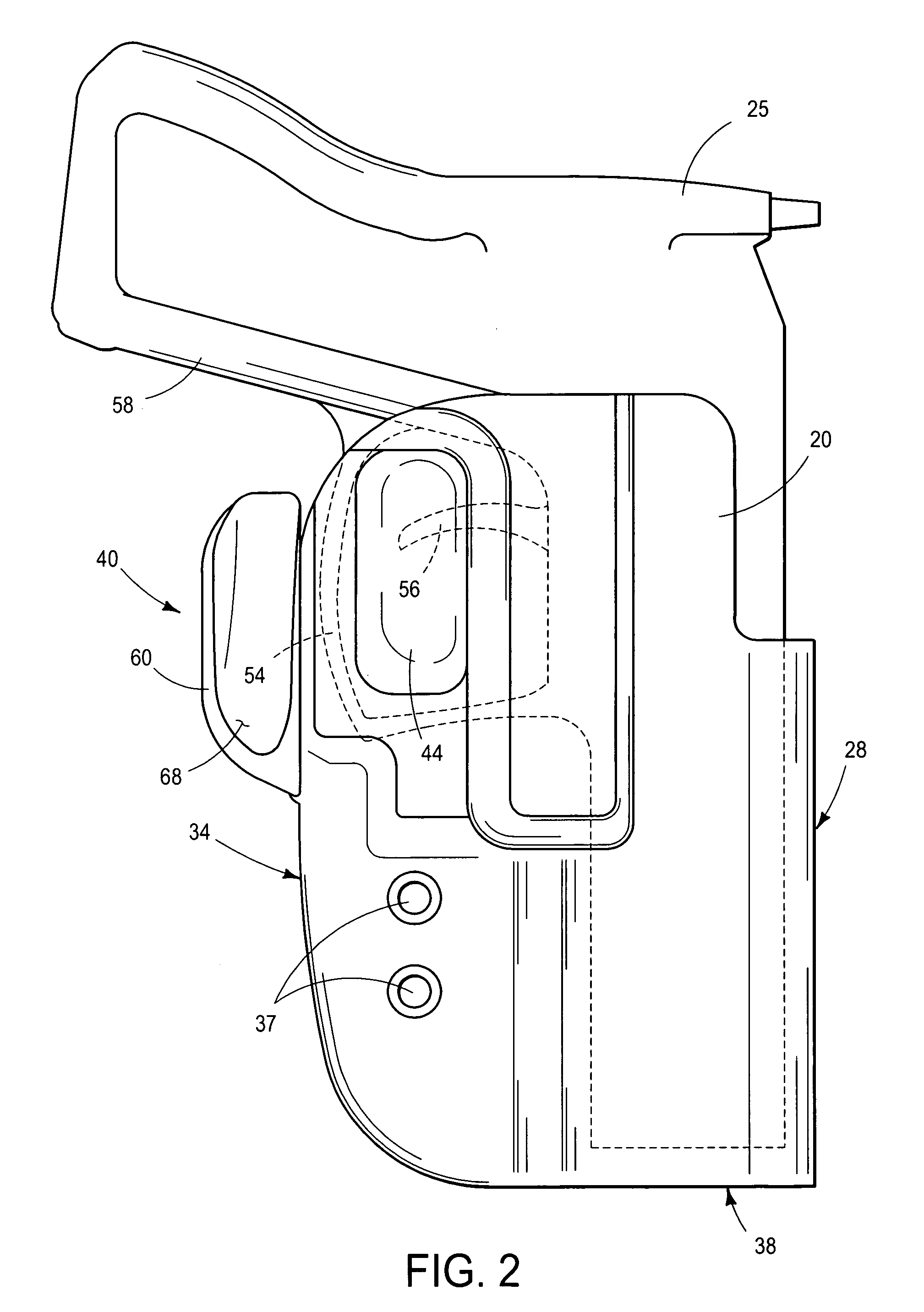
  • Figure 2
    Figure 2
  • Figure 3
    Figure 3
Patent Text Reader

Abstract

A handgun retention device for a holster includes a catch that extends into a handgun receiving cavity defined by a body of the holster where the catch engages a trigger guard of a holstered handgun to retain the handgun in the cavity. A lever is operably coupled to the catch and extends below the grip of the holstered handgun and aft of its trigger guard, typically behind a rear margin of the holster, where the lever can be depressed to move the catch and release the handgun. The position of the release lever may promote safe gun handling. In a preferred embodiment, the catch and lever are formed of a resilient injection molded resin in a unitary structure with a spring arm that flexes when the lever is pressed inwardly toward the user's body.
Need to check novelty before this filing date? Find Prior Art

Description

RELATED APPLICATIONS

[0001] This application claims the benefit under 35 U.S.C. § 119(e) of U.S. Provisional Patent Application No. 60 / 552,927, filed Mar. 11, 2004, which is incorporated herein by reference.TECHNICAL FIELD

[0002] This application relates to security holsters for handguns and the like. BACKGROUND OF THE INVENTION

[0003] Known security devices for preventing unauthorized or unintended withdrawal of a handgun or other weapon from a holster include security straps and flaps, internal retention devices, and security hoods, among others. To release such security devices, the user must typically manipulate snaps, clasps, buttons, or “thumb-break” straps with his or her thumb or index finger, or both. The motions required to release such devices often require the user to let go of the handgun while releasing the security device and can hinder the user's ability to quickly draw a handgun.

[0004] U.S. Pat. Nos. 5,419,474 of Marx et al. and 6,547,111 of French describe interna...

Examples

Embodiment Construction

[0018] With reference to FIGS. 1-5, a holster 10 includes a holster body 20 that defines a cavity 24 sized to receive a firearm 25 (FIG. 2) via a top opening 26 of cavity 24 and to hold firearm 25 therein. Holster 10 is normally attached to a wearer's belt (not shown) or in another location. Holster 10 may include mounting holes 27 for fastening to holster 10 a belt loop or other intermediate device (omitted from the figures for clarity) suited to coupling holster 10 to a belt or other support. Holster body 20 may be made of a wide variety of materials, such as leather, fabric, molded plastic, and other synthetic materials, for example, and by any of a variety of manufacturing methods, such as molding, sewing, lamination, riveting, and other methods. Holster body 20 may be made of a KYDEX® acrylic / PVC sheet material folded back over itself and formed to define a front spine 28. However, holster body 20 is preferably molded of KYDEX resin. The rearward edges of holster body 20 define...