Open service discovery and routing mechanism for configuring cross-domain telecommunication services

a cross-domain telecommunications and open service discovery technology, applied in the direction of digital transmission, data switching networks, electrical appliances, etc., can solve problems such as trust and privacy restrictions, achieve the effects of avoiding bottlenecks and single points of failure, reducing or eliminating scalability problems, and maintaining control over each domain

US20050259655A1Active Publication Date: 2005-11-24RPX CORP
12 Cites 127 Cited by

Patent Information

Authority / Receiving Office
US · United States
Patent Type
Applications(United States)
Current Assignee / Owner
Publication Date
2005-11-24

Smart Images

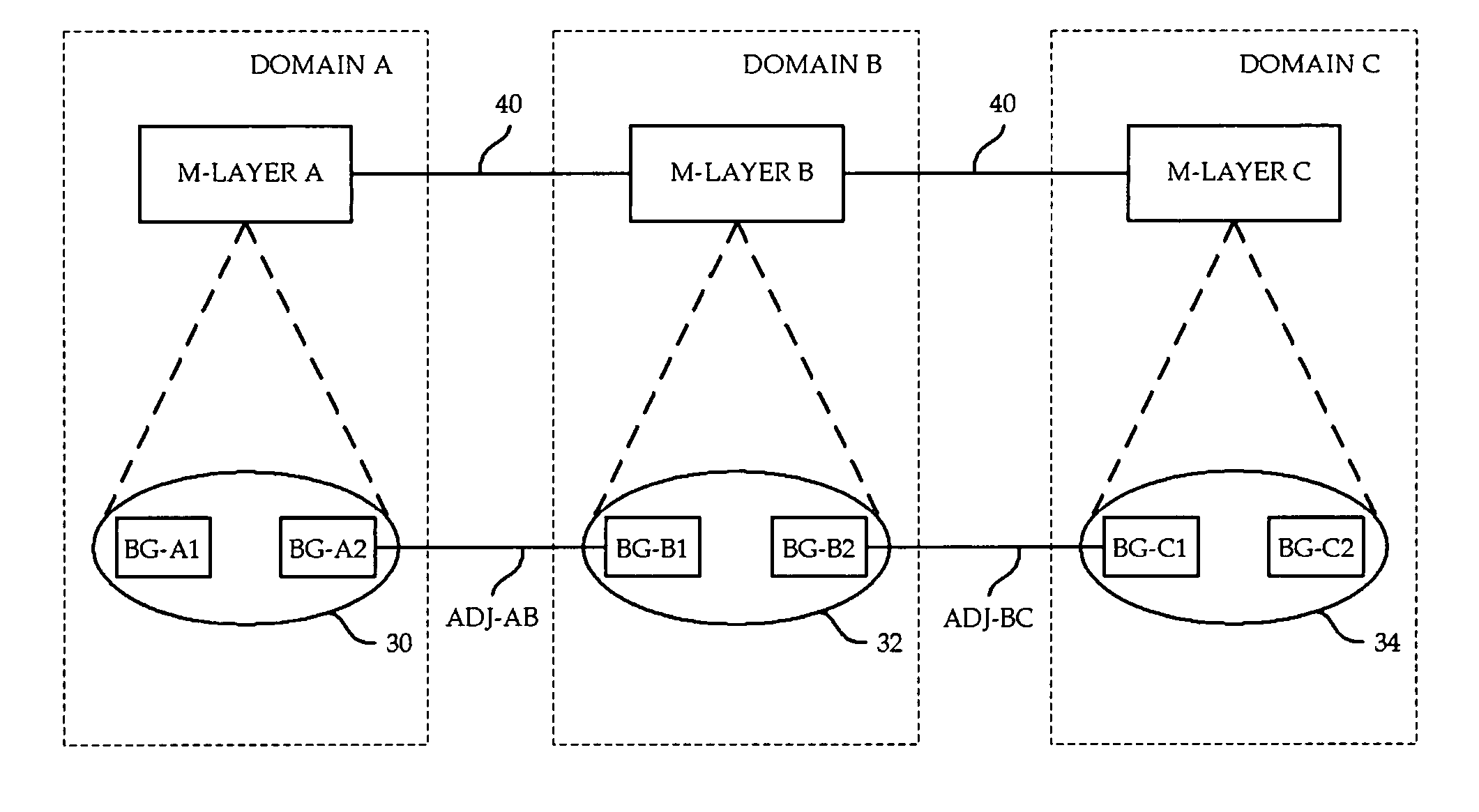
  • Figure 1
    Figure 1
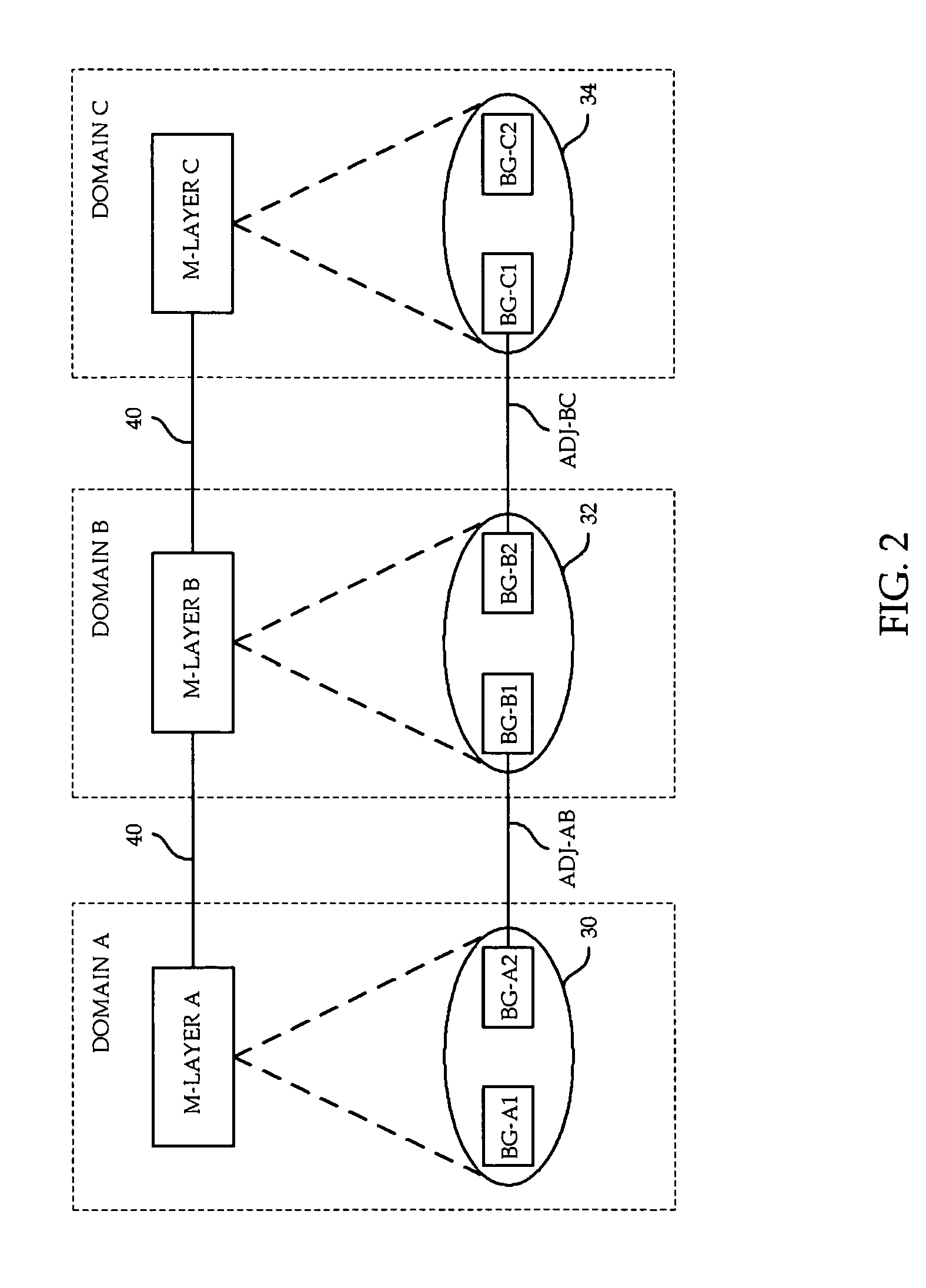
  • Figure 2
    Figure 2
  • Figure 3
    Figure 3
Patent Text Reader

Abstract

Apparatus and method are provided for distributing service domain reachability information across domain boundaries, thereby allowing domain management systems to determine routing for cross-domain services even when the domains have different technologies or administrators. A Service Domain Manager within each domain advertises to neighbouring domains which services it supports. A domain which receives such advertisements forwards the advertisement on to other domains. Each SDM builds a routing information table which specifies the service, the domain, the next hop, and optionally user defined metrics. The routing information table does not include end-point addresses, in order to keep the size of the table manageable. In this way, the NMS of each domain obtains an end-to-end view of service routes.
Need to check novelty before this filing date? Find Prior Art

Description

CROSS-REFERENCE TO OTHER APPLICATIONS

[0001] This application claims priority from Canadian Patent Application 2,467,945, entitled “Open Service Discovery and Routing Mechanism for Configuring Cross-Domain Telecommunication Services” and filed on May 20, 2004. FIELD OF THE INVENTION

[0002] The invention relates to routing within telecommunication networks, and more particularly to exchange of reachability information in multi-domain networks. BACKGROUND OF THE INVENTION

[0003] Configuration and operation of cross-domain services is a major issue for network and network-service providers. As service providers establish peering and wholesale relationships with multiple service provider partners, they find themselves in a complex situation in which services must be deployed across a constellation of different and non-integrated vendor, service, and technology-specific management systems. The problem of cross-domain service management, whether it means coordinating management operations...

Examples

Embodiment Construction

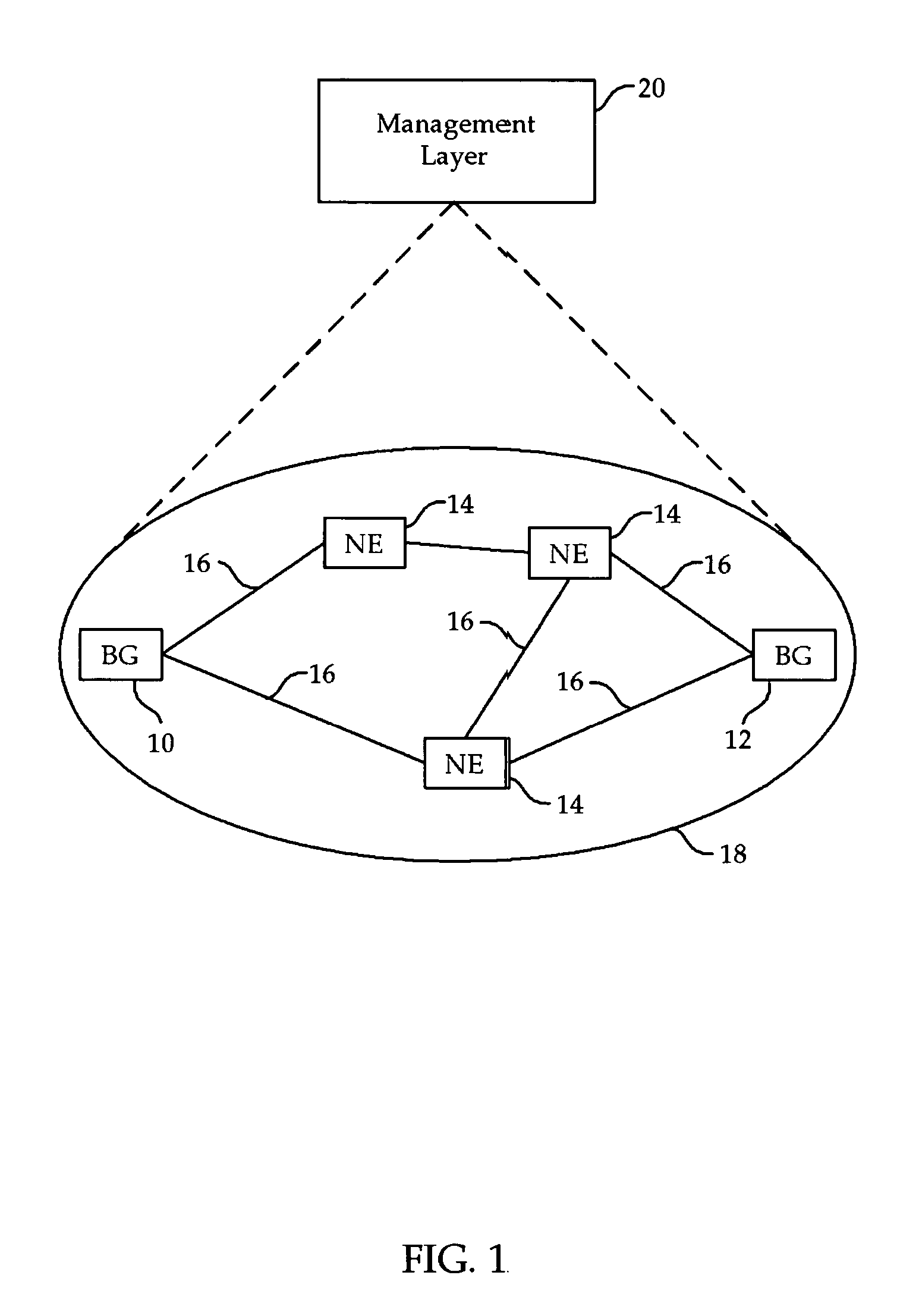
[0017] Referring to FIG. 1, an example of a telecommunication domain is shown. The domain includes a first border gateway 10, a second border gateway 12, and a plurality of interior network elements 14. Collectively, the first border gateway 10, the second border gateway 12, and the plurality of interior network elements 14 are referred to as network elements 18 of the domain. The network elements of the domain are variously interconnected by communication links 16. The domain shown in FIG. 1 is for example purposes only. More generally, the domain includes a plurality of network elements, at least two of which are border gateways. The border gateways provide communication access to devices outside the domain, such as border gateways of other domains or end user devices.

[0018] The domain also includes a management layer 20. The management layer 20 comprises a plurality of components, including a Service Domain Manager (SDM). The SDM is preferably in the form of software instruction...