
Modular Storm Water Filtration System
a filtration system and module technology, applied in the field of filtration systems, can solve the problems of increasing the maintenance frequency of the storm water filtration system, reducing efficiency, and accumulating pollutants on developed land
Patent Information
- Authority / Receiving Office
- US · United States
- Patent Type
- Applications(United States)
- Current Assignee / Owner
- Publication Date
- 2012-02-09
Smart Images
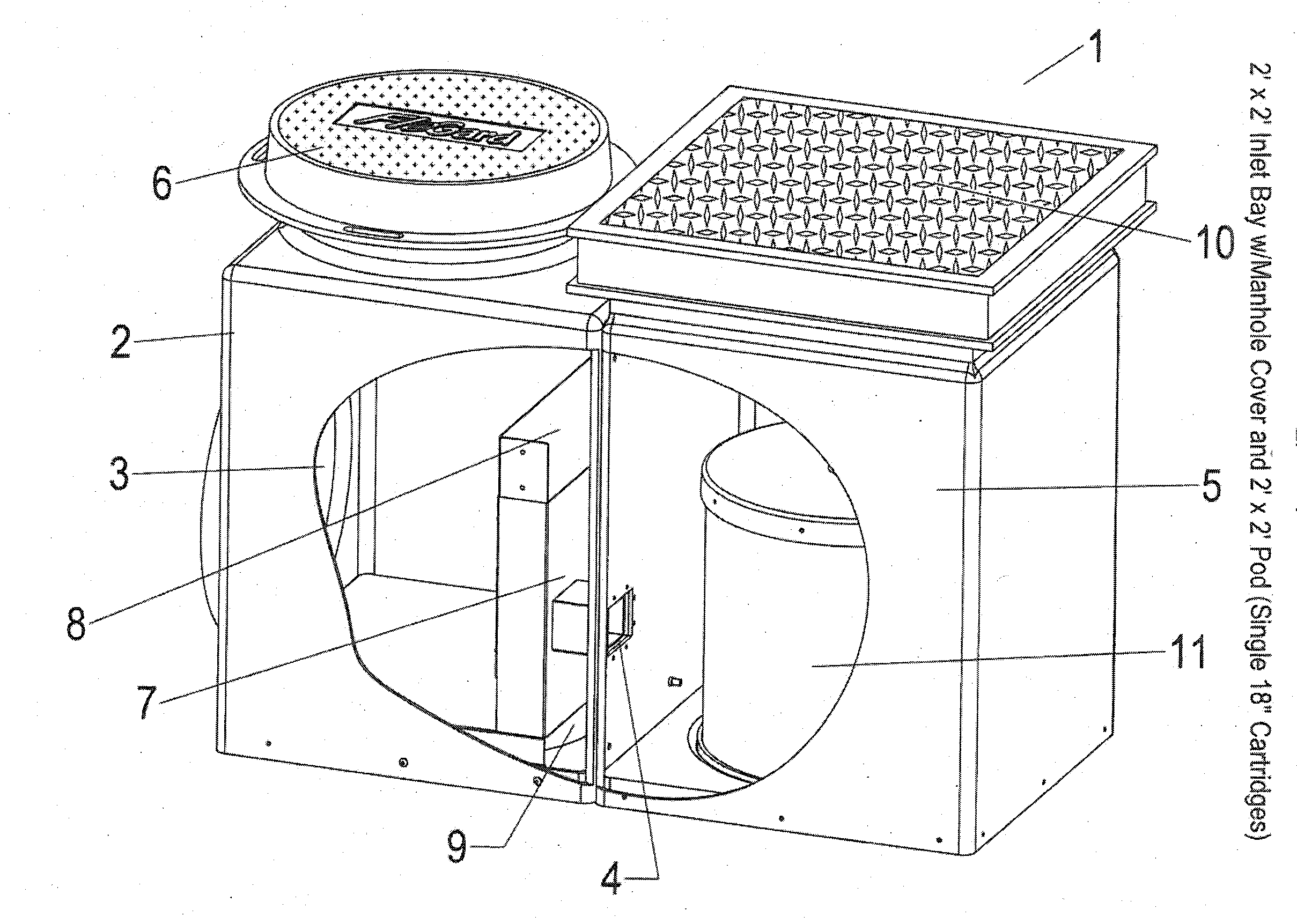
Figure 1 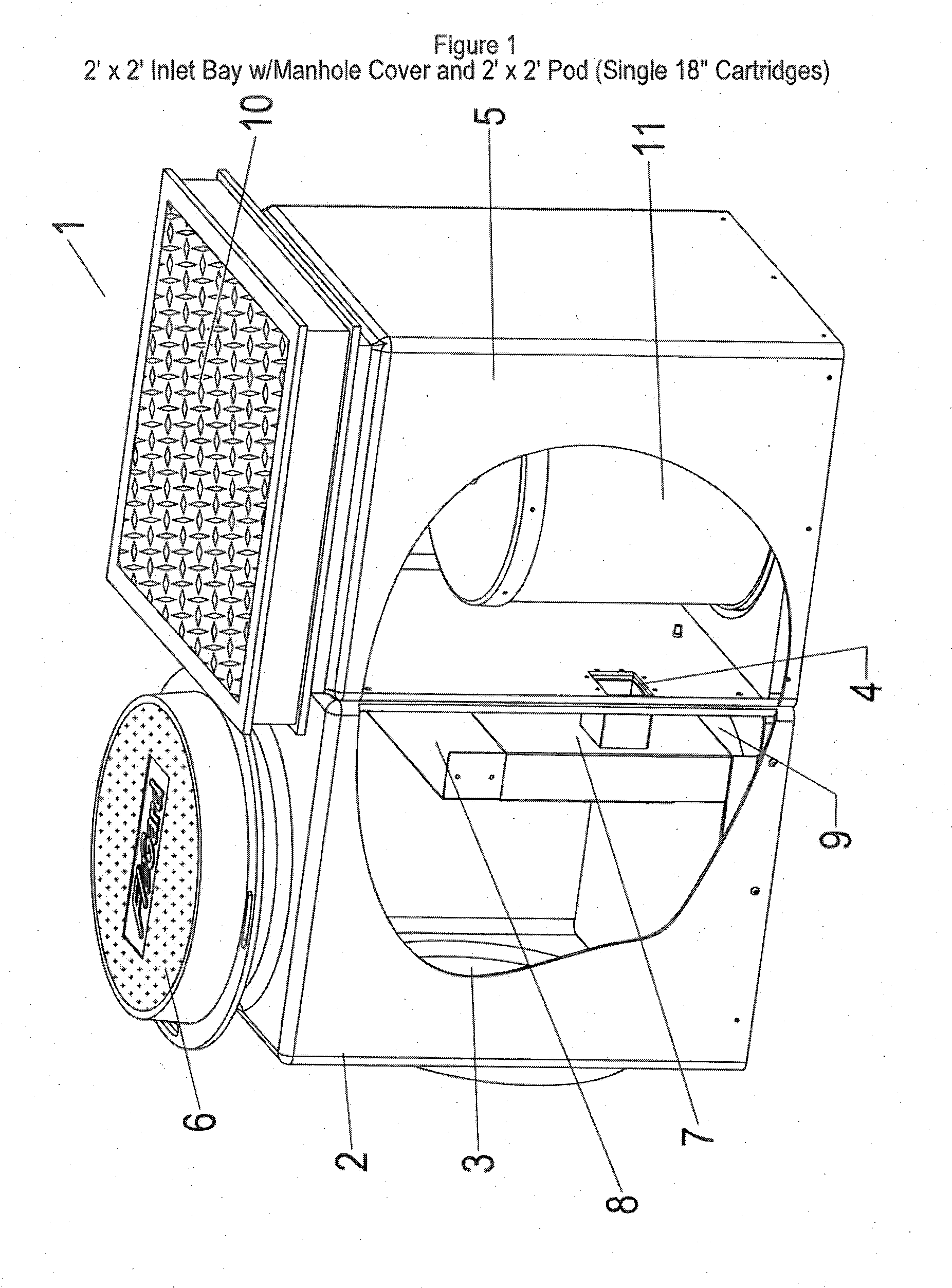
Figure 2 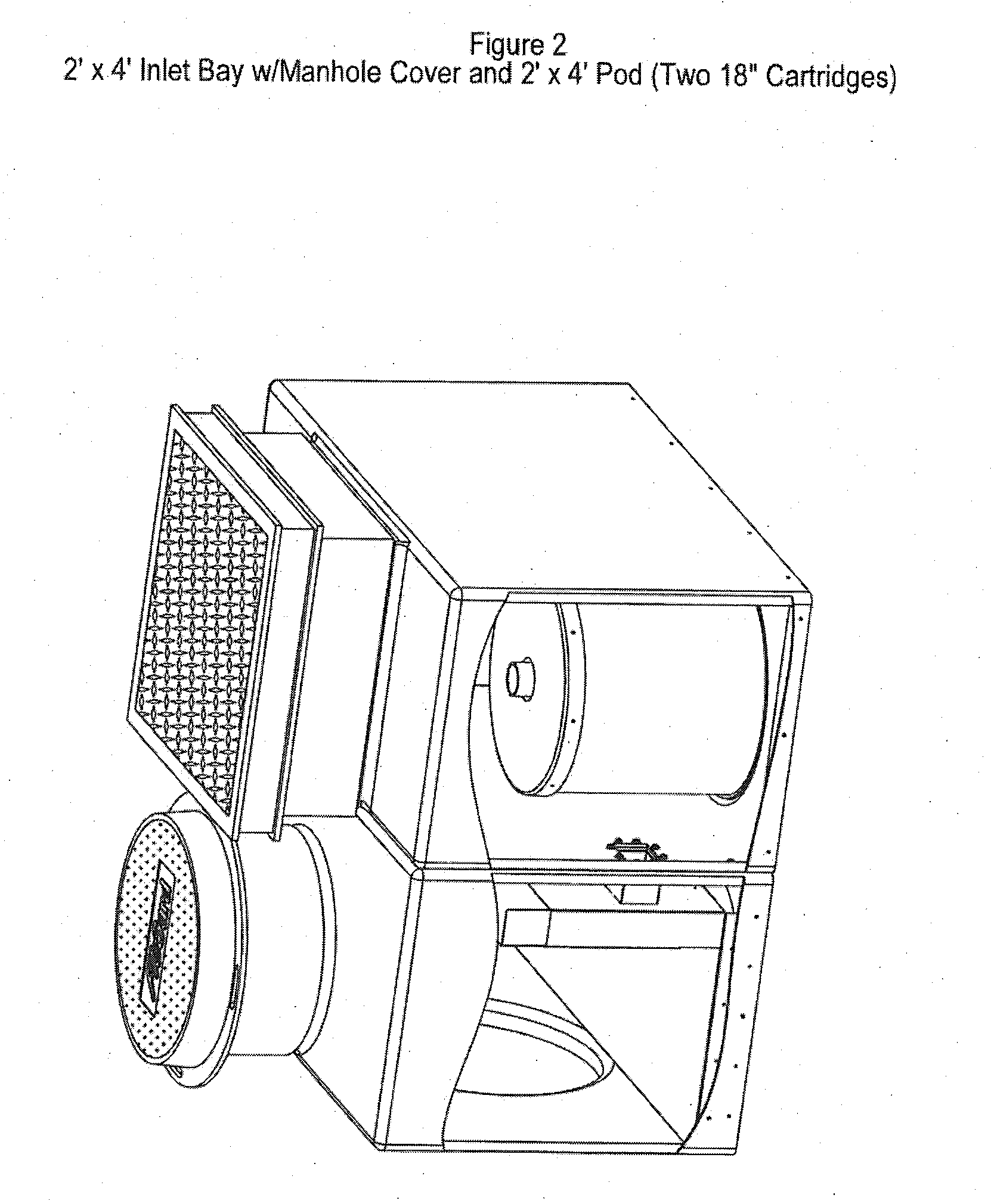
Figure 3
Abstract
Description
CROSS REFERENCE TO RELATED APPLICATIONS
[0001] This application claims priority to International Application No. PCT / US2010 / 030206 filed on Apr. 7, 2010, which claims priority to U.S. Provisional Application Ser. No. 61 / 167,746 filed on Apr. 8, 2009, the subject matter of which are herein incorporated by reference in their entirety.FIELD OF THE INVENTION
[0002] The invention relates to filtration systems that are used to pre-filter storm water entering underground water management detention or retention systems.BACKGROUND OF THE INVENTION
[0003] Nearly any new development of land must incorporate a system for managing water run-off from the developed land. Current regulatory schemes typically require developers to install underground water detention and / or retention systems that effectively maintain a flow of water into and off of the developed land that mimics the natural (i.e., pre-development) flow from the land.
[0004] Such systems typically are installed under large concrete or asphalt...
Examples
Embodiment Construction
[0040]As used herein, the terms “comprises,”“comprising,”“includes,”“including,”“has,”“having” or any other variation thereof, are intended to cover a non-exclusive inclusion. For example, a process, method, article, or apparatus that comprises a list of elements is not necessarily limited to only those elements but may include other elements not expressly listed or inherent to such process, method, article, or apparatus. Further, unless expressly stated to the contrary, “or” refers to an inclusive or and not to an exclusive or. For example, a condition A or B is satisfied by any one of the following: A is true (or present) and B is false (or not present), A is false (or not present) and B is true (or present), and both A and B are true (or present).
[0041]Also, use of the “a” or “an” are employed to describe elements and components of the invention. This is done merely for convenience and to give a general sense of the invention. This description should be read to include one or at ...