Method and system for lidar using spatial information from a light source in combination with nonspatial information influenced by the subject to derive an image
What is AI technical title?
AI technical title is built by Patsnap AI team. It summarizes the technical point description of the patent document.
a technology of spatial information and light source, applied in the field of methods and systems for lidar using spatial information, can solve the problems of obscuring media, unable to image through obscuring media (e.g., smoke or clouds), and unable to reach the theoretical limits of image resolution, etc., to achieve sufficient time resolution and repetition rate, accurate timing, and large ensemble of measurements
Inactive Publication Date: 2012-08-14
US SEC THE ARMY THE
View PDF25 Cites 41 Cited by
Summary
Abstract
Description
Claims
Application Information
AI Technical Summary
This helps you quickly interpret patents by identifying the three key elements:
Problems solved by technology
Method used
Benefits of technology
Benefits of technology
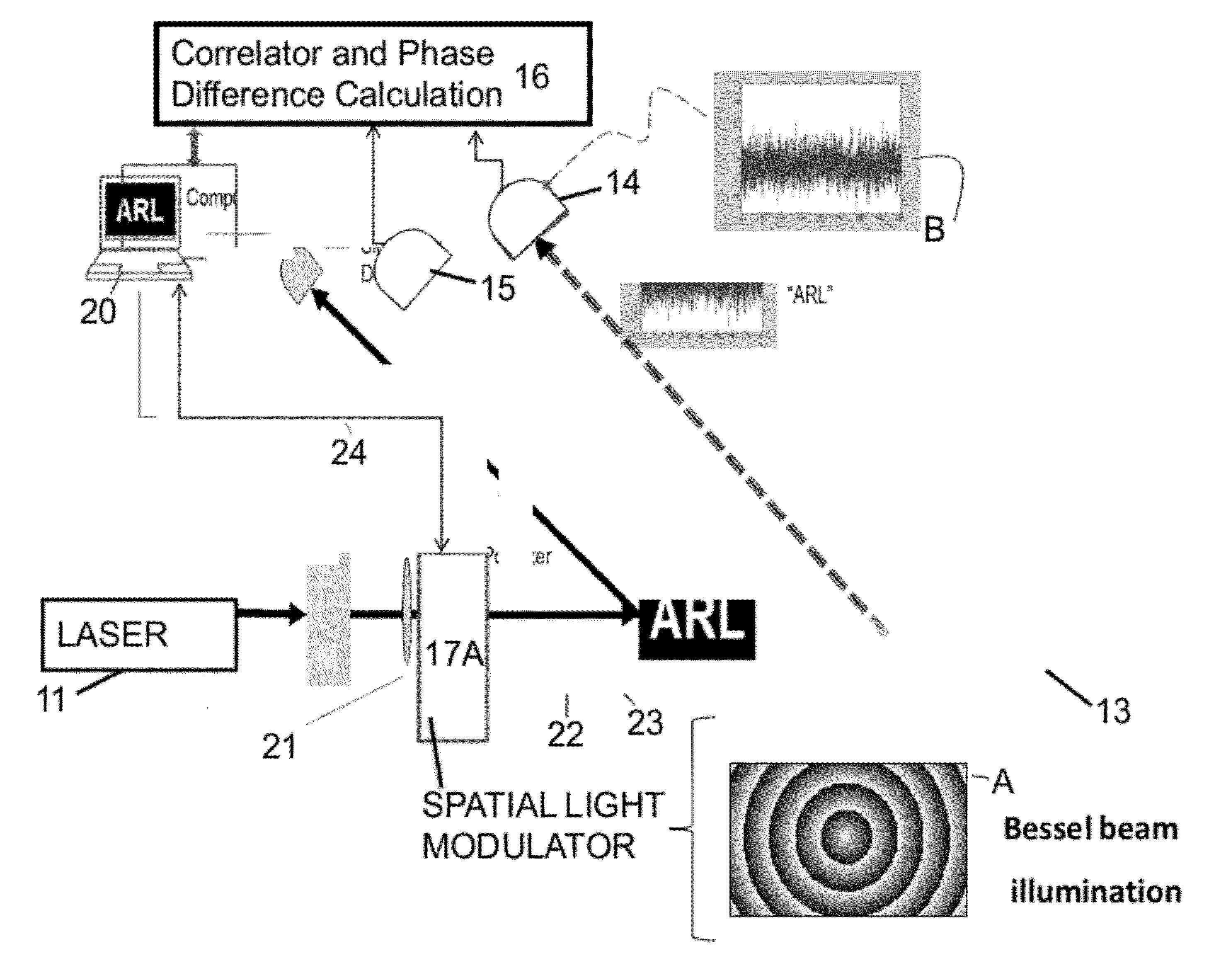
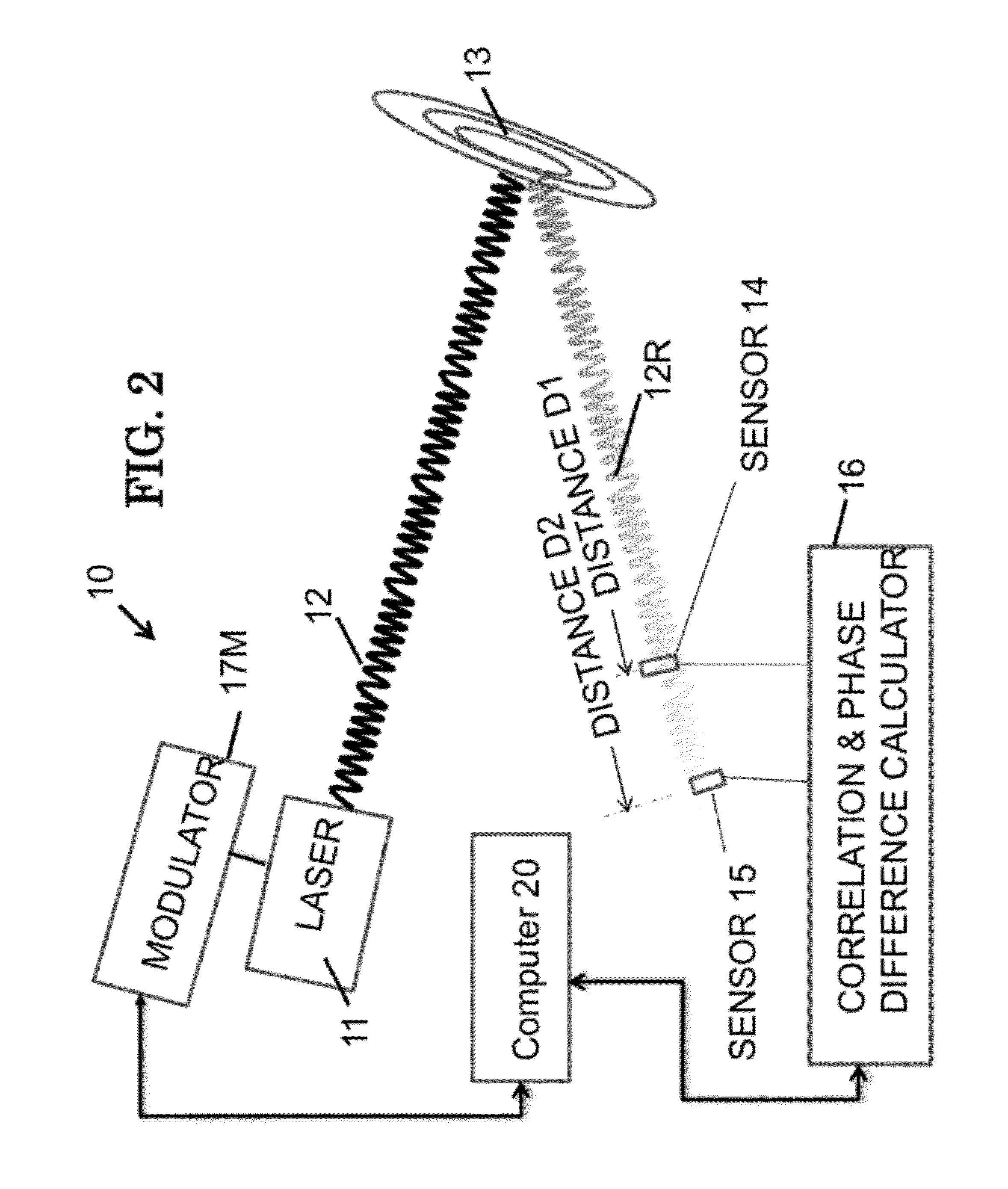
[0022]Attempts at solutions to image by penetration of obscurants have involved the use of different wavelengths and polarimetry. The present invention provides a solution in cases where prior techniques are ineffective or cannot be employed, or when they cannot produce three-dimensional information. A preferred embodiment provides a small package, three dimensional imaging method that is capable of penetrating obscuring media such as smog and fog. A preferred embodiment three-dimensional Ghost-imaging Ladar images objects in three dimensions through adverse imaging scenarios, overcoming scattering challenges, with reduced processing time using photon coincidence measurements.
[0026]A preferred embodiment of the present invention provides the ability to obtain correct structured illumination (using, for example, speckles) and obtain accurate timing with many repetitions so as to create a sufficiently large ensemble of measurements. Several types of sensors can be used that can measure optical information at sufficient speeds to resolve in the nanosecond or smaller time intervals. Various alternate techniques include use of single photon counting modules, high speed laser communication hardware, or windowed coincidence detectors and other fast detectors that ensure sufficient time resolution and repetition rate to acquire an ensemble in a short enough time to produce a successful 3-D Ghost Ladar image.
Problems solved by technology
Imaging through obscuring media is difficult; such as the difficulty of driving in foggy weather.
As discussed in the '401 Application, The ability to image through obscuring media (e.g., smoke or clouds) remains a problem in a variety of fields, such as satellite imaging analysts, firefighters, drivers, oceanographers, astronomers, military personnel, and medical personnel.
Conventional imaging techniques have, to a large extent, arrived at the theoretical limits of image resolution owing to wavelength-limited resolution, optical element distortions, and the reflective interaction between photons and an object to be imaged.
The ongoing lack of theoretical understanding of ghost imaging has hampered efforts to develop reflective ghost imaging systems for practical field uses in such fields as satellite, field, medical and research imaging.
Moreover, there exists a need for a system using ghost image where feedback or measurement is not possible at the target area.
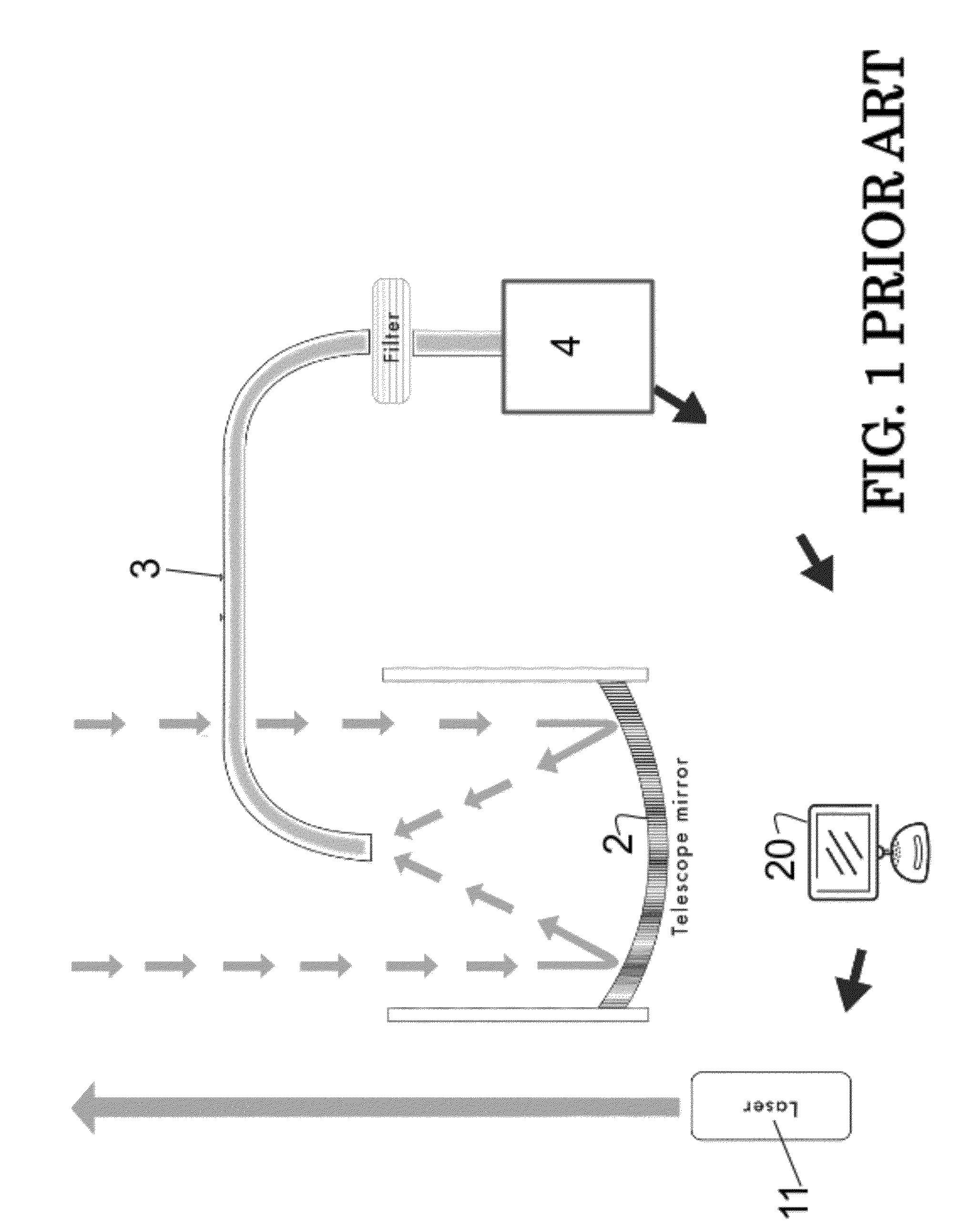
Lidar systems have had some limited success in penetrating some smoke, fog and clouds, but they have limitations when the scattering or absorption is too large.
Method used
the structure of the environmentally friendly knitted fabric provided by the present invention; figure 2 Flow chart of the yarn wrapping machine for environmentally friendly knitted fabrics and storage devices; image 3 Is the parameter map of the yarn covering machine
View more
Image
Smart Image Click on the blue labels to locate them in the text.
Viewing Examples
Smart Image
Click on the blue label to locate the original text in one second.
Reading with bidirectional positioning of images and text.
Smart Image
Examples
Experimental program
Comparison scheme
Effect test
Embodiment Construction
[0065]The present invention now will be described more fully hereinafter with reference to the accompanying drawings, in which embodiments of the invention are shown. However, this invention should not be construed as limited to the embodiments set forth herein. Rather, these embodiments are provided so that this disclosure will be thorough and complete, and will fully convey the scope of the invention to those skilled in the art. In the drawings, the dimensions of objects and regions may be exaggerated for clarity. Like numbers refer to like elements throughout. As used herein the term “and / or” includes any and all combinations of one or more of the associated listed items.
[0066]The terminology used herein is for the purpose of describing particular embodiments only and is not intended to limit the full scope of the invention. The terms lidar, Lidar, Ladar and ladar are equivalent for purposes used herein. As used herein, the singular forms “a”, “an” and “the” are intended to inclu...
the structure of the environmentally friendly knitted fabric provided by the present invention; figure 2 Flow chart of the yarn wrapping machine for environmentally friendly knitted fabrics and storage devices; image 3 Is the parameter map of the yarn covering machine
Login to View More
PUM
Login to View More
Abstract
A method and system for at least three dimensional imaging comprising a processor for processing information; at least one photon light source generating a beam of light; a modulator for modulating the light of the at least one photon light source; a plurality of first receivers operative to detect the influence of a subject on the beam; the plurality of first receivers being operatively connected to the processor and operating to transmit nonspatial information to the processor; the plurality of first receivers being spaced at known, different distances from the subject, whereby comparison of each of the outputs of the plurality of first receivers provides three dimensional information concerning the subject; the processor operating to correlate the outputs of the plurality of first receivers with spatial information derived from the modulated light at correlating intervals of time to create a three dimensional image of the subject.
Description
CROSS-REFERENCE TO RELATED APPLICATIONS[0001]This application claims priority of U.S. patent application Ser. No. 12 / 330,401, entitled “Method and System for Creating an Image Using Quantum Properties of Light Based Upon Spatial Information From a Second Light Beam Which Does not Illuminate the Subject,” filed Dec. 8, 2008, which claims priority to U.S. Provisional Patent Application Ser. No. 60 / 993,792 filed Dec. 6, 2007; which are both incorporated by reference herein. This application claims priority of U.S. patent application Ser. No. 12 / 343,384 filed Dec. 23, 2008, entitled “Method and System for Quantum Imaging Using Entangled Photons Pairs,” which claims priority of U.S. patent application Ser. No. 12 / 330,401, filed Dec. 8, 2008, which claims priority to U. S. Provisional Patent Application Ser. No. 60 / 993,792 filed Dec. 6, 2008, and U.S. patent application Ser. No. 10 / 900,351, filed on Jul. 28, 2004, which in turn claims priority to U.S. Provisional Application No. 60 / 493,10...
Claims
the structure of the environmentally friendly knitted fabric provided by the present invention; figure 2 Flow chart of the yarn wrapping machine for environmentally friendly knitted fabrics and storage devices; image 3 Is the parameter map of the yarn covering machine
Login to View More
Application Information
Patent Timeline
Application Date:The date an application was filed.
Publication Date:The date a patent or application was officially published.
First Publication Date:The earliest publication date of a patent with the same application number.
Issue Date:Publication date of the patent grant document.
PCT Entry Date:The Entry date of PCT National Phase.
Estimated Expiry Date:The statutory expiry date of a patent right according to the Patent Law, and it is the longest term of protection that the patent right can achieve without the termination of the patent right due to other reasons(Term extension factor has been taken into account ).
Invalid Date:Actual expiry date is based on effective date or publication date of legal transaction data of invalid patent.


 Login to View More
  Login to View More