Adaptive time diversity and spatial diversity for OFDM
What is AI technical title?
AI technical title is built by Patsnap AI team. It summarizes the technical point description of the patent document.
a time diversity and spatial diversity technology, applied in the field of time diversity and spatial diversity, can solve the problems of strong signal fading, inability to parallel transmit data packets, and increase data rate capacity, so as to reduce adverse signal fading, increase data rate, and ensure gain. the effect of time diversity
Inactive Publication Date: 2012-12-25
APPLE INC
View PDF24 Cites 1 Cited by
Summary
Abstract
Description
Claims
Application Information
AI Technical Summary
This helps you quickly interpret patents by identifying the three key elements:
Problems solved by technology
Method used
Benefits of technology
Benefits of technology
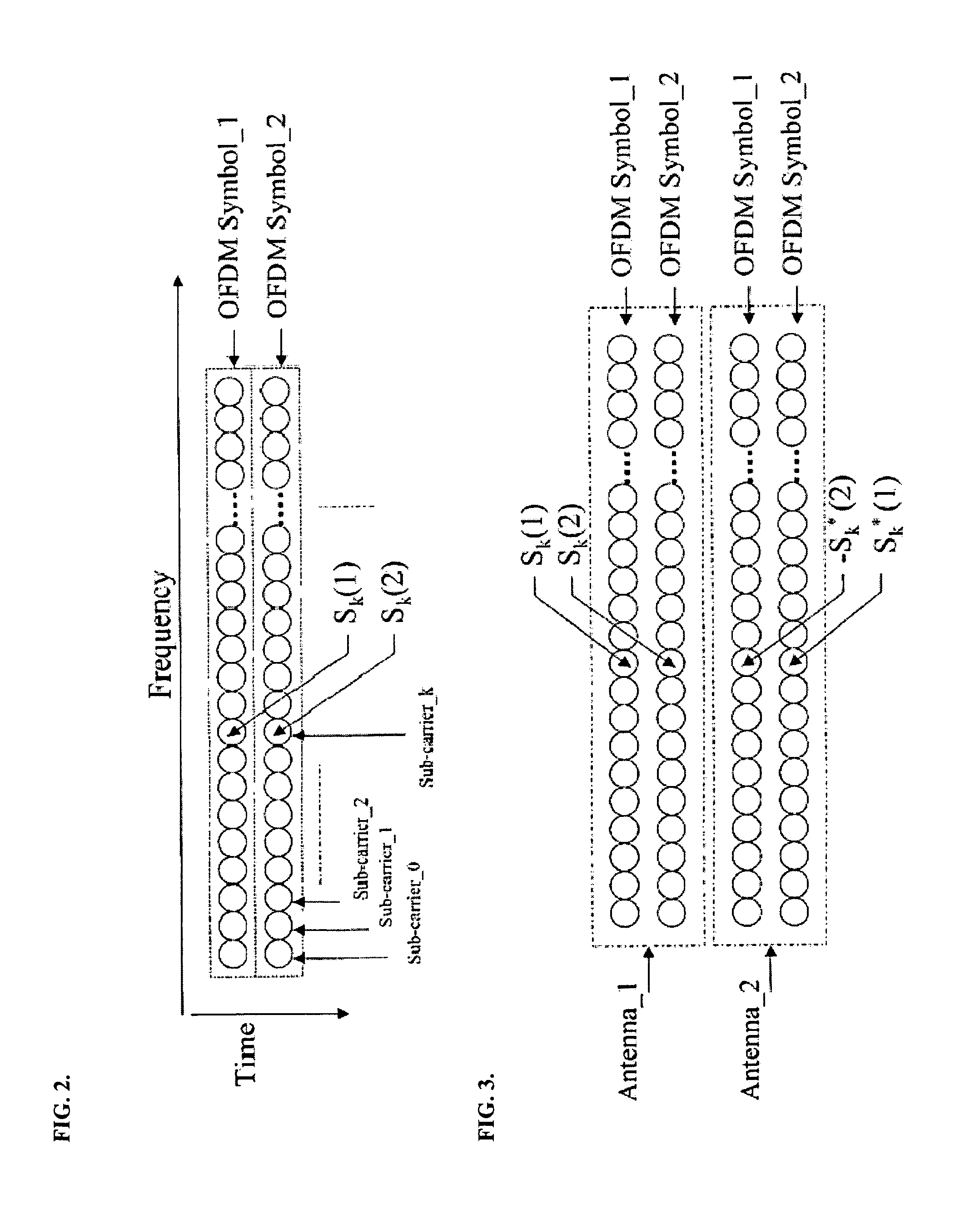
[0023]Time diversity is used to reduce adverse signal fading. Spatial diversity is used to increase the data rate, which time diversity cannot do. When sub-carriers use time diversity, it means that signal fading is strong so that parallel transmission of data packets can not be done to overcome the insufficient gain problem. Instead, time diversity is used to get the necessary gain for the OFDM system, even though the data rate capacity suffers. An SNR gain is assured with time diversity, because of the orthogonality matrix pattern inherent among transmitted samples in the OFDM system. On the other hand, when sub-carriers use spatial diversity, signal fading is weak so that parallel transmissions may occur to increase the data rate capacity. Thus, there is no need to increase the gain of the OFDM system, which means that the data rate may be increased.
Problems solved by technology
When sub-carriers use time diversity, it means that signal fading is strong so that parallel transmission of data packets can not be done to overcome the insufficient gain problem.
On the other hand, when sub-carriers use spatial diversity, signal fading is weak so that parallel transmissions may occur to increase the data rate capacity.
Method used
the structure of the environmentally friendly knitted fabric provided by the present invention; figure 2 Flow chart of the yarn wrapping machine for environmentally friendly knitted fabrics and storage devices; image 3 Is the parameter map of the yarn covering machine
View more
Image
Smart Image Click on the blue labels to locate them in the text.
Viewing Examples
Smart Image
Click on the blue label to locate the original text in one second.
Reading with bidirectional positioning of images and text.
Smart Image
Examples
Experimental program
Comparison scheme
Effect test
Embodiment Construction
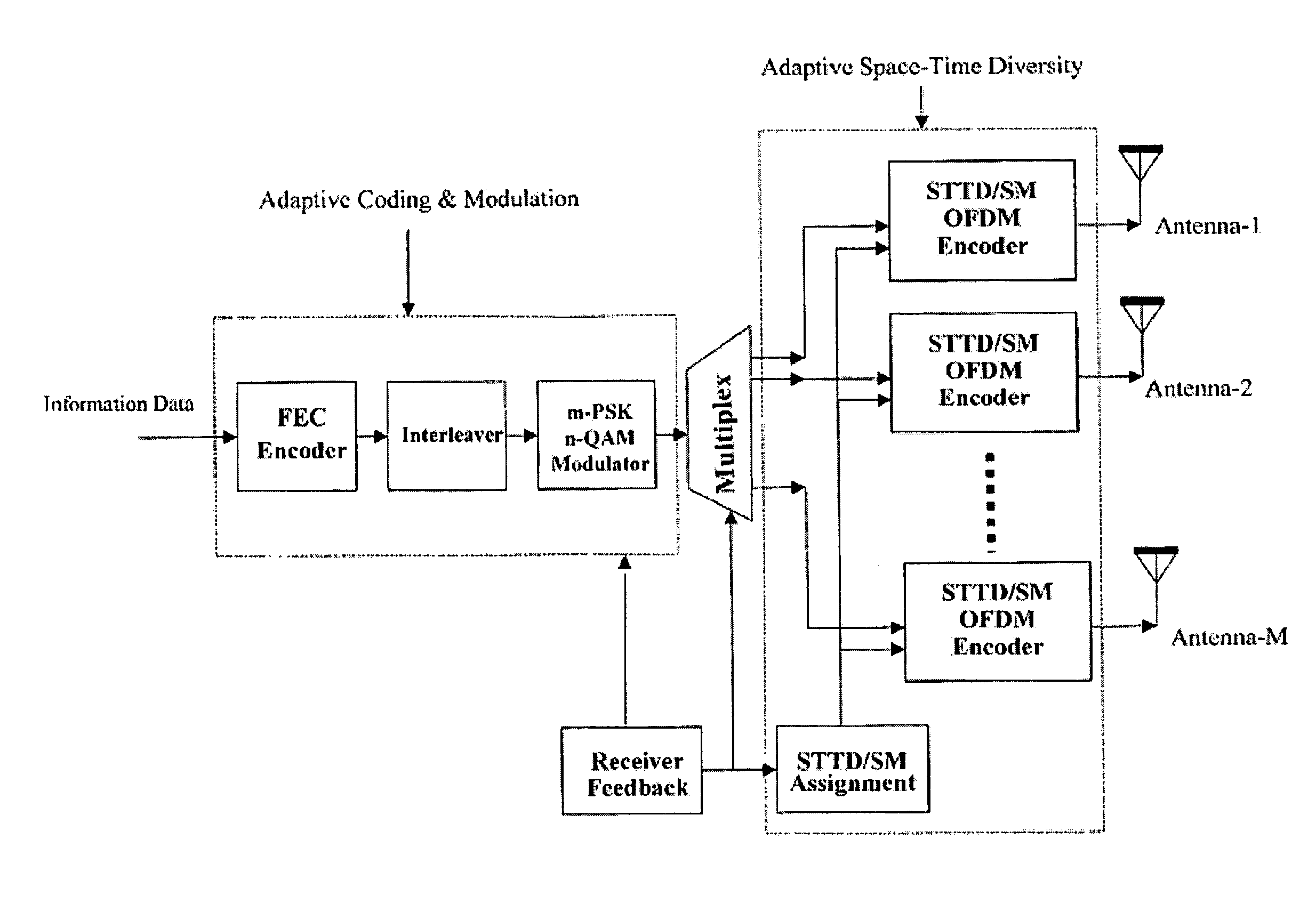
[0034]The invention concerns a practical time and spatial diversity combination that fits into an OFDM system. The OFDM system of the invention can automatically adapt the channel variation and make trade off between time diversity and spatial diversity. In an exemplary environment, the data rate can be increased 1.8 times for 2×2 configuration (2 transmitters, 2 receivers), which gives 80 Mbps, and 2.7 times for 3×3 configuration) 3 transmitters, 3 receivers) which gives 121 Mbps within 6 MHz, while keep the robustness of the system.
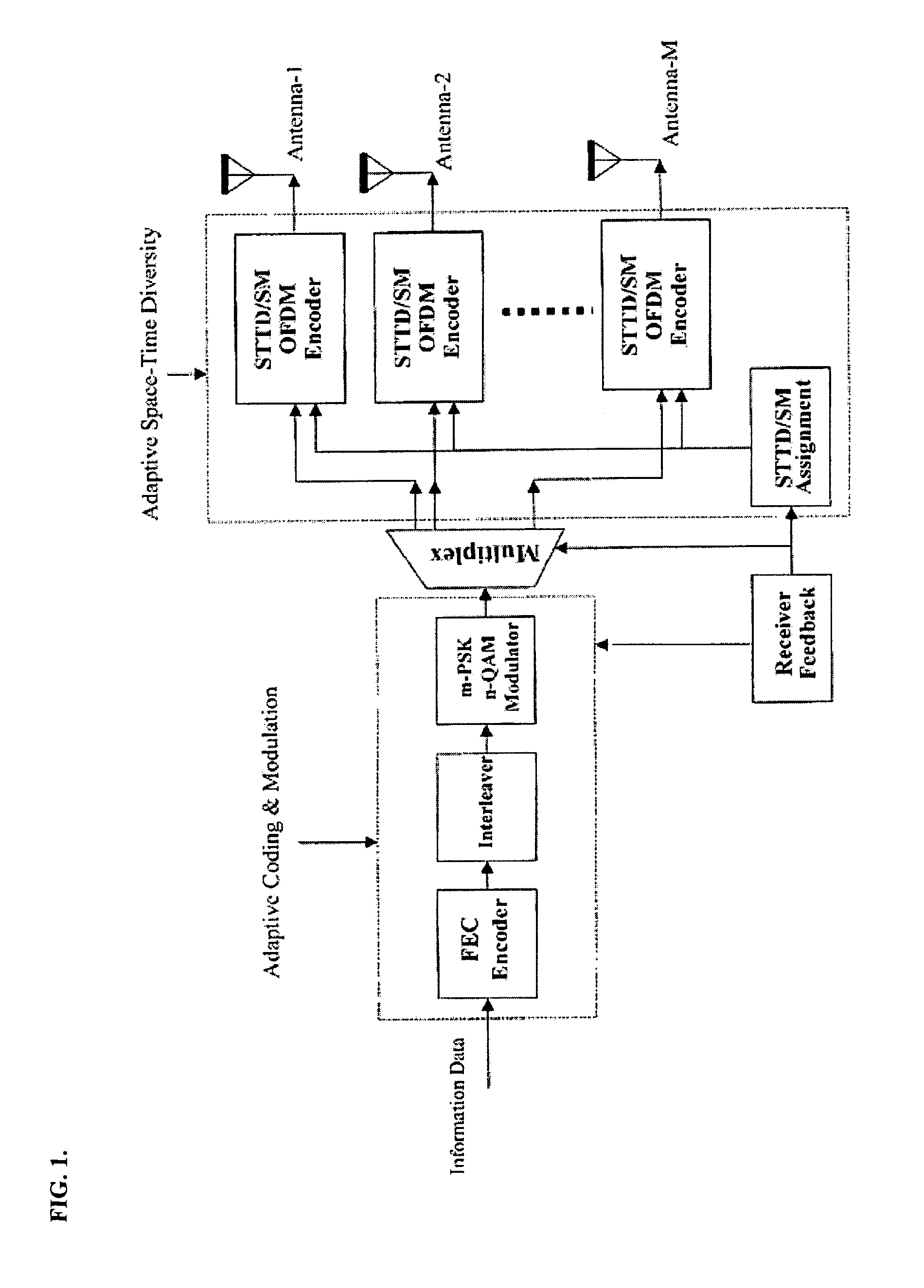
[0035]Turning to the drawing, FIG. 1 shows a generic MEM and OFDM transmitter system. In the figure, STTD and SM are the abbreviations of Space-Time-Transmitter Diversity and Spatial Multiplexing. The MIMO OFDM is configured as two level adaptations as shown in FIG. 1, namely, space / time diversity adaptation and coding / modulation adaptation. The space / time diversity adaptation is determined by the carrier to interference power ratio or signal to noise p...
the structure of the environmentally friendly knitted fabric provided by the present invention; figure 2 Flow chart of the yarn wrapping machine for environmentally friendly knitted fabrics and storage devices; image 3 Is the parameter map of the yarn covering machine
Login to View More
PUM
Login to View More
Abstract
An adaptable orthogonal frequency-division multiplexing system (OFDM) that uses a multiple input multiple output (MIMO) to having OFDM signals transmitted either in accordance with time diversity to reducing signal fading or in accordance with spatial diversity to increase the data rate. Sub-carriers are classified for spatial diversity transmission or for time diversity transmission based on the result of a comparison between threshold values and at least one of three criteria. The criteria includes a calculation of a smallest eigen value of a frequency channel response matrix and a smallest element of a diagonal of the matrix and a ratio of the largest and smallest eigen values of the matrix.
Description
CROSS-REFERENCE TO COPENDING PATENT APPLICATIONS[0001]The present application is a continuation of and claims priority to U.S. patent application Ser. No. 12 / 806,481, filed Aug. 13, 2010 now U.S. Pat. No. 8,077,599, which is a continuation application and claims priority to U.S. patent application Ser. No. 11 / 582,663, filed Oct. 17, 2006, now U.S. Pat. No. 7,801,019, which is a continuation application of U.S. patent application Ser. No. 11 / 315,056, filed Dec. 22, 2005, now U.S. Pat. No. 7,336,601, issued Feb. 26, 2008, which is a continuation application of U.S. patent application Ser. No. 09 / 750,804 to Shiquan Wu et al., filed Dec. 29, 2000, now U.S. Pat. No. 6,985,434, issued Jan. 10, 2006. U.S. patent application Ser. No. 09 / 750,804 claims priority to U.S. Provisional Pat. Application No. 60 / 229,972, filed Sep. 1, 2000. The contents of the aforementioned applications are incorporated in their entirety herein by reference.[0002]Reference is made to U.S. Pat. No. 6,850,481, issued...
Claims
the structure of the environmentally friendly knitted fabric provided by the present invention; figure 2 Flow chart of the yarn wrapping machine for environmentally friendly knitted fabrics and storage devices; image 3 Is the parameter map of the yarn covering machine
Login to View More
Application Information
Patent Timeline
Application Date:The date an application was filed.
Publication Date:The date a patent or application was officially published.
First Publication Date:The earliest publication date of a patent with the same application number.
Issue Date:Publication date of the patent grant document.
PCT Entry Date:The Entry date of PCT National Phase.
Estimated Expiry Date:The statutory expiry date of a patent right according to the Patent Law, and it is the longest term of protection that the patent right can achieve without the termination of the patent right due to other reasons(Term extension factor has been taken into account ).
Invalid Date:Actual expiry date is based on effective date or publication date of legal transaction data of invalid patent.


 Login to View More
  Login to View More