
Preparation method of graphene/titanium dioxide composite photocatalyst
A technology of titanium dioxide and composite light is applied in the field of photocatalysis to achieve the effects of excellent photocatalytic activity, avoiding agglomeration and low cost
Patent Information
- Authority / Receiving Office
- CN · China
- Patent Type
- Patents(China)
- Current Assignee / Owner
- Publication Date
- 2012-06-13
- Estimated Expiration
- Not applicable · inactive patent
Smart Images
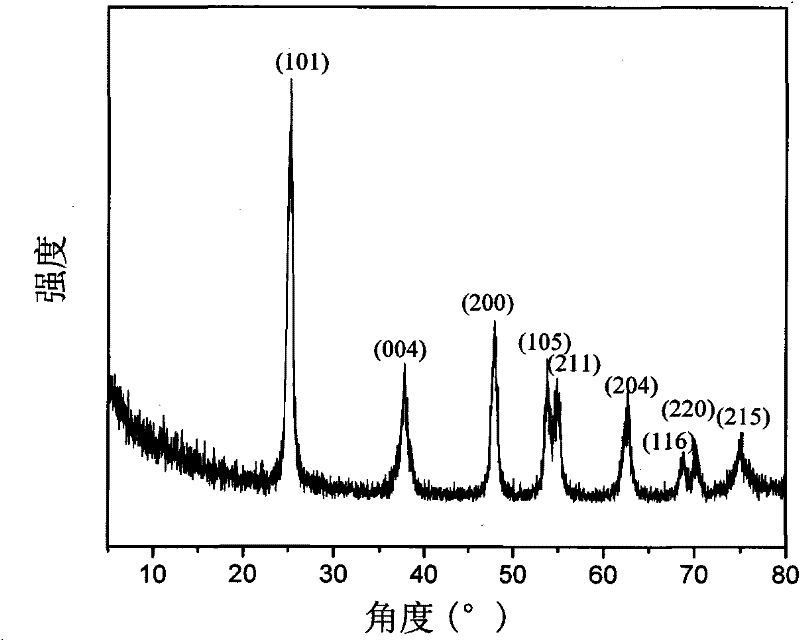
Figure 1 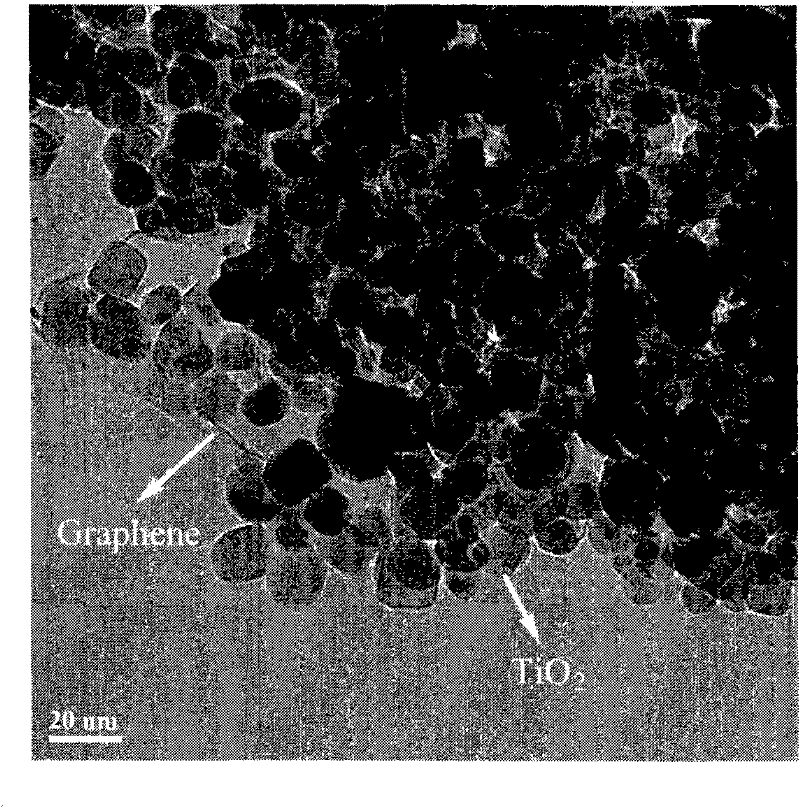
Figure 2 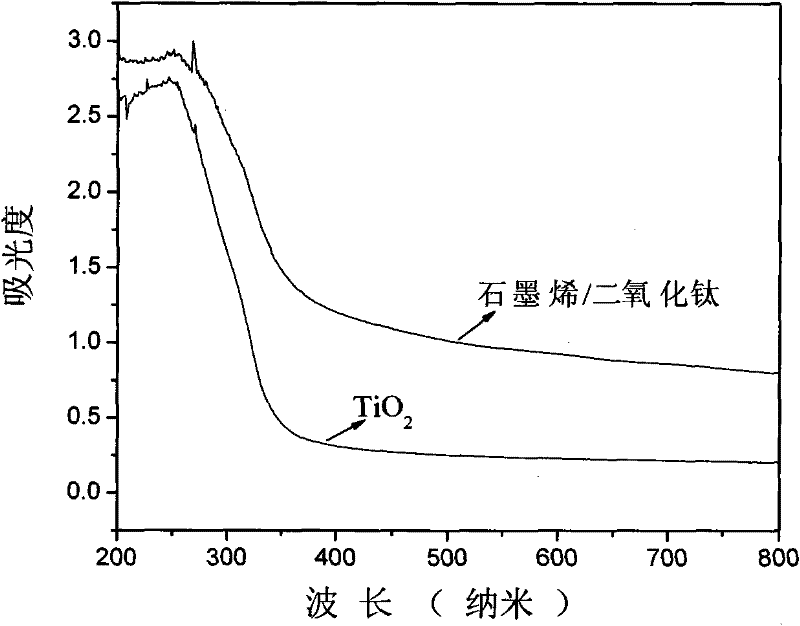
Figure 3
Abstract
Description
technical field
[0001] The invention relates to a method for preparing a photocatalyst, in particular to a method for preparing a graphene / titanium dioxide composite photocatalyst by a hydrothermal method, and belongs to the technical field of photocatalysis. Background technique
[0002] Since 1972 Fijishima et al. in TiO 2 Since the phenomenon of water splitting was found on the electrode surface, TiO 2 As a photocatalyst, it has been widely studied by scientists from all over the world. Under UV light, electrons from TiO 2 The valence band is excited to the conduction band, and positively charged holes are generated on the valence band, so that TiO 2 Has photocatalytic activity. However, the recombination rate of electron-hole pairs generated by photoexcitation is very fast, and the recombination time is about 10 -9 Second. while TiO 2 The time required for the chemical reaction with the organic pollutants adsorbed on its surface is about 10 -8 -10 -3 Second. Th...
Examples
Embodiment 1
[0019] Add 30 mg of graphite oxide to 30 mL of isopropanol, and sonicate for 1 hour to obtain a graphene oxide dispersion. Then 5 mL of n-butyl titanate was added and stirred for 30 minutes, followed by the addition of 1 mL of deionized water and continued stirring for 30 minutes to obtain a beige gel. The gel was transferred to a hydrothermal reactor and reacted at 180°C for 8 hours. The hydrothermal product was washed several times by centrifugation with ethanol and deionized water respectively, placed in a vacuum oven, and dried at 60° C. for 12 hours to obtain a graphene / titanium dioxide composite photocatalyst.
[0020] figure 1 The XRD figure of the graphene / titanium dioxide composite material that is made in this embodiment. All the diffraction peaks in the figure correspond to TiO 2 In the anatase phase, the characteristic diffraction peak of graphite oxide at 2θ=10.7° disappeared, indicating that the hydrothermal reaction effectively reduced graphite oxide to graph...
Embodiment 2
[0022] Add 10 mg of graphite oxide to 30 mL of isopropanol, and sonicate for 40 minutes to obtain a graphene oxide dispersion. Then 5 mL of n-butyl titanate was added and stirred for 30 minutes, followed by the addition of 1 mL of deionized water and continued stirring for 20 minutes to obtain a beige gel. The gel was transferred to a hydrothermal reactor and reacted at 140°C for 12 hours. The hydrothermal product was washed several times by centrifugation with ethanol and deionized water respectively, placed in a vacuum oven, and dried at 50° C. for 18 hours to obtain a graphene / titanium dioxide composite photocatalyst.
Embodiment 3
[0024] Add 50 mg of graphite oxide to 30 mL of ethanol, and ultrasonicate for 1 hour to obtain a graphene oxide dispersion. Then 5 mL of n-butyl titanate was added and stirred for 30 minutes, followed by the addition of 1 mL of deionized water and continued stirring for 30 minutes to obtain a beige gel. The gel was transferred to a hydrothermal reactor and reacted at 200°C for 6 hours. The hydrothermal product was washed several times by centrifugation with ethanol and deionized water respectively, placed in a vacuum oven, and dried at 70° C. for 10 hours to obtain a graphene / titanium dioxide composite photocatalyst.