
Kit capable of quickly detecting amplification of incising incision enzyme nucleic acid of salmonella at constant temperature
An endonuclease nucleic acid and Salmonella technology, which is applied in the determination/inspection of microorganisms, resistance to vector-borne diseases, DNA/RNA fragments, etc., can solve the problems of increased difficulty in biochemical identification methods, achieve strong specificity and ensure specificity Effect
Patent Information
- Authority / Receiving Office
- CN · China
- Patent Type
- Patents(China)
- Current Assignee / Owner
- Publication Date
- 2012-12-26
- Estimated Expiration
- Not applicable · inactive patent
Smart Images
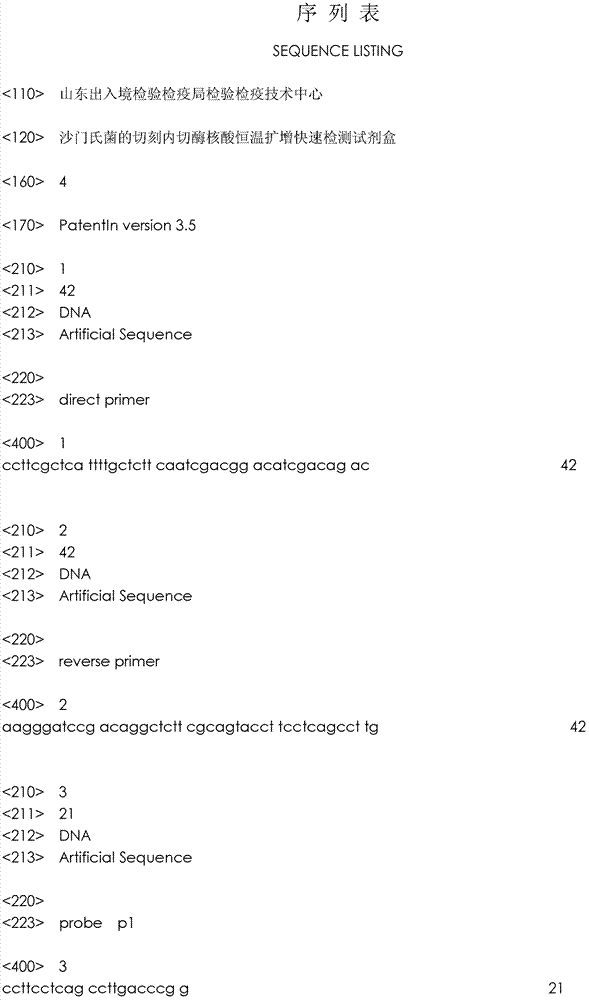
Figure 1 
Figure 2
Abstract
Description
technical field
[0001] The invention belongs to the technical field of detection of pathogenic microorganisms, and in particular relates to a prescription kit for rapid detection of bacterial samples using a nicking endonuclease constant temperature amplification (NEMA) technology and an application thereof. Background technique
[0002] Salmonella (Salmonella spp) belongs to the enterobacteriaceae, including bacteria that can cause food poisoning, gastroenteritis, typhoid and paratyphoid, and is a class of zoonotic foodborne Gram-negative pathogenic bacteria. In addition to infecting humans, Salmonella can also infect many animals, including mammals, birds, reptiles, fish, amphibians and insects. Humans and animals can be asymptomatic carriers after infection, and can also show clinical symptoms. Salmonella may also increase morbidity or mortality, or reduce the reproductive productivity of animals. According to reports, among various bacterial food poisoning incidents in...
Examples
Embodiment 1
[0043] Embodiment 1: to the detection of Salmonella standard bacterial strain
[0044] Prepare Salmonella nicking endonuclease nucleic acid constant temperature amplification kit according to the following formula:
[0045] 1) Template pretreatment reaction solution:
[0046] Each 23μL contains 2.5μL 10×Taq Platinum buffer II, 1.0μL 2.5mmol / L dNTP, 1.0μL 10μmol / L forward primer, 1.0μL 10μmol / L reverse primer, 1.0μL 2.5U / μL Taq Platinum DNA Polymerase and 16.5μL wxya 2 O (sterilized double distilled water).
[0047] The forward primer SEQ ID NO: 1 described therein:
[0048] 5-CCTTCGCTCATTTTT GCTCTTC AATCGACGGACATCGACAGAC-3;
[0049] Reverse primer: SEQ ID NO: 2:
[0050] 5-AAGGGATCCGACAG GCTCTTC GCAGTACCTTCCTCAGCCTTG-3;
[0051] The underlined part in the forward primer and the reverse primer is the nicking endonuclease recognition site;
[0052] 2) NEMA constant temperature amplification reaction solution:
[0053] Each 46 μL contains 5 μL 10×NEBuffer 3, 1.0 μL 2.5 mm...
Embodiment 2
[0076] Example 2: Detection of Escherichia coli ATCC 25922
[0077] Prepare Salmonella nicking endonuclease nucleic acid constant temperature amplification kit according to the following formula:
[0078] 1) Template pretreatment reaction solution:
[0079] Each 23μL contains 2.5μL 10×Taq Plainum buffer II, 1.0μL 2.5mmol / L Dntp, 1.0μL 10μmol / L forward primer, 1.0μL 10μmol / L reverse primer, 1.0μL 2.5U / μL Taq Platinum DNA Polymerase and 16.5 μL ddH 2 O (sterilized double distilled water).
[0080] The forward primer SEQ ID NO: 1 described therein:
[0081] 5-CCTTCGCTCATTTTT GCTCTTC AATCGACGGACATCGACAGAC-3;
[0082] Reverse primer: SEQ ID NO: 2:
[0083] 5-AAGGGATCCGACAG GCTCTTC GCAGTACCTTCCTCAGCCTTG-3;
[0084] The underlined part in the forward primer and the reverse primer is the nicking endonuclease recognition site;
[0085] 2) NEMA constant temperature amplification reaction solution:
[0086] Each 46 μL contains 5 μL 10×NEBuffer 3, 1.0 μL 2.5 mmol / L dNTP, 1.0 μL ...
Embodiment 3
[0109] Example 3: Detection of food samples suspected of being infected with Salmonella
[0110] The food sample was subjected to DNA extraction and amplification detection according to the method described in Example 1, and the product was detected with a universal nucleic acid amplification rapid detection plate. Results The quality control area C showed a red band, and the detection area T also had a red band, indicating that the sample to be tested was infected by Salmonella.
[0111] The primers, probes and kits of the present invention can also detect Salmonella in other samples.
[0112]
[0113]