
Siliceous N-substituted alkyloxy hindered amine compound and its preparation method
A technology for alkoxy hindered amines and compounds, which is applied in the field of silicon-containing N-substituted alkoxy hindered amine compounds and their synthesis, can solve problems such as complex synthesis process, achieve simple operation, overcome easy migration, easy volatility and Extraction works well
Patent Information
- Authority / Receiving Office
- CN · China
- Patent Type
- Applications(China)
- Current Assignee / Owner
- Publication Date
- 2012-10-17
Smart Images
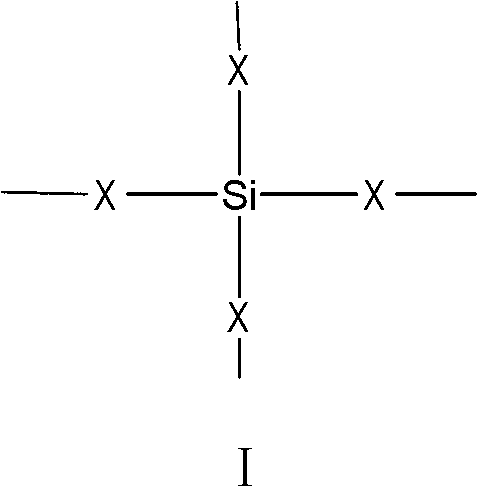
Figure 1 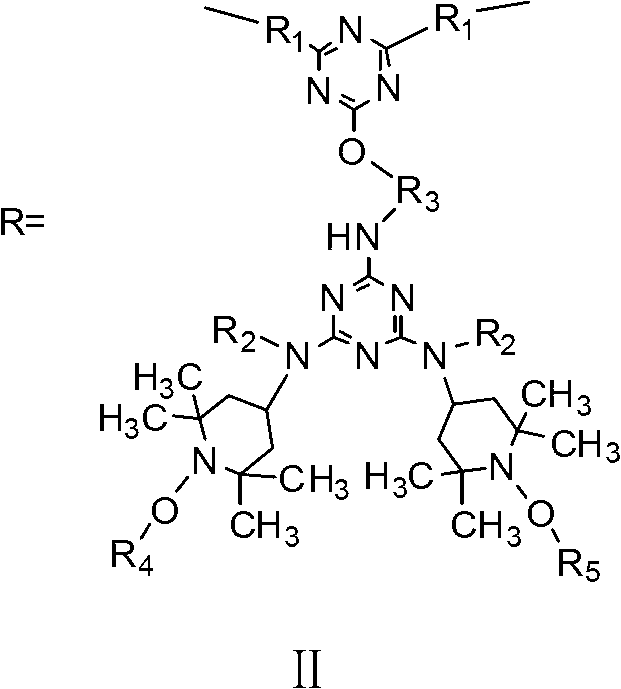
Figure 2 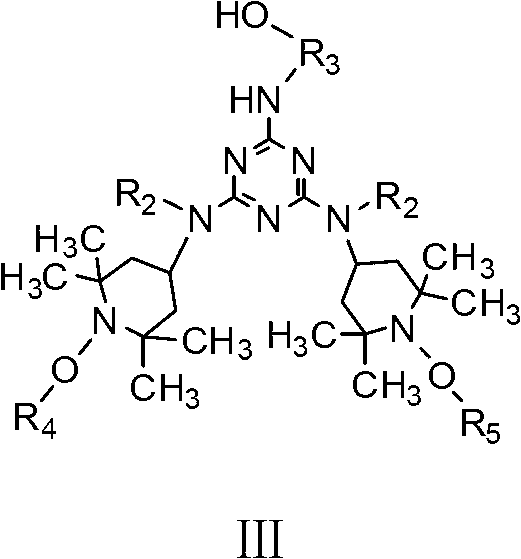
Figure 3
Abstract
Description
technical field
[0001] The invention relates to a hindered amine flame retardant synergist and a synthesis method thereof, in particular to a silicon-containing N-substituted alkoxy hindered amine compound and a synthesis method thereof. Background technique
[0002] In recent years, hindered amines, which have long been used as light stabilizers, have found that N-substituted alkoxy hindered amines have excellent flame retardant properties in the process of performance improvement. N-substituted alkoxy hindered amine, as one of the improved varieties of hindered amine, has the characteristics of low reactivity, and its general chemical structure is:
[0003]
[0004] Wherein, A is an auxiliary group connecting piperidinyl, and B is a substituted alkyl group.
[0005] The flame retardant effect of N-substituted alkoxy hindered amines in polyolefins is mainly due to the high-efficiency recyclable free radical scavenger produced by combustion decomposition to interfere and...
Examples
Embodiment 1
[0034]Add 7.376g (0.04mol) of cyanuric chloride dissolved in 80ml of acetone into a 500m1 reaction kettle equipped with a thermometer and a magnet (magnetic stirrer). The temperature of the reaction system was kept at -10°C. 7.572g (0.01mol) of the first compound (wherein, R 2 for alkyl-C 2 h 5 , R 3 for alkyl-C 2 h 4 -, R 4 is alkyl-CH 4 , R 5 Cycloalkyl-C 3 h 6 ) and 8.70ml of acid-binding agent N,N-isopropylethane (0.05mol) were dissolved in 30ml of acetone, and were added dropwise into the reaction kettle with a micro-injector to control the rate of addition, and the reaction temperature was controlled at -10 At ℃, a substitution reaction of the chlorine atom on the triazine ring on the cyanuric chloride is carried out. After the dropwise addition, the reaction was continued at -10° C. for 5 h at a low temperature, and the pH of the reaction solution was 6.0 at this time. Finally, pour the solution in the reaction kettle into a 250ml three-necked flask and move...
Embodiment 2
[0056] Add 3.688g (0.02mol) of cyanuric chloride dissolved in 80ml of methyl ethyl ketone into a 500m1 reaction kettle equipped with a thermometer and a magnet (magnetic stirrer), control the temperature in a low-temperature thermostat and fully stir to make the reactants evenly dispersed And keep the temperature of the reaction system at 10°C. 7.572g (0.01mol) of the first compound (wherein, R 2 for alkyl-C 2 h 5 , R 3 for alkyl-C 2 h 4 -, R 4 is alkyl-CH 4 , R 5 Cycloalkyl-C 3 h 6 ) and 15ml of acid-binding agent NaOH aqueous solution (2.0mol / L) were dissolved in 30ml of methyl ethyl ketone, and were added drop by drop to the reaction kettle at the same time with a micro-injector to control the rate of addition, and the reaction temperature was controlled at 10°C. A substitution reaction of the chlorine atom on the triazine ring on the polycyanogen chloride. After the dropwise addition, the reaction was continued at a low temperature of 10° C. for 2 h, and the pH ...
Embodiment 3
[0068] Add 1.844g (0.01mol) of cyanuric chloride dissolved in 80ml of acetone into a 500m1 reaction kettle equipped with a thermometer and a magnet (magnetic stirrer). The temperature of the reaction system was kept at 5°C. 7.572g (0.01mol) of the first compound (wherein, R 2 for alkyl-C 2 h 5 , R 3 for alkyl-C 2 h 4 -, R 4 is alkyl-CH 4 , R 5 Cycloalkyl-C 3 h 6 ) and 0.870ml of acid-binding agent N,N-isopropylethane (0.005mol) were dissolved in 30ml of acetone, and were added dropwise into the reaction kettle with a micro-injector to control the rate of addition, and the reaction temperature was controlled at 5°C Next, carry out a substitution reaction of the chlorine atom on the triazine ring on the cyanuric chloride. After the dropwise addition, the reaction was continued at 5° C. for 3 h at a low temperature, and the pH of the reaction solution was 6.5 at this time. Finally, pour the solution in the reaction kettle into a 250ml three-necked flask and move it to...