
Preparation method of 4'-chloro-2-nitrobiphenyl
A technology of nitrobiphenyl and nitrohalobenzene is applied in the preparation of organic compounds, chemical instruments and methods, organic chemistry, etc., and can solve the problems of inflammability and explosion, low aromatization yield, complicated process steps, etc. problem, to achieve the effect of low production cost and short process steps
Patent Information
- Authority / Receiving Office
- CN · China
- Patent Type
- Applications(China)
- Current Assignee / Owner
- Publication Date
- 2015-11-04
Smart Images
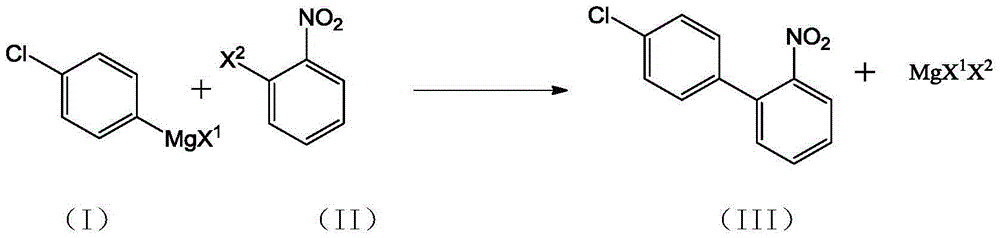
Figure 1 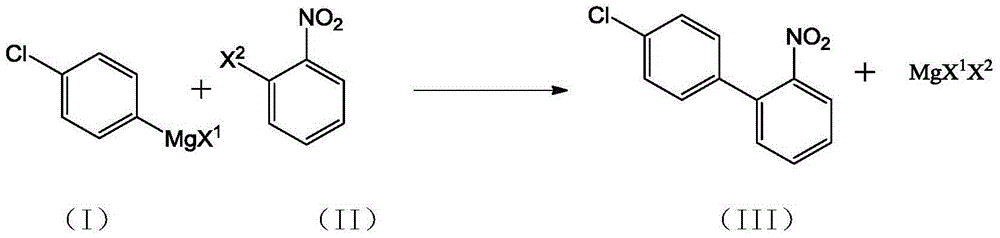
Figure 2
Abstract
Description
technical field
[0001] The present invention relates to a kind of preparation method of 4'-chloro-2-nitrobiphenyl. Background technique
[0002] 4'-chloro-2-nitrobiphenyl is an important intermediate of the pesticide boscalid, and its preparation method has the following reports in the prior art:
[0003] Chinese patent CN97192942.4 discloses a method for preparing 4'-chloro-2-nitrobiphenyl: taking p-chlorophenylboronic acid or its alkyl ester, acid anhydride and o-chloronitrobenzene as raw materials, in the presence of a palladium catalyst Suzuki coupling reaction occurs under the action of 4'-chloro-2-nitrobiphenyl. Chinese patent CN200680006706.2 improves the above method by using bis(4-chlorophenyl)boronic acid instead of p-chlorophenylboronic acid for coupling reaction, which reduces the expensive alkylboronic acid used in the preparation of p-chlorophenylboronic acid The consumption of ester and improved reactivity to reduce the consumption of palladium catalyst. Th...
Examples
Embodiment 1
[0025] Dissolve 10.0g of 2-nitrochlorobenzene in 180mL of tetrahydrofuran, add 3.4g of 1,2-bis(diphenylphosphine)ethane nickel chloride, cool down to -45°C, and keep the system temperature at -40°C~-45°C Slowly add 98.7g of 11% tetrahydrofuran solution of p-chlorophenylmagnesium chloride in about 2 hours, keep it warm for 6 hours after dropping, remove the cold source, slowly rise to room temperature, add 30mL of toluene and 30mL of 20% hydrochloric acid, stir, and static layer Finally, the organic layer was evaporated to dryness to obtain a crude oil product, which was recrystallized using isopropanol to obtain 11.4 g of a yellow solid. After testing, the obtained yellow solid was 4'-chloro-2-nitrobiphenyl with a purity of 96.3%. The reaction yield is 74%.
Embodiment 2
[0027] Dissolve 10.0g of 2-nitroiodobenzene in 150mL of tetrahydrofuran, add 2.3g of 1,2-bis(diphenylphosphine)ethane nickel chloride, cool down to -78°C, and keep the system temperature at -78°C~-70°C Slowly add 45.7g of 15% tetrahydrofuran solution of p-chlorophenylmagnesium chloride in about 4 hours, keep it warm for 12 hours after dropping, remove the cold source, slowly rise to room temperature, add 30mL of toluene and 30mL of 20% hydrochloric acid, stir and statically separate Finally, the organic layer was evaporated to dryness to obtain a crude oil product, which was recrystallized using isopropanol to obtain 6.36 g of a yellow solid. After testing, the obtained yellow solid was 4'-chloro-2-nitrobiphenyl with a purity of 97.0%. The reaction yield is 66%.
Embodiment 3
[0029] Dissolve 10.0 g of 2-nitrochlorobenzene in 200 mL of tetrahydrofuran, add 6.8 g of 1,2-bis(diphenylphosphine)ethane nickel chloride, cool down to -50°C, and keep the system temperature at -45°C~-50°C Slowly add 108.5g of 10% tetrahydrofuran solution of p-chlorophenylmagnesium chloride in about 3 hours, keep it warm for 4 hours after dropping, remove the cold source, slowly rise to room temperature, add 30mL of toluene and 30mL of 20% hydrochloric acid, stir and statically separate Finally, the organic layer was evaporated to dryness to obtain a crude oil product, which was recrystallized using isopropanol to obtain 11.9 g of a light yellow solid. After testing, the obtained yellow solid was 4'-chloro-2-nitrobiphenyl with a purity of 97.5%. The reaction yield is 78%.