
A high water-reducing and high-early-strength polycarboxylate water-reducing agent and its non-pyrogenic preparation method
A polycarboxylate-based, high-early-strength technology, applied in the field of concrete admixtures, can solve the problems of unstable quality, complex production process of water reducing agent, high energy consumption in production, etc., to improve the quality of construction projects and solve the problem of setting time Long-term, the effect of improving production efficiency
Patent Information
- Authority / Receiving Office
- CN · China
- Patent Type
- Patents(China)
- Current Assignee / Owner
- Publication Date
- 2017-05-10
Smart Images
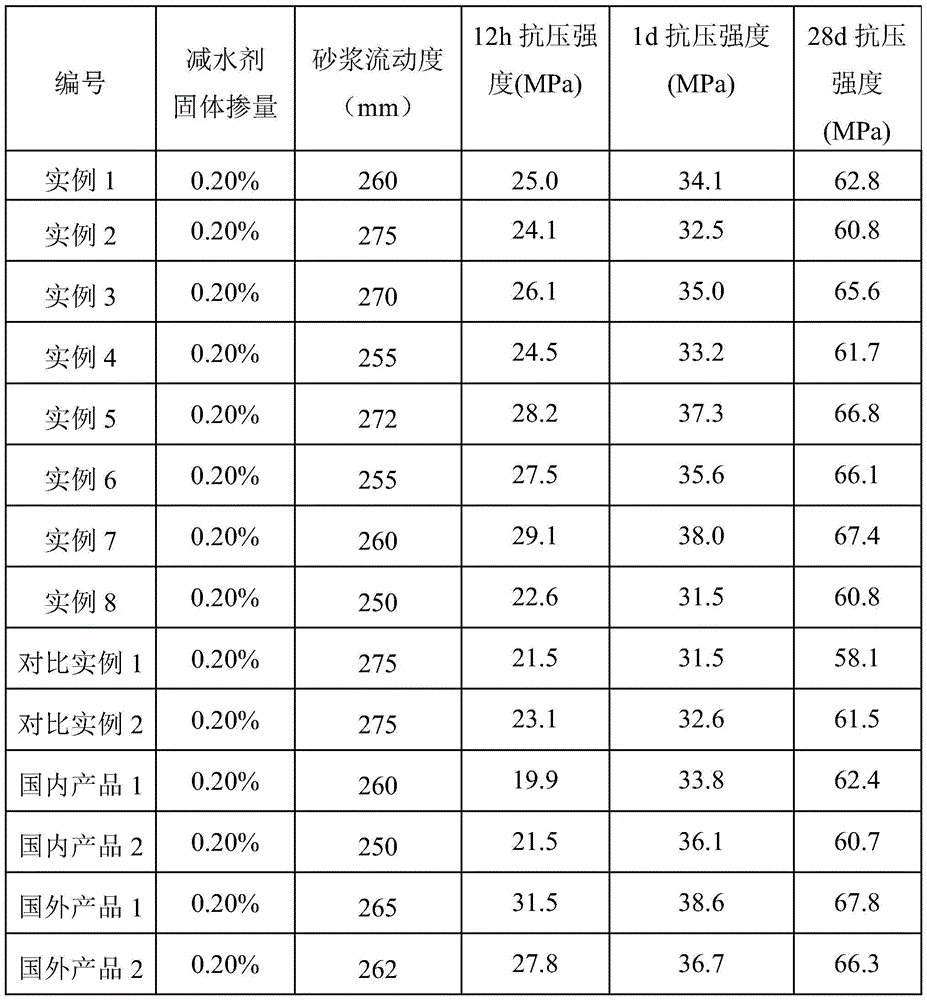
Figure 1 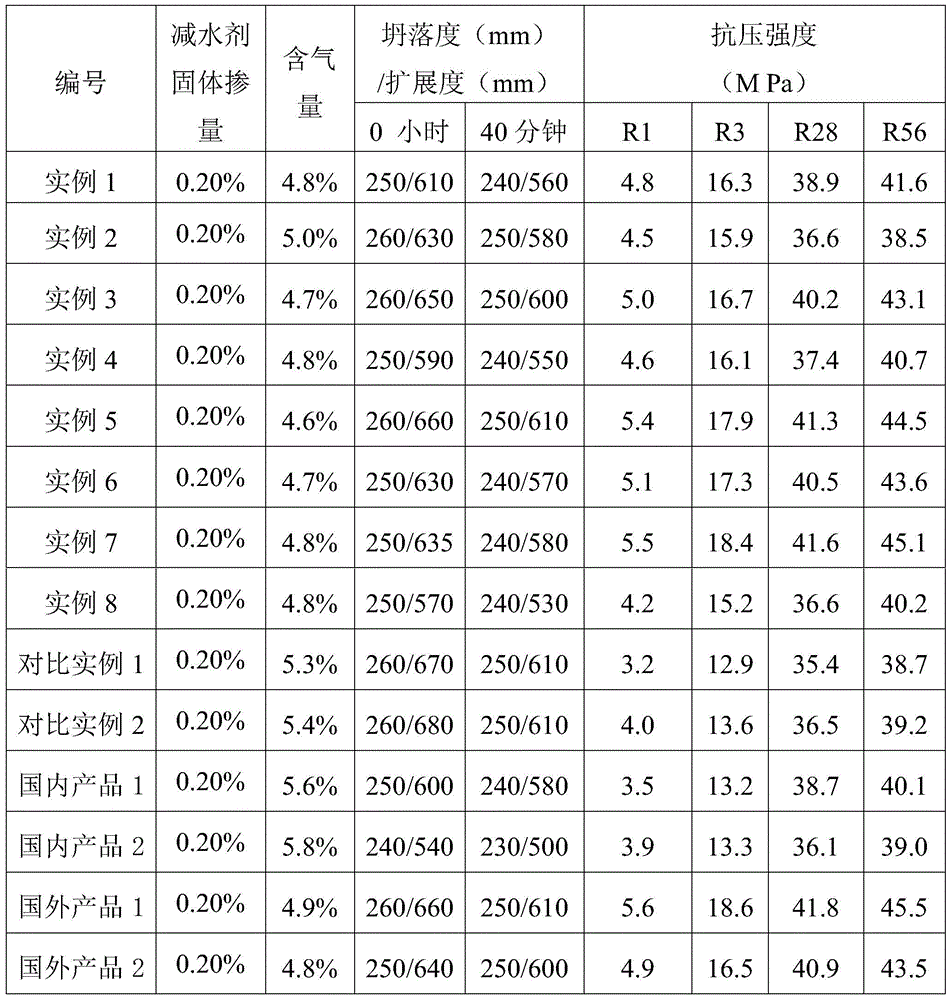
Figure 2
Abstract
Description
technical field
[0001] The invention relates to the technical field of admixtures for concrete in building materials, in particular to a high-water-reducing, high-early-strength polycarboxylate water-reducer and a heat-free preparation method thereof. Background technique
[0002] Concrete is the most widely used artificial building material in the world today. Concrete admixture is a substance that is added to improve the performance of concrete before or during the mixing process of concrete. It can effectively improve the performance of concrete and become an indispensable material in concrete.
[0003] Modern concrete admixtures originated in the early 1930s, and experienced the first generation of ordinary water reducers represented by wood calcium, the second generation of high-efficiency water reducers represented by naphthalene and melamine systems, and the development of polycarboxylic acid systems. The third-generation high-performance water reducer has three stag...
Examples
Embodiment 1
[0047] Prepare high water-reducing and high-slump retention type polycarboxylate high-performance water-reducing agent according to the following raw material quantity and process, specifically:
[0048] (1) Preparation of early-strength polycarboxylate superplasticizer mother liquor T-1
[0049] ①Material preparation: Add 0.20g of L-ascorbic acid into 13g of deionized water, mix evenly, and use tank A for spare, which is material A; 12.0g of acrylic acid, 5.0g of acrylamide, 2.16g of sodium methacrylate, add into 40g of deionized water , mixed evenly, and the B tank is reserved, which is the b material;
[0050] ②Polymerization: Add 289.5g of deionized water and 210g of unsaturated polyoxyethylene ether (MW=4000) into a glass reactor equipped with a thermometer and an electric stirrer, stir and dissolve fully, then add H 2 o 2 1.45g, stir evenly, keep the temperature at 15°C, add material a and material b dropwise at the same time, control the polymerization temperature at ...
Embodiment 2
[0054] Prepare high water-reducing and high-slump retention type polycarboxylate high-performance water-reducing agent according to the following raw material quantity and process, specifically:
[0055] (1) Preparation of early-strength polycarboxylate superplasticizer mother liquor T-2
[0056] ①Material preparation: Add 0.35g of L-ascorbic acid into 13g of deionized water, mix evenly, reserve tank A as material A; add 16.0g of acrylic acid, 6.0g of acrylamide, and 0.45g of 3-mercaptopropionic acid into 40g of deionized water, Mix evenly, and reserve the B tank, which is the b material;
[0057] ②Polymerization: Add 187.3g of deionized water and 140g of unsaturated polyoxyethylene ether (MW=4000) into a glass reactor equipped with a thermometer and an electric stirrer, stir and dissolve fully, then add H 2 o 2 0.57g, stir evenly, keep the temperature at 18°C, add material a and material b dropwise at the same time, control the polymerization temperature at 15-40°C, add mat...
Embodiment 3
[0061] Prepare high water-reducing and high-slump retention type polycarboxylate high-performance water-reducing agent according to the following raw material quantity and process, specifically:
[0062] (1) Preparation of early-strength polycarboxylate superplasticizer mother liquor T-3
[0063] ①Material preparation: Add 0.21g of L-ascorbic acid into 13g of deionized water, mix evenly, reserve tank A as material A; add 12.0g of acrylic acid, 5.0g of acrylamide, 2.28g of sodium methacrylate into 40g of deionized water, Mix evenly, and reserve the B tank, which is the b material;
[0064] ②Polymerization: Add 228.7g of deionized water and 170g of unsaturated polyoxyethylene ether (MW=3800) into a glass reactor equipped with a thermometer and an electric stirrer, stir and dissolve fully, then add H 2 o 2 0.57g, stir evenly, keep the temperature at 27°C, add material a and material b dropwise at the same time, control the polymerization temperature at 15-40°C, add material a d...