

Preparation method of a three-dimensional aminated carbon nanotube array/stretchable textile fiber electrode material
A technology of three-dimensional aminated carbon and nanotube arrays, which is applied in the field of electrochemical materials, can solve the problems of constructing a blank of three-dimensional flexible conductive materials, and achieves the effects of good conductivity, improved lifting force, and increased adsorption capacity.
Patent Information
- Authority / Receiving Office
- CN · China
- Patent Type
- Patents(China)
- Current Assignee / Owner
- Publication Date
- 2018-02-23
Smart Images
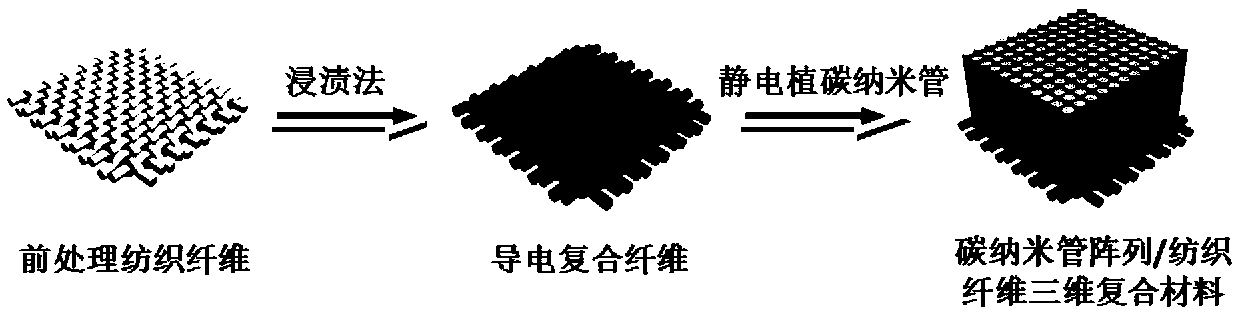
Figure 1 
Figure 2 
Figure 3
Abstract
Description
technical field
[0001] The invention belongs to the field of electrochemical materials, in particular to a preparation method of a three-dimensional aminated carbon nanotube array / stretchable textile fiber electrode material. Background technique
[0002] As an emerging energy storage device, supercapacitor has the characteristics of high power density, short charging time, high cycle performance and energy saving, and has received extensive attention in the field of thin, flexible and wearable power supplies. Although supercapacitors have certain flexibility, they basically do not have stretchability, that is, they cannot achieve large deformations similar to textiles under small stresses, which greatly limits their use in wearable medical monitoring, communication equipment or other small electronic products. Applications. Therefore, it is an important task to realize large-scale and low-cost fabrication of flexible capacitors with high energy density.
[0003] Electrode...
Examples
Embodiment 1
[0046] After the pretreatment, the high-content cationic modified polyester / spandex blended knitted jersey was immersed in the composite preparation solution containing sodium dodecylbenzenesulfonate (10g / L) and aminated carbon nanotubes (1.6g / L). Immersed at room temperature for 5 minutes, dried at 120°C, and repeated 5 times to obtain a conductive stretchable fiber substrate. Place the aminated carbon nanotubes in the electrodeposition treatment solution (mass fraction: potassium aluminum sulfate 6%, sodium silicate 3%, dispersant NNO 15%, penetrant JFC 4%), heat up to 60 ° C, bath ratio 50 : 1, the time is 60min, vacuum filtration and drying. The prepared conductive stretchable fiber substrate is evenly coated with graphene conductive adhesive, and the aminated carbon nanotubes that have been electro-treated are electrostatically implanted on the surface of the substrate on one side, the voltage is 50KV, and the distance between the plates is 120mm. for 5s. After implanta...
Embodiment 2
[0050] After the pretreatment, the high-content cationic modified polyester / spandex blended knitted jersey was immersed in the composite preparation solution containing sodium dodecylbenzenesulfonate (15g / L) and aminated carbon nanotubes (1.6g / L). Immersed at room temperature for 5 minutes, dried at 120°C, and repeated 5 times to obtain a conductive stretchable fiber substrate. Place the aminated carbon nanotubes in the electrodeposition treatment solution (mass fraction: potassium aluminum sulfate 8%, sodium silicate 4%, dispersant NNO 20%, penetrant JFC 4%), heat up to 60 ° C, bath ratio 50 : 1, the time is 60min, vacuum filtration and drying. The prepared conductive stretchable fiber substrate is uniformly coated with graphene conductive glue, and the aminated carbon nanotubes that have been electro-treated are implanted on the surface of the substrate electrostatically on one side, the voltage is 50KV, and the distance between the plates is 140mm. for 5s. After implantat...
Embodiment 3
[0054] After the pretreatment, the high-content cationic modified polyester / spandex blended knitted jersey was immersed in the composite preparation solution containing sodium dodecylbenzenesulfonate (15g / L) and aminated carbon nanotubes (1.6g / L). Immersed at room temperature for 5 minutes, dried at 120°C, and repeated 8 times to obtain a conductive stretchable fiber substrate. Place the aminated carbon nanotubes in the electrodeposition treatment solution (mass fraction: aluminum potassium sulfate 8%, sodium silicate 5%, dispersant NNO 15%, penetrant JFC 6%), heat up to 60 ° C, bath ratio 50 : 1, the time is 60min, vacuum filtration and drying. The prepared conductive stretchable fiber substrate is evenly coated with graphene conductive adhesive, and the aminated carbon nanotubes that have been electro-treated are electrostatically implanted on the surface of the substrate on one side, the voltage is 50KV, and the distance between the plates is 120mm. for 5s. After implanta...