
Synthesizing method using serine to prepare Ramipril key intermediate
A synthesis method and a technology for intermediates, which are applied in the field of synthesis of pharmaceutical and chemical intermediates, can solve the problems of low yield, unfavorable industrial production, large amount of concentrated sulfuric acid, expensive raw materials, etc., and achieve low-cost raw materials, avoid heavy metal pollution, and reduce three wastes. Effect
Patent Information
- Authority / Receiving Office
- CN · China
- Current Assignee / Owner
- Publication Date
- 2016-07-20
- Estimated Expiration
- Not applicable · inactive patent
Smart Images
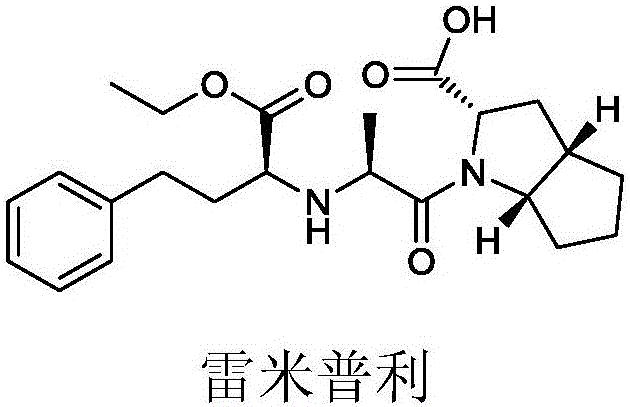
Figure 1 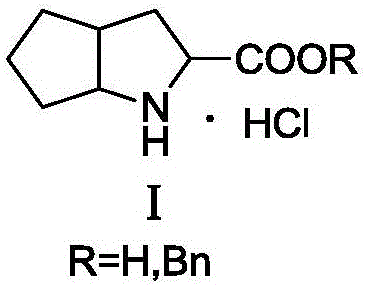
Figure 2 
Figure 3
Abstract
Description
technical field
[0001] The invention relates to the field of synthesis of pharmaceutical and chemical intermediates, especially the preparation of ramipril key intermediate 2-azabicyclo[3.3.0]octane-3-carboxylate hydrochloride or benzyl ester hydrochloride by using serine as raw material synthetic method. Background technique
[0002] Ramipril (Ramipril) is a long-acting, potent angiotensin-converting enzyme inhibitor (ACEI), which is one of the global products of Aventis and developed by its predecessor Hoechst (EP0079022). It is the drug of choice for the treatment of mild and essential hypertension and malignant congestive heart failure. This product has the characteristics of quick onset, long duration, high tissue specificity, good tolerance, and low toxicity and side effects. Chemical name: (S)-2-[N-(1-ethoxycarbonyl-3-phenyl-propyl)alanyl]-2-azabicyclo[3.3.0]octane-3-carboxylate Acid, CAS number: 87333-19-5, the structure is as follows:
[0003]
[0004] In thi...
Examples
Embodiment 1
[0046] The preparation of embodiment 1, DL-serine methyl ester hydrochloride (Ⅲ)
[0047] Add 30mL of methanol into a 100mL three-necked flask, and slowly add 5.4mL of thionyl chloride dropwise under the condition of mechanical stirring in an ice-water bath. , heated to reflux for reaction, and after a reaction time of 20 h, the solvent was distilled off under reduced pressure, and 8.28 g of DL-serine methyl ester hydrochloride (Ⅲ) was obtained after drying, with a yield of 93.7%.
Embodiment 2
[0048] The preparation of embodiment 2, DL-serine methyl ester hydrochloride (Ⅲ)
[0049] Add 30mL of methanol into a 100mL three-necked flask, and slowly add 6.6mL of thionyl chloride dropwise under the condition of mechanical stirring in an ice-water bath. After the dropwise addition, continue to stir for 1h, and put 6.00g (57mmol) of DL-serine (II) into the three-necked flask , heated to reflux for reaction, and after a reaction time of 18 hours, the solvent was distilled off under reduced pressure and dried to obtain 8.32 g of DL-serine methyl ester hydrochloride (Ⅲ), with a yield of 94.2%.
Embodiment 3
[0050] The preparation of embodiment 3, L-serine methyl ester hydrochloride (Ⅲ)
[0051] Add 30mL of methanol into a 100mL three-necked flask, and slowly add 5.4mL of thionyl chloride dropwise under the condition of mechanical stirring in an ice-water bath. , heated to reflux for reaction, and after a reaction time of 10 h, the solvent was distilled off under reduced pressure to obtain 8.46 g of L-serine methyl ester hydrochloride (Ⅲ), with a yield of 95.8%.