

A kind of smut haploid strain uet2 and its application
A UET2, haploid technology, applied in the fields of application, fungi, plant cultivation, etc., can solve the problem of no haploid strains, etc., and achieve the effect of improving environmental adaptability and controlling mating time
Patent Information
- Authority / Receiving Office
- CN · China
- Patent Type
- Patents(China)
- Current Assignee / Owner
- Publication Date
- 2019-04-02
Smart Images
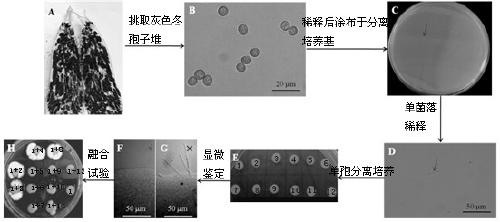
Figure 1 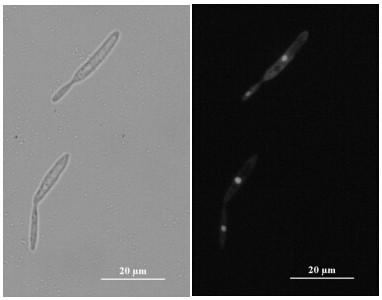
Figure 2 
Figure 3
Abstract
Description
technical field
[0001] The invention belongs to the field of biological technology, and in particular relates to a haploid strain UET2 of smut smut and its application. Background technique
[0002] Ustilago rugosa belongs to the Basidiomycotina genus Ustilago, is a typical dimorphic fungus, and is closely related to Ustilago zea. So far, Zizania is the only known host, and Zizania gestation is the result of the interaction between the specific parasitic Ustilago smut and Zizania plants. Up to now, the planting and breeding of Zizania still adopts the method of separation and screening of Zizania pier, which requires a lot of manpower and material resources, and there are multiple physiological races of Zizania smut, which may be mixed in Zizania plants, resulting in different traits of Zizania varieties. Stable with obvious degradation. Therefore, artificial inoculation is the development direction of Zizania zizania breeding.
[0003] Studies have shown that the mixed i...
Examples
Embodiment 1
[0020] Embodiment 1: bacterial strain screening method
[0021] 1. Collect teliospores: from Longjiao No. 2 gray bamboo ( figure 1 A) Pick teliospores directly.
[0022] 2. Teliospore suspension: pile the picked teliospores into 5 mL sterile water, filter through 4 layers of sterile gauze to obtain a relatively pure teliospore suspension, and finally dilute the teliospore suspension with sterile water Dilute to a final concentration of 10 3 spores / mL. Teliospores form as figure 1 Shown in B.
[0023] 3. Teliospore culture: Take 100 µL of teliospore suspension and spread it on the basidiospore isolation medium, and culture it at 28°C for about 60 hours, finely dispersed single colonies can be seen with the naked eye ( figure 1 C) as standard. Basidiospore isolation medium (1 L) formula is: K 2 HPO 4 1g, MgSO 4 ·7H 2 O 0.5 g, FeSO 4 ·7H 2 O 0.01g, KCl 0.5 g, glucose 18 g, (NH 4 ) 2 SO 4 5.28 g, 10 g of agar.
[0024] 4. Single spore isolation and culture: Pi...
Embodiment 2
[0045] Embodiment 2: Experiment of artificial fertilized bamboo shoots
[0046] The vector of overexpressing EGFP green fluorescent protein was transformed into Ustilago sativa ( Ustilago esculenta ) haploid strain UET2 and its sex-compatible strains (choose No. 2 and No. 3 in Example 1) to overexpress EGFP green fluorescent protein, and the obtained overexpression strains can be detected by fluorescence microscopy, successfully overexpressing EGFP The strains with green fluorescent protein can see the green fluorescent signal under the fluorescent microscope, such as figure 2 shown. Then carry out artificial inoculation experiment, concrete artificial inoculation process is as follows:
[0047] 1) Shake two haploid strains of smut to OD in YEPS liquid medium at 28°C 600 was 1.0, centrifuged to collect the bacteria, diluted with 0.5×YEPS liquid medium to a final concentration of OD 600 The bacterial solution is 3.0, and the two bacterial solutions are mixed for inoculatio...