
An adjustable safety valve for a boiler
An adjustable safety valve technology, applied in the direction of safety valves, valve devices, balance valves, etc., can solve the problems of difficult pressure adjustment operation, inconvenient manual maintenance, and complicated structure of safety valves, and achieve simple structure, stable combination, and safety sex high effect
Patent Information
- Authority / Receiving Office
- CN · China
- Patent Type
- Patents(China)
- Current Assignee / Owner
- Publication Date
- 2019-12-06
Smart Images
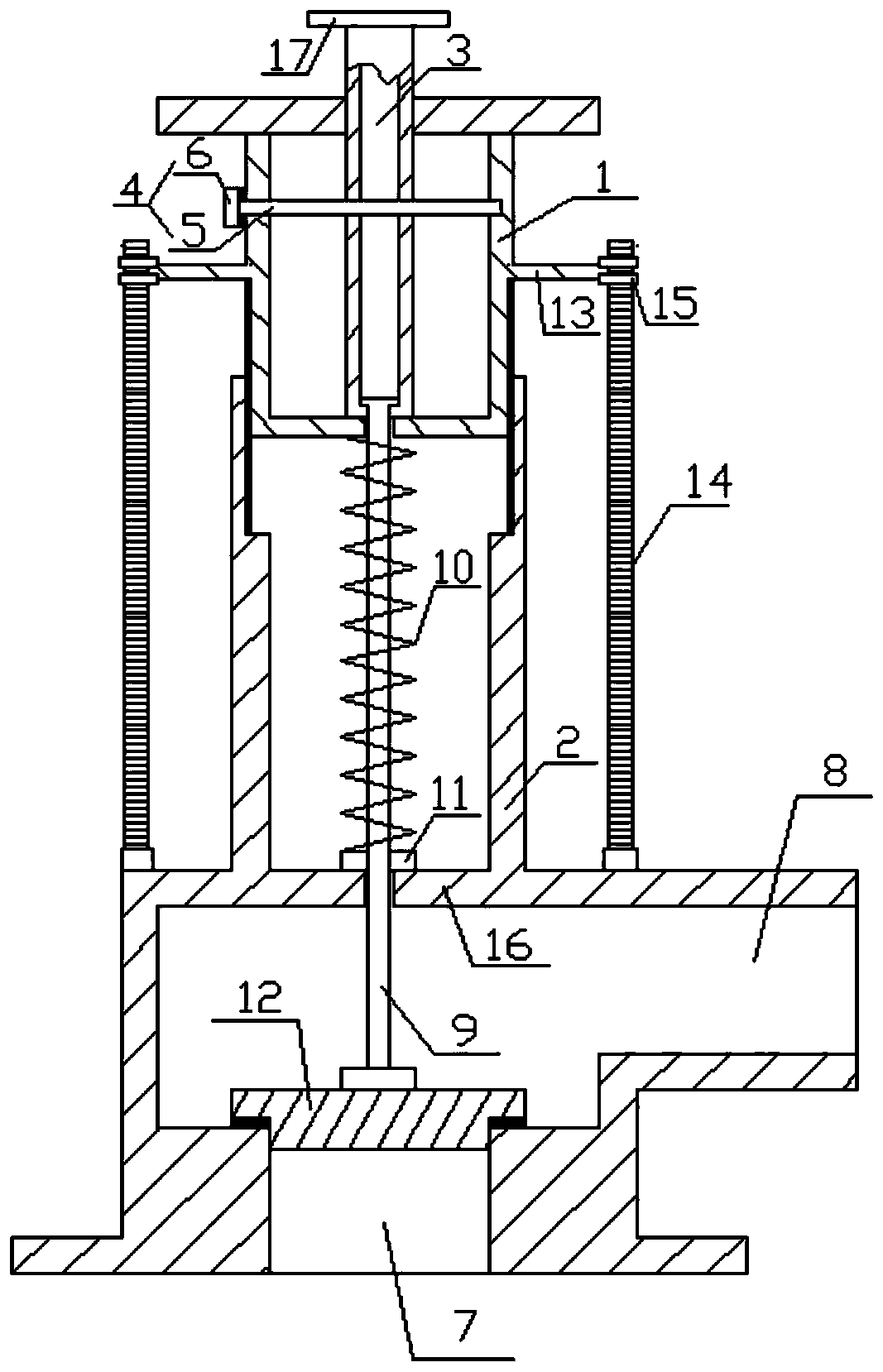
Figure 1
Abstract
Description
technical field
[0001] The invention belongs to the field of boiler safety control, and in particular relates to an adjustable safety valve for a boiler. Background technique
[0002] Boiler is a common energy equipment used in industrial production. During boiler operation, it is very important to control the internal pressure of boiler. As an important component of pressure control, boiler safety valve can play an important role in protecting personal safety and equipment operation. . Common safety valves have various structures such as hammer type and spring type, which can be automatically adjusted according to the set pressure value, but the existing safety valves often have complex structures, manual maintenance and pressure adjustment are inconvenient, and when operators perform other related operations It is easy to cause problems such as accidental touch. Contents of the invention
[0003] In view of this, the present invention aims to propose an adjustable safe...
Examples
Embodiment Construction
[0021] It should be noted that, in the case of no conflict, the embodiments of the present invention and the features in the embodiments can be combined with each other.
[0022] In describing the present invention, it should be understood that the terms "center", "longitudinal", "transverse", "upper", "lower", "front", "rear", "left", "right", The orientations or positional relationships indicated by "vertical", "horizontal", "top", "bottom", "inner", "outer", etc. are based on the orientation or positional relationships shown in the drawings, and are only for the convenience of describing the present invention Creation and simplification of description, rather than indicating or implying that the device or element referred to must have a specific orientation, be constructed and operate in a specific orientation, and therefore should not be construed as limiting the invention. In addition, the terms "first", "second", etc. are used for descriptive purposes only, and should no...