
User cluster analysis method in customer care system
A technology for customer relationship management and user clustering, which is applied in the field of user clustering analysis in customer relationship management systems
Patent Information
- Authority / Receiving Office
- CN · China
- Patent Type
- Applications(China)
- Current Assignee / Owner
- Publication Date
- 2017-05-17
- Estimated Expiration
- Not applicable · inactive patent
Smart Images
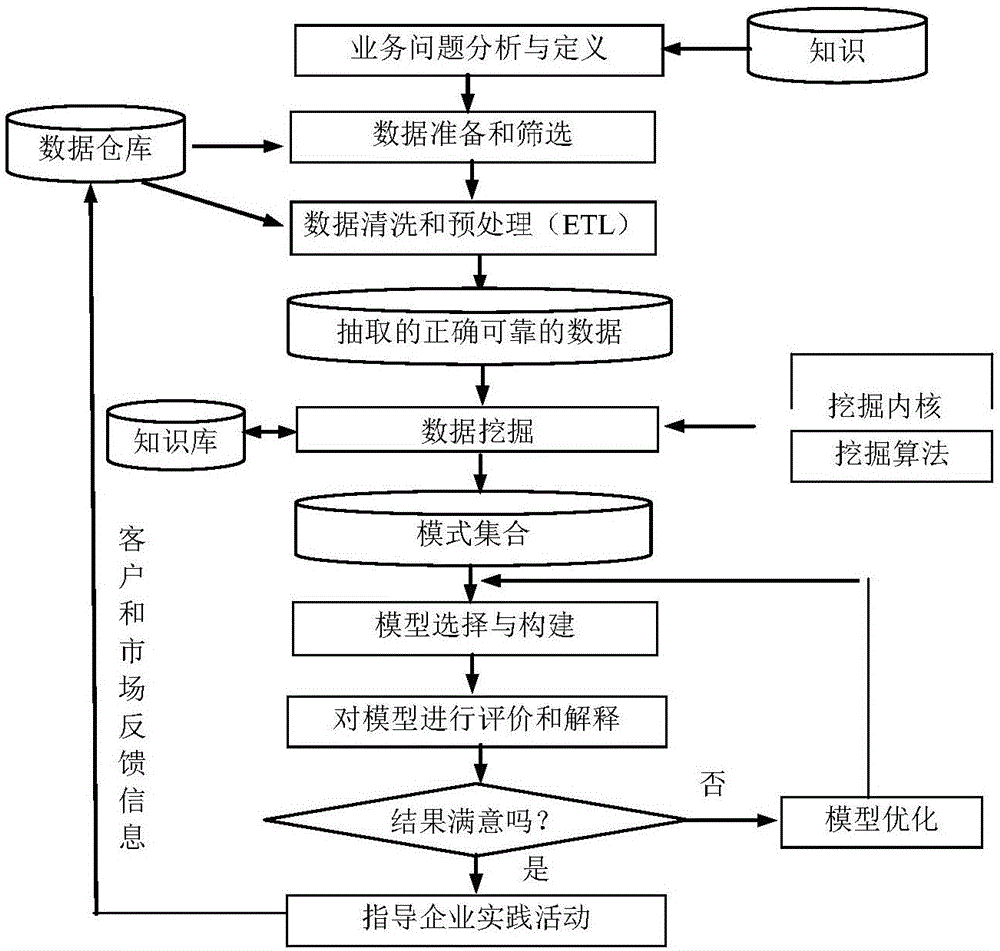
Figure 1 
Figure 2 
Figure 3
Abstract
Description
technical field
[0001] The invention relates to the field of management information systems, in particular to a user cluster analysis method in a customer relationship management system. Background technique
[0002] Customer Relationship Management (Customer Relationship Management, CRM) is the use of modern information technology, through the in-depth tracking of customers, analysis of customer needs, in order to retain old customers, attract new customers, and can timely find that loyalty may occur Change customers, take timely measures to safeguard the interests of the enterprise. With the transformation of the business model from "product" to "customer", the importance of customer relationship management has become increasingly apparent. Customer relationship management is an overall solution for customer-centered marketing in industrialized countries. CRM starts from the actual needs of customers and uses modern information tools to enhance the execution capabilities ...
Examples
Embodiment Construction
[0073] A method for user cluster analysis in a customer relationship management system of the present invention will be further described below using the drawings and embodiments.
[0074] refer to figure 1 , the user clustering analysis method in a kind of customer relationship management system of the present invention comprises the steps successively: definition of business problem, data preparation and screening, data cleaning and preprocessing (ETL), extracted correct and reliable data , data mining, model collection, model selection and construction, model evaluation and interpretation, when the results are satisfactory, guide the company's practical activities, and send customer and market feedback information to the data warehouse in time, so that the company can respond quickly , when the result is unsatisfactory, it will be sent to model selection and construction through model optimization.
[0075] In order to verify the rationality of the algorithm, in the UCI ma...